

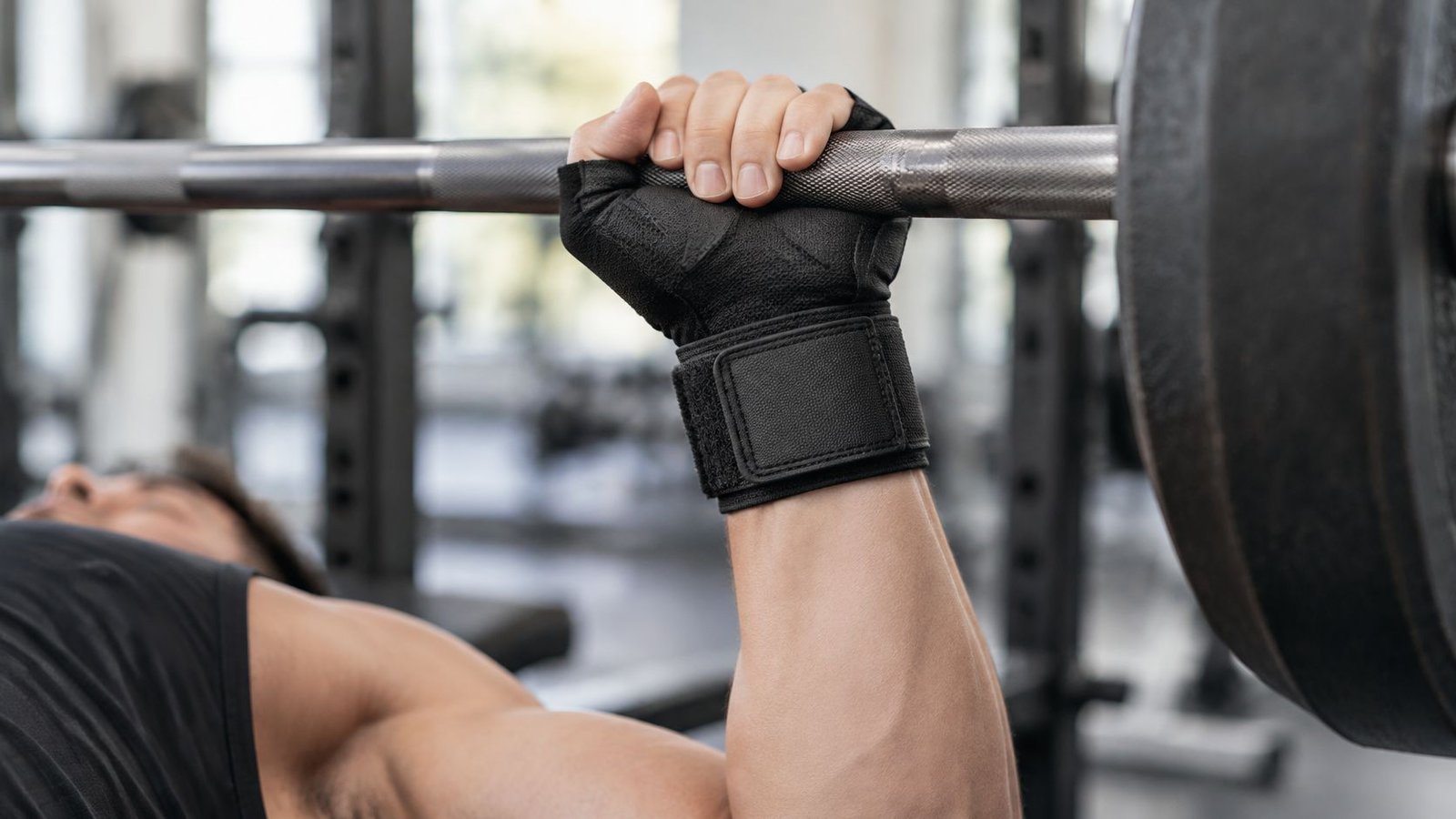
Does a wrist strap make you stronger, or does it just make the bar feel safer in your hands? Most buying guides answer that with a promise of more grip and bigger lifts. The patent record and the published testing say something narrower and more useful. A wrap sets a limit on how far your wrist can fold, and everything you gain in position gets paid for in finger closure, bar feel and, in the stiffest designs, measured grip strength.
That distinction changes how you shop. You don't buy a wrist support lifting glove for force it can't create. You buy a specific amount of wrist control for a specific lift, then check that the control doesn't cost you the hand position that lift depends on.
Table of Contents
- Wrist Support Types and the Lifts They Suit
- How Wrist Support Changes Position and Lifting Output
- How to Fit Wrist Support in Six Steps
- Fit Problems and How to Fix Them
- Caring for Fabric, Neoprene and Metal Supports
- Bowling Wrist Supports and Sanctioned Play Rules
- Pick Your Wrist Support Before Your Next Lift
Wrist Support Types and the Lifts They Suit
Five architectures cover nearly everything on the market, and each one trades dexterity for wrist control at a different rate.
| Support type | Wrap pattern | Restriction | Best for | Main trade-off |
|---|---|---|---|---|
| Short cuff glove | Cuff only, no wrist wrap | Low | Light pulls and general training | Little wrist control under heavy load |
| Single strap wrap | One strap around the wrist | Low to moderate | Presses, rows and general strength work | Strap can loosen during a set |
| Diagonal wrap | Strap crosses the back of the hand | Moderate | Heavy pressing and pulling | Overtightening can reduce finger closure |
| Figure-eight wrap | Strap loops hand and wrist | Moderate to high | Pressing and stability-focused work | Harder to tension evenly |
| Rigid metal or aluminum positioner | Rigid core with fixed panel | High | Wrist-position control and wrists that collapse under load | Limits dexterity and bar contact |
Read columns three and five together. Every layer of restriction you add buys wrist control and costs finger closure, bar feel and the ability to feel where the bar sits in your palm. Metal supports, usually aluminum, sit at the top of that scale and offer the most rigidity, which is exactly what a lifter needs when the wrist collapses under a heavy bench, and exactly what gets in the way on a deadlift where the hand has to close hard and fast.
None of these shapes are a passing trend. A 1996 US patent for a weightlifting glove describes an elongated strap wrapped diagonally across the back of the hand, and names reducing fatigue and preventing overstraining as the design objectives. An earlier figure-eight glove patent from 1991 claims flaps forming a figure-eight support around the hand and wrist, with compression and stabilization as the stated mechanism. Diagonal and figure-eight wraps have been engineered designs for three decades.
Choose the support by the lift you train most often. Then adjust for the wrist you actually have.
Match the architecture to your level as well as your lift. Beginners doing light pulls and general training get everything they need from a short cuff or a single strap wrap. Intermediate lifters pressing every week should move to a diagonal wrap. Competitors whose wrists fold under heavy bench or squat loads can justify a figure-eight wrap or a rigid positioner, provided they accept the loss of bar feel that comes with it. If you tape rather than buy, our guide to wrist support tape covers the wrap patterns and how they stack up against sewn straps.
How Wrist Support Changes Position and Lifting Output
Most of what a wrap does happens before the bar moves at all. It sets a hard stop on a joint that would otherwise fold as far as load and fatigue push it.
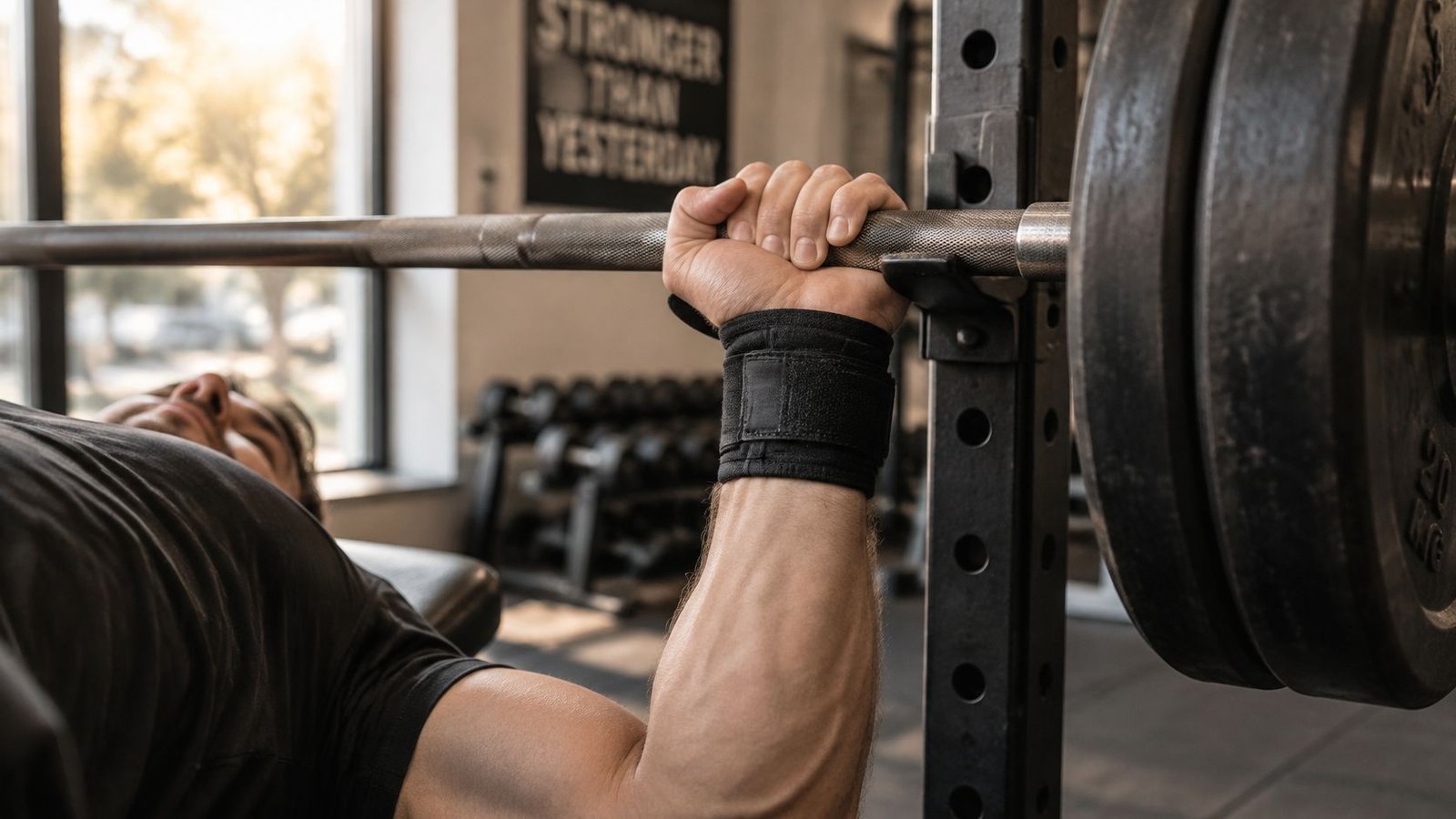
Think of the wrist as a hinge with a bolt through it. The forearm muscles drive the movement, the hand transfers force to the bar, and the wrist is the joint in between that either holds its line or collapses. A strap doesn't add force to that chain. It limits four directions of slop: flexion, extension, radial deviation and ulnar deviation, plus the small forearm-driven wander that shows up late in a set when your grip starts to fail.
The angle that supports the most force
Position matters more than pressure. A grip-position study of 38 healthy right-handed adults measured strength and endurance across wrist positions and found that maximum grip strength commonly occurred around 15° to 30° of wrist extension, with roughly 30° producing maximal strength without significantly compromising grip endurance. Adding an orthosis still reduced grip strength at every tested position, which tells you the benefit comes from positioning rather than compression.
That gives you a design rule you can check in the gym. The wrap should hold the wrist near a modest, controlled extension angle while leaving the knuckles and fingers free to close. It's the same reasoning that separates bowling grip types: the hand's job changes with the implement, so a support that forces one fixed hand position can't serve every task.
What more restriction costs you
The trade-off is measurable, and it isn't small. A comparison of 10 commercial wrist-hand orthoses found that every design reduced dynamometer-measured grip strength, from 1.7% for the least restrictive model to 34.2% for the most restrictive. The devices that limited motion hardest restricted flexion by 86.7%, extension by 76.7% and radial deviation by 83.5%.
Measured cost: the designs that control the wrist best are the same designs that take the most grip away.
That's why maximum stiffness is the wrong buying criterion. A support that impairs bar contact, finger closure or force transfer has traded away the thing you came to the gym to do.
What the lifting studies actually show
Here the evidence thins out fast. A review of wrist wrap and elbow sleeve evidence reports a cross-sectional study of 70 active powerlifters in which wrap style, length and use across events showed no significant association with performance, and a separate comparison of 18 participants found no significant one-rep-max bench-press difference between no wrap, flexible wraps and stiff wraps. Grip-specific testing was just as flat, with maximum grip strength reported at 35.7 kg with wraps against 35.6 kg without, and no meaningful endurance gain.
Usage, meanwhile, is near universal in competition. A survey of competitive lifters in the IUSCA Journal found 88.57% reported using wraps for bench press and 71.43% for squats. Prevalence is not evidence of benefit, and the same research found no significant relationship between wrap characteristics and performance.
So what do gloves give you? Comfort on high-volume pulling, skin protection, warmth, and a more repeatable wrist position from set to set. They don't reliably add strength, and nothing in the published work shows they prevent injury. A wrist support reinforces good technique and does not replace it, and it will not fix a fundamental flaw in swing or timing.
How to test your own glove
Run a protocol on yourself rather than trusting the label. Compare repeated submaximal holds or lifts with and without the glove, and log four things: whether the wrist stays near neutral, whether the glove slips, whether your hand placement on the bar changes, and whether your forearms burn earlier than usual.
Then check three specifics. Can you tension the wrap symmetrically on both hands? Does the closure creep during a set? Does the padding change the effective diameter of the bar in your palm? A wrist that visibly bends backward under load, a hand that can't fully close, or a bar that rolls toward the palm means the support is doing the wrong job, and the fix is a different architecture, not a tighter strap.
How to Fit Wrist Support in Six Steps
Fit decides results, not the size on the label alone. Two gloves from the same brand in the same nominal size can behave completely differently once the strap is under tension.
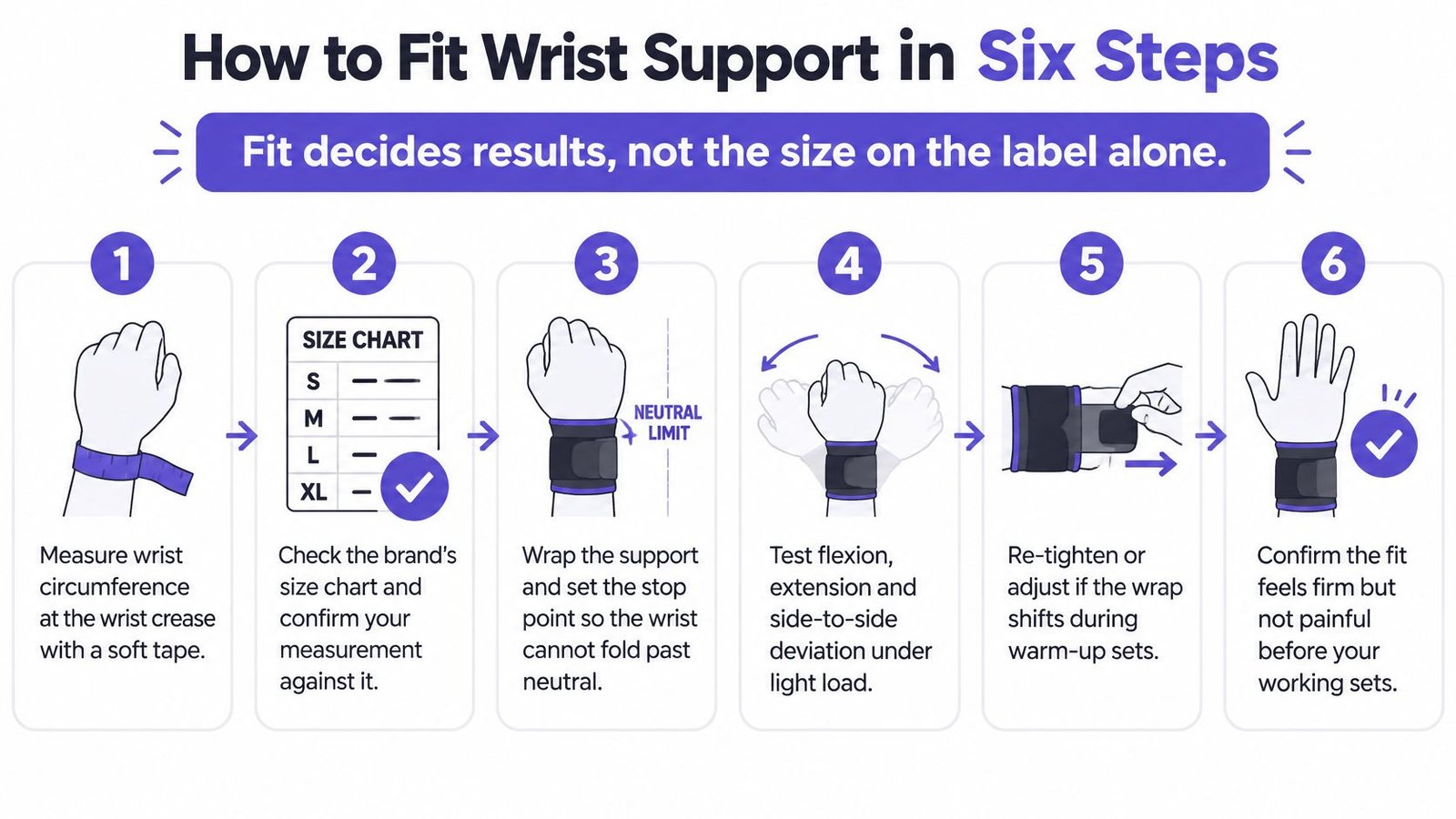
Measure at the wrist crease. Wrap a soft tape around the narrowest point of the wrist, not across the knuckles and not over a sleeve. Check whether the brand's chart sizes on wrist circumference or palm circumference, because the two give different answers and guessing can lead to a glove that migrates. The usual slip is measuring once, years ago, and assuming your wrist hasn't changed.
Put it on with the wrist neutral. Strap up with the hand in line with the forearm, not curled into a fist or bent back. A glove closed over a flexed wrist preloads the strap in the wrong position and will fight you for the whole session. The slip here is buckling down into a grip position before the strap is fastened.
Tighten until it holds, then test one finger. A wrist support should be snug, with enough room to comfortably slide a finger under the straps. If you can't get a finger underneath, you've crossed from support into a tourniquet, and that's the setting that produces tingling halfway through a set.
Here's the fit walkthrough many lifters never get shown:
Close your hand around a bar or handle. Grip an empty bar, a dumbbell or a pull-up bar and confirm the palm and fingers still close completely. Thick padding or a stiff panel can hold the fingers open a few millimetres, which is enough to lose the last inch of your grip. Judging fit with an open hand is the slip that hides this.
Run a light set and watch for drift. Ten to twelve easy reps tell you whether the glove stays where you put it. Check the wrist position at the end of the set, not the start, and look at whether the closure has crept toward the thumb side.
Do one heavy set, then recheck tension. Straps relax under load, and a glove that felt right on the warm-up can be loose by rep five of a working set. Re-tension before the next set rather than grinding through with a support that has stopped supporting.
A good fit feels firm across the back of the hand, leaves the fingers free, and stays exactly where you left it after the last rep. If you finish a set thinking about the glove, it's still wrong.
Fit Problems and How to Fix Them
Tingling or numbness after a set is the symptom I'd treat as urgent, because it means the strap is restricting circulation rather than supporting a joint.
| Symptom | Likely cause | Fix |
|---|---|---|
| Tingling or numbness after sets | Strap too tight and restricting circulation | Loosen the wrap and recheck; stop using the glove if it persists |
| Glove slides during sets | Loose wrap or wrong size | Retension before each set and re-measure against the size chart |
| Palm pain under the bar | Thick padding or stiff wrap | Switch to a thinner support or reduce padding |
| Wrist bends back under heavy pressing | Light cuff with no stiffness | Move to a diagonal wrap or a rigid support |
| Pain that continues after loosening | Overload or an underlying wrist problem | Remove the support and consult a clinician |
Work down that list in order of how quickly the fix can be tested. Loosening a strap, resizing and switching wrap type can all be checked inside one session, so there's no reason to spend a month training around a problem you can diagnose in twenty minutes.
The size question deserves a second look before you blame the design. A glove that slides is usually a half-size too big, and no amount of re-tensioning fixes a strap that has run out of overlap. Palm pain is the opposite problem: padding that feels protective on the rack flattens your grip and concentrates pressure exactly where the bar sits.
Persistent symptoms mean removing the support, not tightening it further.
Be honest about what a light support can do. A light fabric wrist support does not provide the necessary reinforcement for significant wrist pain or a tendency to collapse at the release, and choosing one for that job is how people end up training through a problem that needed assessment.
There's also a timing rule worth holding to. A single bad session that improves when you loosen the strap is a fit issue. The same symptom showing up across three or four weeks is a training issue, and the answer is a change in load, volume or mechanics rather than a stiffer glove.
Caring for Fabric, Neoprene and Metal Supports
Sweat left in a strap does more damage than any single training session, because the salt sits in the fibres and the hook-and-loop closure loses bite.
Fabric and neoprene. Hand wash in cool water with mild soap, rinse thoroughly, and air dry flat away from direct heat. Never machine wash or tumble dry, since heat and agitation damage the materials and weaken the strap. Give them a full day to dry before they go back in the bag.
Metal and rigid supports. Wipe the metal components down with a dry or lightly damp cloth, hand wash the fabric pads and straps separately, and let everything dry completely before storage. Moisture trapped against aluminum or duraluminum is how a rigid positioner starts to corrode at the rivets.
Run a quick inspection every couple of weeks:
- Straps: look for fraying at the fold points and thinning where the strap passes through the buckle.
- Closures: hook-and-loop that has picked up lint and hair stops holding tension, so clean the hooks with a stiff brush.
- Stitching: check the cuff seam and the anchor point where the strap meets the glove.
- Padding: flattened padding no longer supports the wrist, even though the glove still looks intact.
Replace the support when a strap stops holding tension or the padding compresses flat. A glove that needs re-tightening every few reps has told you it's done. Wash after heavy sessions, dry before the next use, and store it flat rather than balled up in a gym bag where the strap stays under tension and the padding takes a permanent crease. Heat, moisture left in the material and stored tension shorten a support's life faster than anything else.
Bowling Wrist Supports and Sanctioned Play Rules
A wrist support is legal in all sanctioned play as long as it has no moving parts that would impart force on the ball. That's the whole rule, and it's the first thing to confirm before you buy anything for league night.
Within that boundary the designs vary as much as lifting gloves do. Metal positioners offer the most rigidity and come with forward-position adjustments, which lets you set how much cup the hand holds. Rigid aluminum positioners with a side-roll adjustment let you change lateral angle to create more or less side roll. Neoprene supports with a single strap sit at the soft end, closer to a short cuff glove in what they can hold. Each type keeps the fingers positioned underneath the ball and helps a consistent roll without altering the ball's surface or adding force.
The mechanics carry over from the gym. A support holds a position; it doesn't generate revolutions on its own, and the restriction trade-off is identical. A device stiff enough to lock the release is also stiff enough to cost you feel at the bottom of the swing, where the thumb exits and the fingers do their work.
Before a competition, work through three checks:
- Confirm the rule with your league or sanctioning body, and read it for the specific event you're bowling.
- Check the device for any mechanism that stores or releases energy into the ball.
- Test it on the lanes, not in the pro shop, across a full practice session including spares.
The sizing steps above apply unchanged. Measure at the crease, strap up neutral, and leave room for a finger under the strap.
Pick Your Wrist Support Before Your Next Lift
Buying decisions go wrong when people start with the product page instead of the problem. Work through this order instead.
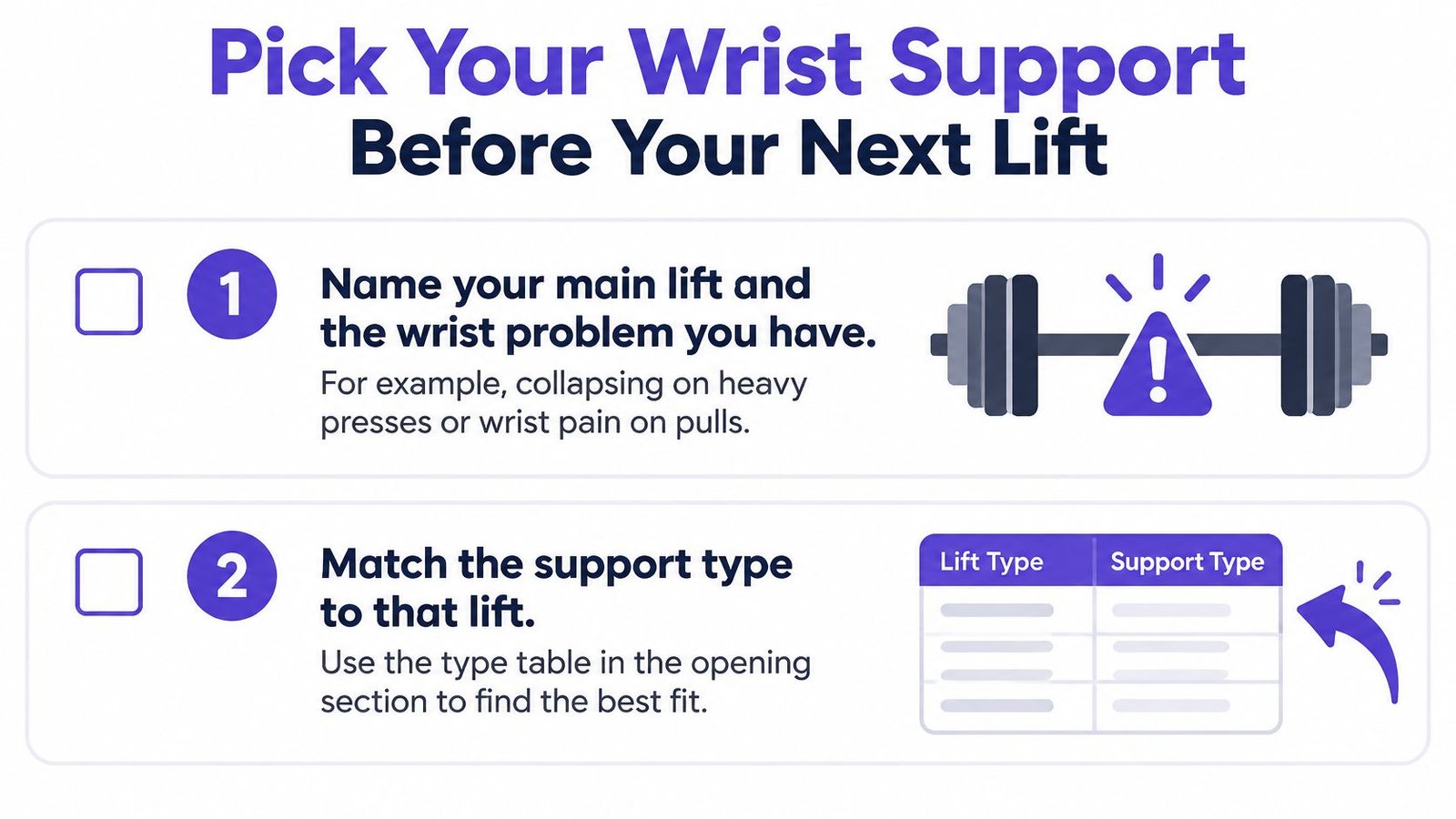
- Name your main lift and the wrist problem. Collapsing on heavy presses and aching on pulls are two different problems that pull you toward different architectures.
- Match the type to the lift, using the comparison table near the top. Short cuff for general training, diagonal wrap for regular heavy pressing, figure-eight or rigid when the wrist folds under load.
- Size it with the six fit steps. Measurement first, size chart second, buckle third.
- Run one light set and one heavy set, logging comfort, slippage and wrist position at the end of each set rather than the start.
- Check for tingling, numbness or pain, and stop using the support if any of them appear.
- Revisit the choice after several weeks. A symptom pattern that repeats points at the training approach, not the equipment.
When we score wrist supports, we judge them on four pillars: Material & Durability, Support & Adjustability, Comfort & Fit, and Performance Impact. You can apply the same framework yourself before spending money. Our Storm Power Glove Plus review shows how those four pillars separate two devices that look similar on a shelf.
Bowlers have a shorter path: confirm the league or sanctioning rule, then test the device on the lanes before competition rather than during it.
The single action worth taking today is to measure your wrist at the crease with a soft tape and write the number down. Everything else follows from that measurement and your main lift.
A wrist support is only as good as the position it holds under load, and that's the standard Bowling Gear Reviews applies whether the device is strapped on for a bench press or a league night. Our reviewers compare wrist supports and gloves side by side on material and durability, support and adjustability, comfort and fit, and performance impact, so you can see which design holds a wrist position and which one just feels tight. Start with your own measurement, then visit Bowling Gear Reviews to compare the supports that match the lift or the lane you train on.
