

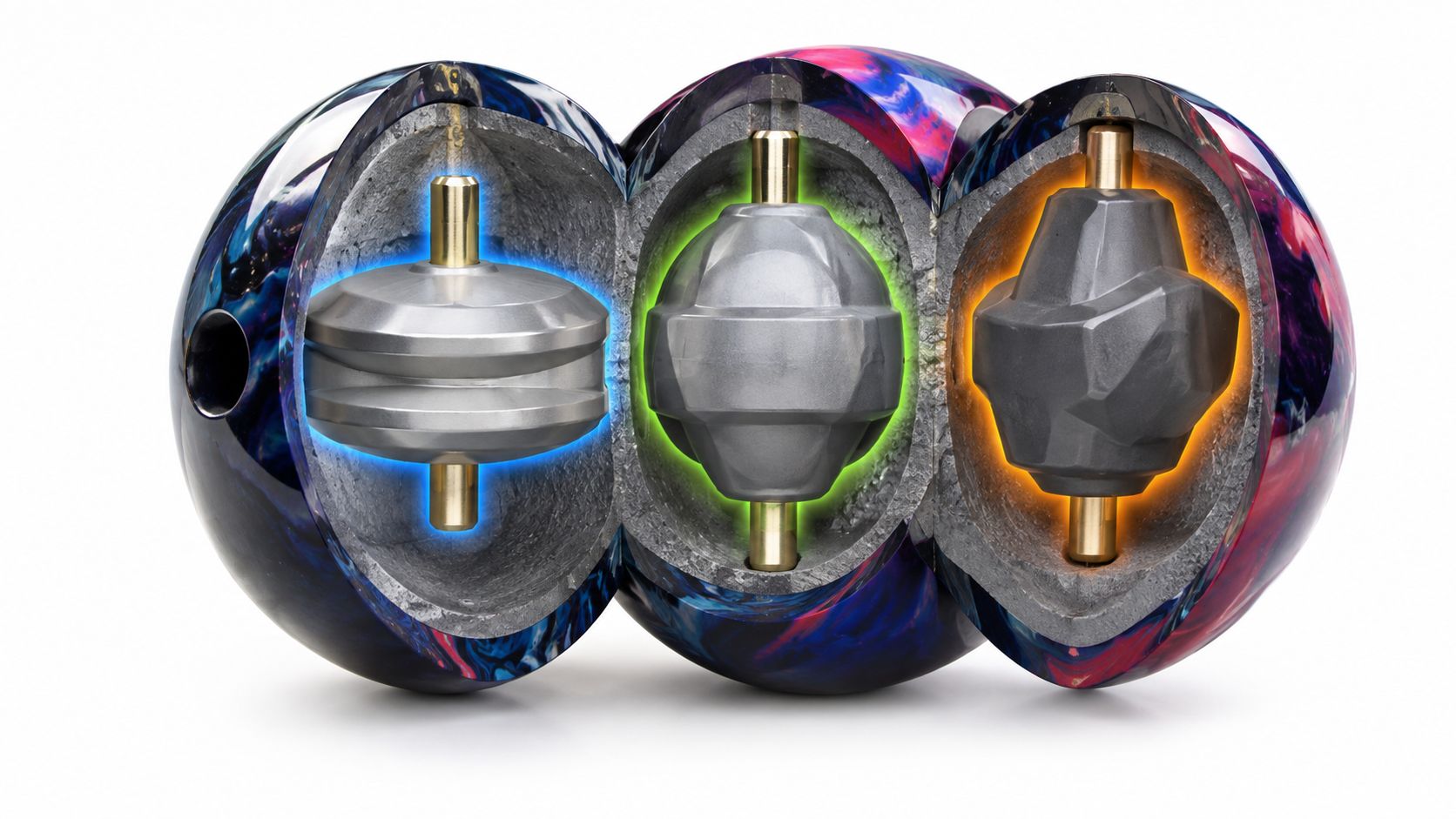
You've just drilled a new bowling ball, taken it to league, and watched it do the opposite of what you expected. It reads the lane too early, skids past the breakpoint, or never creates the shape you saw in the review. The coverstock matters, but the hidden weight block inside the ball often explains the biggest difference between two balls that look similar on the shelf.
Bowling ball weight blocks control how mass is distributed, how quickly the ball revs, how much it flares, and how strongly it changes direction. Once you understand RG, differential RG, intermediate differential, and symmetry, a manufacturer's spec sheet becomes more useful than a marketing name. You can connect the numbers to lane feel, then discuss drilling choices with a pro shop operator using practical language.
This guide starts with the physical core, moves into the numbers, compares major weight-block families, and finishes with a method for choosing a core that matches your speed, rev rate, lane environment, and control needs.
Table of Contents
- Introduction Why Your Ball Hooks Differently Than Expected
- What Bowling Ball Weight Blocks Are and How They Work
- Understanding RG Differential and Asymmetry in Plain Language
- Types of Weight Blocks and How Each Shapes Ball Motion
- How to Read Core Specs and Predict Ball Reaction
- Matching Weight Blocks to Drilling Layouts and Bowler Style
- Choosing Your Next Ball With Confidence
Introduction Why Your Ball Hooks Differently Than Expected
Two bowlers arrive for league with equipment that appears almost interchangeable. Both balls have reactive covers, both are designed for performance conditions, and both were drilled to fit comfortably. One ball clears the front easily and makes a quick move at the breakpoint. The other starts reading in the midlane and continues through the pins with a rounder shape.
The difference might come from surface, coverstock chemistry, drilling, or bowler release. But the weight block is one of the first places to look because it determines the ball's internal mass distribution before the cover ever touches the lane.
A simple comparison helps. Think of two flywheels with the same total weight but different shapes. The flywheel with more mass toward its outer edge behaves differently from one with mass concentrated closer to the center. A bowling ball's core creates a similar effect. Its shape influences how the ball stores energy, starts rotating, exposes fresh cover to the lane, and changes direction.
Practical rule: Don't ask whether a core is “good” or “bad.” Ask whether its motion matches the lane and your release.
The history of bowling ball weight blocks explains why modern equipment can create so many distinct reactions. The shift from basic internal blocks to dynamic core shapes helped establish the performance-ball categories bowlers now recognize. Today, core specifications give you a way to predict motion before you throw the ball, although the coverstock, surface, layout, and your delivery still matter.
By the end, you should be able to look at a spec sheet and form a useful first prediction. You'll also know why maximum differential isn't automatically the right choice, why symmetrical cores can be easier to control, and why drilling can either amplify or soften the core's natural shape.
What Bowling Ball Weight Blocks Are and How They Work
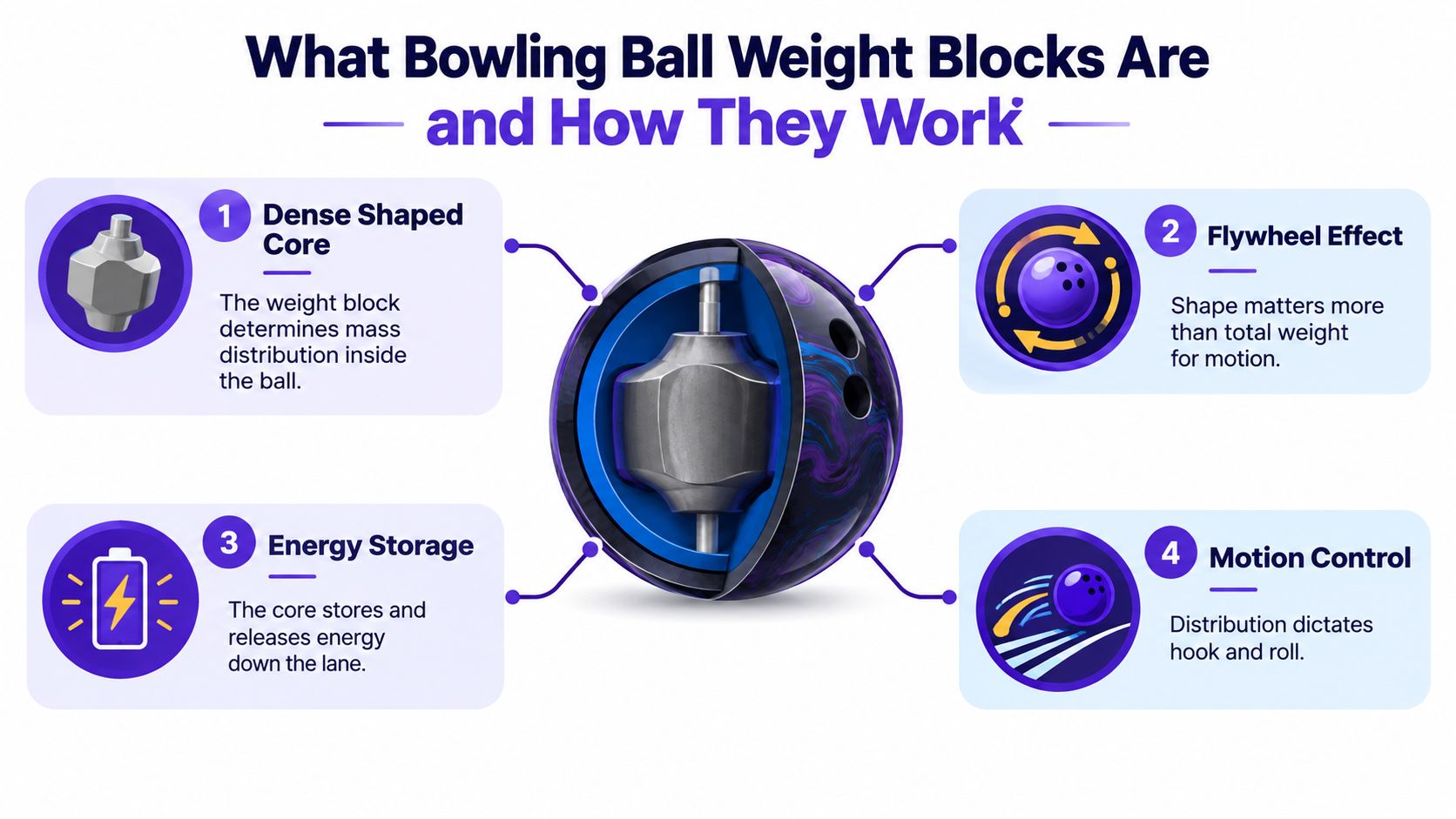
A bowling ball weight block is the dense, shaped interior section that changes how mass sits inside the shell. Manufacturers surround that core with filler and coverstock, but the core's geometry gives the ball much of its rotational personality.
Total ball weight alone doesn't tell you enough. Two balls can weigh the same and still behave differently because their internal mass is positioned differently. A core with mass distributed farther from the center resists changes in rotation in one way, while a core with a different shape can begin revving and changing direction in another.
The flywheel idea
A flywheel stores rotational energy. Its shape affects how easily it starts spinning and how it maintains that rotation. A bowling ball's weight block works through the same broad principle, although lane friction, coverstock, and release speed add complexity.
A core that encourages earlier revving can help a ball read the lane sooner. A core that promotes more length can conserve energy toward the breakpoint. A core with greater separation between its rotational measurements can create more track flare, which lets the ball present fresh cover to the lane during its roll.
The coverstock remains the ball's contact point with the lane. It determines how much traction the shell can create, while the core influences how the ball gets into position to use that traction. Filler brings the finished ball to its intended shape and density. The practical model is simple:
- Coverstock creates traction.
- Weight block organizes rotation.
- Layout changes how the core is oriented.
- Lane friction determines where the stored energy is released.
From pancake blocks to dynamic cores
Modern bowling ball weight blocks became a major design shift in the 1970s, and one historical overview identifies the Johnny Petraglia LT-48 as the first ball to use a weight block in 1976. Early modern balls often used a thin “puddle” or “pancake” block surrounded by filler. Later designs moved toward larger, denser dynamic cores, helping establish the two-piece construction that became foundational for many performance balls, as described in this history of bowling ball construction.
That change mattered because the internal block became an active engine of ball motion. Instead of treating the inside as a way to meet weight requirements, manufacturers could shape it to influence hook, flare, energy retention, and continuation.
Keep one mental picture in mind: the cover is the tire, and the core is the drivetrain. A tire needs traction, but the drivetrain determines how power reaches the road. That analogy will help you interpret the numbers without treating them as isolated technical labels.
Understanding RG Differential and Asymmetry in Plain Language
Two balls can share a similar coverstock yet reach the pins differently. The core numbers explain much of that contrast by showing how mass is arranged around the ball's axes. The main terms are radius of gyration, differential RG, and intermediate differential, the measurement commonly used to discuss asymmetry.
RG predicts when the ball wants to rev
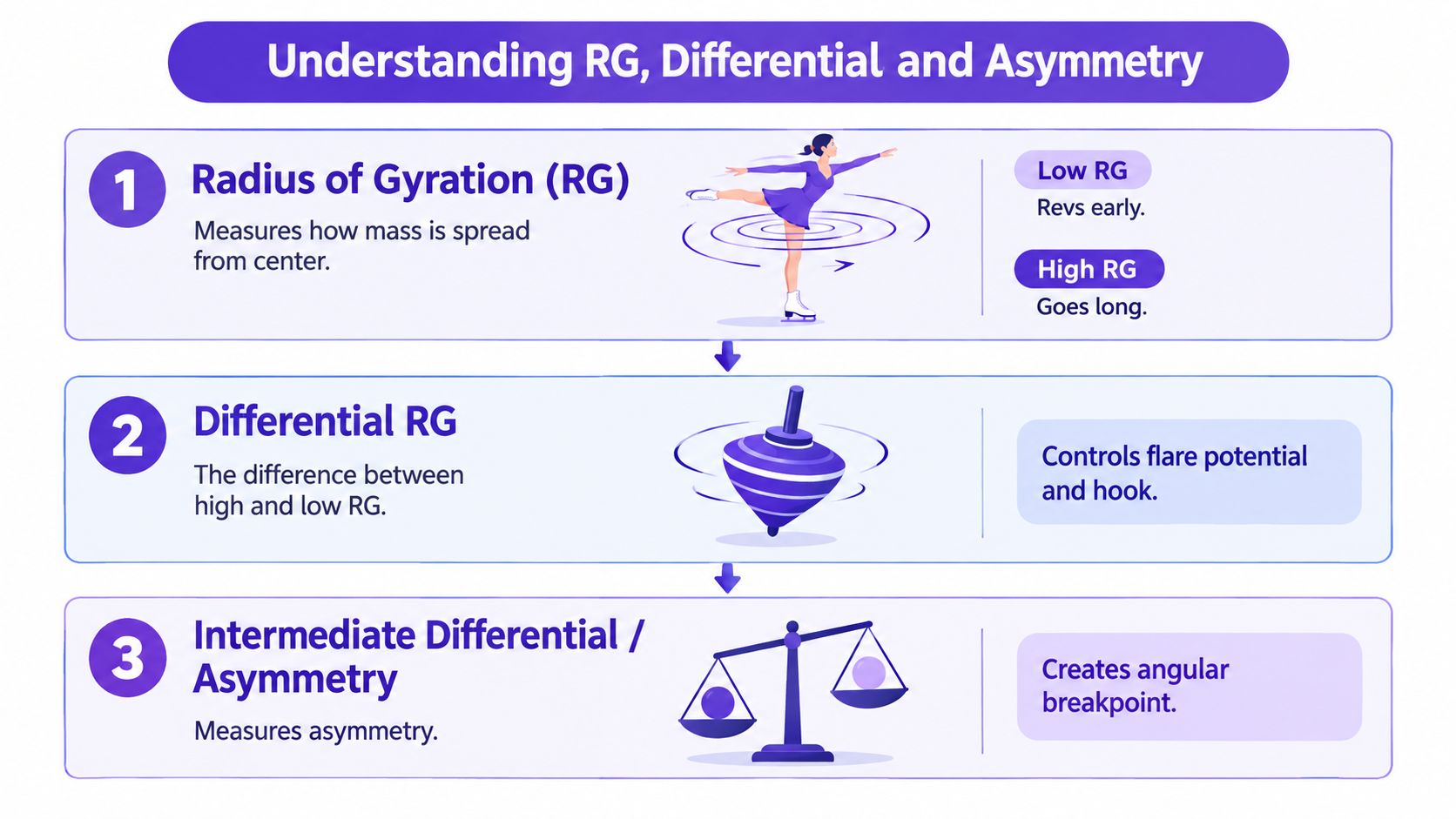
Radius of gyration, or RG, describes how far a ball's mass sits from its center around a particular axis. A lower RG generally helps the ball rev sooner. A higher RG generally lets it travel farther before using as much of its stored rotation.
The figure-skater comparison makes the idea easier to feel. A skater pulling their arms inward spins more readily. A low-RG ball behaves similarly, with its mass distribution supporting an earlier rev. A high-RG ball resists that early change and tends to push farther downlane before its strongest motion appears.
RG sets timing, not total hook by itself. A low-RG ball paired with a mild cover can rev early and remain manageable. A high-RG ball with an aggressive cover can still hook substantially, but its motion may begin later. On the lane, read RG as the point where the ball starts spending its rotation.
Differential controls flare potential
Differential RG is the gap between a ball's highest and lowest RG values. A larger gap generally means greater track-flare potential. As the ball rolls, new sections of cover can touch the lane, which can increase traction and make the ball's migration around its surface more visible.
A low-differential core usually creates smoother, steadier motion. That can suit drier or blended conditions, and it can help a bowler whose release already produces plenty of rotation. A higher differential generally gives the ball more room to flare and can create clearer separation between skid, hook, and roll.
A USBC technology study cited in this bowling ball rules and specifications overview found that low-differential balls averaged 16.8 boards of hook, compared with 20.6 boards for high-differential balls. The same overview reports a comparison in which a ball with .030 differential hooked less than one with .080 differential. Those measurements show the general connection between differential and hook, not a guaranteed result for every bowler, cover, surface, or lane.
Intermediate differential describes asymmetry
A symmetrical core has a more balanced mass distribution across its primary axes. An asymmetrical core has a larger difference between those axes, which often gives the ball a more defined transition and breakpoint shape.
Intermediate differential is the number commonly used to describe that added asymmetry. A higher value can make the move from traction into direction change more pronounced. Bowlers may experience that as a more angular or defined breakpoint, although coverstock and surface can soften or sharpen what they see.
Bowling rules limit differential RG to 0.060 inches. They also permit only 3 ounces, or 85 grams, of static side weight and 3 ounces, or 85 grams, of top weight, according to this bowling ball specifications reference. Balance holes were banned effective August 1, 2020, because they could alter ball dynamics beyond the intended drilled configuration.
Use the numbers as a lane-reaction decoder:
- Low RG: earlier revving and earlier read.
- High RG: more length and delayed roll.
- Low differential: smoother flare and steadier control.
- High differential: greater flare potential and stronger overall hook.
- More asymmetry: a more defined breakpoint shape.
A drilling layout then determines how that core orientation reaches the lane. Treat the specs as a starting forecast, and confirm the forecast with your coverstock, release, surface, and ball speed.
Types of Weight Blocks and How Each Shapes Ball Motion
Core families are useful because they give you a starting expectation before you compare individual models. They aren't rigid categories, and a coverstock can make one ball in a family feel very different from another. Still, the shape and mass distribution establish the ball's basic motion range.
A pancake core is the traditional, simple option. It generally creates limited flare and a stable reaction, making it easier to control when you don't need a large hook footprint. Light-bulb and modified light-bulb designs add more shape to the internal mass distribution, often creating more predictable flare and stronger motion than a basic pancake while remaining relatively readable.
Symmetrical cores distribute mass in a balanced way across their main axes. They can offer a smooth transition and predictable response, especially when differential stays moderate. A low-differential symmetrical ball can be helpful on drier or blended lanes because it doesn't try to create excessive flare or a sudden directional change.
Asymmetrical cores add a stronger difference between axes. They can create more pronounced midlane read and breakpoint definition, particularly when paired with a coverstock designed for traction. That extra motion can be valuable on heavier oil, but it can also become difficult to control if your release already produces high revs or if the lane starts drying up.
| Weight Block Type | Typical RG and Differential | Motion and Best Use |
|---|---|---|
| Pancake | Generally simpler, with limited flare potential | Smooth, controlled reaction for lighter conditions or bowlers who need predictability |
| Light-bulb | Moderate internal shape and manageable flare | Balanced motion for general league use |
| Modified light-bulb | More developed mass distribution than a basic light-bulb | Added traction and continuation without automatically becoming the most angular option |
| Symmetrical | RG and differential vary, but axis balance remains consistent | Predictable transition and controllable shape |
| Asymmetrical | Greater axis separation and potential for stronger breakpoint definition | More pronounced motion when oil volume or lane length demands added traction and shape |
A bowler with lower ball speed and high rev rate may find an aggressive asymmetrical core too responsive once the lane opens. A speed-dominant player may need the same general family to create enough midlane read and continuation. The correct choice depends on the interaction between release and lane, not on the core label alone.
For coverstock context, compare the core with the shell rather than judging either part in isolation. A guide to hybrid reactive bowling balls can help you evaluate how a hybrid cover may change the feel of a given core family.
Lane translation: More flare can create more hook opportunity, but control determines whether that hook reaches the pocket consistently.
How to Read Core Specs and Predict Ball Reaction
A manufacturer's spec sheet gives you a useful first forecast if you read it in the right order. Don't start with the marketing phrase. Start with the measurable core information.
Step one find RG
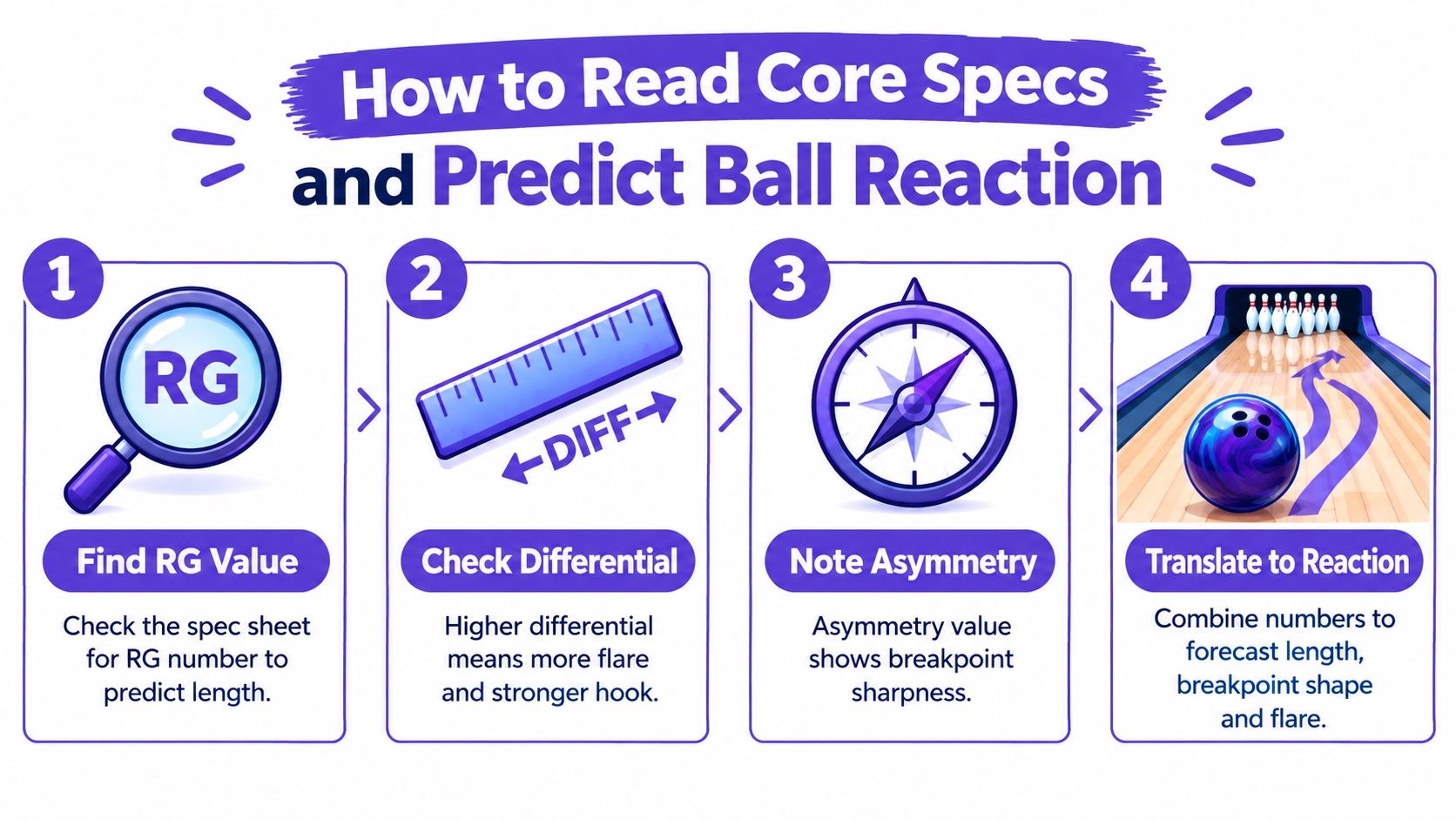
Look for RG first. A lower RG usually points toward earlier revving and earlier lane read. A higher RG generally points toward more length and a later transition into hook.
That prediction is relative. You're comparing balls in the same brand or product range, not declaring that one isolated number guarantees a specific breakpoint.
Step two check differential
Next, inspect differential RG. A higher differential generally means more track flare potential and a stronger hook footprint. A lower differential usually indicates a smoother, more stable reaction.
Then look for intermediate differential. If the ball is asymmetrical, that added value can point toward a more defined or angular change of direction. A symmetrical ball may still hook strongly, but its transition often feels more continuous.
Compare two imaginary spec sheets
Suppose Ball A has a lower RG and modest differential. You'd expect it to begin revving sooner, but its limited flare may keep the shape rounded and manageable. That could suit a bowler who needs earlier read without a violent move off the dry.
Ball B has a higher RG and larger differential, plus meaningful asymmetry. You'd expect more length before the main transition, followed by stronger flare and a more defined direction change. That can help a speed-dominant player create motion, but it may force a rev-dominant bowler to move quickly as friction develops.
The numbers become useful only after you add coverstock and surface. A rougher, stronger cover can make a higher-RG core read earlier than expected, while a polished cover can help a low-RG core retain energy and move farther downlane.
Use a reaction checklist
- Read RG first: Estimate whether the ball should rev early or conserve length.
- Read differential next: Estimate flare and total hook potential.
- Check asymmetry: Anticipate a more defined or less defined breakpoint.
- Add cover and surface: Decide how strongly the ball will access the lane.
- Add your release: Adjust for speed, rev rate, axis rotation, and tilt.
Use hands-on testing notes as a second opinion, not as a replacement for the specs. Bowling ball reviews and buying guides can be useful when you want to compare how a listed core behaves with its actual cover and finish.
A spec sheet predicts tendencies. It doesn't predict your exact line, because the lane and your delivery complete the equation.
Matching Weight Blocks to Drilling Layouts and Bowler Style
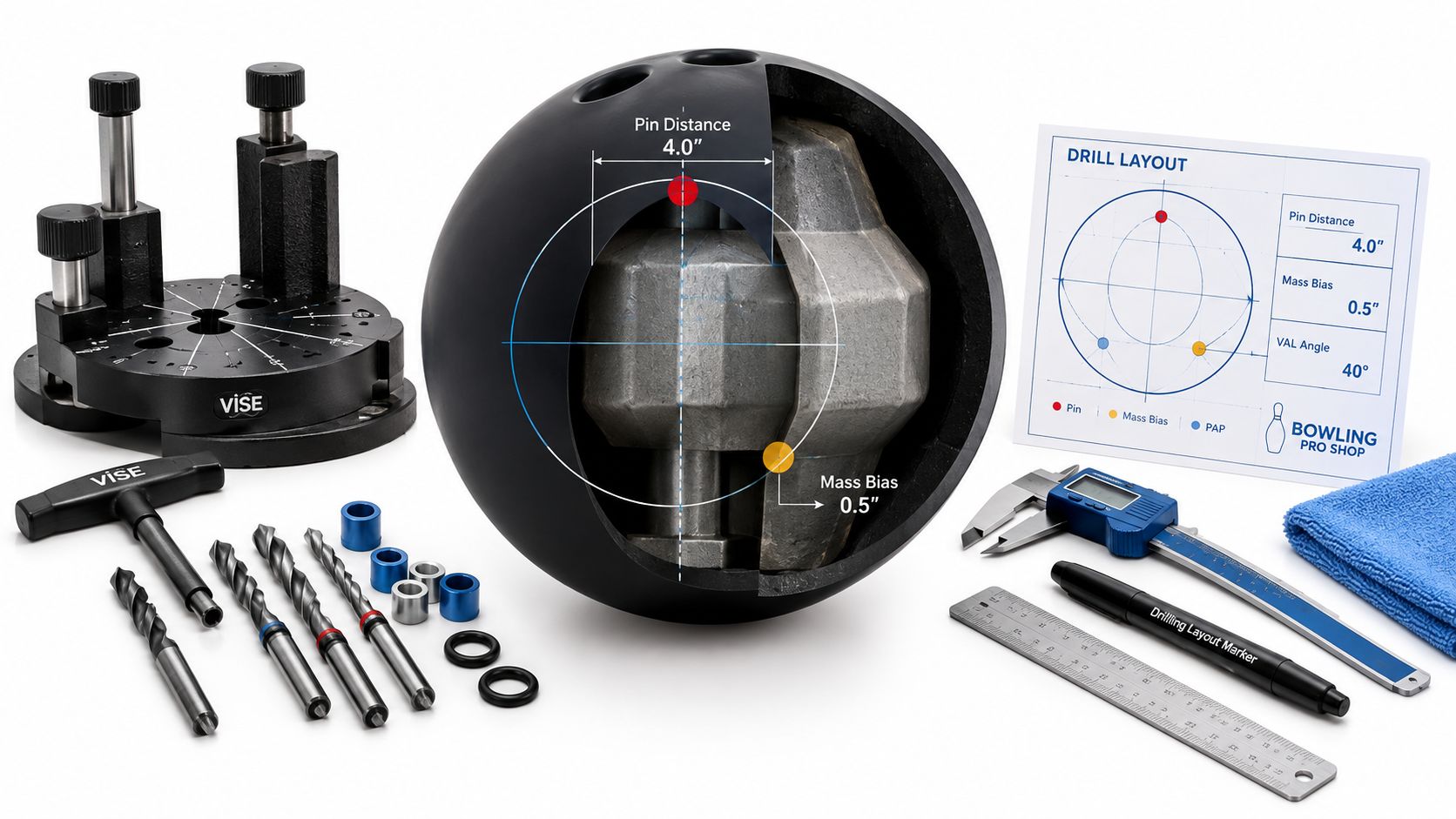
The drilling layout determines how the core sits relative to your track and positive axis point. That orientation can make the same weight block feel earlier, smoother, sharper, or more stable. The core gives you the available motion range, while the layout helps decide how much of that range appears on the lane.
Pin distance, mass-bias placement, and your preferred axis rotation all matter. With a symmetrical core, the layout changes the relationship between the core and your release without introducing the same kind of strong preferred axis found in an asymmetrical design. With an asymmetrical core, mass-bias placement can have a more noticeable effect on breakpoint shape and total reaction.
Start with the reaction you need
A speed-dominant bowler often benefits from a ball and layout that create earlier traction and enough continuation. That doesn't automatically mean choosing the most aggressive asymmetrical core. A lower RG or stronger cover may solve the lack of midlane read without producing an uncontrollable breakpoint.
A rev-dominant bowler usually has the opposite concern. Too much early traction can make the ball burn energy before it reaches the pins. A higher RG, lower differential, smoother cover, or more conservative layout may preserve shape and reduce overreaction.
Beginners should prioritize a predictable fit and controllable motion. A symmetrical core can provide a clearer learning platform because the reaction is easier to read. As your release becomes more consistent, you can use asymmetry and more differential to address specific lane problems rather than buying aggression without a plan.
Give your pro shop a target
Don't walk into the pro shop asking only for “the strongest ball.” Describe the miss you're trying to remove:
- The ball skids too long and leaves weak corners.
- The ball hooks before the breakpoint and loses continuation.
- The ball changes direction too sharply when the lane opens.
- The ball rolls smoothly but can't create enough entry angle.
Then provide your current ball's RG, differential, coverstock, surface, and layout if you have them. That creates a shared language for selecting the next core and drilling it with a clear purpose. A detailed reference on bowling ball drilling layouts can help you prepare for that conversation.
Pro shop conversation: Ask what the layout will change in timing, flare, and breakpoint shape. A layout should solve a lane problem, not exist as a decoration on the drilling sheet.
Drilling also depends on fit, span, pitches, grip choices, and safety. A theoretically ideal core won't perform well if the ball forces you to squeeze, slow down, or alter your release.
Choosing Your Next Ball With Confidence
Choosing among bowling ball weight blocks becomes easier when you separate the decision into layers. First identify the lane and your release. Then choose the core family that supplies the needed timing and flare. After that, use RG, differential, coverstock, surface, and layout to fine-tune the reaction.
A higher differential isn't automatically better. It can create more flare and hook potential, but that extra motion may make the ball harder to control on dry, short, or highly frictional conditions. A smoother symmetrical core can score better than a stronger asymmetrical option if it keeps your launch angle predictable and your pocket entry repeatable.
Use this checklist before ordering:
- Describe the lane: Is the ball reading too early, too late, or with the wrong breakpoint shape?
- Describe your release: Do you create more speed, more revs, or a relatively balanced combination?
- Choose the motion family: Decide whether you need smooth control, earlier traction, more length, or stronger direction change.
- Compare RG and differential: Use RG for timing and differential for flare potential.
- Check asymmetry: Decide whether you need a defined breakpoint or a more continuous transition.
- Confirm the drilling plan: Ask how the layout will amplify or soften the core.
- Test the complete ball: Judge the drilled ball with its actual coverstock and surface, not the core numbers alone.
For a first custom ball, prioritize fit, control, and a reaction you can repeat. For a league upgrade, choose a core that fills a clear gap in your current equipment instead of duplicating its motion. The best selection is the one that gives you a usable lane shape and leaves room for adjustments as conditions change.
Bowling Gear Reviews offers hands-on bowling ball reviews, comparisons, and how-to guides that discuss core design, coverstock, surface, lane suitability, and fit considerations. Visit Bowling Gear Reviews to compare equipment with the weight-block numbers and drilling questions in mind.
