

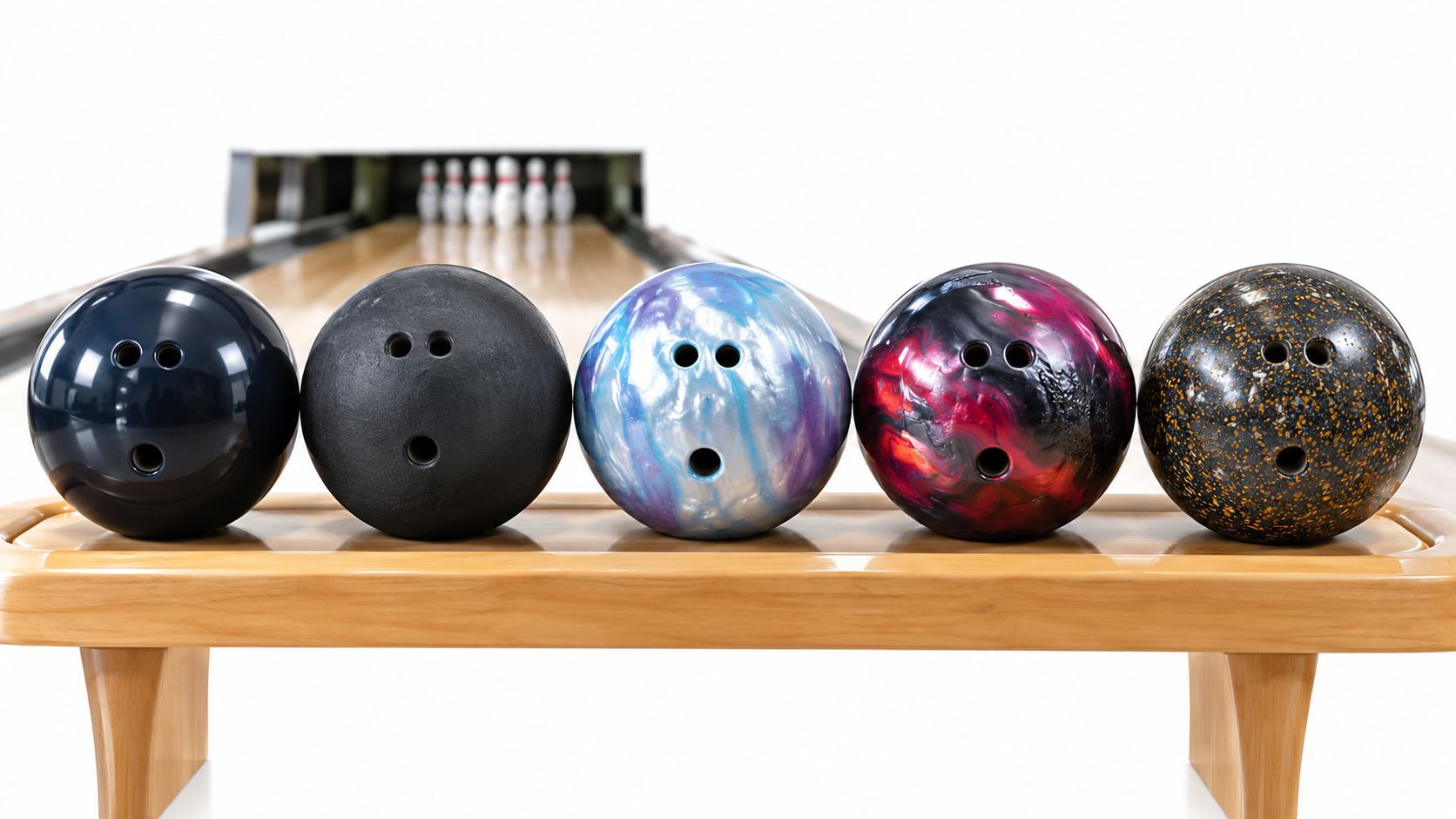
You're standing in front of a pro shop wall, trying to decide which ball belongs in your bag. The colors are attractive, the names sound technical, and every coverstock seems to promise a different kind of hook. You may already know that plastic, urethane, and reactive resin are different types of bowling balls, but that still leaves the practical question: which one matches your release, ball speed, and the oil on the lane today?
A bowling ball isn't one piece of technology. It's a coverstock wrapped around a core, and both parts influence the motion you see. The coverstock controls how the ball creates friction, while the core influences how it revs, flares, and changes direction. Once you understand how those pieces work together, choosing equipment becomes less like guessing from a catalog and more like matching a tool to a lane.
Table of Contents
- Why Bowling Ball Choice Feels Overwhelming
- A Short History of Bowling Ball Materials
- Plastic Urethane and Reactive Resin Compared
- Solid Pearl and Hybrid Reactive Finishes
- Symmetrical and Asymmetrical Cores Explained
- Matching Reaction Shape to Lane Conditions
- Why a Control Ball Often Beats a Power Ball
- Choosing the Right Ball for Your Skill Level
Why Bowling Ball Choice Feels Overwhelming
The pro shop aisle makes bowling equipment look more complicated than it is. A plastic spare ball, a smooth urethane ball, and an aggressive reactive resin ball may all be the same general size, but they're designed to create very different reactions. The color, logo, and product name tell you almost nothing about how those reactions will fit your game.
Start with the two-part model.
The coverstock is the skin
The coverstock is the outer shell that touches the lane. Its chemistry and surface texture determine how easily the ball slides through oil and how strongly it grips the dry portion of the lane. Plastic has a smooth, low-friction response. Reactive resin creates more traction because its porous chemistry can absorb lane oil, giving the ball more opportunity to read the lane and change direction. The Bowling Congress relationship between core and coverstock describes this interaction as a major part of ball motion.
Think of the coverstock as the shoe tread on a car. A smooth tire won't grab the road in the same way as a textured performance tire. Neither is automatically better. Each one works better in a different situation.
The core is the engine
The core is the internal weight block. It affects how quickly the ball starts rotating, how much the track migrates around the shell, and whether the shape looks smooth or angular. Two balls with similar reactive covers can still behave differently because one has a low RG symmetrical core and the other has a higher differential asymmetrical core.
That's why “the best bowling ball” is usually the wrong question. During league play, the lane changes as bowling balls move oil away from the front and carry it toward other parts of the lane. The ball that looks perfect in the opening game may begin hooking too early or skidding too long later. Your job isn't to find one magic ball. It's to understand which reaction shape gives you the most room for error as the lane transitions.
Coach's rule: Choose the reaction you can repeat, not the ball with the most dramatic description.
A Short History of Bowling Ball Materials
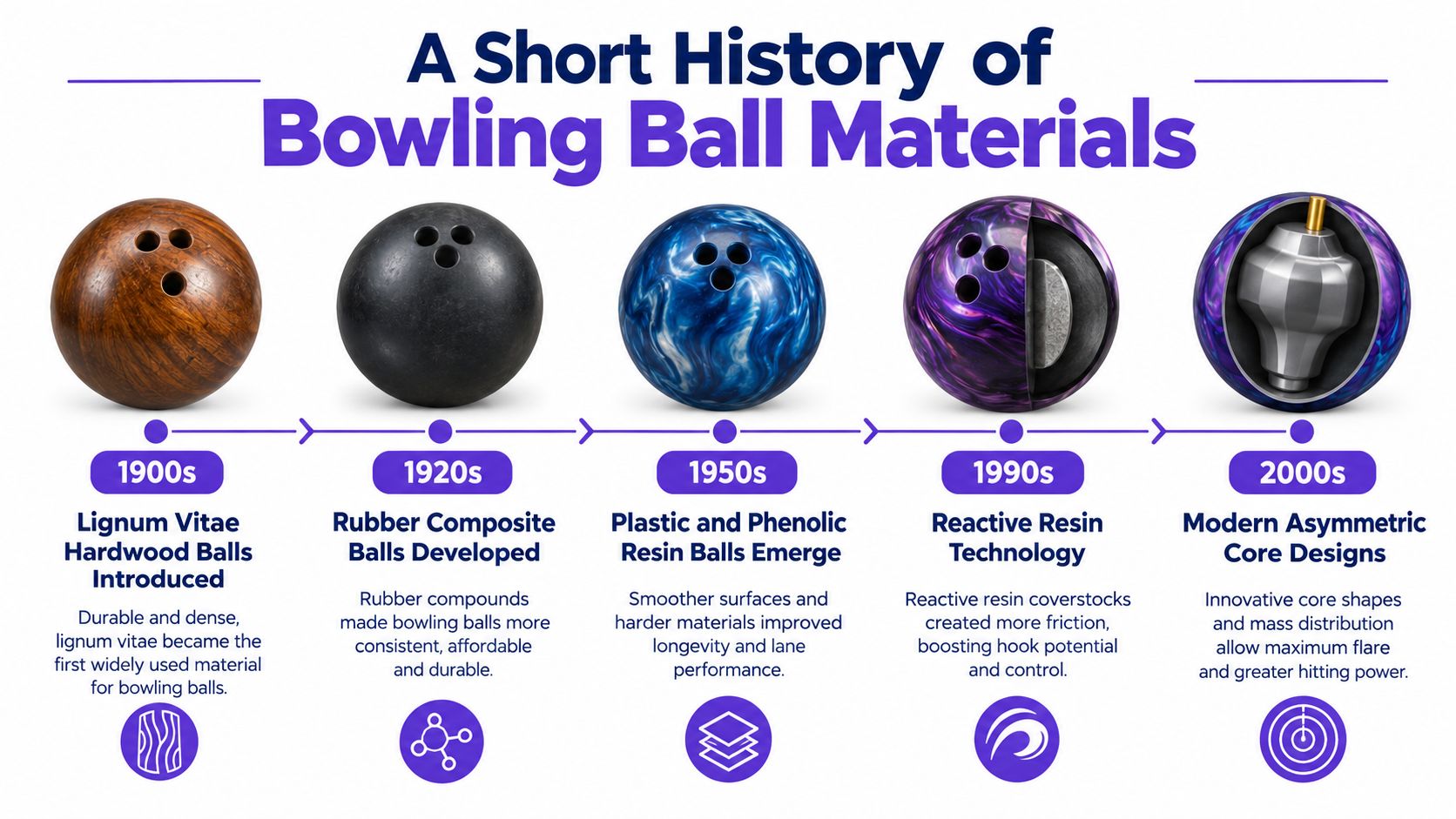
Bowling ball technology developed as a series of solutions to practical problems. Early bowlers worked with hardwood balls, including lignum vitae, a dense wood used before modern synthetic materials became available. Wood gave the game a starting point, but its behavior wasn't as consistent or durable as later materials.
Rubber arrived in 1905, creating a major change in how the ball interacted with the lane. Rubber offered more predictable construction and made stronger, controlled motion possible. It also created more friction than a simple hardwood ball, which changed the relationship between release technique and ball path. The modern material timeline is documented in this history of bowling ball construction.
Plastic made straight shooting easier
Polyester, often called plastic, emerged in 1959 and became dominant by the 1970s. Its smooth surface produced less hook than the materials that followed. That made it useful for bowlers who wanted a predictable line, especially when shooting corner-pin spares.
Plastic didn't replace every other ball. It filled a specific role. A bowler could send it across the lane without asking the ball to make a large move at the breakpoint. That straight-line behavior remains its defining advantage.
Urethane changed control
Urethane rose in the early 1980s. It created more friction than plastic and gave bowlers a smoother, earlier arc. Instead of sliding a long way and making a sharp move near the pins, urethane could read the lane sooner and shape more gradually.
That made urethane useful for players who needed control rather than maximum backend motion. It also showed bowlers that “more hook” and “better reaction” weren't identical ideas. A smaller, earlier move can be more useful than a large move that's difficult to predict.
Reactive resin opened the modern era
Reactive resin became the next major step in 1991. Its porous chemistry was designed to increase friction and backend motion, especially when the ball encountered the drier part of the lane. Reactive resin gave bowlers a way to create more angle while still using lane oil as part of the strategy.
These materials form a progression, not a random collection of categories. Plastic emphasizes predictability, urethane emphasizes control, and reactive resin expands traction and shape. The USBC and PBA equipment standards also show that construction is governed by technical limits, including requirements that bowling balls be solid, non-metallic, and free of voids.
Plastic Urethane and Reactive Resin Compared
If you're choosing your first personal ball, begin with coverstock behavior rather than brand reputation. Ask three questions: how far should the ball skid, how much friction should it create, and how sharply should it turn?
Plastic, or polyester, is the least aggressive option. It produces long skid with minimal hook and is the usual choice for spare shooting. It can also suit a beginner who's still learning alignment, timing, and release control.
Urethane sits between plastic and reactive resin. It creates a smoother arc and reads the lane earlier than plastic. Bowlers often choose it when they want a controlled shape that doesn't make a sudden move at the back of the lane.
Reactive resin uses porous chemistry that can absorb lane oil and create more traction. It offers the broadest range of motion, from smooth solids to sharper pearls, but it also asks you to manage lane transition more carefully.
| Coverstock | Oil Absorption | Hook Potential | Best For | Price Tier |
|---|---|---|---|---|
| Plastic | Minimal | Least aggressive | Spares, straight shots, very dry lanes | Entry |
| Urethane | Lower than reactive resin | Smooth and controlled | Control, shorter or drier conditions | Mid |
| Reactive resin | Porous chemistry can absorb oil | Moderate to highly aggressive, depending on finish and core | Medium to oily conditions, shaped strike reactions | Performance |
How they behave on the same lane
On a fresh lane, plastic usually travels cleanly through the front and remains predictable. Urethane begins to read earlier and creates a rounded move. Reactive resin can create substantially more traction, but its exact shape depends on whether the cover is solid, pearl, or hybrid and whether the surface is dull or polished.
As the lane dries in the front, the difference becomes easier to see. Plastic remains relatively straight. Urethane may begin to read earlier and lose energy if it encounters too much friction. Reactive resin can either become more useful by reaching the breakpoint with stored energy or become too early and too strong if its surface is too rough for the changing condition.
The coverstock guide from Bowling Gear Reviews is useful when you need to compare these families before looking at individual models. The important lesson is that coverstock only gives you the first layer of the answer. Within reactive resin, surface texture and core geometry create several distinct reaction shapes.
Solid Pearl and Hybrid Reactive Finishes
Reactive resin isn't one uniform category. Manufacturers tune its response through additives, resin formulation, and surface preparation. The simplest way to understand the major finishes is to focus on where the ball begins to create traction.
Solid reactive
A solid reactive cover usually has a duller, more textured appearance. That texture helps the ball create friction sooner, producing a stronger mid-lane read and a smoother continuation through the pins. Bowlers often look to solids when the lane offers more oil and the ball needs help starting its motion.
A solid isn't automatically a heavy-oil solution. A rough solid can become too early when the heads dry, especially for a bowler with a high rev rate or slower ball speed. That's where surface adjustments matter. Smoothing the surface can reduce early traction, while restoring texture can help the ball read sooner.
Pearl reactive
A pearl reactive cover generally has a shinier surface and is designed to conserve more energy through the front of the lane. It can travel farther before responding to friction, then make a sharper move when it reaches the breakpoint.
That shape can be valuable after the front of the lane has begun to dry. It can also create problems if the breakpoint is too dry or if the bowler already generates substantial rotation. A pearl that turns too quickly may force you to move inside before you're ready.
Hybrid reactive
A hybrid reactive cover combines solid and pearl characteristics. The goal is usually to balance earlier traction with a more responsive backend. Hybrids can serve as versatile benchmark equipment, particularly when you want a readable mid-lane without giving up all of the angular motion at the back.
| Finish Type | Surface Texture | Mid-Lane Read | Best Lane Condition |
|---|---|---|---|
| Solid reactive | More textured, often matte | Earlier and stronger | More oil or a need for traction |
| Pearl reactive | Smoother and shinier | Later and more responsive | Medium conditions or transition |
| Hybrid reactive | Blended characteristics | Balanced read and continuation | Changing or mixed conditions |
Layouts influence how these covers express themselves, but layout doesn't erase the underlying cover behavior. Surface prep can be just as important. A polished ball may clear the front more easily, while a sanded surface can create earlier traction. Clean the ball after use, then ask a pro shop to restore the surface when its reaction no longer matches its original role.
Symmetrical and Asymmetrical Cores Explained
Imagine two spinning tops. One has its weight balanced around the center, so it spins with a calm, predictable rhythm. The other has weight shifted away from the center, so it has a stronger tendency to change how it rotates as it travels. That's a useful starting analogy for symmetrical and asymmetrical bowling ball cores.
A symmetrical core has balanced mass distribution around its main axis. It tends to create a smoother, more predictable transition from skid to hook to roll. That doesn't mean it's weak. A strong coverstock on a symmetrical core can still create substantial traction.
An asymmetrical core places mass in a less uniform arrangement. The added imbalance can produce more flare potential and a more defined change of direction. It can be valuable when a bowler needs the ball to create angle, but it also requires a release and lane match that can control that extra response.
Three numbers worth understanding
You don't need to memorize every specification, but three terms appear often on ball sheets:
- RG, or radius of gyration, helps describe how quickly the ball wants to begin revving. Lower RG generally promotes earlier roll, while higher RG tends to support more length before the ball changes direction.
- Differential describes the potential for track flare. Higher differential generally means more flare potential, which can help the ball encounter fresh surface as it rolls.
- Intermediate differential is an additional specification associated with asymmetrical cores. It helps describe the core's mass bias and can influence how defined the transition looks.
USBC testing found that flaring balls with differential RG values of .030 and .060 hooked more than non-flaring balls with values around -.002 and .000, as reported in the full USBC technology study. The figures matter because they show that core specifications are not just marketing language. They describe measurable differences in how the ball can move.
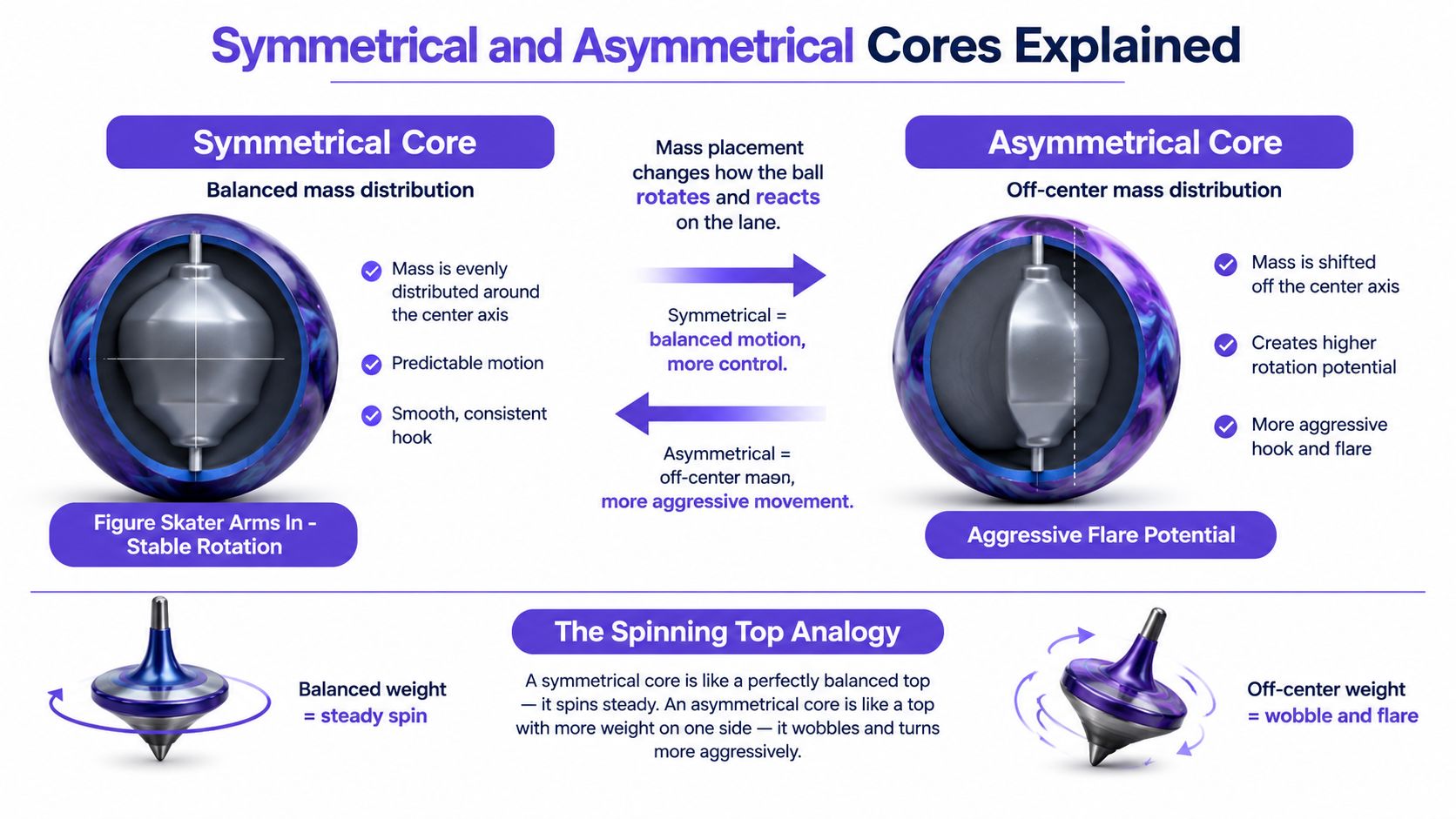
A symmetrical core often gives a bowler a calmer benchmark shape. An asymmetrical core can provide stronger flare and a more pronounced breakpoint. Neither core type works alone, though. Coverstock, surface, drilling layout, speed, rev rate, and axis rotation all decide whether that potential becomes useful motion or an overreaction.
For a plain-language look at internal weight blocks, see this guide to bowling ball weight blocks.
Matching Reaction Shape to Lane Conditions
A ball's category tells you what it's made from. Its reaction shape tells you how it behaves on the lane. That distinction helps explain why a weaker ball can outperform a stronger one on the same house shot after the lanes begin to transition.
Use four broad shapes as a coaching vocabulary:
- Smooth: The ball starts reading earlier and changes direction gradually. This shape offers control when a sharper move would create overreaction.
- Benchmark: The ball provides a readable blend of length, mid-lane traction, and continuation. It's often the first shape a bowler uses to understand a lane.
- Strong asymmetrical: The ball combines substantial traction with more flare and a defined response. It belongs in situations where the lane can support stronger equipment.
- Angular: The ball saves energy through the front, then responds sharply when it sees friction. It can help when the heads have dried and a smoother ball is no longer getting far enough downlane.
| Reaction Shape | Dry Lanes | Medium Lanes | Oily Lanes |
|---|---|---|---|
| Smooth | May read too early | Useful when control is needed | Strong match when traction is difficult |
| Benchmark | Can work with surface changes | Natural starting point | Useful if the cover is strong enough |
| Strong asymmetrical | Often too early | Useful for stronger players or more volume | Appropriate when the lane supports high traction |
| Angular | Can overreact at the breakpoint | Useful as the lane opens | May skid too far if it lacks surface or cover strength |
The same house shot can favor different balls
Suppose your benchmark ball is striking well in the opening game. As the front of the lane dries, it begins to hook earlier and lose energy before reaching the pocket. Many bowlers respond by throwing harder or moving their feet without changing equipment.
A better option may be a cleaner pearl or a polished hybrid. That ball can get through the changed front portion more easily and preserve energy for the breakpoint. The weaker-looking ball wins because its shape matches the transition.
Later, if the lane develops too much friction downlane, the angular ball may become difficult to control. A smoother ball can then produce the better pocket shape, even if its catalog description sounds less powerful.
Read the lane, not the label: “Stronger” means more traction potential. It doesn't mean more strikes on every shot.
Coverstock and core always work as a pair. A pearl cover on an asymmetrical core may create a sharp move, while a solid cover on a symmetrical core may create a smoother and earlier read. The all-lane bowling ball guide can help organize those combinations, but your own release determines which version of the shape you see.
Why a Control Ball Often Beats a Power Ball
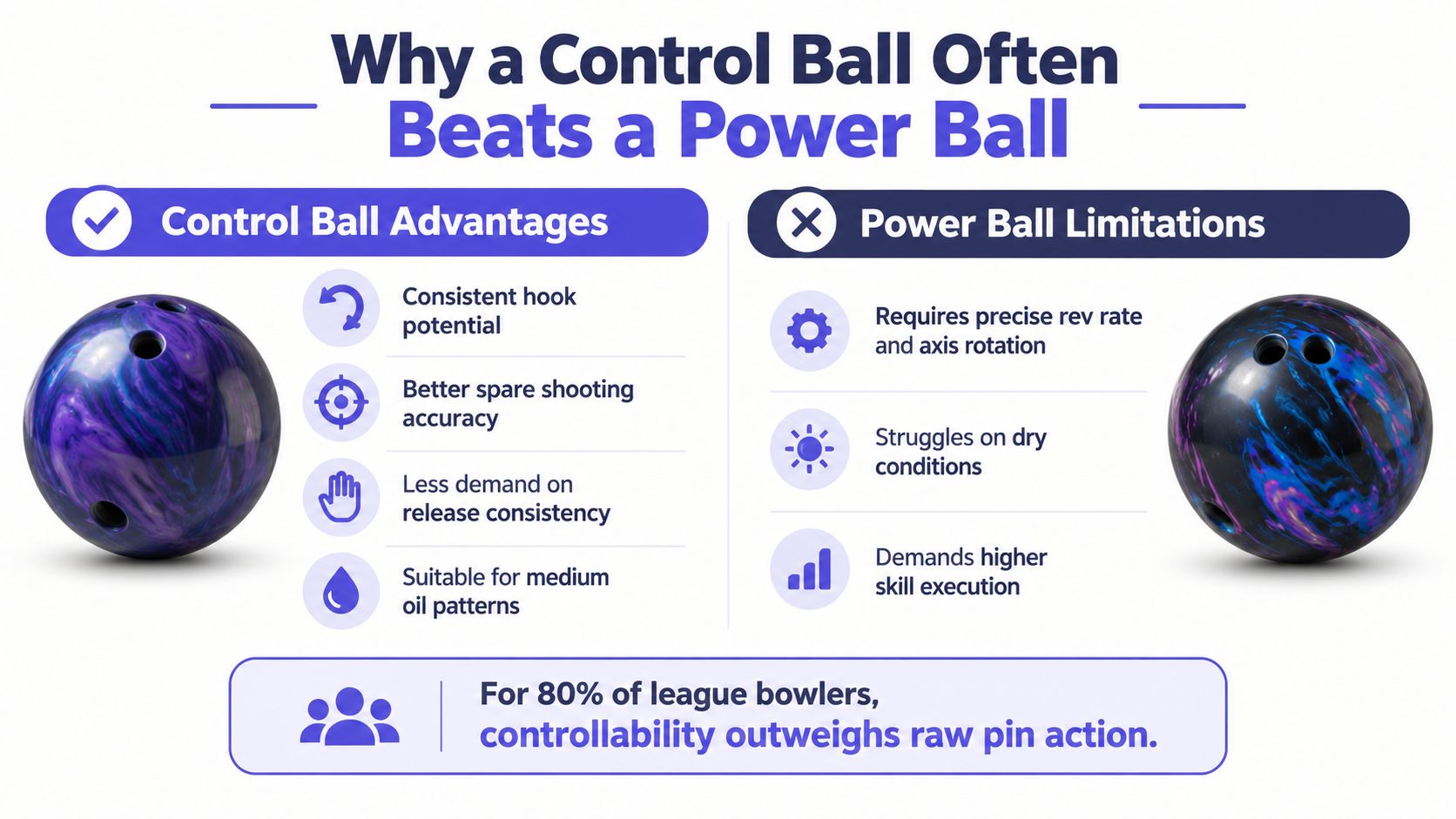
A high-performance ball can look impressive during a demo. It creates a large move, sends pins in different directions, and seems to offer more margin because it hooks so much. In practice, aggressive equipment can punish a release that isn't yet consistent.
A control ball usually gives you a smoother transition and a more readable breakpoint. A symmetrical core or a lower-differential asymmetrical core can help reduce the sudden change of direction that causes a ball to jump high or miss the pocket weak. That predictability is valuable on the medium conditions common in league bowling.
Power requires matching inputs
Aggressive asymmetrical equipment often responds strongly to changes in rev rate, axis rotation, speed, and hand position. If your release creates too much rotation for the lane, the ball may hook before it reaches the pocket. If your speed dominates your rev rate, the same ball may skid too long and turn too late.
A smoother reactive ball gives you more ways to stay in play. You can move your feet, change your target, adjust the surface, or alter speed without asking the ball to make an extreme move. That makes it a useful learning tool as well as a scoring tool.
Choose usable motion over impressive motion
A high-rev player with strong speed control may take advantage of a powerful ball on fresh oil. A newer league bowler may get better results from a benchmark-style reactive ball that reads the lane without demanding perfect timing.
That doesn't make the control ball inferior. It gives you a reaction you can repeat when the lane is changing and your release isn't identical every shot. Spare reliability matters too. If your strike ball creates too much movement across the lane, a plastic spare ball remains the cleaner tool for straight conversions.
Power is best understood as matchup potential, not raw hook. The right ball is powerful because it gives your game a useful shape on the condition in front of you.
Choosing the Right Ball for Your Skill Level
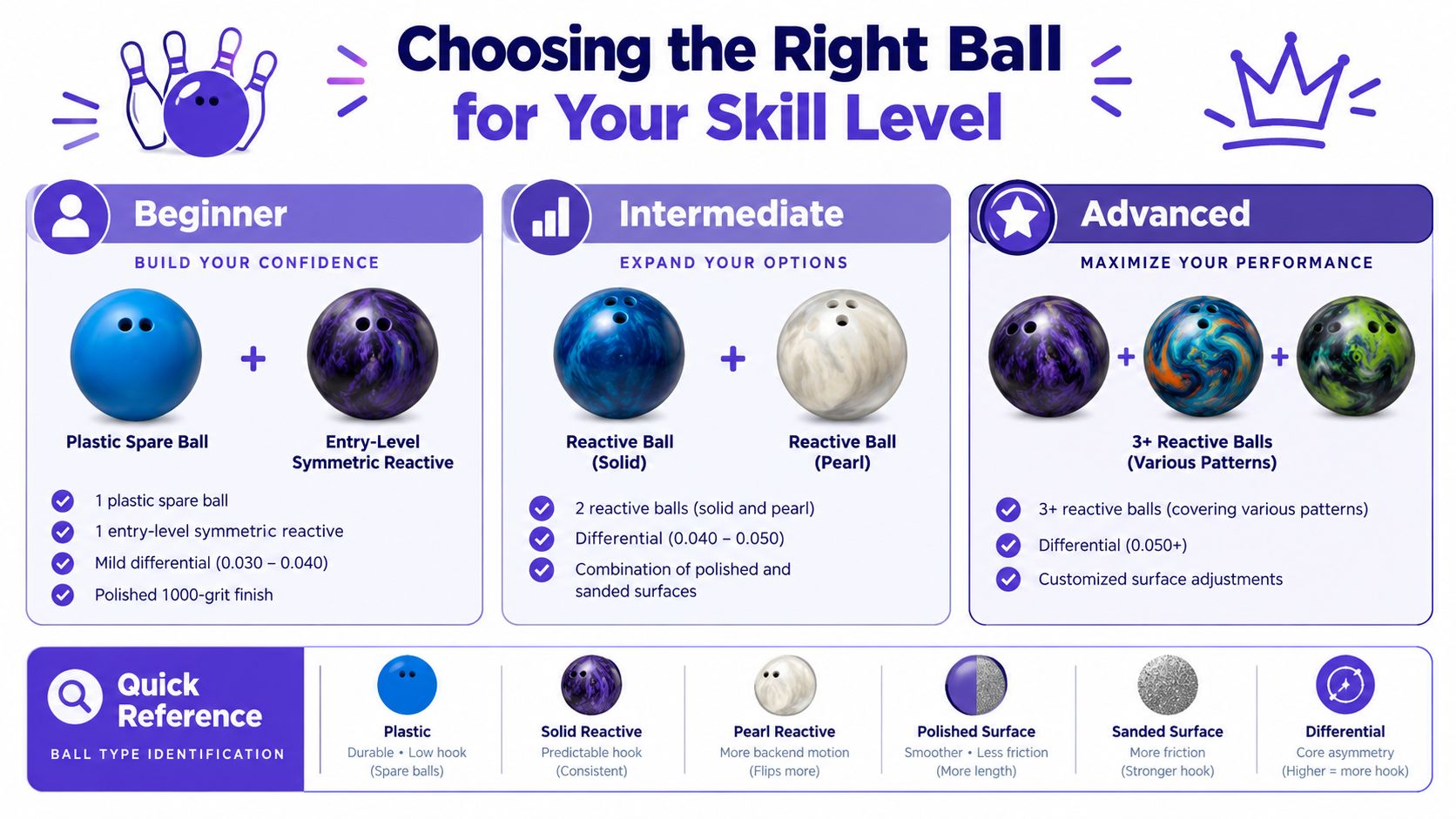
Your first decision should match your current release, not the equipment carried by the strongest bowler in your league. Start with the motion you can control, then add more specialized shapes as you learn how your ball reacts to oil and transition.
Beginners need simplicity
If you're still learning your approach and release, plastic offers the most predictable path. It's especially useful for spare practice because it minimizes hook and lets you focus on targeting.
For strike attempts, an entry-level reactive ball with a symmetrical core and a manageable surface can introduce hook without overwhelming you. Your priority should be learning how the ball moves from the breakpoint to the pocket, not maximizing the number of boards it covers.
League bowlers need a benchmark
A regular league bowler usually benefits from a benchmark reactive ball that handles a broad range of medium conditions. A solid or hybrid symmetrical design can give you a readable starting point, while a plastic ball covers spare duty.
Once you can identify whether your ball is hooking too early or too late, you can make meaningful adjustments. Sometimes that adjustment is a move with your feet. Sometimes it's a surface change. You may not need another ball until you can explain what your current ball is doing.
Experienced players can build by shape
As your release becomes more consistent, add equipment for specific reactions rather than collecting balls that all hook in the same way.
- Fresh-lane option: A stronger solid or asymmetrical ball can provide traction when the lane has more oil.
- Transition option: A hybrid or benchmark piece can keep the reaction readable as the front changes.
- Later-transition option: A pearl reactive ball can clear the front and create a sharper response when the lane opens.
- Spare option: Plastic remains valuable because straight-line accuracy doesn't depend on the lane making a hook.
Surface adjustment is one of the most practical upgrades available. A pro shop can alter texture or polish so an existing ball reads earlier, clears the front more easily, or blends an overactive breakpoint. That may solve a reaction problem without adding another ball to your bag.
Book a pro shop fitting before buying from a catalog. The drilling layout, hand fit, span, thumb release, and surface condition all affect the reaction you'll see. A knowledgeable technician can watch your release, compare your speed and rev rate, and recommend a ball that complements your game rather than offering only the strongest available cover.
Bowling Gear Reviews publishes hands-on bowling ball reviews, comparisons, and buying guides that examine coverstock, core design, surface preparation, hook shape, and lane-condition fit. Visit Bowling Gear Reviews to compare equipment by reaction shape and find practical guidance before your next pro shop purchase.
