

You've just thrown the perfect stroker shot in practice. The ball reads the midlane, turns cleanly at the breakpoint, and rolls through the pocket. Then league starts, the lane changes, and that same shot leaves flat sevens or weak tens all night. You move left, slow down, add hand, and somehow the ball gets less reliable.
That usually isn't a release problem. It's a match-up problem. The best bowling balls for strokers aren't necessarily the strongest balls on the shelf. They're the balls that create enough traction for a lower-rev release, preserve energy through the pins, and give you a breakpoint you can repeat when the lane starts to transition.
| Stroker need | Better equipment direction | What to avoid |
|---|---|---|
| Earlier midlane read | Medium-strength reactive or controlled urethane-style cover | Very weak plastic or overly clean pearl |
| Predictable continuation | Symmetric core with moderate differential | Maximum-flare asymmetrical equipment on ordinary conditions |
| Dry-lane control | Weaker cover, polished surface, or urethane-style motion | Aggressive sanded solid |
| Oil traction | Stronger solid or hybrid cover with suitable surface | Shiny equipment that skids past the breakpoint |
| Legal tournament versatility | Current-rule-approved reactive option | Assuming every urethane-style ball is legal everywhere |
Table of Contents
- Why Strokers Need a Different Ball Shortlist
- What Defines a Stroker Release and Why It Matters
- Best Bowling Balls for Strokers by Lane Condition
- Urethane, Reactive, and the 2026 Eligibility Question
- Layout and Surface Prep Tips to Match Your Game
- How We Tested These Balls on the Lanes
- Building Your Stroker Arsenal and Where to Start
Why Strokers Need a Different Ball Shortlist
A stroker can make a ball look perfect for the first few shots and still carry the wrong equipment for the night. I've seen bowlers with clean timing and a beautiful twelve-to-seven shape keep leaving corner pins because their ball either never picked up in the midlane or burned too much energy before it reached the pocket.
That's why I don't start with a brand list. I start with the bowler's release profile, lane volume, and desired breakpoint shape. A ball that's ideal for a high-rev player can be too angular for a stroker, while a ball marketed as “smooth” can roll out if its coverstock is too strong for the lane.
The four decisions that matter
Oil volume comes first. Modern lane preparation generally puts conditioner over approximately the first two-thirds of the lane, with more friction near the backend. USBC research also reports that the volume of oil applied to lanes has nearly tripled over the past four decades, while modern ball technology and higher-revolution releases break down patterns faster. Those conditions make a one-ball answer unrealistic. USBC's equipment research explains why ball strength has to match the lane rather than the bowler's ego.
Coverstock controls the first conversation with the lane. A solid reactive creates earlier traction, a hybrid usually balances traction and length, and a pearl reactive tends to store more energy for a sharper response. Urethane-style equipment reads earlier and smoother, but it can struggle to create enough continuation when the lane demands more recovery.
The core shapes the motion after the cover starts working. A symmetric core with moderate differential usually gives a stroker a readable arc. A strong asymmetrical core can create needed flare on heavy oil, but it can also force the ball into an over-under reaction when the lane doesn't provide enough volume.
Surface determines whether the design behaves as intended. The same ball can become earlier and smoother after adding texture, or cleaner and more angular after polishing. A stroker should treat surface as part of the ball selection, not as an afterthought.
Pro shop rule: Buy the ball that gives you the largest usable window, not the ball that hooks the most in a ten-shot demo.
My default starting point is a benchmark symmetric reactive with a controllable cover. It should read the midlane without jumping off the spot, continue through the pins without rolling out, and remain useful after the front part of the lane changes. That design gives a stroker more room to adjust with feet, target, and surface.
What Defines a Stroker Release and Why It Matters
The practical stroker profile in the supplied bowling research sits around 14 to 18 mph ball speed and 200 to 300 RPM. Those figures describe a useful starting point, not a permanent label. Your axis rotation, axis tilt, rev rate, speed, and lane environment still decide whether a particular ball is too early, too weak, or too sharp. The bowling-ball selection reference supports the broader principle that coverstock, core, and surface must be evaluated together.
| Spec | Typical stroker reference | Ball-selection impact |
|---|---|---|
| Ball speed | 14 to 18 mph | More speed can delay traction, while slower speed gives the cover more time to respond |
| Rev rate | 200 to 300 RPM | Lower revs need help from cover friction and core flare |
| Axis rotation | Individual value matters more than the label | More rotation can create stronger downlane response |
| Axis tilt | Individual value matters more than the label | Higher tilt may need a cleaner surface to avoid early roll |
| Core differential | Moderate for a benchmark ball | Higher differential generally increases flare and directional change |
| Surface | Box finish as the starting reference | Texture adds earlier traction, polish delays the response |
Read the release before choosing the cover
Lower rev rate means the ball gets less hook from rotation alone. That doesn't mean you need the strongest cover on the market. It means the cover has to create enough friction in the midlane for the core to do useful work.
Ball speed changes the timing. A slower release lets the ball interact with the lane for longer, so an aggressive sanded solid may start too early and lose its energy before the pins. A faster stroker may need more surface or a stronger cover because the ball can skid too far before it begins to roll.
Axis tilt changes the shape again. A low-tilt release tends to make the ball read earlier, while higher tilt can keep it cleaner through the front. The high-tilt stroker often needs a surface that clears the heads without making the breakpoint uncontrollably sharp.
Use core numbers as a screening tool
USBC permits undrilled-ball RG values from 2.460 to 2.800 inches and limits total RG differential to 0.060 inches, as documented in the USBC equipment specifications manual. Those limits don't tell you which ball will strike best, but they help narrow the field.
For a benchmark stroker ball, I prefer a symmetric design with roughly 0.030 to 0.045 inches of total differential. That gives the ball enough flare potential to create traction and continuation without automatically producing the violent change of direction associated with a stronger asymmetrical design.
If you're comparing ball categories before visiting a pro shop, this guide to different types of bowling balls is a useful primer. Once you know your profile, though, stop shopping by category alone. Two reactive balls can behave nothing alike after drilling and surface preparation.
Best Bowling Balls for Strokers by Lane Condition
The right pick changes with oil volume. I'd rather put a stroker in the correct weaker ball on a dry lane than watch a powerful solid burn up before it reaches the pins. On heavier oil, I'll accept a stronger cover, but only when the bowler can still control the breakpoint.
| Lane condition | Top pick | Coverstock | Core type | Recommended surface | Why it works for strokers |
|---|---|---|---|---|---|
| Dry or friction-rich | Storm Pitch Black | Urethane-style | Symmetric control design | Smooth, lightly textured or polished based on reaction | Controls the breakpoint and reduces overreaction |
| Dry to medium-light | Ebonite One | Weaker reactive | Symmetric benchmark-style design | Box finish, then polish if it reads too early | Adds more continuation than urethane without excessive flare |
| Medium | Storm Phaze II | Solid reactive | Symmetric core | Box finish or a light surface adjustment | Reads the midlane and keeps a rounded continuation |
| Medium | Motiv Pride Empire | Reactive benchmark option | Controllable core design | Factory finish, then tune by lane friction | Offers a useful middle ground for speed-dominant strokers |
| Heavy | Hammer Obsession | Strong reactive | Asymmetric | Add surface when the heads are slick | Creates traction when weaker balls skid too long |
| Heavy or higher-volume transition | 900 Global Zen | Strong reactive | Dynamic core design | Factory finish or controlled texture | Gives a stroker more recovery when the lane demands it |
Dry lanes need control, not zero hook
On dry lanes, Storm Pitch Black is the safer control choice when you want an early, rounded motion. Its urethane-style reaction can keep the ball from leaping off the dry backend, especially when your release already creates a smooth shape.
Ebonite One is the better alternative when urethane-style motion is too flat through the pins. A weaker reactive cover can create more continuation while remaining manageable on lighter volume. I'd start it near box finish and polish only if the ball reads too soon.
Don't automatically reach for plastic as your strike ball. A stroker's natural control can make plastic look clean but leave the ball deflecting at the pocket. Plastic still has a place as a spare tool, but it doesn't belong in the main strike-ball shortlist unless your specific lane strategy demands a straight trajectory.
Medium volume is where the benchmark earns its place
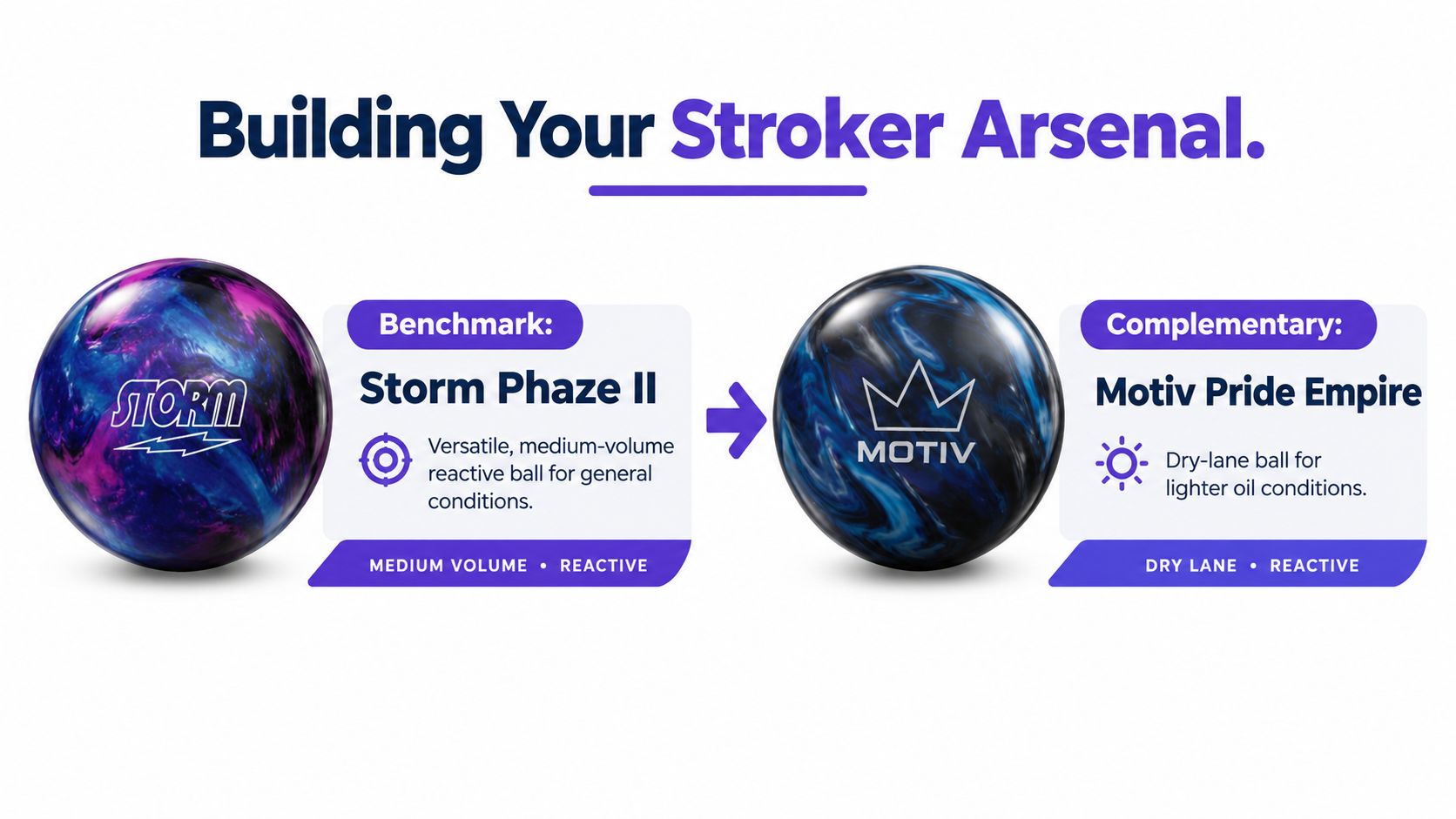
For ordinary league conditions, Storm Phaze II is my first recommendation from this group. The solid reactive cover gives a lower-rev bowler enough midlane read, while the symmetric design helps keep the shape rounded rather than forcing a sideways move at the breakpoint.
Motiv Pride Empire is the complementary benchmark option. I'd consider it when the bowler needs a controlled reactive shape but doesn't want a ball that feels overly dependent on friction at the end of the lane.
The factory finish is the starting point, not a commandment. If the ball skids too long, add a small amount of texture. If it reads before the breakpoint and leaves flat corners, increase surface smoothness or move to a weaker cover.
Heavy oil requires traction with energy retention
A stroker on heavy oil often makes the wrong adjustment by choosing the most angular ball available. That can create a skid-flip reaction, but it doesn't necessarily create reliable pocket entry. I prefer a stronger solid or hybrid that reads the heads and keeps moving through the pins.
Hammer Obsession and 900 Global Zen belong in this category when the lane has enough volume to support them. They're not automatic league-night choices. They become useful when your benchmark ball skids too far, misses the breakpoint, or fails to recover after you move into more oil.
On a house shot, I'd be cautious about adding too much surface to these balls. On a flatter sport pattern, earlier traction may be necessary. Compare them by breakpoint distance, front-lane read, continuation, and missed-target recovery, not by the number printed on a manufacturer's hook chart.
Urethane, Reactive, and the 2026 Eligibility Question
Urethane remains useful for a stroker, but it's no longer a purchase you can make without checking the event rules. USBC rules effective in 2026 place restrictions on slow oil-absorbing high-performance balls. Products with oil-absorption times above 90 minutes must meet a 78D manufactured-hardness standard for certain approvals, and some major events prohibit them regardless of hardness. The USBC tournament rule changes and FAQ should be your reference before entering a serious event.
That creates three separate questions. Is the ball legal for the event? Will its hardness remain compliant after use? Does its motion suit your release and the lane? A ball can pass one question and fail another.
| Coverstock type | Hardness range | Surface prep | USBC status in 2026 | Best stroker use |
|---|---|---|---|---|
| Urethane-style | Varies by product and condition | Smooth texture or controlled polish | Check the exact model and event rules | Shorter, flatter, or friction-sensitive patterns |
| Weaker reactive | Product-specific | Box finish or polish | Usually the easier alternative to evaluate, subject to approval | Medium and lighter conditions |
| Hybrid reactive | Product-specific | Box finish with small adjustments | Check approval status | Balanced traction and continuation |
| Strong solid reactive | Product-specific | Texture for oil, smoother finish for control | Check approval status | Higher-volume lanes |
| Plastic | Product-specific | Factory polish | Common spare-ball category, subject to event rules | Straight spares rather than primary strike shape |
USBC testing found that urethane can soften with use. In one test, solvent treatment produced hardness as low as 30.7D, with associated performance changes. That's why I won't tell a tournament bowler to buy a urethane-style ball based only on how smooth it looks in a store.
Choose the motion, then verify eligibility
Urethane gives earlier, smoother friction and usually limits backend separation. That can help a stroker control a short or flat pattern, but it can also produce a lazy shape when the lane needs continuation.
A weaker reactive ball is often the smarter modern substitute. It can clear the front more easily, create a defined but manageable breakpoint, and preserve more energy through the pins. Hybrid reactive equipment sits between those choices, offering more traction than pearl without the full commitment of a strong solid.
The guide to urethane bowling balls can help you compare the category, but check the exact approval status for your league or tournament. Don't assume a ball is legal because it has a familiar coverstock name.
Layout and Surface Prep Tips to Match Your Game
A good ball can look wrong after a poor layout or an unsuitable surface. I've drilled enough stroker equipment to know that the bowler's PAP measurement and release video tell me more than a generic “stroker layout” label.
Start with a current ball that you understand. Bring it to the pro shop, measure your PAP, and record a few shots from the side and behind the foul line. The driller can then choose a pin position, angles, and balance strategy that fit your actual release rather than an assumed style.
Start with a controllable pin position
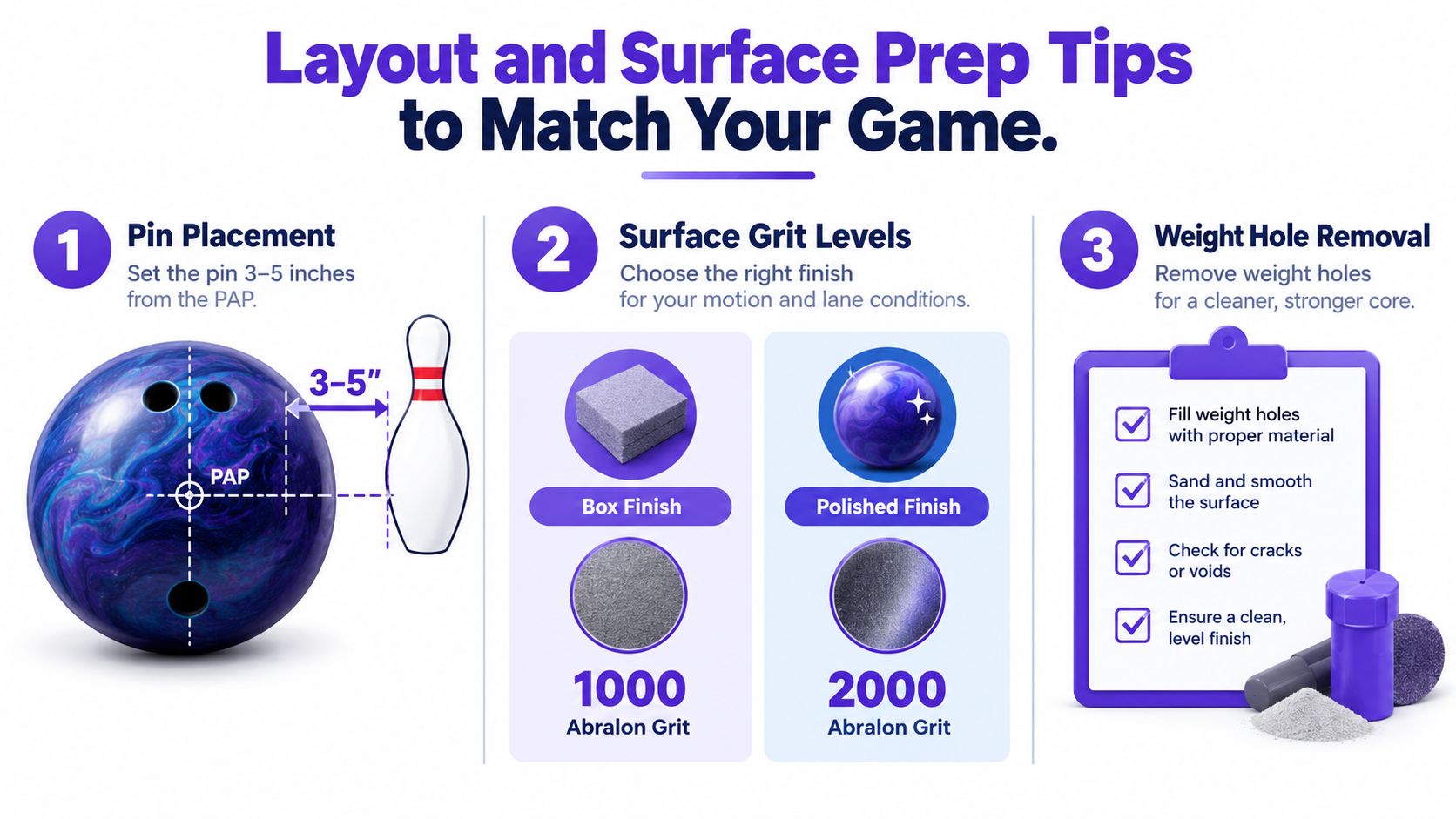
A pin placement around 3 to 5 inches from the PAP is a practical starting point for many stroker layouts, but it isn't a universal prescription. The distance affects flare potential and how quickly the core changes position during the roll.
A stroker who needs earlier read may benefit from a layout that lets the ball rev sooner. A bowler with lower tilt or slower speed may need a cleaner arrangement so the ball doesn't use all its energy before the breakpoint. Your driller should also consider finger placement, thumb exit, axis rotation, and the ball's RG and differential.
The dual-angle approach gives the pro shop more control over this decision. One angle can influence how quickly the ball revs, while the other can influence the transition from skid to hook. You don't need to memorize the layout system. You do need to explain what your current ball does when you miss right and when you miss left.
Match the surface to the miss
Use the reaction, not the label, to select the finish.
- Box finish: Start here when you don't yet know how the ball matches your release.
- 1000 Abralon: Add texture when the ball skids too long or misses the breakpoint.
- 2000 grit: Use a more moderate adjustment when you need earlier read without making the motion too blunt.
- Polished finish: Smooth the surface when the ball hooks before the breakpoint or loses energy downlane.
A ball that hooks early and leaves flat corners usually needs a cleaner surface, a weaker cover, or a straighter launch. A ball that misses right and never recovers needs more traction, a stronger cover, or a layout that helps it rev sooner.
For more layout-specific detail, use this guide to bowling-ball drilling layouts. Then take the ball to your pro shop for a controlled adjustment rather than making several changes at once.
This video is useful before discussing layouts with your driller:
How We Tested These Balls on the Lanes
A stroker ball test should resemble the conditions where you bowl. I'd start with a medium-volume house pattern and then move to a heavier, flatter sport condition. The point isn't to crown the ball with the most total hook. It's to identify the ball that gives the bowler the clearest response to common misses.
The test lineup begins with a control ball, followed by the benchmark reactive, then progressively stronger coverstocks. I'd keep the release as consistent as possible, use the same target system, and make surface changes only after recording the original reaction.
The scorecard matters more than memory
For each ball, record:
- Front-lane read: Did the ball begin to roll before the intended breakpoint?
- Breakpoint distance: Did it reach the intended friction window?
- Shape: Was the transition smooth, continuous, or too sharp?
- Missed-target recovery: Did the ball recover when it missed inside or outside?
- Pin continuation: Did it keep driving after entering the pocket?
- Transition response: Did the ball remain usable after the front started to hook?
A stroker should also distinguish release speed from the speed shown at the pins. One published stroker review methodology uses a representative profile of 15.4 mph, 225 RPM, 40 degrees of axis rotation, and 20 degrees of axis tilt, while noting that scoring-system speed is typically 2 to 3 mph lower than release speed because the ball slows down the lane. The Bowling This Month ball-review archive provides useful context for this distinction.
What the categories reveal
On a medium condition, a benchmark symmetric reactive should give the cleanest combination of traction and continuation. A pearl reactive can create a stronger backend, but it may become too sensitive once the lane develops friction outside the target line.
Urethane-style equipment should read earlier and smoother. That can be excellent on shorter or flatter conditions, but the ball may lack continuation when the bowler needs to move deeper inside. A stronger solid should earn its place only when the benchmark ball skids through the oil or fails to recover.
I'd rather see a stroker use a ball that gives a clear answer to every miss than one that produces an impressive first shot. The winning ball is the one that keeps the bowler's feet, target, and release working together after the lane stops being fresh.
Building Your Stroker Arsenal and Where to Start
Build the bag in order of usefulness, not excitement. A stroker usually gains more from covering the common medium condition than from buying an extreme heavy-oil ball that sits unused for most league nights.
First, buy the benchmark
Start with Storm Phaze II or Motiv Pride Empire as the medium-volume reactive. The purpose of this ball is simple. It should be strong enough to read the midlane, smooth enough to control the breakpoint, and versatile enough to remain useful after the lane changes.
If your current equipment either skids past the breakpoint or jumps too hard off friction, this is the purchase that usually fixes the widest part of the problem. Have it drilled to your PAP and begin near the factory surface before making adjustments.
Add the dry-lane complement
Next, add Storm Pitch Black for smooth control or Ebonite One for a little more continuation. Choose the Pitch Black when your house shot creates quick friction and your reactive equipment wants to jump. Choose the One when urethane-style motion is too flat or too early.
This second ball should not duplicate the benchmark. It should let you stay in your normal launch area when the lane is lighter or when the first ball begins reading too soon.
Add heavy-oil coverage last
For higher-volume conditions, consider Hammer Obsession or 900 Global Zen. These stronger options can create traction when the benchmark ball skids too far, but they require better speed control and surface management. They're useful additions, not automatic replacements for the benchmark.
If you can afford only one ball, buy the smooth, controllable symmetric reactive that matches the lane volume you see most often. A three-ball arsenal is valuable, but a properly fitted benchmark ball with the right surface will improve more nights than an aggressive specialist that only works in rare conditions.
Book a pro shop consultation before your next league night, and bring your current ball, PAP measurements if you have them, and a release video. Bowling Gear Reviews offers hands-on bowling equipment reviews, comparisons, and practical fit guidance, so visit Bowling Gear Reviews to compare current balls before you finalize the drilling and surface plan.
