

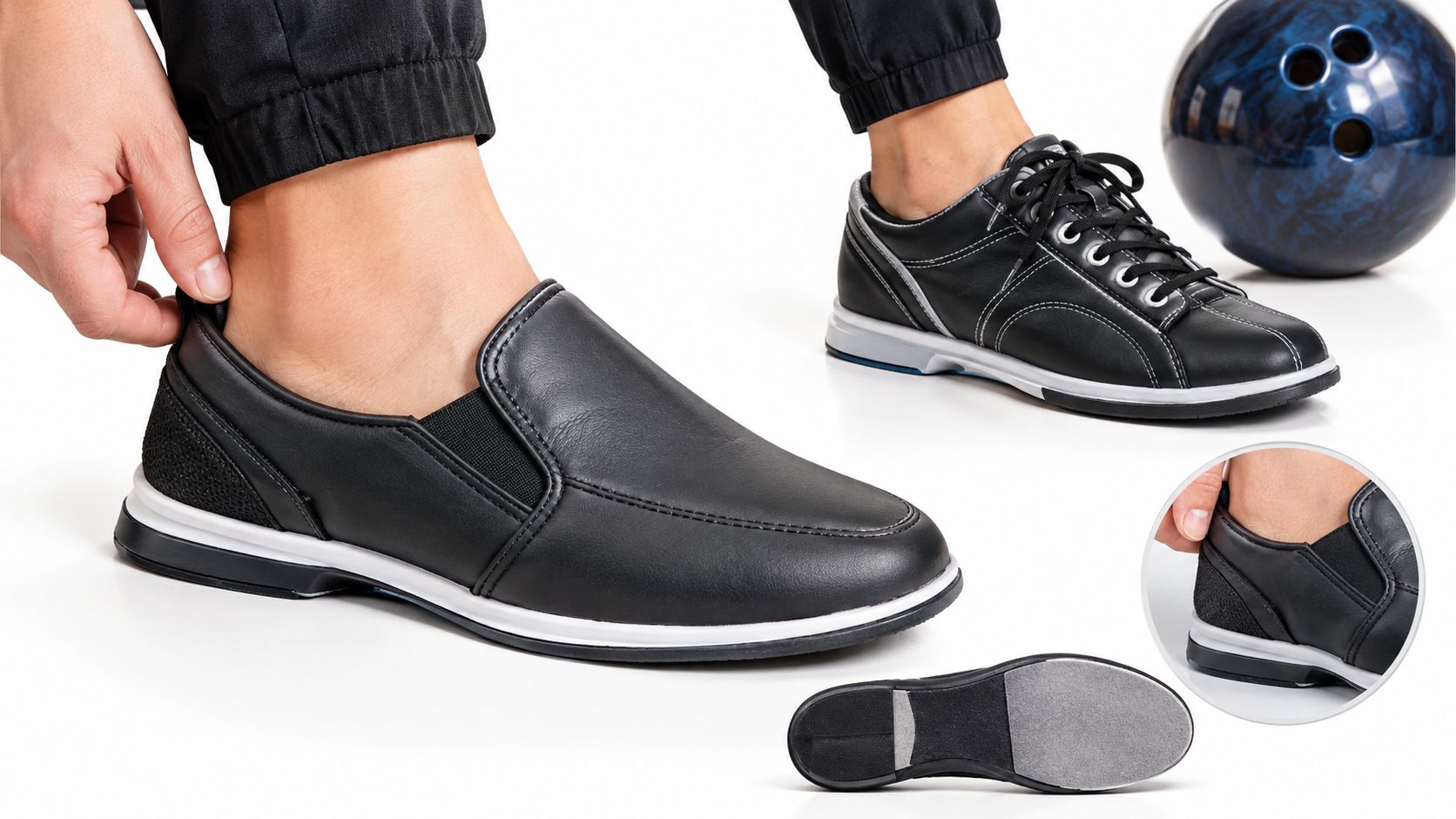
Stop buying slip-ons because they're easy to get on. That's the most popular advice in bowling, and it's backwards. A shoe you can't tighten has to fit perfectly at frame one and still fit perfectly in game three, when your feet have swelled, your socks have compressed, and you're tired. If it doesn't, your heel moves, your slide changes, and your release moves with it.
Table of Contents
- Why Slip-On Bowling Shoes Are a Fit Test, Not a Shortcut
- What Slip-On Actually Means vs Lace-Up and BOA
- Slide and Braking in Bowling Shoe Soles
- Fitting Slip-On Shoes for Narrow, Wide, and High-Volume Feet
- Who Should Actually Choose Slip-On Bowling Shoes
- Keeping the Slide Consistent Off the Approach
- Final Recommendation for 2026 Buyers
Why Slip-On Bowling Shoes Are a Fit Test, Not a Shortcut
I've fitted hundreds of bowlers who loved how bowling shoes slip on in the shop and hated them by the second game. The problem wasn't comfort while standing. It was heel retention and lateral stability once they started moving. A secure fit keeps the heel seated while walking and lets the toes lie flat without compression, because excess internal movement can alter final-step timing and release position, as explained in guidance on choosing bowling shoes for heel and toe fit.
That's why I treat every slip-on as a pass or fail test. Can you shift weight from heel to toe without the heel lifting? Can you simulate your approach without the foot rolling inward or outward? If you can't, walk away. Elastic doesn't give you a second chance to fix it later.
What Matters More Than Entry Speed
Bowling serves a huge recreational base, and that shapes what sells. A U.S. State Department educational feature citing the United States Bowling Congress reported more than 70 million Americans bowl each year, and the Bowling Proprietors Association of America figures in that same feature put more than 60 percent of bowlers under age 34, according to the State Department bowling feature citing USBC and BPAA figures. Lots of those bowlers bowl occasionally, with family, or in a casual league. Fast fitting matters to them.
It doesn't change the functional job. Bowling shoes exist because their soles are designed not to scratch or mar alley floors, and because the approach demands predictable interaction between shoe and surface. Whether you're a beginner, a senior who struggles bending to tie laces, a parent buying for youth bowlers, or someone with wide or narrow feet, slip-on describes entry style, not performance tier.
Shop rule: If a slip-on needs thick socks, toe clawing, or hope to stay put in the store, it'll fail you on the approach.
Judge the upper first for hold, then judge the sole for slide and braking, then test both across a league-length session in your head before you pay. Convenience is only valuable when it doesn't compromise controlled sliding and stopping. Most slip-on disappointments happen because buyers reversed that order.
What Slip-On Actually Means vs Lace-Up and BOA
Slip-on means your foot enters through a stretch opening. It tells you nothing about slide quality, width, or whether the shoe suits a right-handed or left-handed delivery. You'll see elastic gore panels on the sides, a pull tab at the heel, knit collars that stretch like a sock, and sometimes a hook-and-loop strap marketed as slip-on because there's no tying.
The infographic below separates entry method from adjustment, which is where most shoppers get confused.
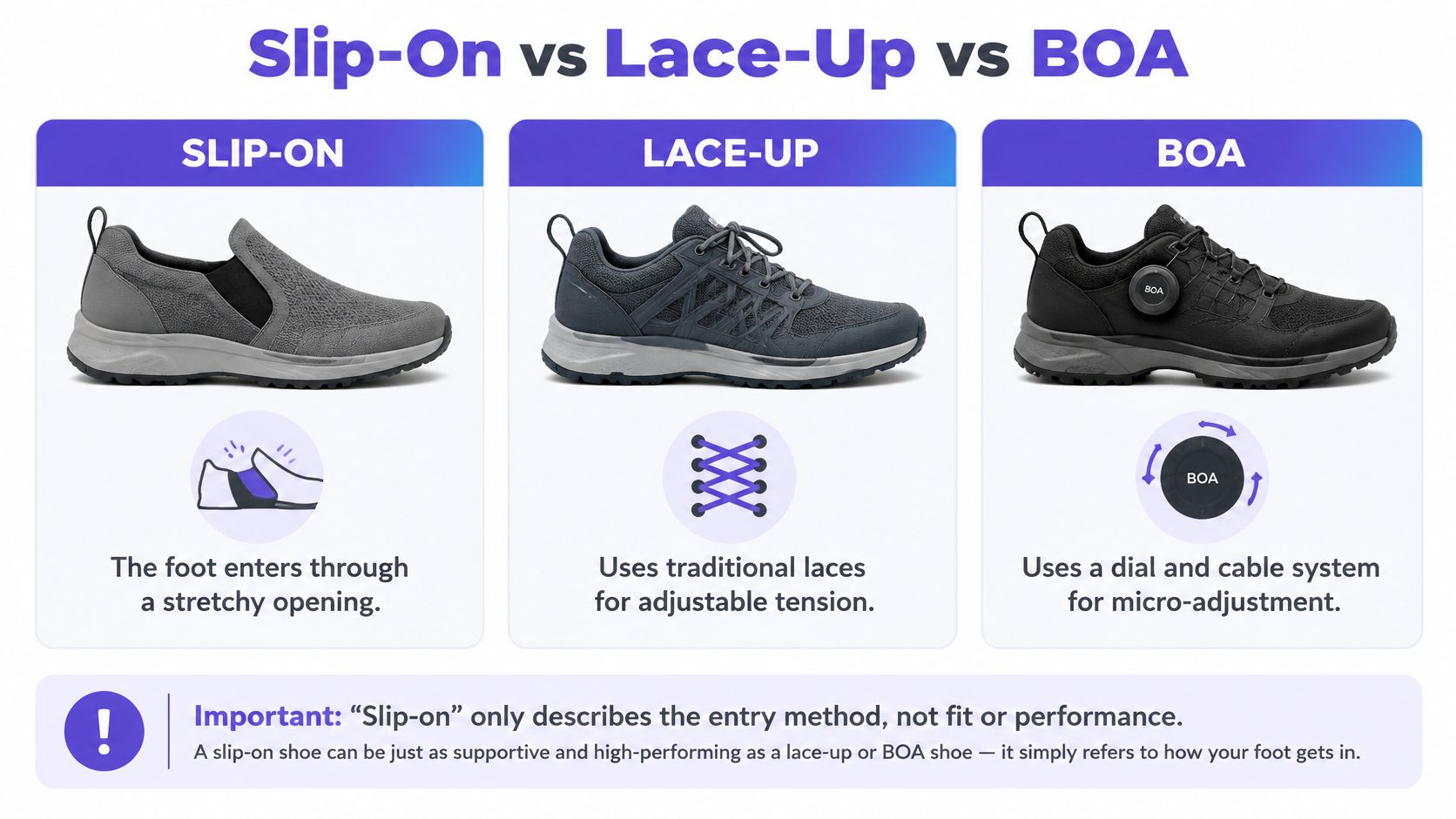
Lace-up shoes use traditional eyelets so you can change tension across the forefoot, midfoot, and ankle separately. You can leave the toes roomy and lock the heel down, or loosen the top eyelets late in a session. That's a real advantage if your feet swell or if one foot is slightly larger than the other.
BOA-style dial systems pull a cable evenly when you turn the dial. They're fast, they give micro-adjustment between games, and they don't loosen the way a sloppy knot can. Dexter's performance lines, for example, pair dial closures with interchangeable soles and heels on models built for serious adjustment. You're paying for tension control, not fashion.
| Closure | How It Holds | Main Trade-Off |
|---|---|---|
| Slip-on elastic | Stretch collar and gore | Fast entry, no real tightening |
| Lace-up | Zone-by-zone tension | Slower entry, most control |
| BOA dial | Even cable tension | Fast adjustment, higher cost |
| Hook-and-loop | One or two straps | Easy for kids and seniors, coarse fit |
Rental counters and beginner shoes lean toward simple uppers and fixed soles because they need to work for almost anyone. Mid-tier shoes add better collars, structured heel counters, and sometimes a strap. Performance shoes from brands like Dexter, Brunswick, and Hammer move toward laces or dials because the bowler is also swapping slide pads and expecting the upper to stay locked while the sole changes.
Watch how closure and hold interact in motion before you decide a stretch collar feels secure enough.
A soft slip-on can feel great at the counter because nothing pinches. On the approach, that same softness lets the midfoot roll and the heel climb. Don't confuse absence of pressure with support.
Slide and Braking in Bowling Shoe Soles
Bowling shoe design has never been about making both feet slippery. It's about controlled sliding paired with reliable braking, and that split is old. A U.S. patent published on May 1, 1962 described the conventional arrangement as leather on the sliding foot and hard rubber, with a leather toe tip, on the braking foot, and it specifically called out approaches that were slippery or sticky as a reason to engineer traction and slide separately in the 1962 bowling shoe patent on dual sole design. The stated goals were reducing slipping, abrupt stops, and leg fatigue.
Later design moved toward adjustability. A patent filed June 10, 1999 and granted as US6662476B1 proposed sole regions with different coefficients of friction and replaceable sole members, so bowlers could alter slide and traction for different conditions and styles. That's the direct ancestor of modern interchangeable systems from Dexter and Brunswick, where slide pads and heels are swapped to match a sticky or slick approach. If you're unsure why that friction split matters, read why bowling shoes are slippery on one foot and grippy on the other before you shop.
Why Basic Slip-On Soles Fail Good Bowlers
Many entry-level slip-ons use a simplified sole system with relatively uniform slide behavior on both feet. Technical guidance describes low friction under the sliding foot and higher traction under the opposite foot as central to controlled deceleration, balance, and repeatable release mechanics in the explanation of differentiated slide and traction soles. For a right-handed bowler, the slide normally happens on the left foot. Left-handers need the reverse. A universal sole works for either hand, which is why rental fleets and casual brands like KR Strikeforce use them, but universal also means compromised.
Test it plainly:
- Slide start: Does the slide begin smoothly, or does it grab then release?
- Traction foot: Does your push-off foot hold during the final step without skidding?
- Stopping distance: Can you repeat the same finish position across several deliveries?
- Heel brake: Does the heel stop you progressively, or do you lurch at the foul line?
Microfiber and leather slide materials generally give a smoother, more controllable glide than ordinary rubberized soles. Material alone doesn't guarantee anything, because wear, approach dust, and moisture change friction fast. I've seen a good leather pad turn grabby after one trip across a damp concourse.
A slip-on upper can't compensate for a sole that sticks one frame and skates the next.
Prioritize predictable, foot-specific friction over easy entry. If a slip-on has a uniform sole and you bowl league every week, you're buying a ceiling on your approach consistency. Beginners may not hit that ceiling right away. Improving bowlers hit it sooner than they expect.
Fitting Slip-On Shoes for Narrow, Wide, and High-Volume Feet
Fit slip-ons standing, in the socks you'll bowl in, late enough in the day that your feet aren't at their smallest. Length is the easiest part and the least important. Width and volume decide whether a laceless shoe works, and sizing charts only get you to a starting point, which is why it's worth checking bowling shoe sizes and width conversions before ordering a size you can't adjust.
Use the four checks in the fitting infographic below in order. Don't skip to the walk-around.
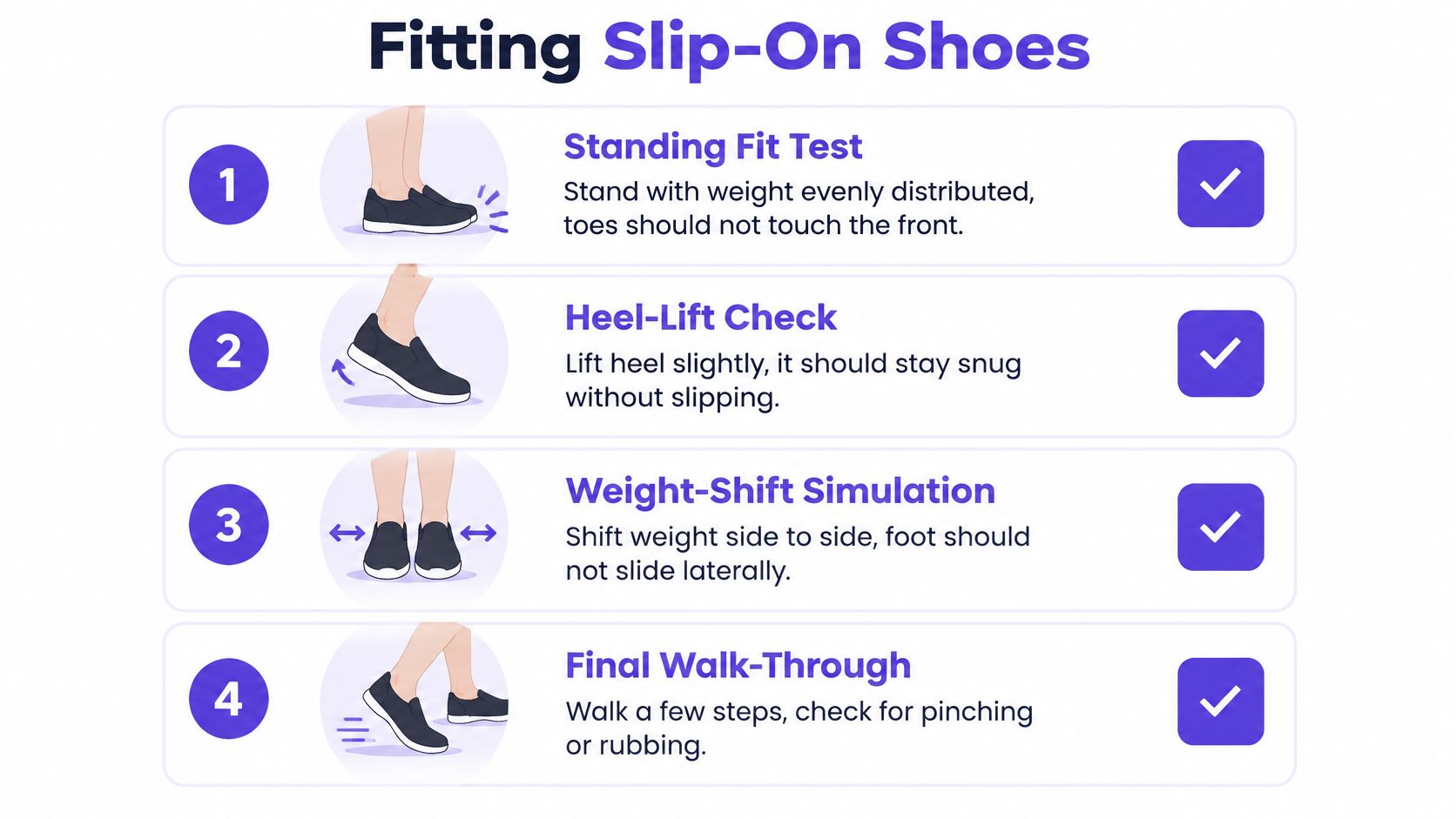
The Four Checks I Run in the Shop
- Standing fit test: Stand with weight even. Toes lie flat, don't curl, and don't press the front. If you're clawing to feel secure, the shoe is too loose or too long.
- Heel-lift check: Walk and rise onto your toes. Reject the pair if the heel lifts and drops back with each step. That lift becomes friction, blisters, and a shifting plant foot.
- Weight-shift simulation: Shift heel to toe and side to side like your final steps. Reject it if the foot rolls inward or outward or slides laterally inside the upper.
- Approach simulation: Take your normal steps without a ball. Your stopping foot should land in the same place and feel planted, not swimmy.
Narrow feet are the hardest slip-on fit. A standard collar leaves side-to-side room, so bowlers size down for hold and end up with compressed toes and toe jam during the slide. If your heel is narrow but your forefoot isn't, most elastic slip-ons will betray one end or the other. Choose a structured model with a firm heel counter, or go lace-up and lock the heel with a runner's loop style lacing pattern.
Wide feet fail differently. The elastic stretches to let you in, feels fine for ten minutes, then keeps stretching across a season until the midfoot has no real hold. Look for an actual wide last, not just a stretchy knit in a regular width. If the forefoot feels compressed while standing, it won't improve when your foot swells in game three.
High-volume feet and high insteps get one genuine benefit from slip-ons. Entry is easier than forcing a foot under tight laces. The offset is midfoot looseness once you're in, because there's no way to pull the upper down over the arch.
Repeatability benchmark: A good slip-on holds the same heel position after repeated approaches. If you'd need to reposition it mid-session, it's the wrong shoe.
Feet swell and socks compress during league play. Laces and dials rescue that fit in seconds. A slip-on can't, so the fit you test has to have margin built in, snug at the heel without toe pressure, stable at the midfoot without squeezing the forefoot. That's a narrow target. Some feet hit it easily. Many don't.
Who Should Actually Choose Slip-On Bowling Shoes
Buy for your foot behavior and your session length, not for how often you bowl. A once-a-month bowler with a narrow heel can be a worse slip-on candidate than a weekly league bowler whose medium-volume foot happens to match a structured slip-on last perfectly. Bowling's asymmetric sole design, with a sticky or rubbery sole on the non-sliding foot and a harder sole on the sliding foot, is confirmed in the academic description of bowling footwear design, so every profile below still needs that sole logic respected.
| Bowler Profile | Slip-On Verdict | Lace-Up Verdict | BOA Verdict |
|---|---|---|---|
| First-time buyer | Good if fit passes all checks | Safer default | Overkill at first |
| Casual family bowler | Best use case | Fine | Unnecessary |
| Youth bowler | Good for fast changes, watch growth looseness | Better as feet stabilize | Rarely needed |
| Senior bowler | Good if bending or grip strength is an issue | Good with help tying | Excellent, easy one-hand adjustment |
| Weekly league bowler | Only with stable fit over long sessions | Strong choice | Strong choice |
| Competitive bowler | Pass | Good with interchangeable soles | Best for micro-adjustment |
| Narrow or asymmetric feet | Usually pass | Best control | Good if last fits |
| Wide, high-volume feet | Only in a true wide last | Strong choice | Good if instep room allows |
Beginners and casual families are where slip-ons win. You're replacing rentals, bowling a game or two, and you want your own clean pair that goes on fast between frames and pizza. A universal microfiber sole from an athletic-style brand is enough, and easy entry keeps kids from wandering the concourse in socks.
Seniors need a split decision. If tying laces is painful or balance while bending is shaky, a slip-on or dial shoe is a safety feature, not a convenience. But reduced balance also punishes heel slip harder. I'd rather put a senior in a BOA shoe they can tighten seated than in a loose knit slip-on.
League-average bowlers should default to laces or BOA unless a slip-on passes the full fitting protocol and stays stable through a full league night in practice. Your feet change over three games. Your approach conditions change between centers. Adjustment handles both.
Competitive bowlers shouldn't buy slip-ons. You need interchangeable slide soles and heels, foot-specific traction, and an upper that locks while you experiment underneath it. That's performance lace-up or dial territory from Dexter, Brunswick, or Hammer, not elastic.
Keeping the Slide Consistent Off the Approach
Most slide problems I troubleshoot didn't happen on the approach. They happened at the snack bar, in the restroom, or on a wet walk to the parking lot. Slip-ons make this worse because they're so easy to keep wearing. Bowlero's safety rules specifically say to clean soles before bowling, after visiting the restroom, or after going anywhere outside or inside the center, and they warn that moisture or sticky substances can cause falls in Bowlero safety rules on cleaning bowling shoe soles.
Treat your bowling shoes as approach-only equipment. If you leave the bowling area, either change back into street shoes or accept that you now owe your soles an inspection before your next delivery. Lane oil past the foul line, spilled soda on the concourse, and restroom moisture all change friction in different directions, and none of them announce themselves until you're mid-slide.
A Pre-Shot Routine That Takes Ten Seconds
- Look: Check the slide pad and heel for moisture, gum, food, or shiny glazed spots.
- Wipe: Use a dry towel or your hand to clear dust. Follow a consistent method from how to clean bowling shoes without ruining the slide pad rather than improvising with water.
- Dry: If the sole is damp, stop. A damp slide foot sticks, and a damp traction foot skates. Both can put you on the floor.
- Test: Take one slow practice slide step behind the approach before committing to a full delivery.
Don't overcorrect with aggressive brushing. A wire brush can restore a glazed leather or microfiber pad, but scrubbing hard every few frames roughs the surface unevenly and makes the slide grabby and unpredictable. Brush lightly, in one direction, only when the pad feels slicker or deader than it should.
If something touched your sole that you wouldn't want on the approach, assume your friction changed until you've proven otherwise.
Replace or retire the shoe when the slide pad is cracked, peeling, or glazed smooth and light brushing no longer helps, when the heel shows uneven wear that tips your finish, or when the elastic collar has stretched enough that cleaning the sole isn't your biggest problem anymore. Bowlers with reduced balance, kids, and anyone returning from an injury should be stricter. Sit out a frame and fix the sole. One stubborn delivery on a contaminated shoe isn't worth a fall.
Final Recommendation for 2026 Buyers
Here's my decision tree, the same one I use at the counter. Answer candidly and don't negotiate with the results.
Buy a slip-on if you bowl casually or with family, your foot is medium width and medium volume, the shoe passes the heel-lift and weight-shift checks in your bowling socks, and the sole matches your sliding foot or is a universal sole you're comfortable sliding on. Seniors who can't manage laces and parents buying for kids belong here too, provided the fit is snug, not merely stretchy.
Skip the slip-on and buy laces or BOA if you bowl league weekly, your feet swell noticeably, one foot fits differently than the other, you're narrow or wide enough that standard lasts fail you, or you want interchangeable slide soles and heels. That's most improving bowlers, and there's no shame in it. Adjustment is a performance feature.
For 2026 shopping, expect entry-level slip-ons to compete on athletic styling and fixed universal soles, and expect to pay more as you add structured heel counters, true wide lasts, foot-specific soles, and replaceable pads. Don't pay performance money for a shoe that offers only convenience. The features worth funding are sole quality, heel braking, and a collar that holds its shape, in that order.
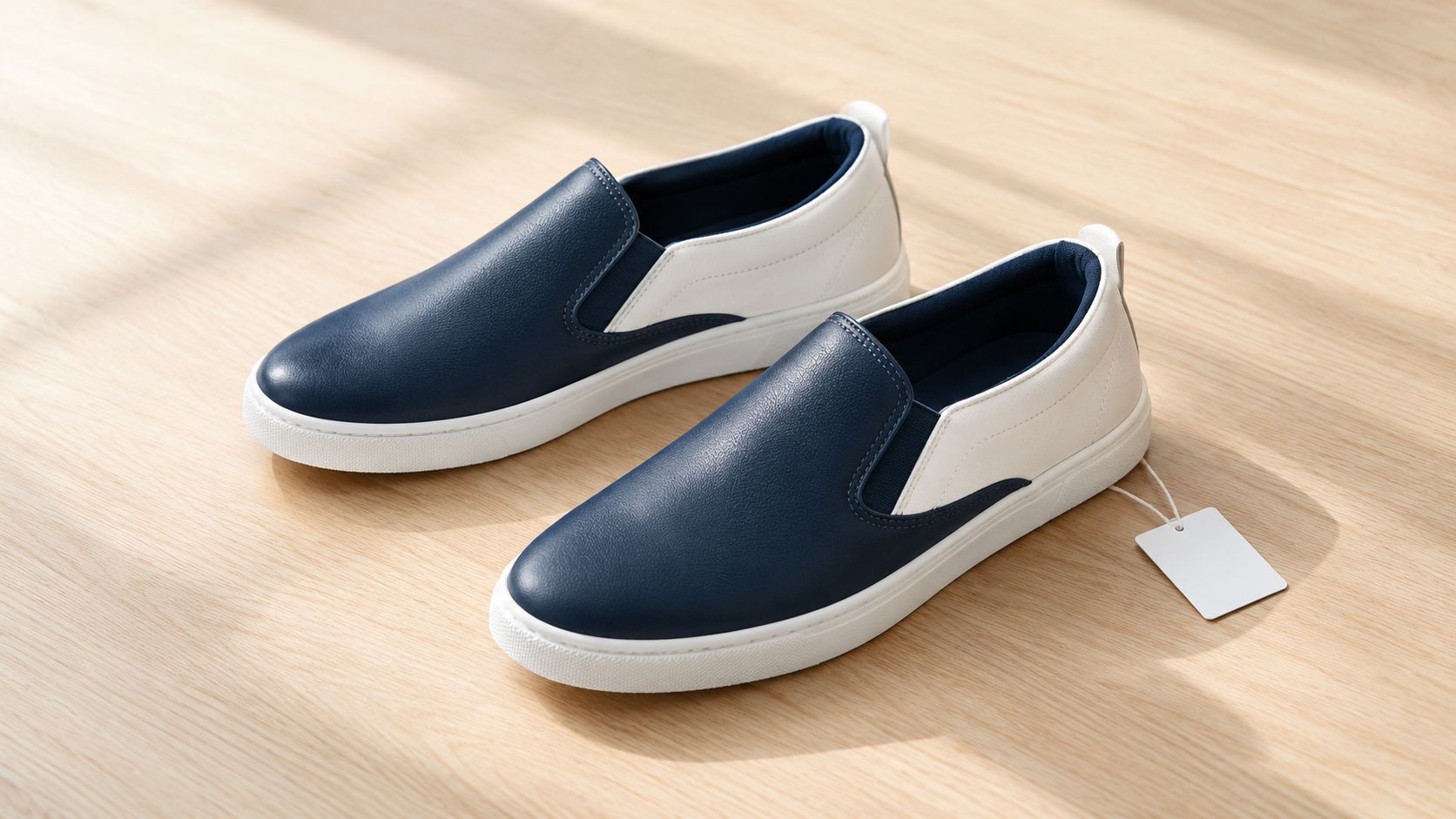
Bench any slip-on, regardless of age or price, when you see stretched elastic that no longer hugs the ankle, glazing or cracking on the slide pad, sole separation at the toe or heel, or a heel counter that collapses when you squeeze it. Those failures don't heal, and each one shows up first at the foul line.
My verdict after years of fittings is simple. Slip-ons are a legitimate choice when entry speed, foot shape, and short sessions all line up. They are not an upgrade path, and they are not more modern than laces. Buy the closure your feet can trust in game three, not the one that felt easiest in the store.
Visit Bowling Gear Reviews for hands-on bowling shoe evaluations covering narrow and wide fit profiles, slide and traction systems, and league-length wear testing, plus independent reviews of balls, bags, and accessories. Use the fit checks from this guide alongside our shoe comparisons to shortlist models that match your foot shape and session length, then buy the pair that passes on the approach, not just at the counter.
