

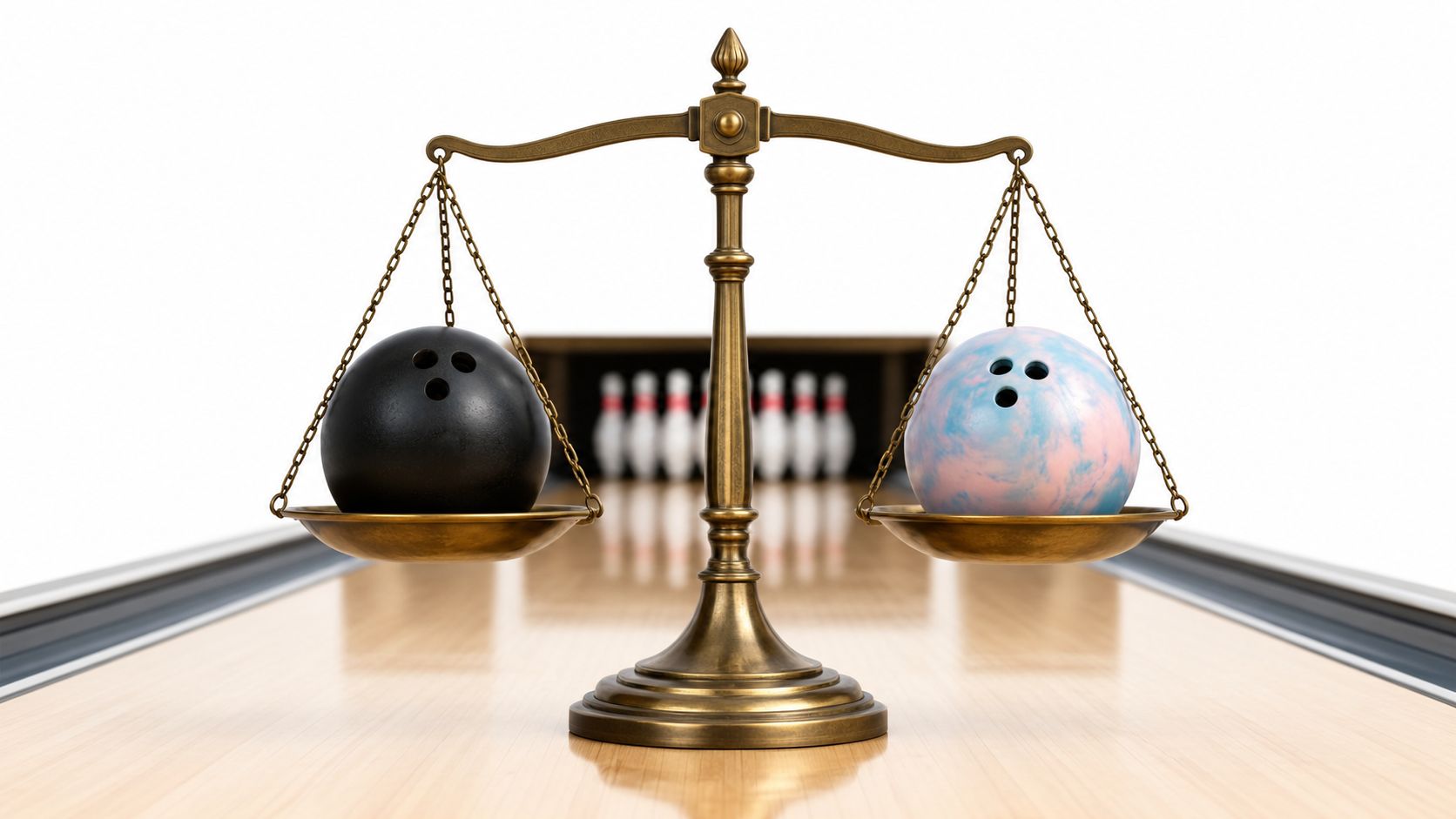
A 150-pound bowler typically starts near a 15-pound ball, while a 200-pound bowler usually starts around 15 to 16 pounds, with 16 pounds as the legal ceiling. The best bowling ball weight is the heaviest ball you can swing and release repeatedly without tension, timing problems, or loss of balance.
You walk to the house-ball rack, spot a 15 or 16 pound ball, and grab it because it looks like the serious choice. The first swing feels manageable. By the approach, your shoulder has crept upward, your grip has tightened, and the ball leaks right while the 7-pin stands untouched.
That scene is common because bowlers treat weight like a strength test. It isn't. Ball weight is a fit decision built around a free swing, reliable timing, and a release you can repeat late in a session. The 10% body-weight guideline gives you a useful starting point, but your actual answer depends on body size, functional strength, rev rate, drilling, and control.
Table of Contents
- Why the Heaviest Ball on the Rack Is Rarely the Right One
- The 10% Rule and the 16 Pound Ceiling Explained
- Body Weight, Strength, Rev Rate, and Control
- Two Simple At-Home Drills to Pick Your Weight
- Best Ball Weights by Bowler Type
- Common Weight Myths That Hurt Your Score
- How Weight Fits Into the Rest of Your Ball Choice
- Your Action Plan and Final Questions
Why the Heaviest Ball on the Rack Is Rarely the Right One
A heavy house ball can feel powerful in your hand and still be a poor match for your game. The problem usually appears before the ball reaches the pins. You lift it higher than normal, squeeze the finger holes, shorten the pushaway, or pull the ball through the downswing because your body is trying to protect itself from the load.
Those compensations change your timing. Your feet may speed up to catch the ball, or your swing may slow down enough to make you late at the foul line. Either way, the release becomes a recovery move instead of the natural end of the approach.
Watch the swing, not the number
The useful question isn't, “Can I pick up this ball?” Most adults can lift a ball once. Ask instead, “Can I swing this ball freely through my normal approach and release?”
An over-weighted ball often creates recognizable signs:
- Shoulder hike: Your bowling shoulder rises during the backswing instead of staying relaxed.
- Grip squeeze: Your fingers and thumb tighten to keep control of the ball.
- Forward lean: You chase the ball with your upper body because the weight is pulling you off balance.
- Late release: The ball leaves your hand after your normal timing window.
- Finish loss: You can't hold your finish without stepping out or falling away.
Practical rule: If you have to muscle the ball through the downswing, it isn't your best bowling ball weight, even if you can physically hold it.
A lighter ball that stays on line, exits your hand cleanly, and lets you finish in balance can produce better results than a heavier ball that destroys your timing. Pin action depends on the energy you deliver consistently, not the number printed on the ball alone. When the weight causes you to lose speed control, launch angle, or revolutions, its theoretical advantage disappears.
Make repeatability the standard
Test a candidate weight across repeated shots rather than judging it from one strong delivery. Your best choice should let you reproduce the same pushaway, swing height, foot speed, release position, and finish without conscious effort.
That standard also explains why a house ball may feel heavier than a custom ball with the same listed weight. Poorly fitting holes force you to squeeze, and squeezing makes the ball feel less stable. A properly drilled ball supports the hand and allows the thumb to exit without a fight.
The rest of the decision becomes much easier once you stop chasing the heaviest option and start testing the heaviest repeatable option.
The 10% Rule and the 16 Pound Ceiling Explained
The familiar starting point is simple: choose a ball near 10% of your body weight, while never exceeding 16 pounds. Bowling industry guidance presents that rule as a practical anchor, not a guarantee, and Bowling.com's ball-weight guidance makes the same distinction between a starting calculation and a comfortable final choice.
A 150-pound bowler lands near 15 pounds under the calculation. A 180-pound bowler reaches the 16-pound ceiling, while a 200-pound bowler also remains capped at 16 pounds rather than moving higher. The history of the 16-pound bowling ball limit traces the maximum back to the American Bowling Congress standard adopted in 1913, and modern sanctioned play still treats 16 pounds as the upper legal limit for most ten-pin balls.
Use the rule as an anchor
| Body Weight (lb) | 10% Target (lb) | Common Ball Weight to Try |
|---|---|---|
| 120 | 12 | 11–12 |
| 130 | 13 | 12–13 |
| 140 | 14 | 13–14 |
| 150 | 15 | 14–15 |
| 160 | 16 | 14–16 |
| 180 | 18, capped at 16 | 15–16 |
| 200 | 20, capped at 16 | 15–16 |
The table gives you a sensible place to begin, but it assumes more than body weight. It assumes you have enough functional strength to support the ball, a swing that isn't excessively muscled, and timing that remains stable under load.
That's where the rule falls short. A bowler with a high rev rate may choose a little less weight to protect the swing and keep the release clean. An athletic adult with strong control may handle a ball closer to the ceiling. Neither decision contradicts the rule. Both bowlers are testing the calculation against actual mechanics.
Understand what the ceiling does
The 16-pound limit is a legal boundary, not a recommendation that every adult should use 16 pounds. USBC equipment specifications also regulate balance tolerances for balls above 10 pounds, so drilling must preserve legal balance as well as a comfortable hand position.
Heavier can increase pin-driving potential, but only when you can maintain a relaxed swing and consistent release. If the ball strains your wrist, shoulder, or forearm, the resulting accuracy loss can outweigh any added mass. Start at the 10% target, then move down or up based on what your body does during repeated shots.
Body Weight, Strength, Rev Rate, and Control
Four variables determine whether the 10% starting point suits you: body weight, functional strength, rev rate, and control. Body weight provides the first reference, but it shouldn't overrule visible strain or a deteriorating release.
A larger bowler who lacks shoulder stability may need less weight than the calculation suggests. A smaller bowler with an efficient swing may handle a heavier ball comfortably. The listed weight doesn't know how you hold the ball, how quickly you move your feet, or how long you can maintain your form.
Strength means useful endurance
Bowling strength isn't measured only by how much you can lift in a gym. Grip endurance, forearm control, shoulder stability, and the ability to keep the wrist quiet through a session matter more than a single forceful effort.
A ball that feels fine for one shot may become a problem after repeated approaches. If your thumb swells, your fingers curl deeper into the holes, or your shoulder tightens as you continue, your usable weight is lower than your first impression suggested.
Your grip style also changes how the ball loads the hand. Review the practical differences among bowling grip types before comparing weights, especially if you're moving from a house ball to a custom fit.
Rev rate changes the balance
High-rev bowlers create substantial rotation without needing to force the ball through the lane. Their priority is often preserving the timing that lets the hand stay behind and around the ball at the right moment. Extra weight can drag the swing, shorten the release window, and make the bowler pull the shot.
Lower-rev bowlers may benefit from the stability and energy of a heavier ball if their speed and timing remain controlled. The point isn't to match someone else's number. It's to match the load to the way you generate motion.
Control breaks the tie
Use a five-shot standard. The right weight is the heaviest candidate you can deliver five times with the same general tempo, balanced finish, relaxed shoulder, and clean thumb exit.
If the first two shots look strong but the last three require effort, step down. Your bowling ball weight should support your complete session, not just your best warm-up shot.
Two Simple At-Home Drills to Pick Your Weight
You can identify obvious tension before buying a ball or visiting a pro shop. These drills don't replace lane testing or professional fitting, but they reveal whether a candidate weight changes your posture, grip, and swing.
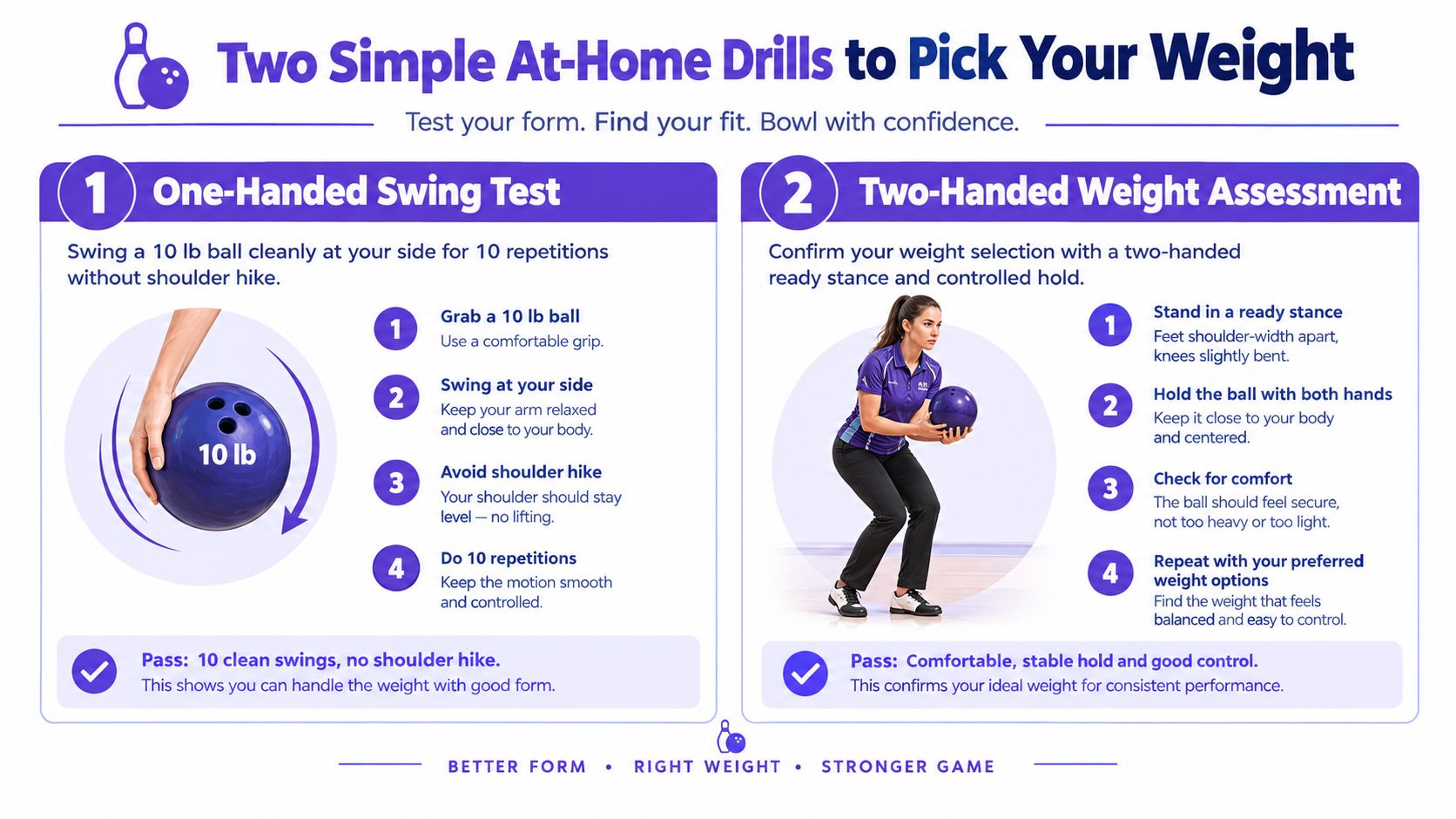
Start with the one-handed swing test
Use a safe open space and begin with a 10-pound ball. Hold it in your bowling hand with a relaxed grip and swing it gently at your side for 10 repetitions, keeping the shoulder down and the wrist neutral.
Don't imitate a full-power delivery. You're checking whether the ball can move freely while your arm stays loose. Stop the set if you feel sharp pain, numbness, or instability.
Look for these changes as you test progressively heavier options:
- Shoulder position: The shoulder should stay level rather than hiking toward your ear.
- Hand pressure: Your fingers shouldn't clamp harder as the ball reaches the back of the swing.
- Tempo: The swing should remain smooth instead of becoming abrupt or shortened.
- Finish of the set: Your final repetition should look and feel like the first.
Increase the weight in 1 to 2 pound steps until your mechanics break down, then return to the last weight that stayed relaxed. Perform the drill twice, resting between attempts, and don't test after heavy lifting or when you're already fatigued.
Add the staircase test
For the second check, hold the ball at chest height for 30 seconds, then simulate a four-step approach without rushing. Keep your chest upright, shoulders relaxed, and feet quiet. A passing weight lets you maintain posture without leaning forward, shaking, or tightening the grip.
This drill tests more than arm strength. It asks whether your body can carry the ball while your lower body moves, which is closer to the demand of a real approach.
Use both tests on separate attempts. If the swing test passes but the staircase test creates a forward lean, choose the lighter option. If both pass, take the candidates to a lane and judge them by release quality and late-session comfort.
Here's a visual demonstration to help you compare the feel of a controlled approach with a forced one:
Best Ball Weights by Bowler Type
Weight recommendations change with experience because technique changes how efficiently you use the ball. A beginner needs enough mass to feel stable but not so much that every shot becomes a strength exercise. An established league bowler can use more weight once the approach and release remain dependable.
The ranges below are starting points, not rules that override your drills. Pick the row that matches your current mechanics, not the player you hope to become.
| Bowler Type | Weight Range | Body Weight Anchor | Rev-Rate Fit | Drop a Pound If… |
|---|---|---|---|---|
| Beginner | 11–14 lb | Near the 10% calculation, below 16 lb | Moderate or developing release | Your forearm tightens or your swing becomes deliberate |
| League bowler | 13–15 lb | Commonly near the calculated adult range | Moderate to strong, with stable timing | You lose your finish late in a session |
| Competitive bowler | 14–16 lb | Near the upper end of the legal range if comfortable | Strong rev rate or speed control | The ball pulls your timing late or forces you to muscle it |
Beginners need room to learn
A new bowler should prioritize a free swing and a repeatable finish. The first custom ball should feel like an extension of the arm, not an object that requires constant grip correction.
The common adult starting range is 11 to 14 pounds, and many adults eventually move higher as their control improves. Start at the point where you can focus on alignment, footwork, and release instead of surviving the weight.
League bowlers need session stamina
A league bowler with consistent form often settles in the 13 to 15 pound range. The useful test is not whether the ball feels powerful during practice. It's whether the same tempo survives warm-up, competition, and the later frames when fatigue exposes poor fit.
If your approach shortens or your hand begins to squeeze, don't defend the heavier choice. A small reduction can restore the timing that makes your existing ball speed and rev rate useful.
A heavier ball also interacts with the drilling decisions discussed in bowling ball drilling layouts. Layout and fit can change how easily the ball clears your hand, so evaluate the complete setup rather than the number alone.
Competitive bowlers chase efficiency
Experienced competitors may use 15 to 16 pounds when they can control speed, rev rate, and release without tension. The ceiling only helps if the bowler can exploit it across changing lane conditions and long sessions.
A tournament-level player who loses timing with the heavier option should step down without treating that choice as a weakness. Efficiency beats ego when every shot must start from the same physical position.
Common Weight Myths That Hurt Your Score
Weight advice gets distorted when bowlers reduce performance to impact alone. Three myths cause repeated mistakes, especially when a player chooses a ball by reputation instead of by release quality.
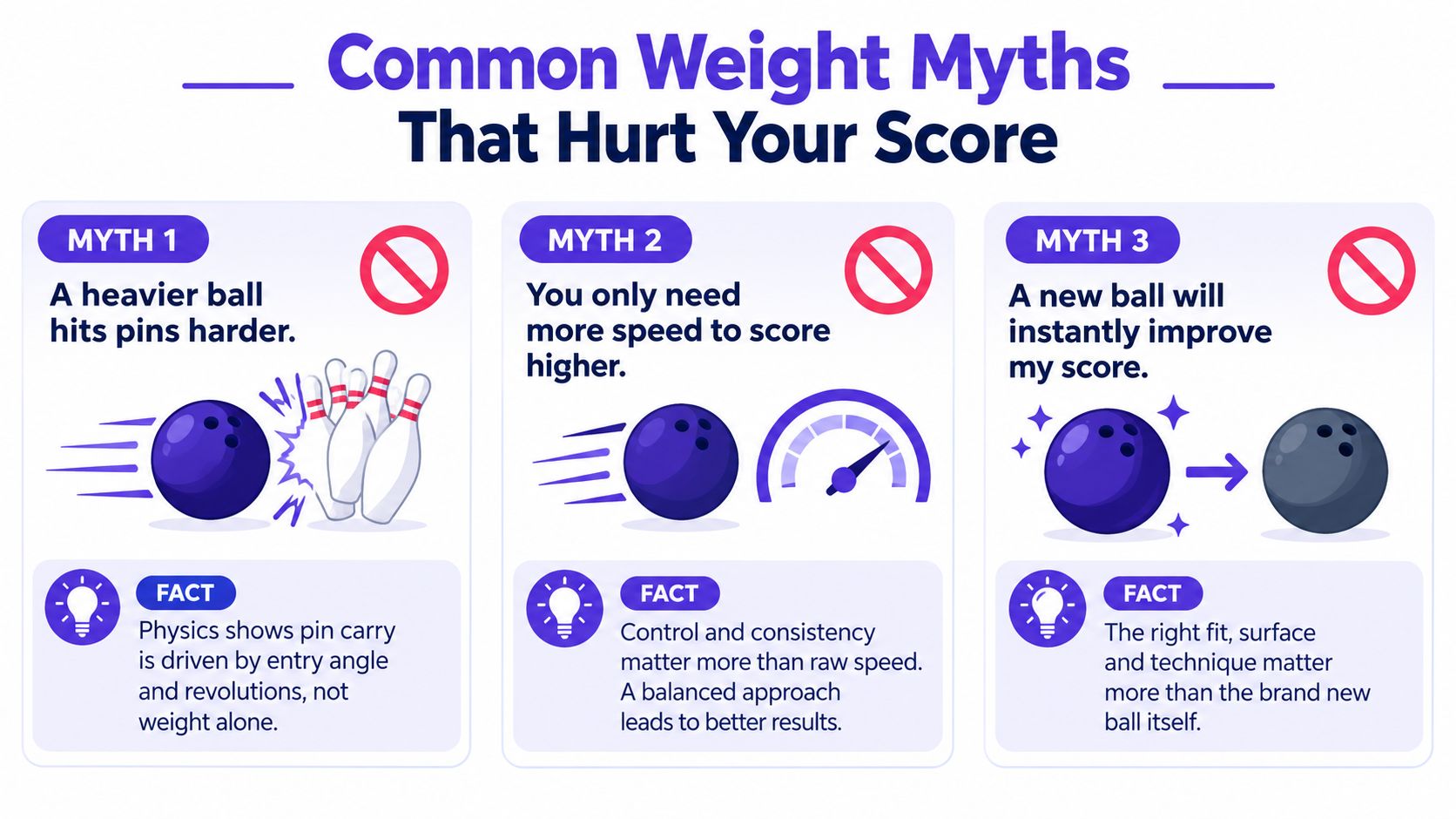
Myth one, heavier always hits harder
A heavier ball can carry more energy into the pins, but only if you deliver it with useful speed, rotation, and entry angle. If the extra load makes you slow down, pull the shot, or release late, you've traded theoretical force for a poorer impact path.
Pin carry comes from the whole delivery. A relaxed ball at the correct speed and angle can outperform a heavier ball that arrives without the intended motion.
Myth two, lighter balls belong only to beginners
Lighter equipment can make sense for experienced bowlers who need to protect timing, joints, or endurance. Senior bowlers, two-handed players, and spare specialists may choose 12 or 13 pounds deliberately when that weight produces a cleaner line and repeatable release.
The right choice depends on the job the ball must perform. A spare ball, a long practice session, and a high-rev strike ball can place different demands on the same bowler.
Myth three, your weight never changes
Your usable weight can change after an injury, a strength loss, a technique change, or a new drilling arrangement. A ball that felt comfortable years ago may now cause shoulder tension, while a different fit can make the same listed weight feel easier to control.
A weight decision should be revisited when your release changes, not defended because it worked in the past.
Re-test after a meaningful change in health, training, grip, or equipment. Don't wait for recurring soreness to prove that the old choice no longer fits.
How Weight Fits Into the Rest of Your Ball Choice
Ball weight is one lever in a larger fit system. Two balls with the same listed weight can behave and feel very differently because their coverstock, core, surface, layout, and finger fit alter how the ball stores and releases energy.
A 15-pound reactive resin ball can create a stronger shape and different pin interaction than a 15-pound polyester ball. That doesn't mean one weight is automatically superior. It means the coverstock changes how much the bowler must manage through the swing and downlane motion.
Read the complete equipment combination
| Fit Variable | How It Interacts with Weight | When to Adjust |
|---|---|---|
| Coverstock | Changes traction, hook shape, and energy transfer at the same listed weight | When the ball reads too early or too weak |
| Core design | Influences track flare and motion, which can make the ball feel more or less demanding | When reaction needs change without changing weight |
| Drilling layout | Alters flare and the way the ball clears the hand | When the release feels late or unstable |
| Thumb and finger fit | Controls grip pressure and release effort | When you squeeze, hang up, or feel excess span pressure |
| Surface preparation | Changes how quickly the ball responds to the lane | When motion needs more or less traction |
A strong layout on a demanding coverstock can ask more from your rev rate and speed control. If you respond by choosing a lighter ball without addressing the layout or surface, you may solve one symptom while creating another.
Fit can rescue a marginal choice
The holes deserve particular attention. A thumb hole that's too tight can make a moderate ball feel heavy because you hold it longer and squeeze to prevent it from sticking. Incorrect finger pitches can pull the hand into tension, while poor span can make the release feel forced.
A pro shop can evaluate those details alongside the ball's weight block design. The goal isn't to make every ball feel identical. It's to make the ball leave your hand without unnecessary effort.
Surface changes also matter. Polishing or dulling a cover can alter when the ball uses its energy, which can change how heavy the overall setup feels during the shot. Treat weight as part of ball selection, not as a substitute for correct coverstock, layout, and hand fit.
Your Action Plan and Final Questions
Use a short testing process instead of guessing at the rack or relying on what another bowler throws. The best bowling ball weight should survive a real evaluation, not just feel impressive during one delivery.
Run the decision in five steps
- Measure your body weight and calculate the starting point. Use the 10% guideline as an anchor, then respect the 16-pound legal ceiling.
- Rehearse your normal tempo with an empty hand. Keep the approach and finish consistent so the ball doesn't force you into a different rhythm.
- Perform both at-home drills. Use the one-handed swing test and staircase test to identify shoulder, grip, posture, and balance problems.
- Check stamina with comparable effort. Hold and move the candidate weight under safe conditions, then compare how your arm and shoulder feel after rest.
- Visit a pro shop with your top two candidates. Ask for a thumb-fit, finger-fit, and layout check before ordering a custom ball.
A pro shop should watch you move, not just measure your hand. Bring notes from your tests, including when tension appears and whether it affects your swing or finish.
Questions bowlers usually ask
Is 16 pounds always best? No. It's the legal maximum, not a universal target. Use it only if you can swing and release it comfortably without sacrificing timing or balance.
Why can a 12-pound ball still hit hard? A lighter ball can still arrive with useful speed, rotation, and entry angle. If that weight lets you deliver the ball more accurately and repeatably, it may produce better practical results than a heavier option you can't control.
How often should I retest my weight? Retest whenever your strength, health, grip, release, or equipment changes. You should also reassess if soreness or late-session timing problems become recurring rather than occasional.
Should seniors automatically drop weight? No. Age alone doesn't select the ball. A senior bowler should use the heaviest weight that remains comfortable, stable, and repeatable across the intended session.
Your final standard is straightforward: choose the heaviest ball you can swing through your line repeatedly without sore shoulders, grip strain, a forced downswing, or late-release timing. Test it, let a pro shop confirm the fit, and move up or down only after your mechanics provide evidence.
Bowling Gear Reviews evaluates bowling balls and related equipment through hands-on testing, practical comparisons, and fit-focused guides. Visit Bowling Gear Reviews to compare ball options, drilling considerations, and accessories before you commit to your next weight.
