

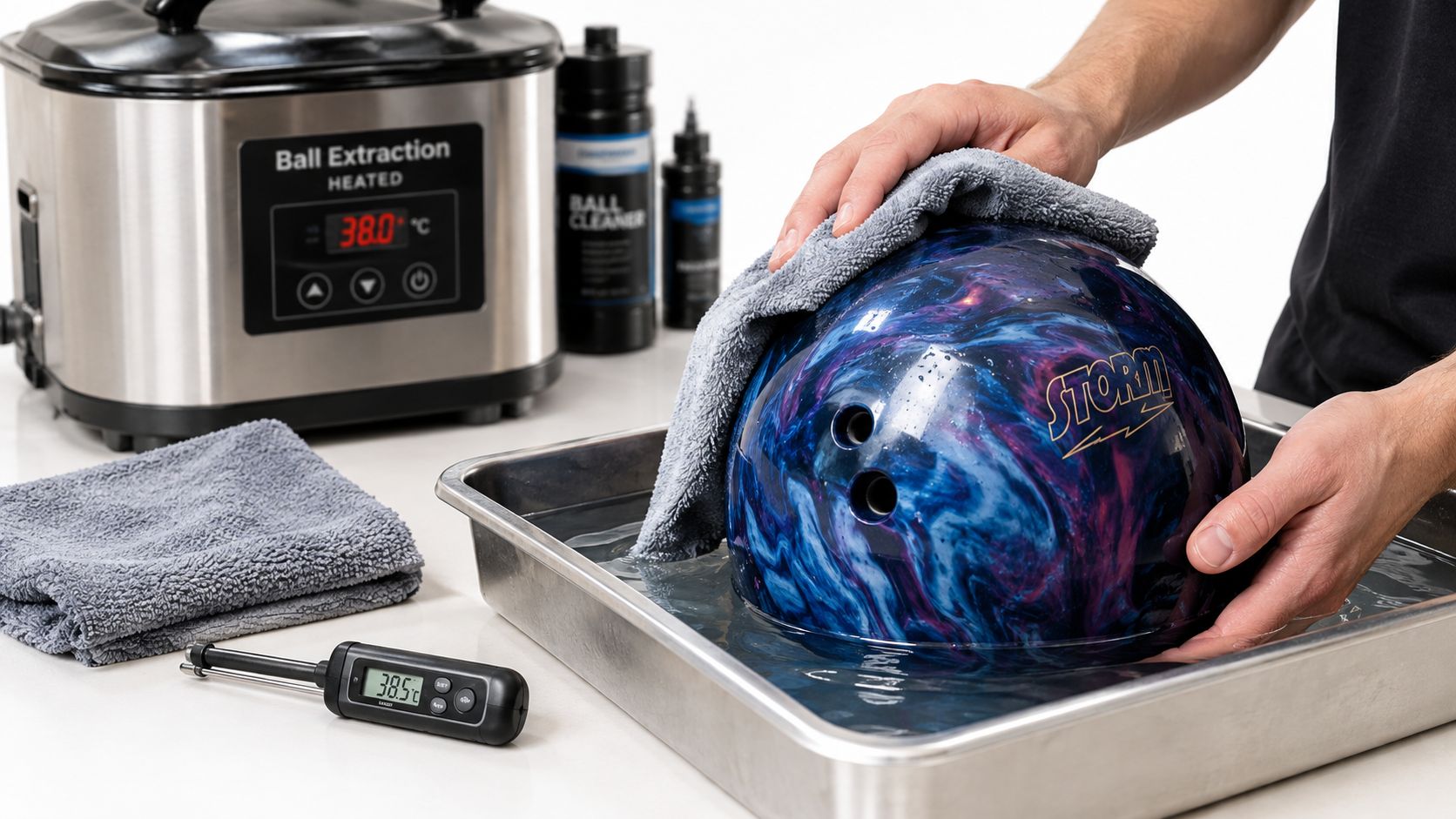
Your usual line is there, your release feels normal, and the ball still gets to the pocket. But the backend looks lazy, and the corner pins are starting to pile up. You wipe the cover, try a stronger cleaner, and wonder whether the ball is finished.
Bowling ball oil extraction might help, but it isn't automatically the right repair. Removing absorbed oil, restoring surface roughness, and recovering the reaction you remember are different jobs. Before you heat anything, work out which job your ball needs.
Table of Contents
- Why Bowling Balls Absorb Lane Oil in the First Place
- Pre-Extraction Checks Every Bowler Should Run First
- At-Home Oil Extraction Methods That Work
- Heated Professional Extraction the Right Way
- How Often to Extract Based on Coverstock and Volume
- When Oil Extraction Is the Wrong Fix
- Choosing the Right Method and Building a Maintenance Schedule
Why Bowling Balls Absorb Lane Oil in the First Place
A league bowler notices weak backend on a freshly dressed house shot and assumes the ball needs de-oiling. That's a reasonable possibility, not a diagnosis. A changed surface, a different lane condition, or inconsistent delivery can produce a similar complaint.
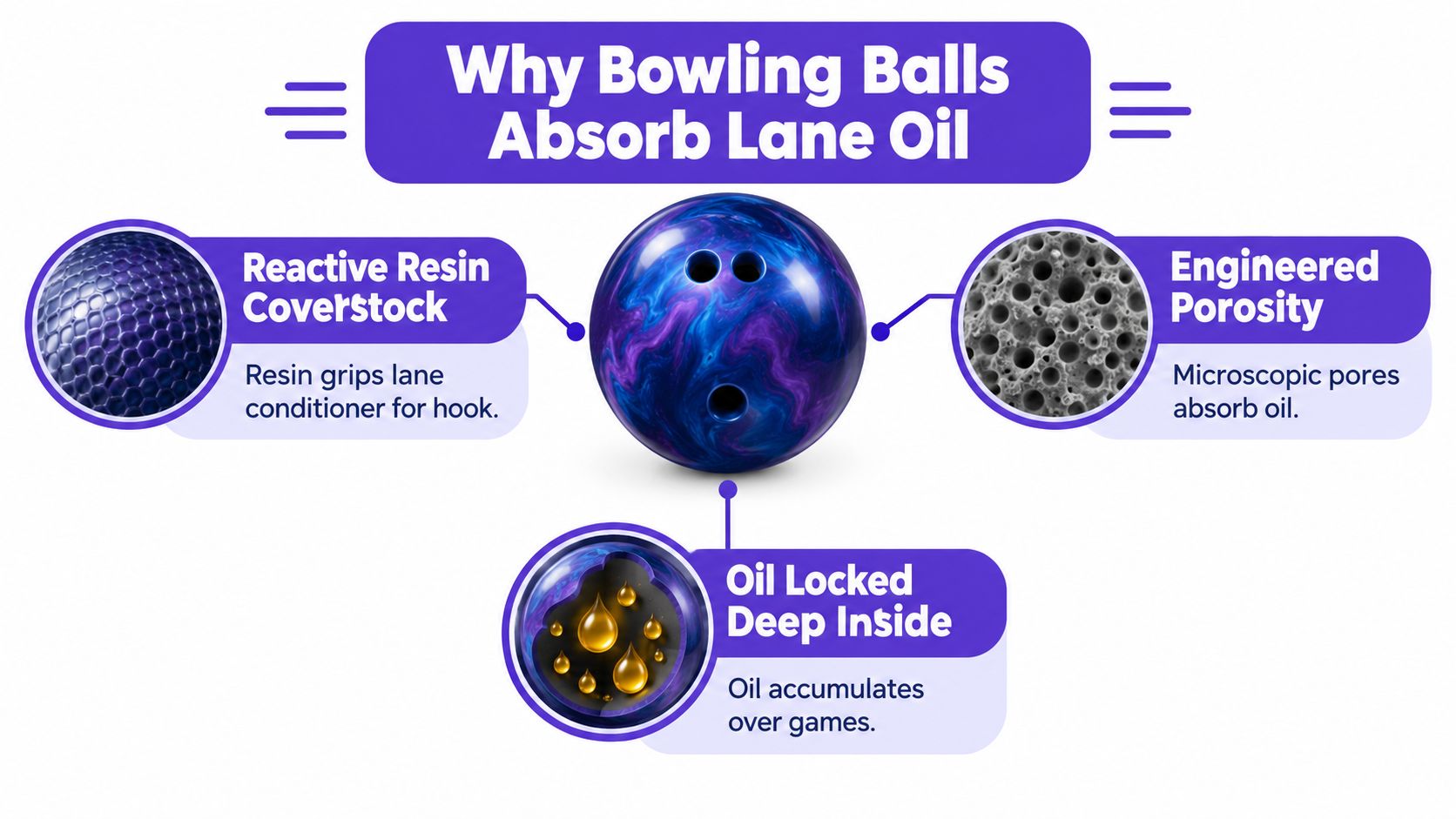
The reason absorbed oil belongs on the shortlist is the reactive-resin coverstock. Its engineered porosity allows lane conditioner to enter the cover rather than remain entirely on top. Understanding bowling ball coverstocks helps separate that maintenance problem from choosing the wrong ball for the condition.
Surface Oil and Absorbed Oil Aren't the Same
Surface oil is accessible to a towel and suitable cleaner. Absorbed oil sits within the coverstock, where a quick wipe can't reach it. A ball can look clean without being free of absorbed conditioner.
That distinction explains why cleaning and extraction shouldn't be sold as interchangeable services. Cleaning addresses what you're carrying away from the lane on the exterior. Extraction addresses oil that has entered the material.
USBC established quantitative absorption tests, and its sample of approximately 800 submitted balls included about 12% with absorption times below 6 minutes 46 seconds; the fastest approved reactive-resin ball recorded then absorbed the test oil in 2 minutes 33 seconds, while faster-absorbing balls tended to hook more, require more lane adjustments, and deplete oil farther downlane, according to the USBC Bowling Technology Study.
Practical rule: A clean-looking cover isn't proof that absorbed oil is gone, and a weak-looking backend isn't proof that absorbed oil caused it.
The practical connection is broader than hook potential. Coverstock behavior affects how the ball reads the lane and how the lane changes around you. Maintenance helps preserve a useful relationship between the cover, the drilling layout, and the conditions you bought the ball to handle.
Don't treat extraction as cosmetic housekeeping. Treat it as a targeted service whose value depends on the diagnosis and the reaction afterward.
Pre-Extraction Checks Every Bowler Should Run First
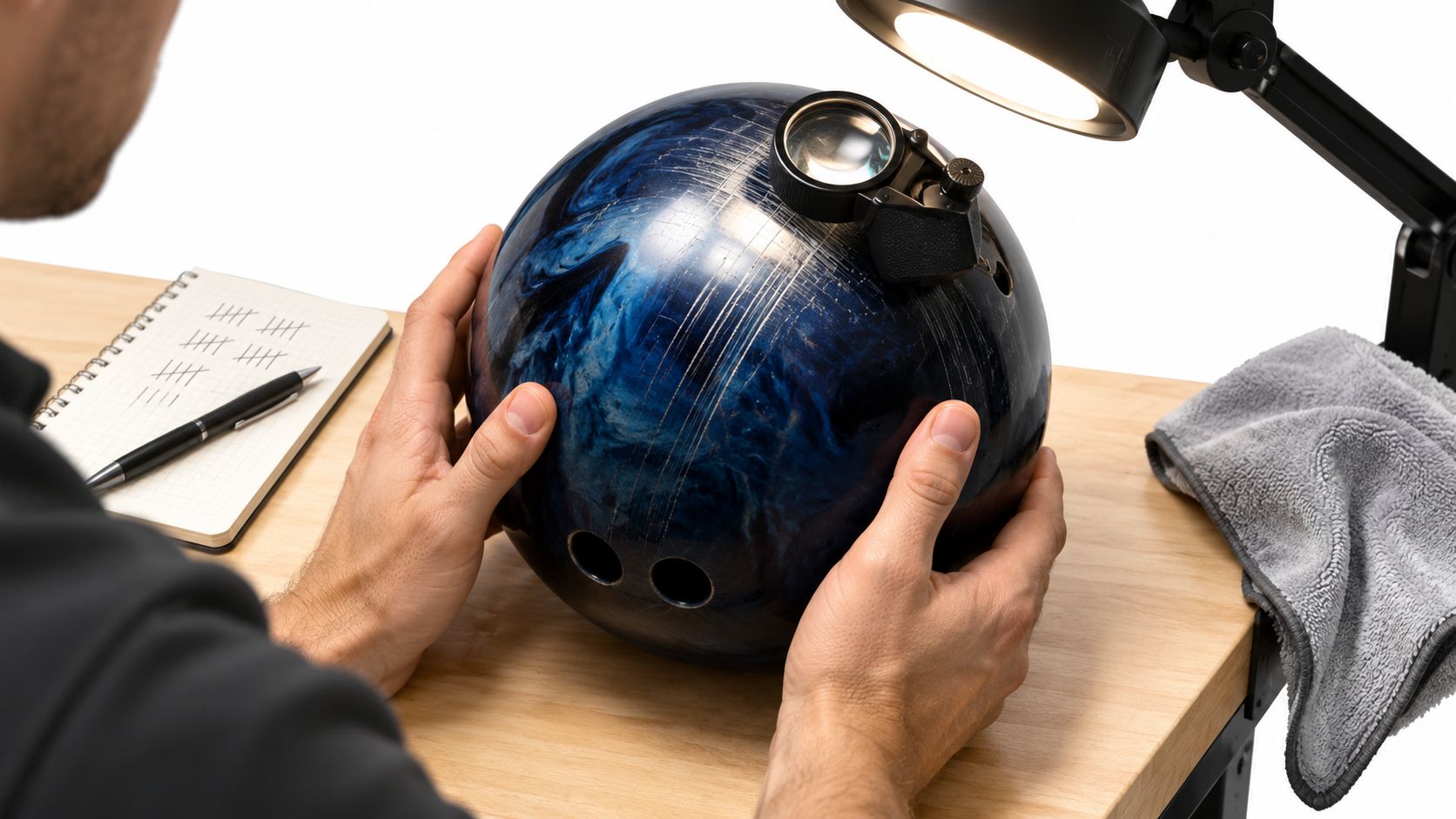
Start with the ball under a strong light, not inside a heater. A glossy track, visible scratches, or a surface that no longer resembles your intended finish can tell you more than another bottle of cleaner.
Record what you find before making changes. Without a baseline, it's easy to mistake a different lane or a better shot for a successful repair.
Check the Ball Before Choosing the Service
- Track its use. Count games on this ball, not every game you've bowled with your entire arsenal. Include practice and tournament use.
- Inspect the finish. Compare the track area with less-used areas. If a previously matte cover is now shiny, put surface restoration on the work order.
- Check holes and inserts. Before any immersion method, confirm that the finger holes can be properly sealed. Don't assume installed inserts provide a watertight barrier.
- Record a baseline shot. On a familiar condition, note where the ball begins reading, its breakpoint shape, and how it continues through the pins. Treat an isolated shot as a starting note, not conclusive evidence.
- Rule out a mismatch. Ask whether you're testing on comparable oil and whether your speed, release, and target are consistent. Extraction won't make an unsuitable layout-condition combination suitable.
Keep a Simple Service Log
| Field | What to Record |
|---|---|
| Ball and coverstock | Model, cover type, and identifying details |
| Game count | Use since the last relevant service |
| Intended surface | Grit or finish you're trying to maintain |
| Cleaner used | Product name and application method |
| Reaction notes | Read point, breakpoint shape, continuation, and carry |
Stop and address the surface when the main evidence is unwanted shine. You may still need extraction, but heating won't recreate the missing texture.
Also inspect the ball's condition before committing to a treatment. If you see damage or aren't sure whether the ball can safely tolerate the proposed method, have the shop evaluate it first. An extraction appointment should begin with an inspection, not an assumption that every tired-looking ball needs the same treatment.
At-Home Oil Extraction Methods That Work
A ball that feels oily may need one of three different fixes: remove residue from the surface, draw some absorbed oil from the coverstock, or restore the ball's original reaction. Those outcomes are not interchangeable. Approved cleaner and microfiber handle routine surface care. A home bath may remove some absorbed oil, but it cannot restore worn coverstock or guarantee the reaction the ball had when new.
For most bowlers, a bowling-ball cleaner is the practical first choice. Use the least aggressive method that matches the problem. Improvised heating adds risk without a reliable way to measure oil release.
Comparing At-Home Bowling Ball Oil Extraction Methods
| Method | Typical Oil Removal | Time Required | Cost | Best For |
|---|---|---|---|---|
| Approved cleaner and microfiber | Accessible surface oil and residue, not demonstrated deep extraction | Brief hands-on cleaning | Cleaner and reusable towel | Routine post-session care |
| Controlled warm-water bowling-ball bath | May remove some absorbed oil; results aren't equivalent to professional extraction | Preparation, soaking, rotation, and complete drying | Basin, suitable cleaning product, and hole-sealing supplies | A cautious home attempt when the manufacturer permits immersion |
| Improvised hot-water soak | Uncertain; hotter water doesn't establish better results | Similar preparation with less reliable control | Household supplies, but greater uncertainty | Avoid: uncontrolled heat, no dependable oil-release measure |
Where Home Methods Fit
For surface cleaning, follow the cleaner's label and the ball manufacturer's instructions. Use a clean microfiber towel so you don't spread residue with a loaded cloth. Wiping removes accessible oil and grime; it does not establish that oil has been extracted from inside the coverstock.
A controlled bath is a conditional home option, not a routine treatment. Seal the holes, use a product confirmed as compatible with the ball and immersion, rotate the ball during treatment, and let it dry completely. If you can't confirm compatibility or control the process, leave the bath to a shop.
Published warm-water detergent guidance should be treated as a limited technique, not a blanket endorsement of putting any cleaner in bath water. A product that is suitable for wiping a cover may not be suitable for prolonged soaking. Generic directions for reactive resin also shouldn't be applied to every urethane or polyester ball.
A greasy-looking bath proves that something entered the water. It doesn't prove the coverstock is fully extracted or that the ball's original reaction is back.
Don't boil, microwave, or use household degreasers. Uncontrolled heat does not provide a dependable measure of oil release, and a more aggressive soak won't repair worn surface texture. If the ball still reads poorly after proper cleaning, identify whether the problem is absorbed oil, lost roughness, or a changed reaction before choosing another treatment.
Heated Professional Extraction the Right Way
A professional heated extractor makes sense when the diagnosis points to absorbed oil and the ball is suitable for the process. The advantage isn't just heat. It's controlled temperature, monitored oil release, and a repeatable workflow.
The shop should know the equipment's operating instructions and the ball manufacturer's restrictions. A documented test ceiling isn't permission to run every ball at that ceiling.
What the Brunswick Benchmark Actually Shows
In the Brunswick Revivor research, oil-soaked balls were wiped with cleaner and paper towels every 10–15 minutes until sweating stopped after six cycles, with a documented ceiling of 150°F (65.6°C); treated balls reportedly matched control-ball reaction, and a follow-up involving three warmings over 270 games found reaction identical to controls with fewer than 10 games, without observed durability problems.
That's useful manufacturer evidence, not an independent trial or a universal recipe. Different covers and equipment instructions can require different treatment. The number of cycles in that test shouldn't become a package every ball must receive.
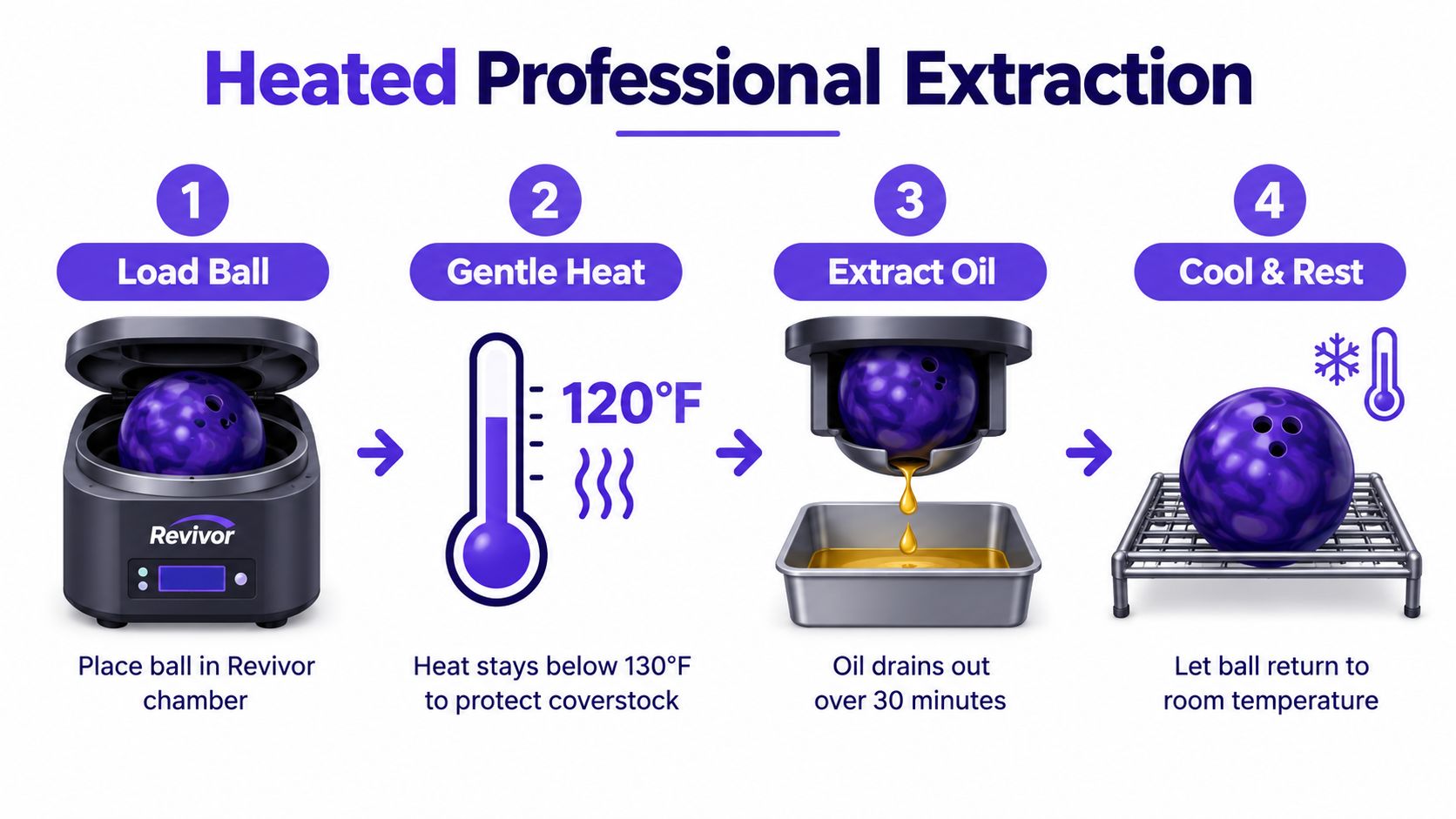
Treat the graphic as a process overview, not a source of operating temperatures or treatment duration. Follow the actual machine and ball instructions.
A Shop Workflow Worth Paying For
- Inspect and document. Note the cover condition, intended finish, prior treatment, and reason for service before loading the ball.
- Set and monitor temperature. Use equipment designed for bowling-ball extraction. Verify temperature rather than assuming the machine display tells the whole story.
- Remove exuded oil. Wipe at the prescribed intervals with compatible cleaner and a fresh wiping surface. Leaving released oil on the cover defeats the purpose of monitoring extraction.
- Continue according to the equipment procedure. Read the oil release alongside the prescribed limits. Don't keep heating indefinitely because the ball still feels slightly tacky.
- Cool fully and evaluate. Let the ball return to room temperature before assessing its finish or carrying out planned surface work.
Improvised ovens, hair dryers, and heat guns aren't equivalent tools. They don't provide the same dependable control, and excessive heat can damage the coverstock, alter physical properties, or create a safety hazard.
Oil sweating is a process indicator, not the final verdict. The service is complete only when the ball is safe to handle and its performance can be evaluated under comparable conditions.
How Often to Extract Based on Coverstock and Volume
Build the schedule around exposure and observed behavior, not a date on the calendar. A bowler rotating several balls and a bowler practicing extensively with the same reactive ball shouldn't automatically book identical service intervals.
The absorption findings discussed earlier also argue against treating every reactive cover as identical. Use the ball's own history to decide when to inspect and when to escalate.
Use Game Counts as Inspection Prompts
A commonly cited extraction interval is approximately 50–75 games, with higher-volume bowlers potentially needing attention closer to 40 games, but these are guidance rather than validated universal thresholds in the equipment-maintenance guidance.
Those ranges are useful reminders to inspect, not automatic instructions to heat. If reaction remains consistent and the cover is maintained, a shop assessment may lead to cleaning or surface work instead.
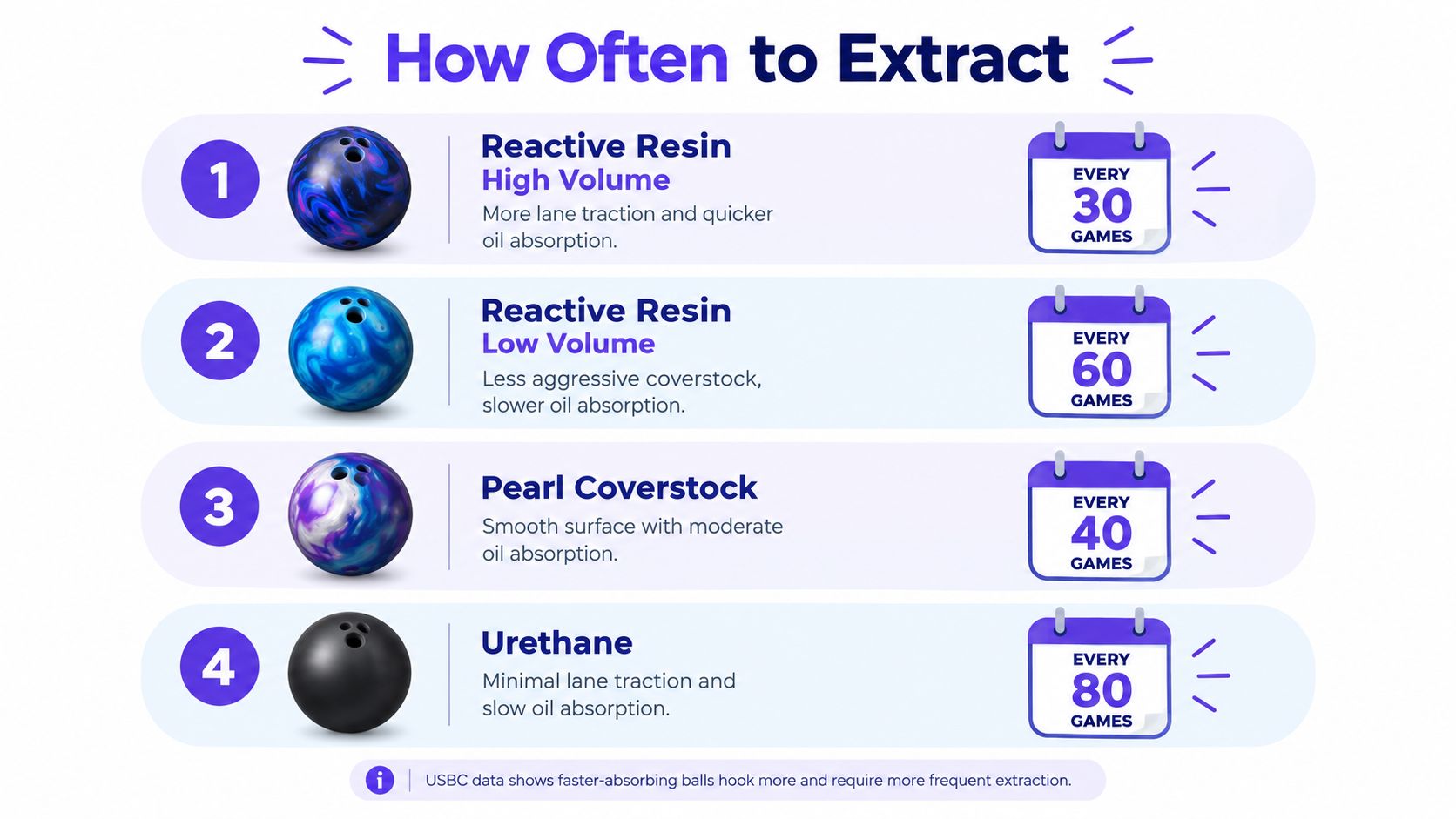
The cover-specific schedules illustrated above aren't validated universal service thresholds. Don't use the graphic's calendar labels to override manufacturer advice or your documented reaction history.
Match the Cadence to the Bowler
| Bowler Profile | Scheduling Approach |
|---|---|
| League bowler using a reactive ball regularly | Use accumulated games to prompt inspection, then compare reaction |
| Heavy practice or tournament bowler | Review the log more frequently and plan service around testing opportunities |
| Bowler rotating an arsenal | Track each ball separately rather than assigning one schedule to the whole bag |
| Spare-ball user | Don't borrow a reactive-ball extraction schedule without confirming a relevant need |
A coverstock label alone doesn't establish an extraction date. In particular, don't assume that “pearl” tells you the whole maintenance story. Keep the formulation, finish, exposure, and actual behavior together in your assessment.
Persistent oil return after cleaning or a repeatable reaction change deserves attention. A difficult night on an unfamiliar lane doesn't justify immediate extraction.
Competition planning matters too. Schedule significant service when you have an opportunity to test the result before relying on that ball. A treatment that produces a useful change during practice can become an unwelcome surprise if your first verification happens in an event.
When Oil Extraction Is the Wrong Fix
A ball can sweat oil in an extractor and still be the wrong ball for tonight's lane. It can also emerge clean but retain the glossy track that caused your complaint. Oil removal isn't a certificate of restored performance.
The mistake is judging success by the visible oil instead of the job you needed done. A shop should distinguish the treatment performed from the reaction recovered.
Separate the Outcomes
| Desired Outcome | Appropriate Work | What It Doesn't Establish |
|---|---|---|
| Remove absorbed oil | Compatible, controlled extraction | That the intended texture has returned |
| Restore surface roughness | Deliberate surface preparation | That absorbed oil has been removed |
| Recover useful or original reaction | Relevant maintenance followed by comparable lane testing | That every historical condition can be reproduced |
If the cover has developed unwanted shine, bowling ball sanding addresses the texture question directly. Extraction and resurfacing may belong on the same work order, but they're separate services with separate purposes.
Don't request a full surface change merely because the extractor released oil. Specify the intended finish and the motion you're trying to recover. Otherwise, you won't know whether the resulting difference came from extraction or the new surface.
More Traction Isn't Always a Better Match
USBC found hardness readings changed by just under 2 to 3.6 points when measured through oil, that dry wiping didn't remove oil's effect, and that reactive samples absorbed the oil within two hours, according to the USBC hardness research report.
That finding supports careful verification; it doesn't prove that every extraction restores hook. Surface oil can complicate what you're measuring, and an apparently clean exterior isn't a complete performance assessment.
Service decision: Ask for the motion you need, not the maximum amount of oil a machine can make the ball release.
As a practical possibility, restored traction may make a ball read too early for its current assignment. If you're already fighting early read, pursuing “more hook” through extraction could move you farther from a useful reaction. Test breakpoint shape and continuation, not just total hook.
Keep maintenance separate from sanctioned play. Cleaner approval doesn't by itself settle when or how a product may be used during competition. Check the applicable rules before applying chemicals or changing the surface, and complete planned extraction outside play rather than improvising a treatment at the venue.
Choosing the Right Method and Building a Maintenance Schedule
Choose the next action from the evidence, then schedule enough practice to evaluate it. Don't stack treatments because you have the ball on the bench.
A Decision Path for Your Next Session
- Was the change sudden or gradual? A sudden difference calls for checking lane conditions and delivery first. A gradual, documented decline after accumulated use makes maintenance assessment more reasonable.
- Has the finish changed? Unwanted shine calls for surface attention. Persistent performance issues with the intended texture intact make professional extraction worth discussing.
- Can you test before competition? If not, avoid an elective overhaul of a dependable ball immediately before you need it.
Routine cleaning fits exterior residue. Professional extraction fits a supported absorbed-oil diagnosis. Extraction plus resurfacing fits a ball needing both services. None of those is the answer when the core problem is equipment-condition mismatch.
If the target finish includes polish, use a deliberate process such as this guide to polishing a bowling ball at home, rather than polishing automatically after extraction.
A Reusable Maintenance Record
Record: Ball and coverstock | Game count | Intended finish | Cleaner or extractor used | Actual temperature if heated | Cycles completed | Pre-service reaction | Post-service reaction.
After bowling, keep the routine simple:
- Clean appropriately. Use a compatible bowling-ball cleaner outside play.
- Inspect the track. Note changes in shine, scratches, or condition.
- Update the log. Record use and meaningful reaction observations.
- Book the right service. Request extraction, surface preparation, or evaluation according to the evidence.
Start with your current ball's finish and reaction notes. That gives you a concrete next step instead of another unmeasured cleaning experiment.
Bowling Gear Reviews offers hands-on equipment reviews, comparisons, and maintenance guides that connect coverstock and surface choices to lane performance. Visit Bowling Gear Reviews to compare care options and plan the surface preparation that fits your ball after extraction.
