

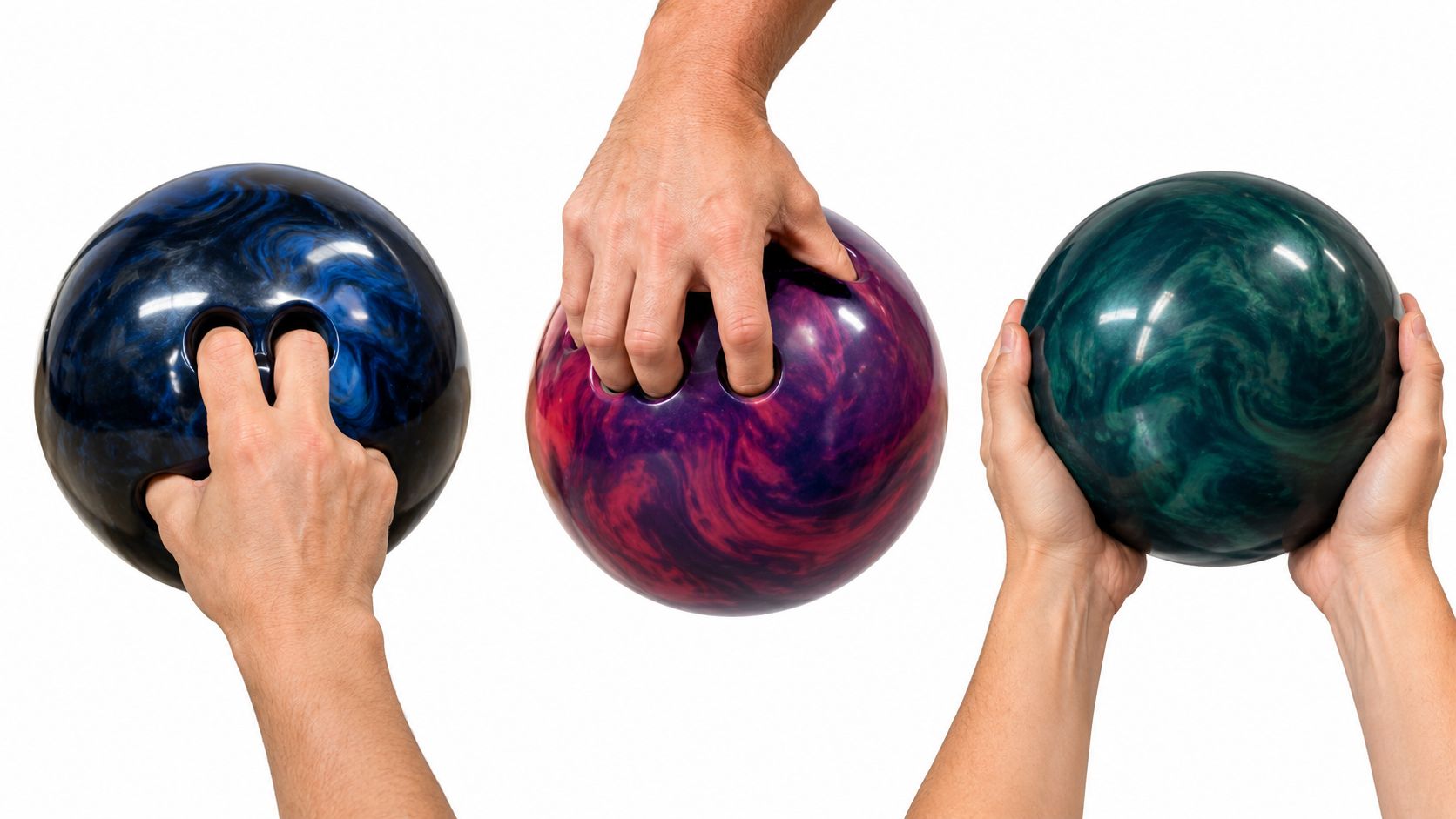
You're on the approach, the ball feels secure in your palm, and then your thumb hangs up just long enough to send the shot wide. Another bowler in your league changes to fingertip drilling and suddenly seems to create more shape, while someone else keeps throwing a straight, dependable ball with a conventional grip. It's easy to conclude that one of these bowling grip types must be correct for everyone.
That's not how fitting works. Your hand size, finger flexibility, span, pitch, wrist position, release timing, and physical comfort all influence the result. A grip should help you repeat a clean release, not force your hand into a style that looks powerful but feels strained.
Table of Contents
- What a Bowling Grip Actually Is and Why It Matters
- Conventional and Fingertip Grips, the Two Foundations
- Semi-Fingertip, Inserts, and Thumbless Grips Explained
- How the Five Main Bowling Grip Types Compare
- Fitting a Grip to Your Hand at the Pro Shop
- Two-Handed and No-Thumb Deliveries Through a Grip Lens
- Common Myths About Bowling Grips and the Truth Behind Them
- Choosing the Right Bowling Grip Type for Your Game
What a Bowling Grip Actually Is and Why It Matters
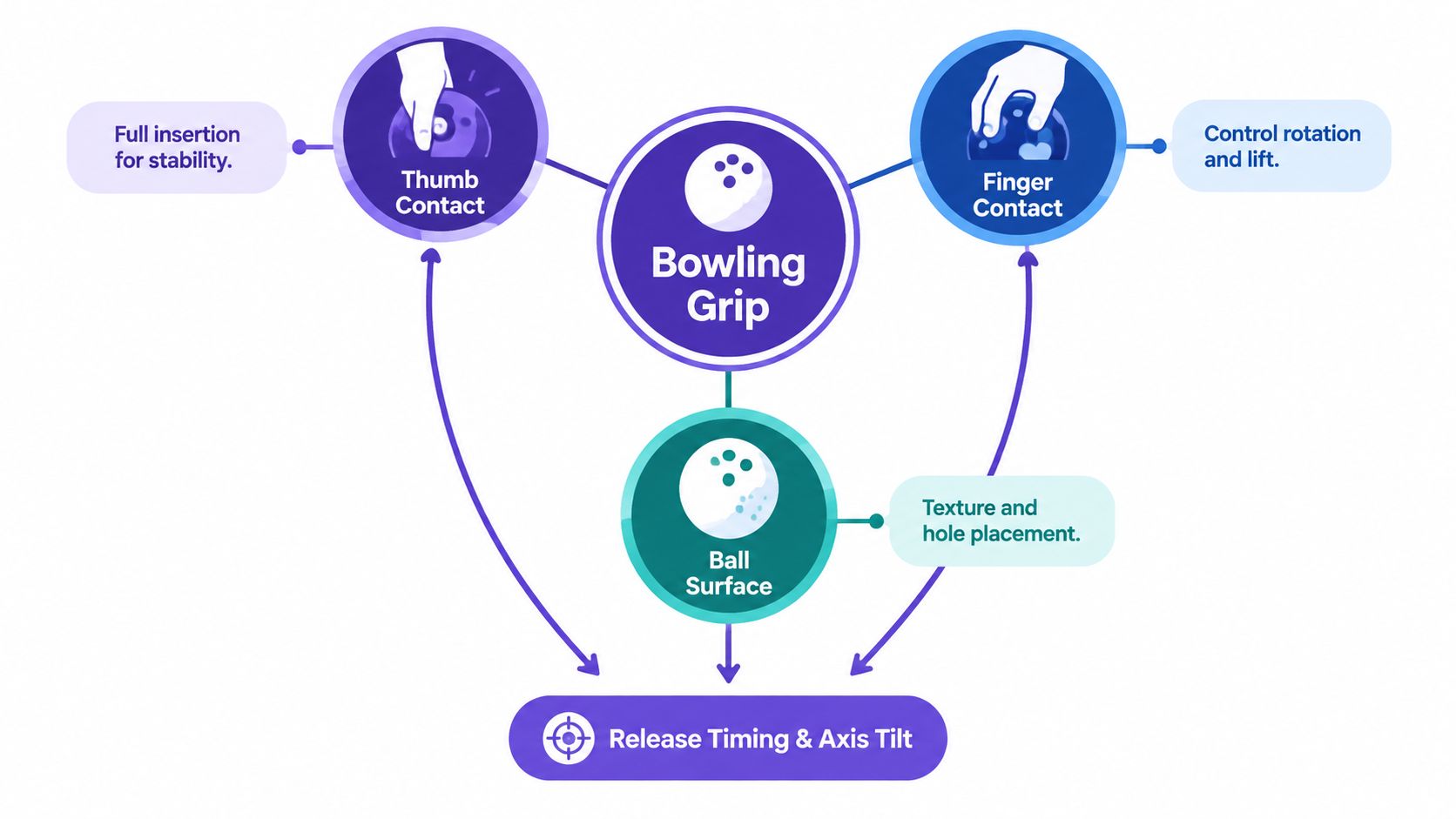
A bowling grip is the working relationship between your thumb, fingers, and the ball surface. Your hand doesn't hold the ball. It supports the ball during the swing, controls when the thumb exits, and allows the fingers to lift or rotate through release. Those small timing differences affect the ball's axis tilt, axis rotation, revolutions, and direction downlane.
Start with the thumb. A thumb that fits properly lets you support the ball without clenching your forearm. If it sticks, you may squeeze harder. That tension can delay release and make the shot feel unpredictable. The fingers then become compensators instead of controlled sources of lift.
The two fitting measurements that shape the grip
Span is the distance between the thumb hole and the finger holes, considered with the natural spread of your hand. A span that's too long can pull your fingers into the ball and make the grip feel aggressive. A span that's too short can crowd the hand and reduce power.
Pitch is the forward or reverse angle of a drilled hole. The right pitch follows the way your thumb and fingers bend and rotate. It can change thumb exit, finger pressure, and whether the ball feels relaxed or demanding at the bottom of the swing.
Those measurements work alongside the grip style. This guide covers conventional, fingertip, semi-fingertip, inserts, thumbless, and two-handed approaches. Inserts aren't a finger-depth grip by themselves, but they're an important fitting option that changes the contact surface and feel inside the holes.
Practical rule: Choose the grip that lets you hold the ball lightly, release it cleanly, and repeat the same hand position without pain.
There isn't one universally superior option. Conventional drilling may give one bowler the control needed for spare shooting, while fingertip drilling may give another the benefit needed to create a controlled hook. The right decision begins with your anatomy and release, not with the grip used by the most aggressive player in your center.
Conventional and Fingertip Grips, the Two Foundations
The simplest distinction is how far the middle and ring fingers enter the ball. A conventional grip places those fingers into the ball to the second knuckle, while a fingertip grip places them only to the first knuckle or distal finger joint. The terminology can vary between instructional sources, so ask your pro shop to demonstrate the exact depth on a fitting ball.
A conventional grip gives the fingers more contact inside the holes. That extra insertion can make the ball feel stable and can help a recreational bowler roll a straighter shot. It's often comfortable for bowlers who prioritize accuracy, spare shooting, or a relaxed learning experience over maximum rotation.
A fingertip grip leaves more of each finger outside the ball. That longer lever gives the fingers more room to lift as the thumb exits, supporting greater rotation and hook potential when the bowler has the strength and timing to use it. A fingertip fit isn't automatically better. If the span, pitch, or hole size is wrong, the additional leverage can become finger strain rather than useful release control.
A peer-reviewed study of elite bowlers found that 74.4% used a fingertip grip and 25.6% used a conventional grip. The study also reported symptoms among 100% of conventional-grip bowlers and 86.2% of fingertip-grip bowlers, so the findings suggest that grip choice may influence hand and wrist stress, but they don't prove that one grip prevents discomfort for every bowler. See the full peer-reviewed bowling grip study for the definitions and sample details.
Conventional versus fingertip at a glance
| Feature | Conventional Grip | Fingertip Grip |
|---|---|---|
| Finger insertion | To the second knuckle | To the first knuckle or distal joint |
| Typical feel | Supported and familiar | More open, leveraged, and release-focused |
| Common ball motion | Straighter roll or controlled arc | More rotation and hook potential |
| Useful for | Beginners, recreational bowlers, spare shooters | Bowlers developing hook and higher revs |
| Main trade-off | Comfort and control versus leverage | Motion potential versus fitting demands |
A historical bowling text also describes conventional and fingertip as the two basic grip families. It associates conventional with recreational bowlers seeking a straighter roll and fingertip with skilled bowlers seeking rotation, while noting that inserts were already in use as far back as the 1940s in the historical bowling instruction text. The modern pro shop is refining an old idea, not inventing the concept of customized hand contact.
Semi-Fingertip, Inserts, and Thumbless Grips Explained
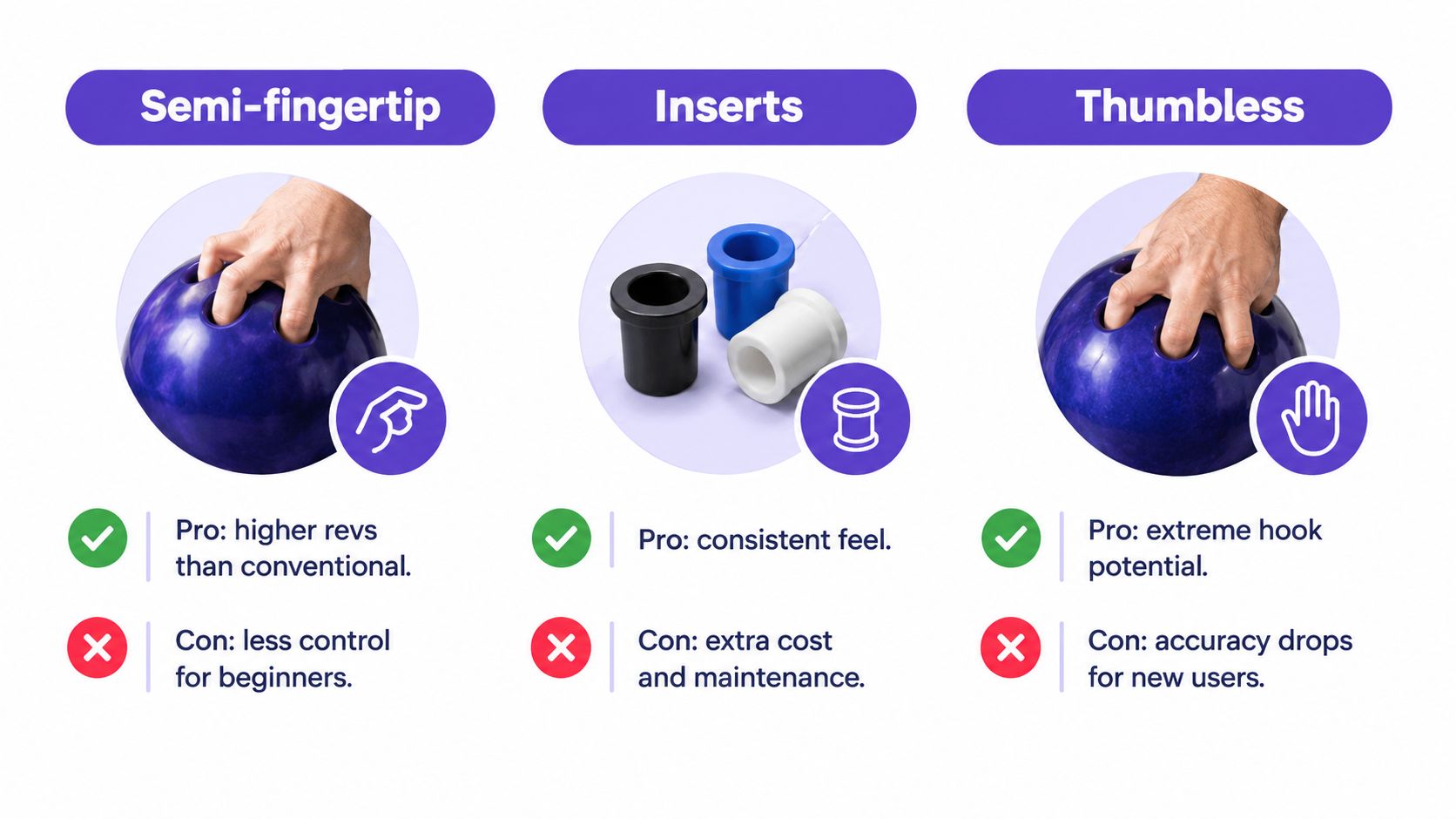
Not every hand feels comfortable at either extreme. Some bowlers find conventional drilling too restrictive but aren't ready for the finger exposure and control of a full fingertip fit. Semi-fingertip drilling sits between the two, generally placing the middle and ring fingers between the first and second knuckles while the thumb enters to the first knuckle.
That intermediate geometry can provide more lift than conventional drilling without demanding the same release pattern as fingertip. It can suit a bowler transitioning toward more rotation, although an improperly matched span or pitch may make it feel unnatural. Discomfort isn't evidence that you need to toughen your hand. It's usually a reason to have the fit checked.
Inserts change the contact, not the basic finger depth
Finger inserts are removable molded pieces placed inside the finger holes. They can alter texture, diameter, shape, and consistency from ball to ball. A bowler whose bare drilled holes feel rough, loose, or inconsistent may gain a more repeatable finger contact with inserts.
Insert shapes also influence where pressure lands. Lift-style inserts encourage a particular finger contact, while oval-shaped options can spread pressure differently around the finger. The best choice depends on your finger shape and release, so a pro shop should fit them rather than treating inserts as a universal upgrade. For a closer look at shapes and materials, consult this guide to bowling ball finger inserts.
Thumbless bowling removes the thumb from the ball during the delivery. That frees the thumb from the timing equation and can allow substantial rotation, but the bowler must control the ball with the fingers, wrist, forearm, and body position. Accuracy can suffer while the player learns to manage the altered release.
Two-handed bowlers often use a thumbless release, but two-handed delivery and thumbless delivery aren't identical terms. A two-handed bowler may place the thumb in the ball during part of the approach and remove it before release. The second hand supports the ball and helps create stability, while the bowling hand still needs a sound finger fit.
How the Five Main Bowling Grip Types Compare
A quick comparison helps, but the table should be treated as a starting point rather than a prescription. Finger depth, hand position, and release style overlap, particularly when inserts or a two-handed delivery enter the discussion.
| Grip | Knuckle Position | Release Style | Ideal Bowler | Main Trade-Off |
|---|---|---|---|---|
| Conventional | Fingers to the second knuckle | Straight or mild arc | Recreational bowler, spare shooter, beginner | Stability versus lower leverage |
| Fingertip | Fingers to the first knuckle or distal joint | Rotational release with hook potential | League bowler learning a controlled hook | More motion versus greater fitting demands |
| Semi-fingertip | Between the first and second knuckles | Moderate lift and controlled arc | Bowler seeking a middle ground | Compromise feel versus less familiar geometry |
| Fingertip with inserts | Fingertip depth with molded finger contact | Tunable lift and rotation | Bowler who wants repeatable finger feel | Maintenance and fit changes |
| Thumbless | Thumb omitted from release | Strong roll or high-rotation shape | Experienced power player or two-hander | Rev potential versus accuracy and control |
How to read the choices
Conventional earns its place when you want the ball to feel secure and your priority is repeatable direction. It's a sensible choice for a straight shooter or a bowler whose hand doesn't tolerate a longer lever.
Fingertip fits a bowler who wants to develop hook through a clean thumb exit and active finger release. The style rewards a matched span and pitch, not deeper finger strength.
Semi-fingertip can help a bowler move away from conventional drilling gradually. It's also useful when a full fingertip layout feels too demanding, though the intermediate position can feel less natural until the hand adapts.
Inserts make sense when the finger holes need a consistent surface or when you want to tune contact across several bowling balls. They don't eliminate the need for correct drilling.
Thumbless is a specialty route. It can free the release, but it also removes a major stabilizing contact point. New users should expect a learning period and should focus on control before chasing dramatic shape.
Fitting a Grip to Your Hand at the Pro Shop
A good fitting starts with your hand at rest, not with a favorite professional's ball. The pro shop operator should observe how your thumb bends, how your fingers spread, and whether your wrist naturally cups or flattens. Those details determine how the holes should meet your hand.
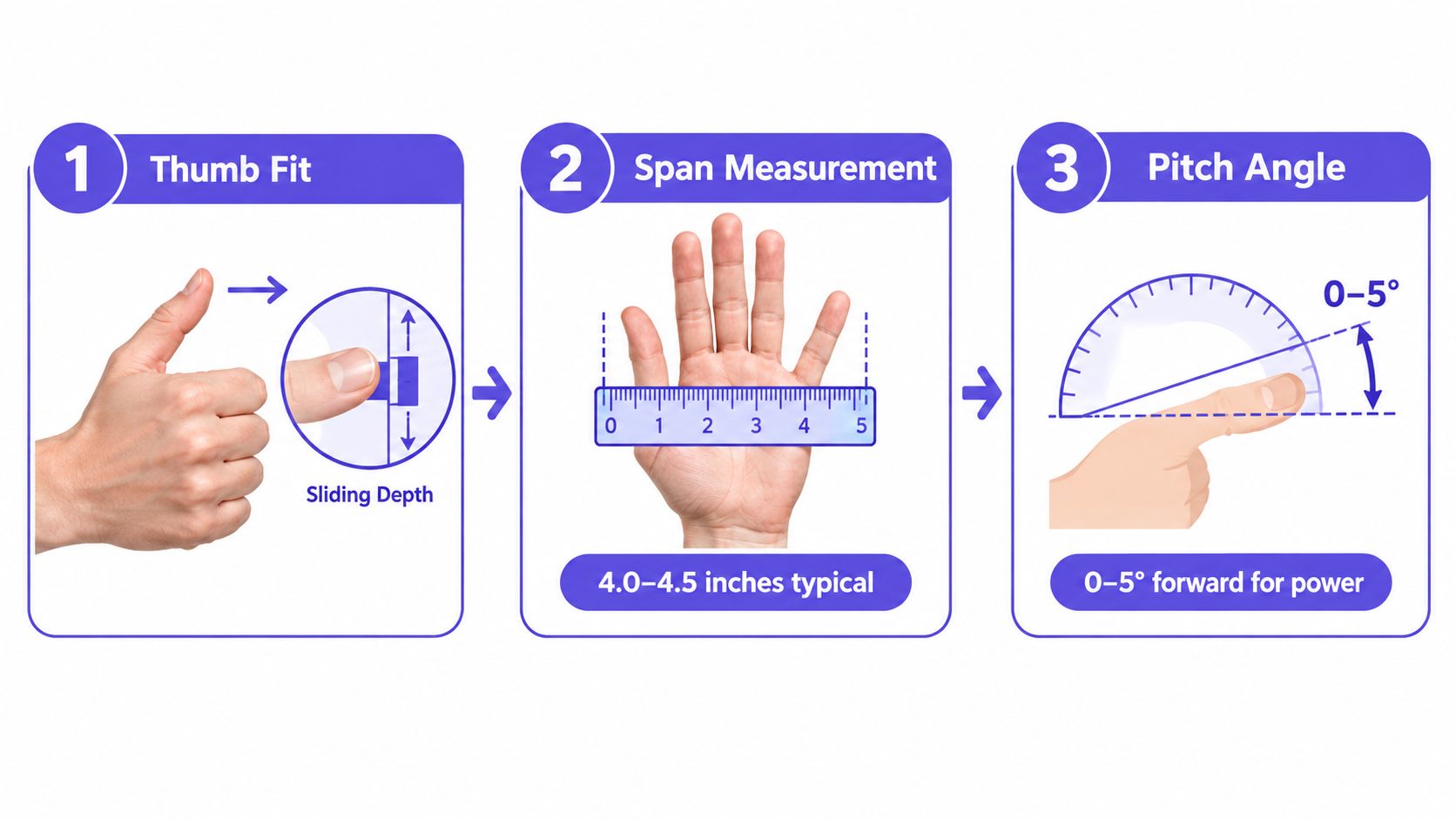
Use the ball as a support, not a weight you have to squeeze. A practical conventional benchmark is a thumb that sits fully in the thumb hole. For a fingertip fit, the crease of the first finger joint should lie midway across the finger holes when the thumb is fully seated, as described in this bowling grip fitting reference.
Span comes before small adjustments
Span controls how far your fingers reach and how much the hand creates. If it's too long, the fingers may pull against the front edge of the holes. If it's too short, the fingers can feel crowded and the thumb may struggle to exit freely.
Pitch works with span. Forward pitch angles the hole toward the fingers, while reverse pitch angles it away from them. The correct direction and amount depend on your joints, flexibility, and release. A bowler with a flexible thumb may need a different fit from a bowler whose thumb joint stays relatively rigid, even if their hands look similar.
Inserts, tape, and the fitting card
Choose inserts when you want a consistent molded finger surface, interchangeable contact, or a way to fine-tune several bowling balls. Choose tape when one thumb hole needs a small temporary adjustment because conditions, swelling, or fit has changed.
A fitting isn't finished when the holes are drilled. Roll the ball, check the thumb exit, and report exactly where pressure appears. Keep the span and pitch recorded on a fitting card, and revisit the fit as your release develops. Guidance on how drilling choices interact with ball layout is available in this guide to bowling ball drilling layouts.
Fit check: If you need to squeeze the ball to keep it secure, stop changing your release first. Have the thumb hole, finger size, span, and pitch examined.
Two-Handed and No-Thumb Deliveries Through a Grip Lens
A two-handed delivery changes how the bowler supports the ball during the approach, but it doesn't make finger fitting irrelevant. The bowling hand still needs a comfortable relationship with the finger holes, and the thumb still matters if it enters the ball during the swing.
A typical two-handed bowler uses the non-bowling hand to support the ball through much of the approach. The bowling hand often uses fingertip-style finger placement, while the thumb may enter for control and then leave before release. The second hand helps the player carry and stabilize the ball, so the delivery can create substantial rotation without requiring the same one-handed wrist action.
A no-thumb delivery takes a different route. The thumb stays out or exits very early, leaving the fingers and wrist to manage the ball through the bottom of the swing. Some bowlers choose this approach because thumb clearance is difficult or uncomfortable. Others use it to pursue a high-rotation release. Either way, the lack of thumb contact reduces one source of directional stability.
What changes during fitting
Compared with a standard one-handed thumb-in release, two-handed and no-thumb styles can require different span decisions because the thumb's role and release timing change. Finger pitch remains important because the fingers still need to enter and leave without excessive pressure. A hole that feels acceptable in a static hand measurement may feel wrong once the player uses the faster, more forceful release associated with these styles.
Two-handed bowlers should also avoid assuming that a rigid wrist device will solve a release problem. Their support needs often differ from those of a one-handed power player. If hand stability or wrist comfort is the issue, compare the equipment options in this guide to bowling gloves for control, then test any aid during practice before relying on it in competition.
The key distinction is simple. Two-handed is a delivery method, while no-thumb describes thumb participation. Both can work, but both still depend on correct finger contact, manageable ball weight, and a release the bowler can repeat.
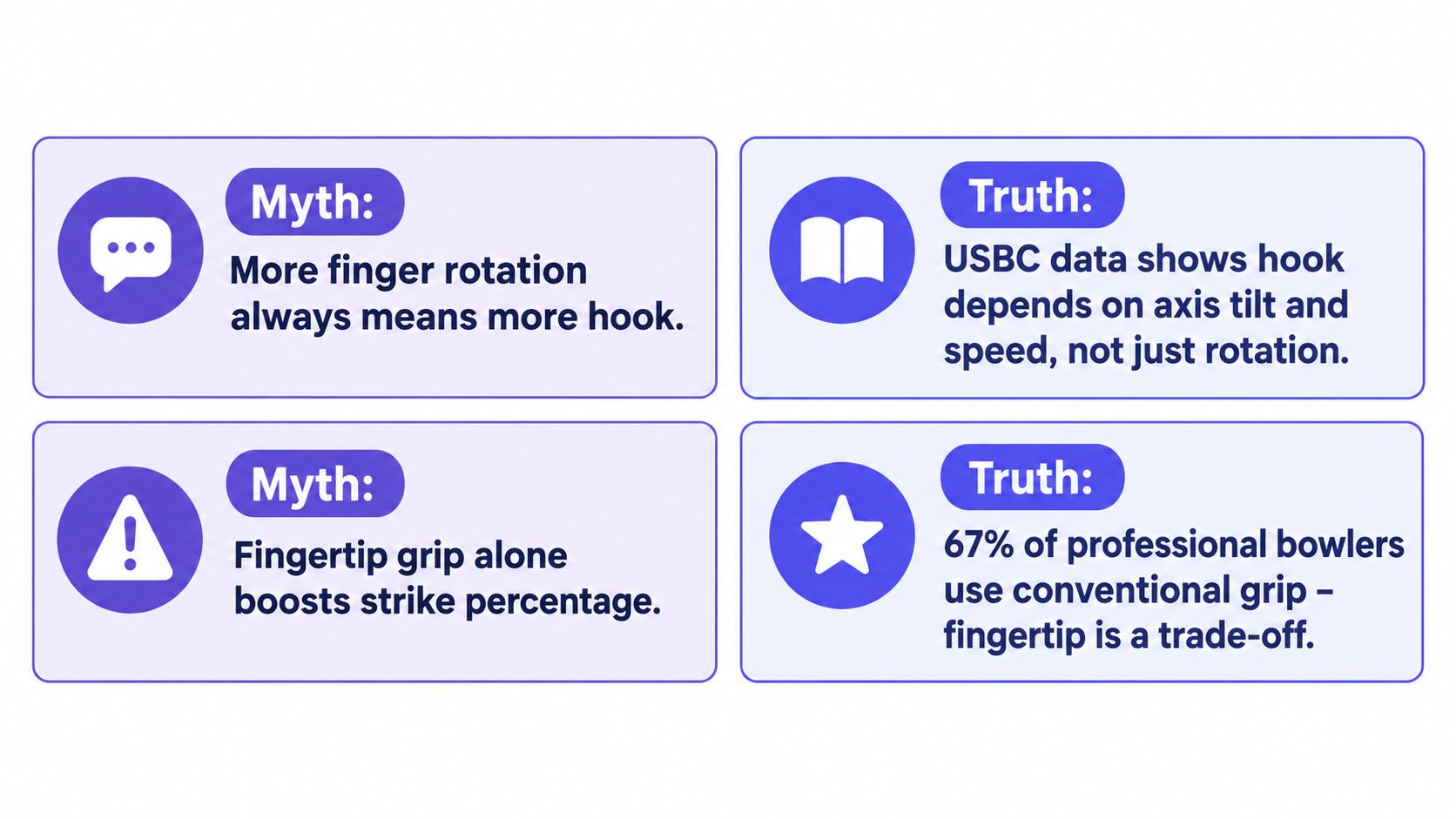
Common Myths About Bowling Grips and the Truth Behind Them
Myth one says more rotation always means more hook
Rotation matters, but it doesn't operate alone. Ball speed, axis tilt, axis rotation, release timing, ball surface, and lane friction all influence the shape you see. A bowler can add finger rotation and still get an undesirable result if the ball skids too long, changes direction too sharply, or loses energy before reaching the pins.
The peer-reviewed study cited earlier describes grip differences and symptom rates among elite bowlers, but it doesn't establish that fingertip drilling automatically creates a better score or a universal performance gain. Grip provides a mechanical opportunity. The bowler's release decides how much of that opportunity becomes useful motion.
Myth two says fingertip drilling alone makes you a better bowler
A fingertip grip can support more force, but it also asks for better fit and timing. If the thumb sticks, the span stretches the hand, or the fingers experience too much pressure, the bowler may lose accuracy while trying to create shape.
Conventional drilling isn't merely a beginner's setup. The historical coaching source links it with recreational straight-ball control, and the modern clinical study documented conventional grip use among high-level bowlers as well. Some players match their speed, rev rate, hand strength, or physical limits more effectively with a deeper finger fit.
Better question: Does this grip help you repeat your intended launch angle and release without pain?
Treat grip as one part of a system. Wrist position, ball weight, surface condition, drilling layout, lane strategy, and physical comfort all matter. Changing to fingertip, thumbless, or two-handed delivery can alter the system, but no single change guarantees better results.
Choosing the Right Bowling Grip Type for Your Game
Start with the problem you're trying to solve. If your current ball feels secure but your fingers lack room to release, a semi-fingertip trial may be more sensible than jumping directly to a highly advanced fingertip fit. If your ball already hooks too early or your hand feels strained, changing grip depth without checking surface, layout, and fit may move you farther from control.
Match the grip to your hand and release goal
A bowler with smaller fingers, limited hand strength, or a naturally low-rev release may prefer conventional drilling or semi-fingertip. Those options can provide a stable platform while the player learns to control speed, target, and hand position.
A stroker or tweener seeking a controlled arc will often investigate fingertip drilling with a carefully matched span and pitch. The aim isn't maximum rotation. It's a clean thumb exit and enough finger action to create a predictable shape.
A power player or two-handed bowler may benefit from inserts for consistent finger contact. A bowler who intentionally keeps the thumb out may consider a thumbless setup, but should treat accuracy and physical comfort as requirements, not afterthoughts.
Use this release checklist
- Thumb fit: The thumb should seat fully and leave without grabbing.
- Finger position: Confirm the intended knuckle depth and the first-joint crease benchmark for the chosen fit.
- Span and pitch: Ask the pro shop to explain how both measurements match your hand's natural movement.
- Ball weight: Use a weight you can swing and release without squeezing or collapsing your wrist.
- Practice test: Roll the ball repeatedly and watch whether the release stays clean as your hand becomes tired.
- Comfort review: Stop if you feel sharp pain, numbness, or persistent pressure in the thumb, fingers, or wrist.
Book a pro-shop fitting before buying your next custom ball. Ask the operator to record your span and pitch on a fitting card, then trial two grip options over three sessions before committing to a permanent change.
Bowling Gear Reviews publishes hands-on equipment reviews, comparisons, and practical guides covering bowling balls, finger inserts, gloves, wrist supports, and other fit-related accessories. Visit Bowling Gear Reviews to compare gear with your grip style and release needs in mind, then take your shortlist to a pro shop for a proper fitting.
