

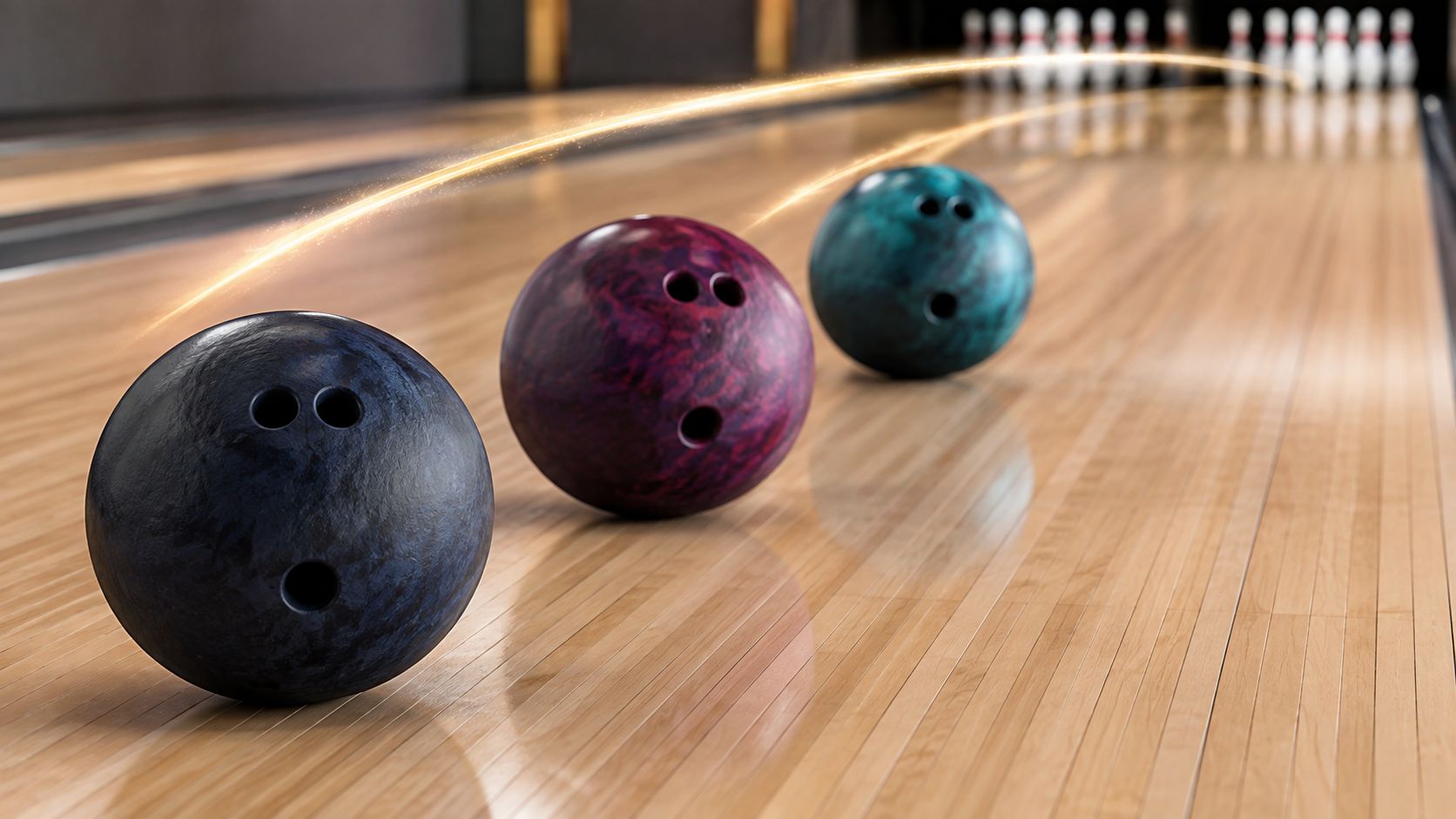
You've just finished a league game on a pair that feels used up. Your reactive ball sees the dry outside boards and makes the corner too early, while moving inside creates a violent change of direction at the breakpoint. A urethane ball often gives you a calmer option, reading the lane sooner and shaping through the pocket instead of making the sharp move you're trying to avoid.
That's why bowling balls urethane remain relevant for league bowlers, sport-pattern players, and anyone who needs control after the fronts have burned. This guide explains the material in plain language, compares it with reactive resin and particle covers, shows how it changes lane transition, and reviews seven Amazon urethane options by intended use rather than by marketing language. It also includes the equipment-rule question many older roundups miss, because hardness and manufacturing date can affect tournament eligibility in 2026.
Table of Contents
- Introduction to Urethane Control on Modern Lanes
- What Urethane Coverstock Really Is and How It Moves
- Urethane Versus Reactive and Particle Coverstocks
- How Urethane Behaves on Different Lane Conditions
- 7 Best Urethane Bowling Balls on Amazon Tested and Compared
- Keeping Your Urethane Ball Consistent With Proper Care
- Choosing the Right Urethane Ball and Staying Compliant in 2026
Introduction to Urethane Control on Modern Lanes
Urethane first appeared commercially in 1980, when the AMF Angle became widely cited as the first urethane bowling ball and the first two-piece urethane model. Hammer began producing urethane coverstock balls for AMF by 1981, and urethane stayed dominant until the early 1990s, as documented in the history of modern bowling ball technology. Its competitive impact showed up in scoring trends. The American Bowling Congress recorded perfect games rising from 14,889 in 1991-92 to 17,654 in 1992-93, a gain of nearly 20%, as reactive resin displaced urethane as the leading performance technology, according to the same historical account.
Modern urethane fills a different role. Reactive resin can create a powerful change of direction when the lane offers enough oil and friction in the right places, but that shape can become difficult on short patterns, dry outside boards, or lane fronts that have already received plenty of traffic. Urethane usually gives the bowler more time to see the motion develop. It's less like throwing a ball at a target and more like guiding a vehicle through a gradual bend.
What this guide measures
The useful question isn't just whether a ball hooks. Every coverstock can hook under the right conditions. The better questions are where the ball starts to read, how much energy it retains for the pins, whether the breakpoint stays predictable, and how the ball changes the lane for the next game.
The product discussion below uses a practical testing lens. Coverstock type, core design, surface preparation, observed hook shape, and lane-condition fit matter more than a manufacturer's promise. Amazon currently lists 169 results in its dedicated urethane bowling ball category, so shoppers have plenty of choices but also plenty of opportunities to buy a ball that doesn't match their lane environment, release, or competition schedule, as shown by Amazon's urethane bowling ball category.
There's one more question now. If you bowl sanctioned events, you need to ask whether a particular urethane ball is legal for your competition, not just whether it gives you control.
What Urethane Coverstock Really Is and How It Moves
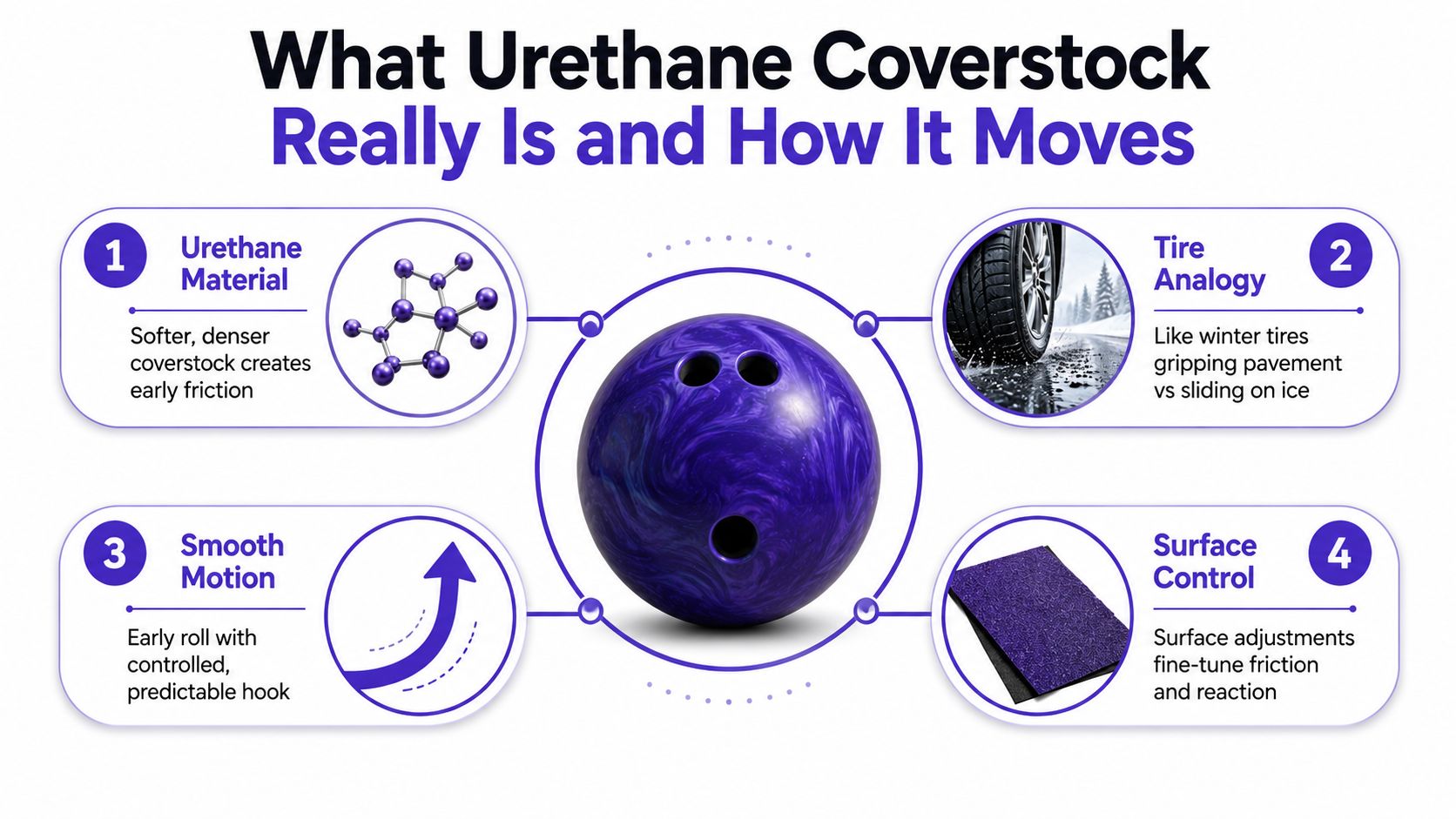
A bowling ball has a core inside and a coverstock outside. The coverstock is the part that touches the lane, encounters conditioner, creates friction, and determines much of the ball's visible motion. Urethane is a coverstock material designed to create traction primarily through direct surface contact, rather than through the stronger oil-absorption behavior associated with reactive resin.
Think about tires. A winter tire grips pavement through its contact surface. On ice, that same tire can slide because the surface doesn't provide the friction it needs. Urethane behaves in a comparable way on a bowling lane. It interacts directly with the lane surface, so its reaction depends heavily on the amount of oil, the lane texture, and the ball's surface preparation.
The motion sequence
Watch a urethane shot in stages:
- The ball leaves the oil pattern and begins reading earlier. It generally doesn't wait as long as a cleaner reactive ball before responding to friction.
- The midlane becomes more blended. Instead of storing energy for a dramatic turn, the ball uses friction progressively.
- The breakpoint stays smoother. Urethane commonly produces a continuous arc with less backend shape.
- The entry angle is controlled. That can help when a sharper reaction would miss the pocket high or jump past the breakpoint.
Core concept: Urethane controls friction mechanically. The core and surface still matter, but the coverstock sets the basic personality of the motion.
The core acts as a supporting actor. A higher-differential core can create more flare potential within the urethane category, while a lower-differential design can keep the reaction more stable. Surface preparation also changes the amount of friction. A rougher surface can help the ball read sooner, while a polished surface can let it travel farther before making its move. Those adjustments refine urethane's shape, but they don't turn it into reactive resin.
That distinction prevents a common mistake. Bowlers sometimes change layouts or polish a urethane ball expecting it to become a completely different type of equipment. It may become cleaner or more responsive, but it will still show the coverstock's characteristic preference for earlier, smoother motion.
Urethane Versus Reactive and Particle Coverstocks
The simplest comparison is about how each coverstock manages oil and friction. Urethane has the lowest oil-absorption behavior among common performance cover technologies, so it tends to carry oil on its surface. Reactive resin absorbs more oil and can create a stronger transition from skid to hook to roll. Particle coverstocks add textured material to the reactive system, giving them a rougher, more traction-oriented response in heavier conditions, as explained in this coverstock comparison.
| Feature | Urethane | Reactive Resin | Particle |
|---|---|---|---|
| Oil handling | Low oil absorption, surface oil remains important | Absorbs oil and changes reaction as the cover loads | Uses textured additives with reactive-style oil handling |
| Friction creation | Direct contact with the lane | Cover interaction plus oil absorption | Strong surface traction and textured contact |
| Typical hook shape | Earlier, smoother, more continuous | More skid and stronger backend shape | Earlier traction with a powerful, heavy-condition response |
| Backend response | Controlled and rounded | Sharper or stronger, depending on design and surface | Strong continuation with substantial traction |
| Best fit | Short patterns, burned fronts, and control lines | Medium to heavier conditions needing shape | Heavier oil and players needing maximum traction |
Why wiping matters
Reactive resin can pull some oil into the cover as it travels. Urethane usually leaves more of that oil on the surface, so the ball can transfer oil downlane and gradually change its own reaction. Wiping the ball frequently during play helps keep the surface response more stable and reduces unwanted oil movement.
This doesn't mean urethane is always the safer choice. On fresh heavy oil, a smooth urethane ball may struggle to create enough traction. Because it doesn't self-adjust through meaningful oil absorption, it can lose energy or produce a flat entry if the bowler throws it too directly through too much conditioner.
Matching the cover to the pattern
A typical house shot often rewards a ball that creates enough angle to carry from the pocket. Reactive resin usually gives more shape for that job, especially when the bowler needs to open the lane. Urethane becomes more attractive when the outside is playable but reactive equipment responds too abruptly, or when a short pattern makes the breakpoint difficult to control.
Particle is a different tool again. It's aimed at traction and continuation in conditions where urethane may slide too long and a smoother reactive ball may fail to read the oil volume. The right choice depends on the lane, not on a universal ranking.
How Urethane Behaves on Different Lane Conditions
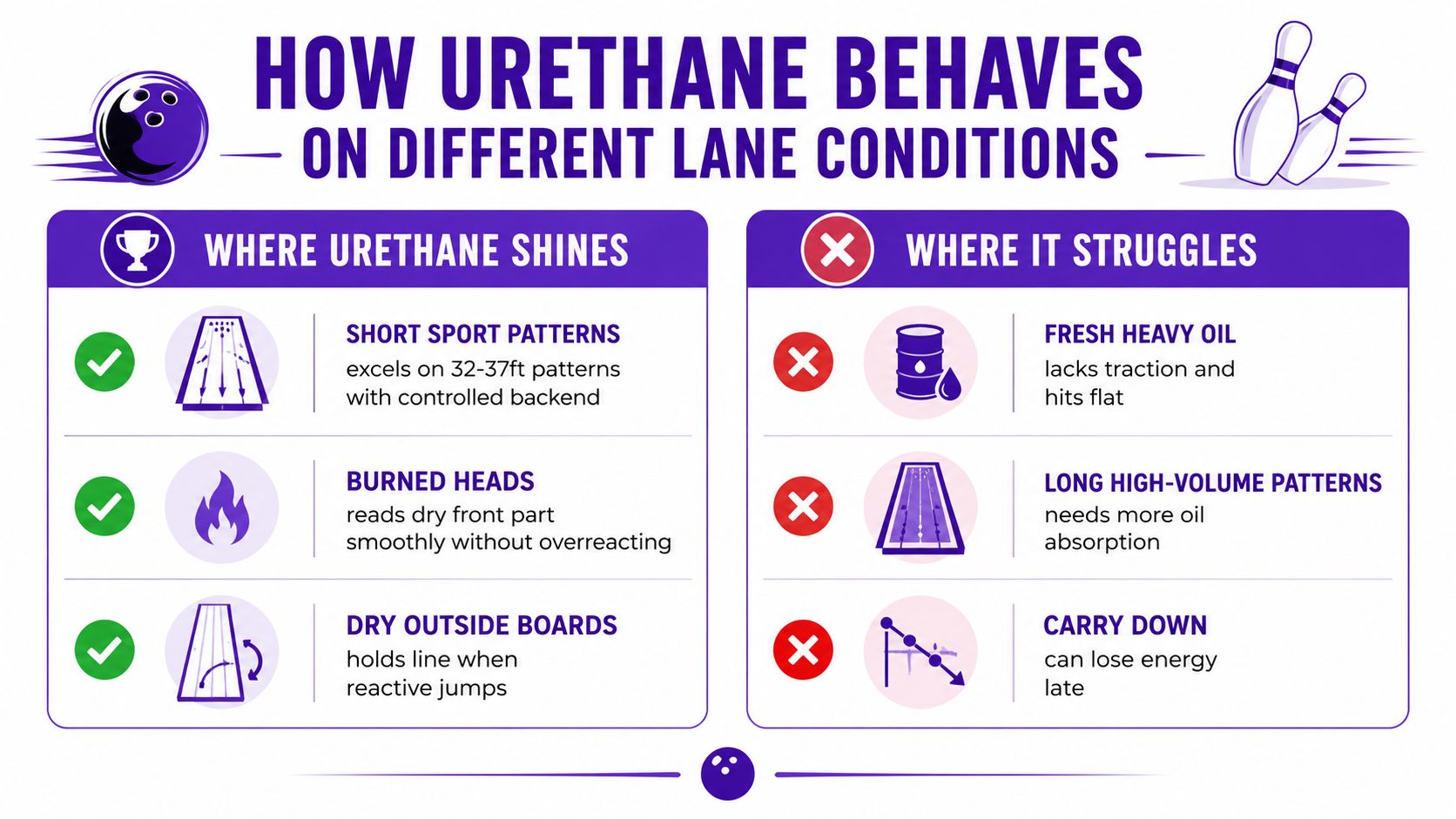
Urethane works best when a bowler needs to blend friction, not maximize angle. Short sport patterns, burned lane fronts, and dry outside boards can all reward a ball that starts earlier and moves gradually. The ball gives you a clearer read because it doesn't make the breakpoint decision all at once.
Where urethane earns trust
On a short pattern, the bowler often has limited room to create a large hook zone. A reactive ball may see the dry too quickly, while urethane can use the lane's friction in smaller steps. On burned heads, urethane's earlier read can make the front part of the lane feel less jumpy. On dry outside boards, the smoother response can keep the ball from racing off the edge.
The difficult condition is fresh heavy oil. Urethane has limited oil absorption, so it can skid through the conditioner without generating enough continuation. The result may look controlled at the breakpoint but weak at the pins. Long, high-volume patterns create a similar challenge because the ball needs more traction and energy management than a traditional urethane cover commonly provides.
Use this beginner's guide to reading bowling lane oil patterns before deciding that the ball itself is the problem. A lane pattern tells you where friction exists and where the ball must travel through oil.
The transition question most players miss
Urethane doesn't only affect your shot. It can affect the pair after the first game because the ball's oil interaction and lane friction change the environment for everyone. In an earlier USBC simulation, reduced-differential RG balls with slower oil absorption removed 4.2% less oil than high-differential RG balls, while high-differential RG urethane balls removed 38.2% less oil than the comparison category in that study, according to the USBC technology study.
Those figures shouldn't be treated as a universal prediction for every model. They show why “stable” doesn't mean “neutral.” A urethane ball may reduce the need for a large move for its owner while leaving a different transition shape for teammates later in the block.
Practical adjustments include:
- Move your feet gradually: If the ball reads too early, move inside or increase speed before changing equipment.
- Change surface with purpose: A rougher surface can increase early traction, while polish can add length, but each change should be tested on the actual lane.
- Watch the pins: A ball that looks smooth but leaves weak corners may need more entry angle, more speed control, or a different coverstock.
- Track the next game: Don't judge urethane only by game-one pocket hits. Observe what the pair does after repeated shots.
7 Best Urethane Bowling Balls on Amazon Tested and Compared
Amazon's category gives bowlers a broad retail starting point, but product pages can vary by weight, drilling option, surface, and availability. The seven picks below are organized around practical roles. They aren't interchangeable, and the right choice depends on whether you need benchmark control, a cleaner urethane look, a stronger urethane read, or a lower-risk entry into the category.
| Pick | Best for | Motion type | Price |
|---|---|---|---|
| Classic Control | Benchmark urethane shape | Smooth and predictable | Check current Amazon listing |
| Pearl Urethane | More length from urethane | Cleaner with controlled backend | Check current Amazon listing |
| Power Urethane | Stronger urethane continuation | Earlier and more forceful | Check current Amazon listing |
| True Urethane | Traditional urethane motion | Soft, rounded arc | Check current Amazon listing |
| Hybrid Blend | Versatility across conditions | Blend of urethane control and reactive response | Check current Amazon listing |
| Tournament Spec | Competition-focused buyers | Controlled motion with compliance priority | Check current Amazon listing |
| Budget Pick | First urethane purchase | Accessible, smooth control | Check current Amazon listing |
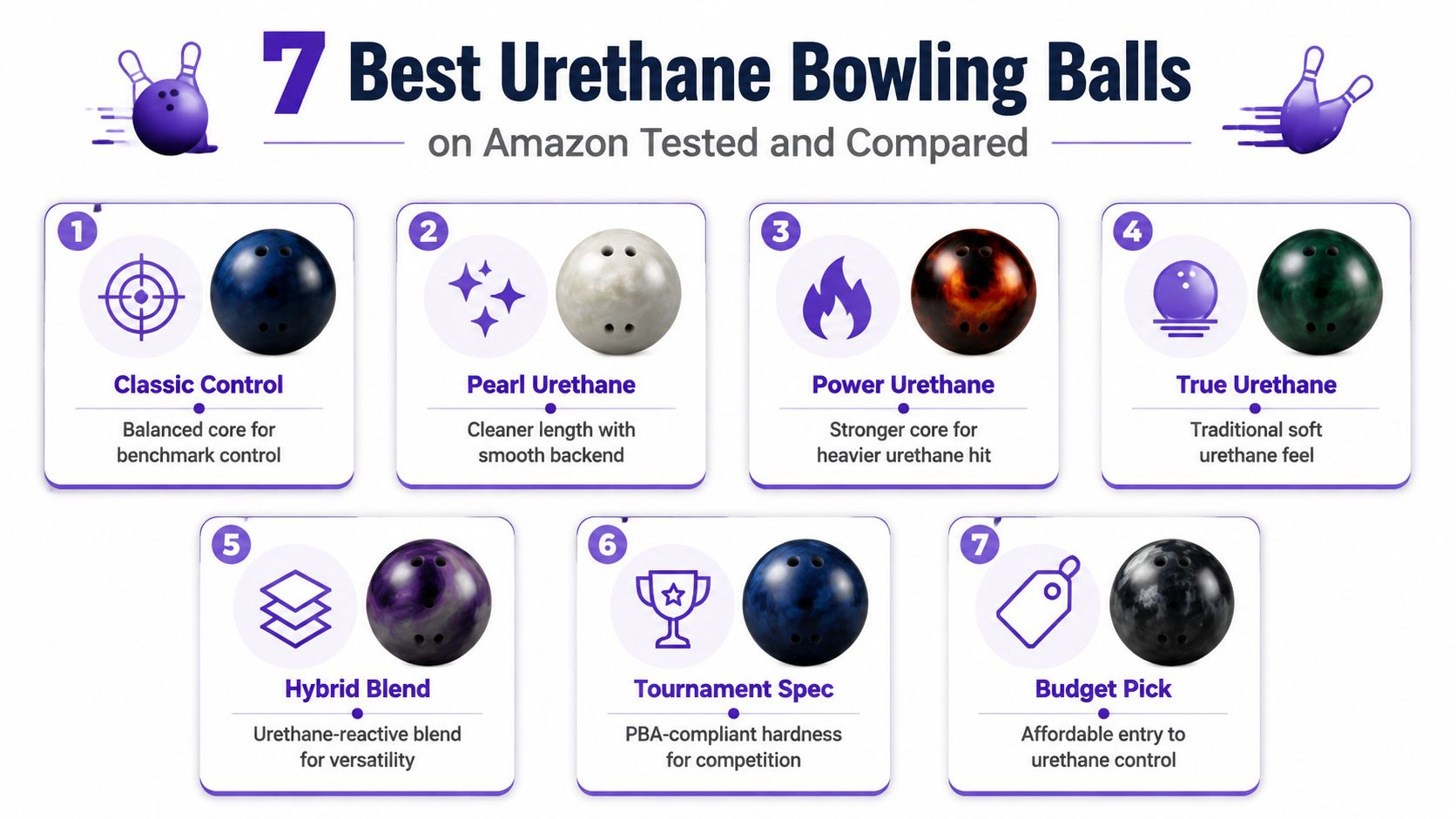
Classic Control
A classic control model is the benchmark choice for a player who wants to learn what urethane is supposed to do. Look for a traditional urethane cover and a balanced core profile, then confirm the listed surface before purchase. On the lane, the useful sign is a predictable midlane read with a rounded move that doesn't leap sideways.
Pros
- Smooth breakpoint response.
- Easy to read during practice.
- Useful for players learning speed and rotation control.
Cons
- Can lose entry angle in heavier oil.
- May feel too early for bowlers with high rev rates.
- It won't replace a strong reactive ball on every house shot.
Verdict: Choose this role when you want a reference point for short patterns and control practice.
Pearl Urethane
Pearl urethane is aimed at bowlers who like urethane's rounded shape but need the ball to clear the front a little more easily. The pearlized appearance doesn't guarantee a specific reaction, so pay attention to the listed coverstock and surface. A good match produces length without turning the breakpoint into a sharp reactive move.
Pros
- Cleaner look through the heads.
- Useful when solid urethane reads too soon.
- Maintains a smoother direction change than many reactive options.
Cons
- Can miss the pocket on fresh heavy oil.
- Surface changes can alter the reaction quickly.
- Bowlers may mistake “more length” for “more backend.”
Verdict: This is the better fit for players who need urethane control after the fronts begin to go away.
Power Urethane
A power-oriented urethane ball usually combines a stronger core influence with a cover intended to maintain urethane's smoother response. The lane test should show more continuation than a very mild control ball, while still avoiding the sudden breakpoint response that creates problems on short or dry conditions.
Pros
- More presence through the pins.
- Better fit for bowlers who overpower very mild urethane.
- Can provide a useful bridge between traditional urethane and reactive equipment.
Cons
- May read too early for slower speed players.
- Still has limited heavy-oil versatility.
- Requires careful surface selection.
Verdict: Pick this role when traditional urethane looks safe but leaves weak corners.
True Urethane
A true urethane model is the vintage-style choice. It prioritizes a soft, direct relationship with the lane and a continuous arc over maximum recovery. Bowlers with lower tilt or a more direct release may find it easier to control, while high-rev players may need to manage speed and surface carefully.
Pros
- Familiar, rounded motion.
- Strong option for dry outside boards.
- Helps players practice projecting the ball without chasing backend.
Cons
- Limited traction in heavy oil.
- Can burn up energy if the surface is too rough.
- May be too early for some modern house-shot conditions.
Verdict: Choose it for traditional urethane motion and deliberate lane play.
Hybrid Blend
A hybrid blend is for the bowler who wants urethane-like control with a little more versatility. Because blended covers can respond differently from traditional urethane, verify the product description and don't assume that “hybrid” means the same thing across brands. The ideal motion is a controlled read with enough continuation to handle changing friction.
Pros
- Broader condition range than very soft urethane.
- Useful for bowlers building a small tournament arsenal.
- Can reduce the jump from smooth control equipment to stronger reactive equipment.
Cons
- Less predictable if you're seeking a pure urethane look.
- May need more careful drilling and surface testing.
- Harder to classify by name alone.
Verdict: Consider this category when one traditional urethane ball feels too limited.
Tournament Spec
A tournament-focused model puts compliance ahead of convenience. Confirm the ball's hardness information, manufacturing date, and eligibility for the event you plan to enter. A ball that performs well in league play may still be restricted in a national tournament.
Pros
- Compliance is part of the buying decision.
- Useful for competitive bowlers who need a controlled shape.
- Encourages proper documentation and pro-shop verification.
Cons
- Rules can differ by event.
- Older inventory may carry eligibility concerns.
- A product title alone isn't enough to establish legality.
Verdict: Choose this role only after checking the current USBC requirements for your competition.
Budget Pick
A budget urethane ball can introduce a new bowler to earlier, smoother motion without requiring a complete equipment overhaul. Judge the listing carefully for the actual coverstock, available weights, drilling details, and return terms. The value comes from matching the ball to a clear use case, not from choosing the lowest listed price.
Pros
- Lower barrier to trying urethane.
- Useful for practice and dry-lane control.
- Can complement a stronger reactive ball.
Cons
- Specs and availability may vary by listing.
- Factory surface may not suit your lane.
- It may lack the core options found in premium models.
Verdict: Buy this category when you want to test urethane's shape before investing in a specialized competitive model.
For a deeper look at one established control option, read the Storm Pitch Black Solid Urethane bowling ball review.
Keeping Your Urethane Ball Consistent With Proper Care
Urethane needs a simple routine because oil stays close to the surface. Wipe the ball during play, especially after shots that leave visible conditioner on the cover. Removing that oil helps maintain a stable reaction and reduces the chance of transferring oil farther downlane.
After every session
- Wipe immediately: Use a bowling-ball towel after each shot or short series of shots.
- Clean gently: Use a cleaner approved for bowling equipment, and avoid aggressive solvents.
- Inspect the cover: Look for damaged areas, unusual gloss, or a change in how the ball feels in your hand.
- Store carefully: Keep the ball in a cool, dry place away from heat, moisture, and chemical exposure.
USBC research shows that friction, shear forces, and lane-oil exposure can make urethane softer with use. Hardness matters because it affects reaction consistency and rule compliance. In one USBC test, a urethane ball began at 74D, measured 72.6D after 10 shots, and reached 70.2D after 190 shots, as reported in USBC hardness research.
Harsh chemical treatment creates another risk. USBC testing recorded one case where solvent soaking drove urethane hardness down to 30.7D, with the hardness later recovering toward normal ranges, according to the same report. That recovery doesn't make solvent treatment safe. It complicates enforcement and can create unpredictable reaction changes.
Care rule: If a cleaner smells unusually strong or is intended for industrial use, don't put it on a urethane cover without confirming that it's approved for bowling equipment.
Ask a pro shop to inspect the ball when its reaction changes without a clear lane explanation. A pro can check the surface, evaluate visible wear, and discuss whether the ball's hardness or cover condition should be documented.
Choosing the Right Urethane Ball and Staying Compliant in 2026
Start with the lane. Choose traditional control for short or burned conditions, a cleaner urethane shape when the fronts go away, and a stronger or blended option when you need more continuation. Then match the ball to your release. High-rev players may need more length or speed, while direct players may benefit from earlier friction.
For sanctioned competition, verify the rules before purchasing. USBC says slow oil-absorbing high-performance balls with oil absorption times over 90 minutes must meet a minimum hardness of 78D for sale in the United States, with the manufacturing standard taking effect on December 31, 2025, as stated in the USBC announcement on slow oil-absorbing balls. National-event eligibility also depends on manufacturing date. USBC identifies pre-August 1, 2022 slow oil-absorbing high-performance balls as ineligible for national tournament use regardless of hardness, according to the tournament-rule FAQ.
Check the model, absorption classification, hardness documentation, and manufacturing date with the seller or pro shop. USBC also says on-site hardness spot checks will be added through its field-testing program, so compliance should be part of the purchase decision, not an afterthought.
Bowling Gear Reviews provides hands-on bowling-ball reviews, comparisons, care guidance, and lane-condition advice based on observed equipment behavior. Visit Bowling Gear Reviews to compare urethane models, review practical fit notes, and choose equipment that matches both your game and your competition rules.
