

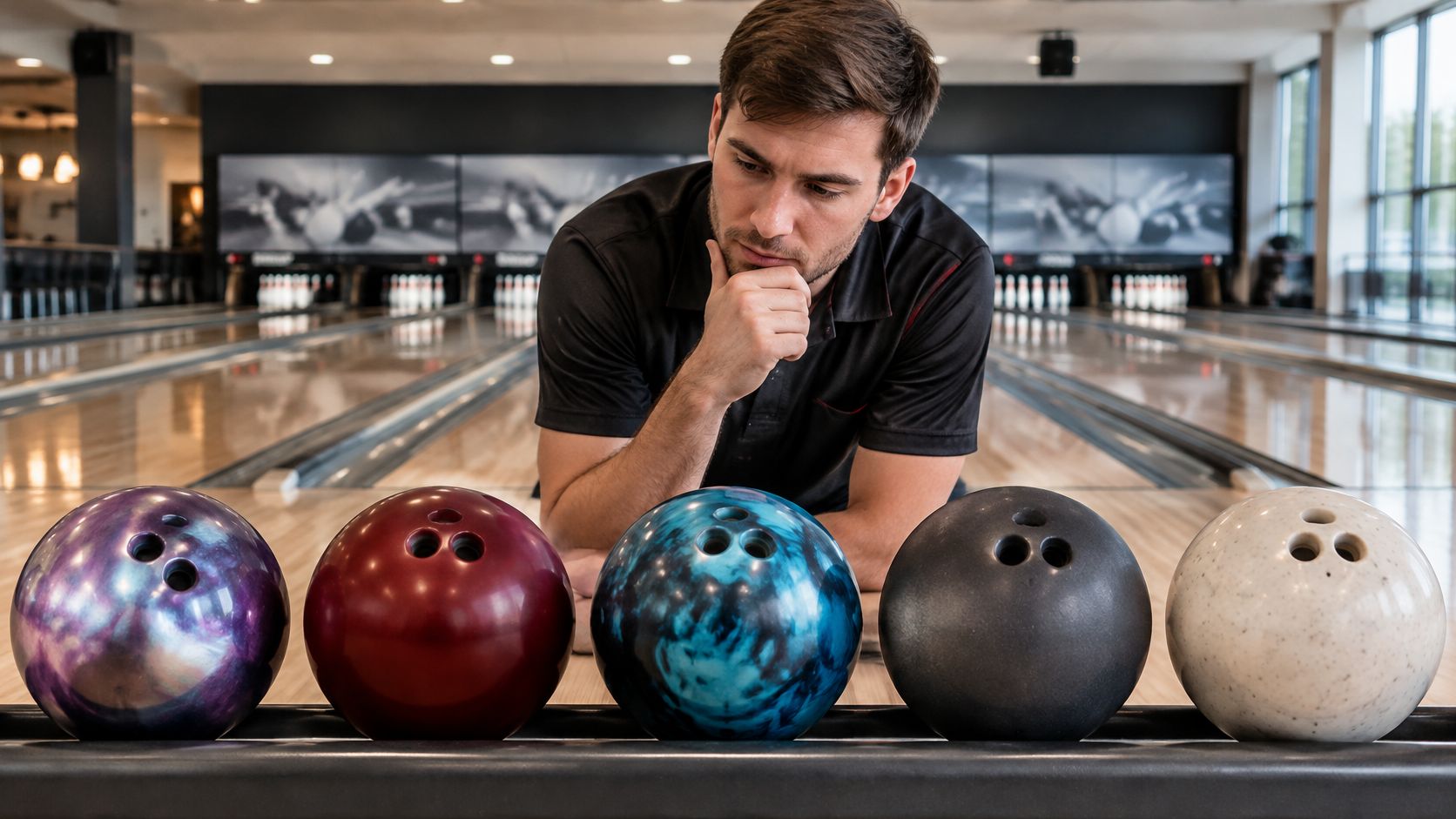
Buy the ball that hooks the most. That's the advice most roundups sell, and it's how bowlers end up with a ball that reads too early, burns up in game two, or isn't eligible for the tournament they entered.
The best bowling balls on the market aren't ranked by total hook. They're matched to your oil volume, speed, rev rate, and the events you bowl. A strong ball that gives you a jumpy, unrepeatable breakpoint is worse than a weaker ball that finds the pocket the same way for three games.
Start with legality and usable shape. Then talk about hook.
Table of Contents
- Best Ball Picks by Lane and Bowler
- How Coverstock, Core and Hardness Change Motion
- Side-by-Side Motion and a 20-Shot Test
- Check 2026 Approval Before You Buy
- Which Ball to Buy for Your Level
- Set Weight Surface and Layout for Your Release
Best Ball Picks by Lane and Bowler
A 220-average league bowler buys the strongest pearl on the shelf and loses carry by game two. The ball isn't bad; the match is. Pick a role first, confirm the ball is legal for the events you bowl, then pick a model that fills that role.
USBC reported that it tested and approved more than 244 bowling-ball models in 2024, so popularity isn't a quality filter. With that much choice, you need a shortlist by lane and bowler, not another ranked top ten.
2026 Quick Picks by Lane and Bowler
| Role | Benchmark or cover | Best lanes | Fits | Main risk |
|---|---|---|---|---|
| Strong pearl reactive | MOTIV Nuclear Forge, low RG, high differential | Medium-heavy oil | Higher-rev players who need recovery | Overhooks after transition |
| Solid reactive | Solid reactive resin, low RG, higher differential | Fresh heavy oil | Speed-dominant or high-rev league bowlers | Early midlane read on dry backends |
| Hybrid reactive | Hybrid cover, moderate differential | Medium house shots | Most league bowlers upgrading one ball | Too much motion on short patterns |
| Control urethane | Slow oil-absorbing urethane | Short sport and dry-to-medium | Players who miss the pocket from over-hook | 2026 hardness and tournament limits |
| Spare or entry ball | Polyester or mild entry reactive | Dry lanes and corner pins | Beginners and spare shooters | Too little hook on oil |
Each row names a role, not a winner. Find your lane condition first, then read the risk column, because that risk is what the ball does when you're wrong about the pattern.
The MOTIV Nuclear Forge is the benchmark for one job only: strong pearl reactive motion on medium-heavy oil. Its low-RG, high-differential core revs early and flares hard, giving higher-rev players recovery when they need continuation through the pins.
Don't force that profile onto burned lanes. After transition, or once oil carries down, a strong pearl can push too far, then snap too late. You'll see it as a mix of soft corner pins and sudden splits instead of a stable breakpoint.
How to Read the Other Four Roles
- Solid reactive: Choose this for fresh heavy oil when the ball must start in the midlane. It's the wrong choice when the heads are already dry, because it reads before it reaches its breakpoint.
- Hybrid reactive: This is the safest single-ball upgrade for a typical house shot. It gives you length without giving up traction as the pattern opens up.
- Control urethane: Use it when control beats continuation, especially on short sport patterns. Check hardness and event eligibility before you pay.
- Polyester: Keep it for spares, dry lanes, and a first custom-drilled ball. It won't create enough entry angle on oil to carry consistently.
Before you choose, learn to recognize the types of oil patterns in bowling you face on league night. A house shot that transitions by game two doesn't reward the same ball as fresh heavy oil, even in the same center.
Buy for the miss you can live with. A controllable late read beats a spectacular hook you can't repeat.
Two compliance facts frame every pick. Keep weight at 16 pounds or less, and don't treat RG plus differential as a total-hook prediction on their own. Layout, surface, speed, rev rate, and oil volume change the result.
Every product on this list is legal for sanctioned competition, we only recommend products we believe offer value to readers, and brands don't influence the reviews. Confirm surface and 2026 eligibility before checkout anyway, because approval status can differ by event.
How Coverstock, Core and Hardness Change Motion
Coverstock decides how much friction the ball creates. Core numbers decide when it revs and how much it flares. Hardness affects feel, lane response, and whether the ball passes approval checks.
The diagram below maps the three parts before you compare spec sheets.
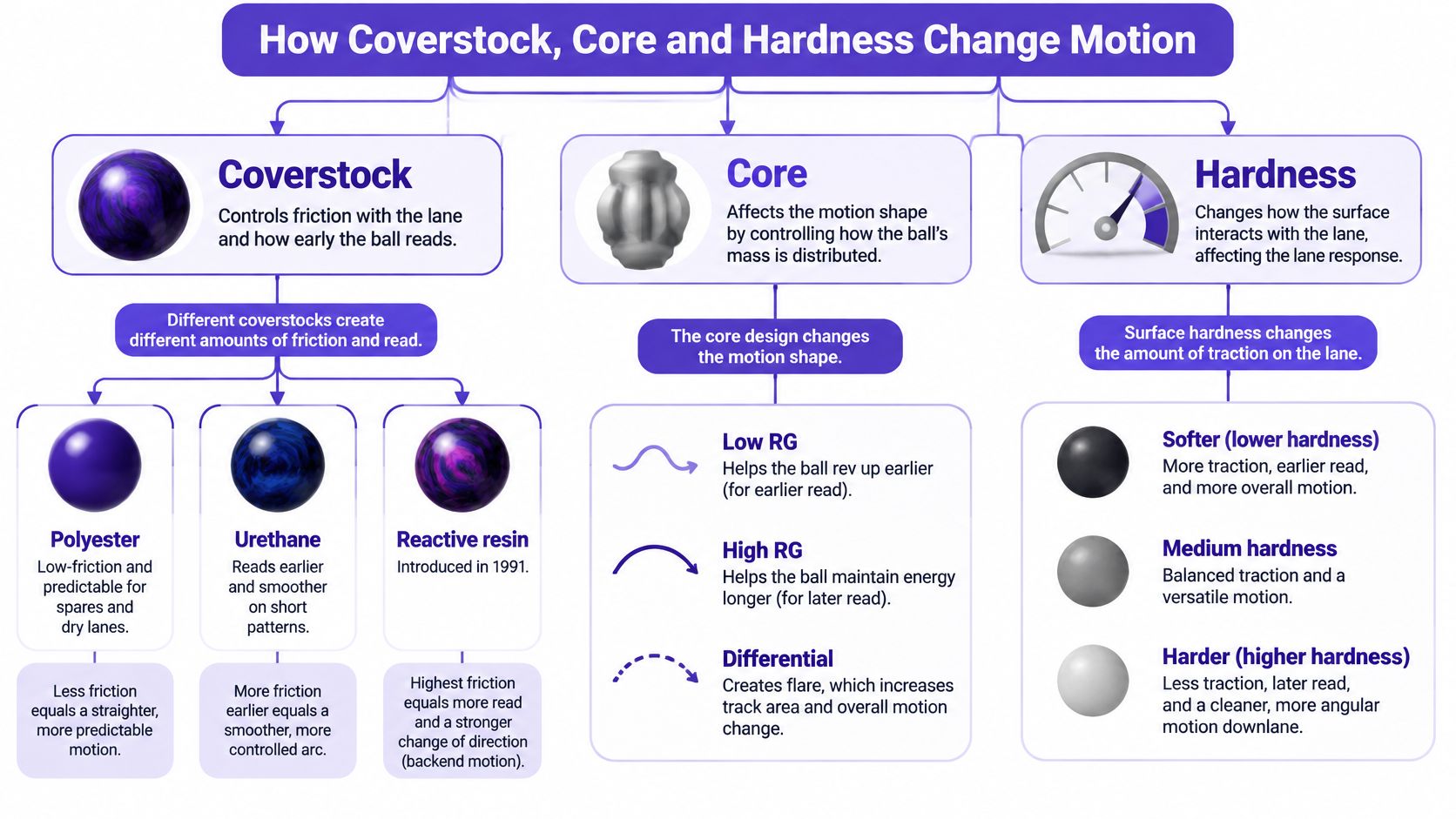
Coverstock Sets Friction
Polyester is low-friction and predictable, which is why it still works for spares and dry lanes. Urethane reads earlier and smoother, giving you a controlled arc on shorter patterns instead of a sharp backend move. Reactive resin grips harder in oil and creates stronger backend motion when it finds friction.
That range didn't appear overnight. According to the history of bowling ball materials, polyester balls were introduced in 1959, urethane emerged during the 1980s, and reactive-resin coverstocks arrived in 1991. Each step moved design away from low-friction predictability toward stronger traction and more specialized lane performance.
Surface grit can change the same ball more than a new marketing name. A duller finish reads the lane sooner and smooths the backend. A polished pearl pushes farther downlane and delays the breakpoint, which helps on medium oil and hurts you when there's heavy oil at the breakpoint.
Core Numbers Set Shape
RG tells you how early the core wants to rev. A lower RG revs sooner, which helps the ball start its motion in oil. A higher RG delays that motion and preserves energy for drier conditions.
Differential tells you how much track flare potential the core has. More flare exposes fresh coverstock to the lane, increasing traction and continuation. Less flare keeps motion smoother and more controlled, which is useful when the backends are flying.
Asymmetry changes how quickly the ball transitions from skid to hook to roll. Don't chase one number. Compare published RG, differential, factory finish, and approval status together, because no single spec predicts total hook.
Practical rule: If two balls have similar cores, the one with the right surface for your oil volume wins. Change surface before you blame the core.
Use a strong oil ball only as a benchmark for that role, not as a universal target. A high flare, low RG pearl that looks ideal on medium-heavy oil can be the hardest ball in your bag to control once the front part of the lane dries out. Shape has to match the lane in front of you.
Side-by-Side Motion and a 20-Shot Test
Compare families on the same lane, not on separate demo nights. Oil volume and transition will change the ranking if you don't.
The chart below puts the five motion shapes side by side.
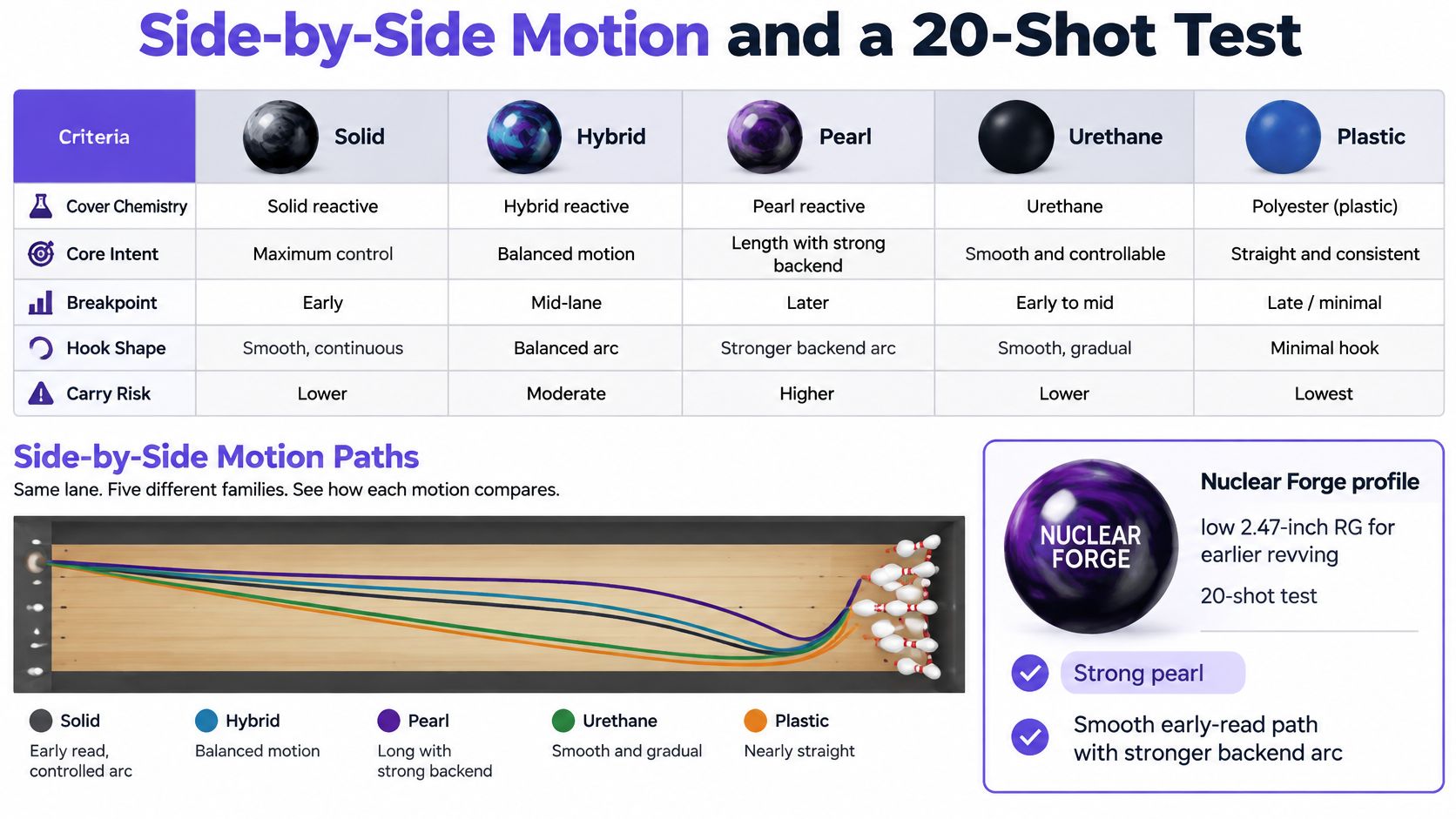
Cover Core and Motion Compared
| Family | Cover and core cue | Reads earliest on | Hook shape | Miss to avoid |
|---|---|---|---|---|
| MOTIV Nuclear Forge | Pearl reactive, symmetrical, low RG, high differential | Medium-heavy oil | Length then strong continuation | Too much backend on burned lanes |
| Solid reactive | Solid reactive, low RG, higher differential | Fresh heavy oil | Early, arcing midlane read | Hooking before the breakpoint on dry |
| Hybrid reactive | Hybrid cover, moderate differential | Medium house shot | Balanced length and traction | Overreaction as heads dry |
| Urethane | Slow-absorbing urethane, smoother core response | Short and sport patterns | Controlled, earlier, less flip | Weak drive through heavy oil |
| Polyester | Low-friction polyester | Dry lanes and spares | Very little hook, straight | Leaving flat 10-pins from a strike ball |
For medium-heavy oil, prioritize low RG with substantial differential instead of judging by coverstock name alone. The USBC equipment specifications manual treats RG and differential as regulated dynamic specifications, which makes published figures the right basis for comparing cores. The Nuclear Forge sits at the aggressive end of that scale, pairing a low RG that revs early with a high differential that flares hard and drives through the pins.
That same profile becomes a liability after transition. Lower-revolution players on drier lanes will watch it read too soon or jump off the dry. Strong continuation only helps if you can keep it in the pocket.
Run the 20-Shot Test Before You Decide
Every review at Bowling Gear Reviews comes from bowlers with real experience testing gear in real bowling conditions. Run the same kind of check with a simple log.
- Throw the factory finish first: Bowl at least 20 shots on your normal pattern without changing surface. Record breakpoint distance, pocket entry angle, front-lane read, and nine-pin or corner-pin carry.
- Make one surface change: Use one controlled grit adjustment, not a full resurface. Throw another 20 shots from the same area of the lane.
- Compare repeatability: Count flush pocket hits, light hits, and through-the-nose misses. The ball that hits flush most often wins, whatever its biggest single hook looked like.
Watch how breakpoint shape changes between finishes in the video below, then apply the same observation to your own log.
Each miss in the right column of the table is a diagnostic. A solid reactive that hooks before the breakpoint is telling you the heads are gone. Urethane that drives weakly through heavy oil is telling you the volume is too high for that cover. Match the miss to the condition and the table becomes a selection guide for your next ball.
The winning ball gives you the most repeatable pocket entry on your usual pattern. If you can't repeat the breakpoint, you don't own the motion, no matter how strong it looks.
Two bowlers can rank the same ball differently and both be right. Layout, speed, rev rate, axis rotation, and oil volume all change the outcome. A 20-shot log on your own pattern settles the argument better than any spec sheet.
Check 2026 Approval Before You Buy
Shelf availability tells you nothing about tournament eligibility. A ball can be legal to buy, legal in your Tuesday league, and still barred at a national event. That gap is the risk buyers miss heading into 2026.
Retail availability, league legality, national tournament eligibility, and rules outside the United States are four separate questions. A yes at one level guarantees nothing at the next.
Run all four checks below before you drill anything.
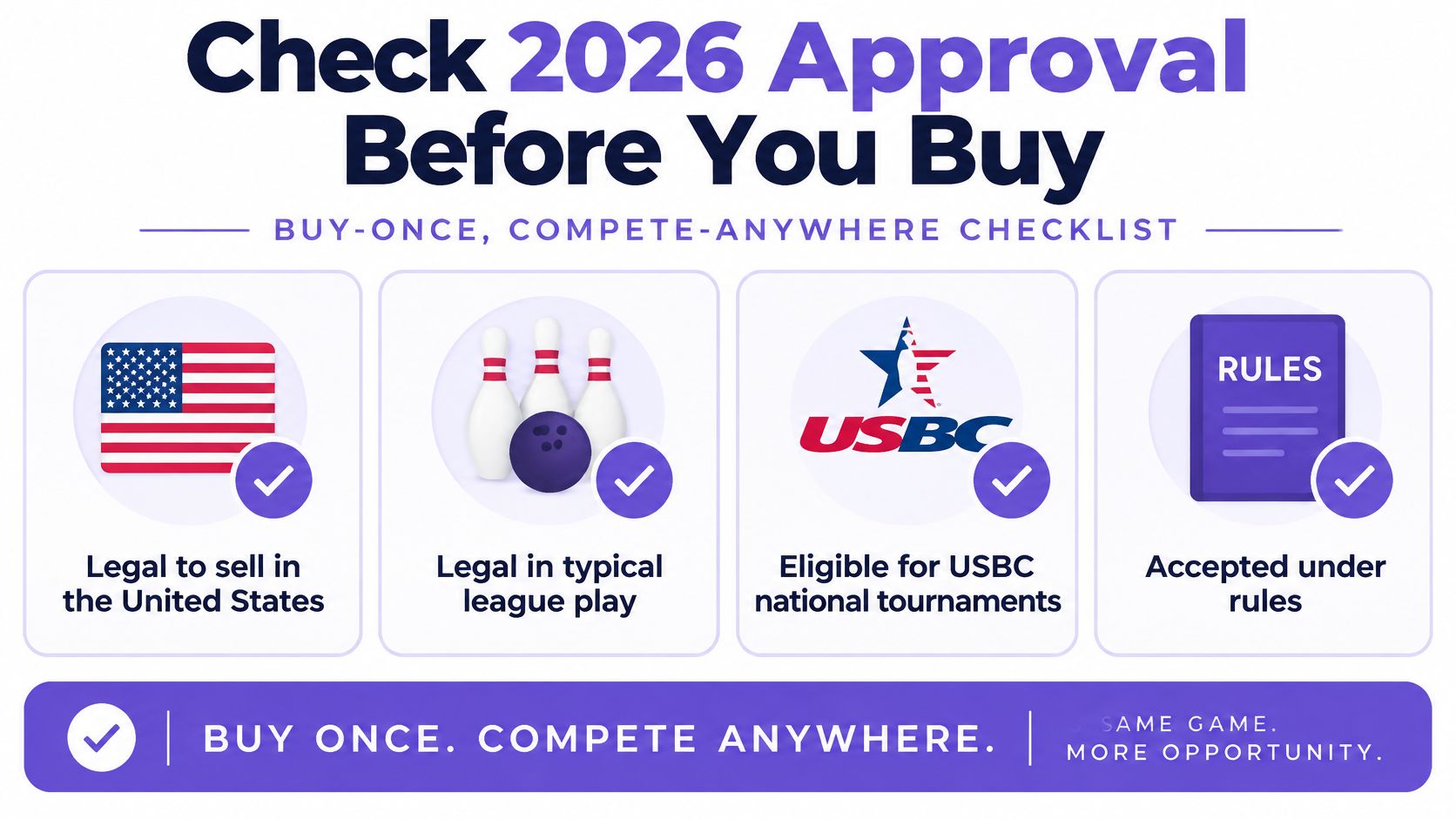
Four Legality Levels for 2026
| Level | What it requires | How to check |
|---|---|---|
| Sold in the United States | Approved for sale; new slow-absorbing high-performance balls with absorption above 90 minutes need 78D hardness from December 31, 2025 | Date-stamped approval and Approved Ball List entry |
| League play | Accepted under your league rules; older approved balls can stay legal | League rule sheet and ball approval status |
| USBC national tournaments | Individual events can restrict or ban slow-absorbing urethane beyond the base approval rules | Event rule sheet for each tournament entered |
| Outside the United States | Accepted under local federation rules | Local governing body rulebook |
Urethane is the flashpoint because control players rely on it for short and sport patterns. If you're weighing that route, read our guide to urethane bowling balls and match the specific model to current hardness and event rules before you buy.
Grandfathering is where bowlers get caught. An older approved ball can stay legal in typical league play while a specific national tournament bars it. League acceptance does not travel with you into a stricter event.
Your Four-Item Checkout Check
- Date-stamped approval: Confirm the exact model appears on the Approved Ball List and note the approval date.
- Coverstock class: Determine whether the ball counts as a slow oil-absorbing high-performance model. The label on the box alone doesn't settle that.
- Hardness where it applies: If it's slow-absorbing urethane, verify the 78D requirement for new balls in that category.
- Event rule sheet: Check every tournament you plan to enter, because event policy can be stricter than basic equipment approval.
Stay inside the legal weight limit too. Weight compliance and model approval still leave tournament eligibility open.
Basic approval is not the same as tournament eligibility. Check the event sheet before you drill, not at check-in.
Verify all four levels and the buy-once-compete-anywhere plan holds. Skip one, and you're gambling that a tournament director reads the rule the way your pro shop does.
Which Ball to Buy for Your Level
Match the ball to the bowler standing on the approach today, not the bowler you hope to become by next season. A ball you can't control now won't teach you a better release.
We publish reviews of bowling balls, shoes, and accessories, and brands don't influence our reviews. We also provide easy-to-understand explanations of bowling technology and gear, so use the scenarios below as buying rules you can verify on the lane.
First Custom Ball and Spare Shooting
Start with polyester or a mild entry reactive on a dry-to-medium house shot. You'll learn targeting and spare angles without fighting backend snap. Plan a hybrid reactive later, after your release repeats.
Keep strike balls off corner pins. Use polyester or a mild reactive for spares so a small miss doesn't hook away from a 10-pin or 7-pin. Your signal that it's working is simple. The ball holds its line through the backend and your spare conversion stops depending on luck.
Gift buyers should copy this logic. Prioritize a weight the bowler can control and a pro-shop fitting over a flashy coverstock. A well-fitted entry ball beats a strong ball drilled from a guess.
League Upgrade for Lower Revs and Higher Speed
Choose a hybrid reactive for medium oil if you're speed-dominant or lower-rev. It gives you enough traction to reach the pocket without the skid you get from a polished pearl that pushes past the breakpoint. You'll see a rounder, earlier read and fewer washouts.
Skip the strongest pearl here. On a fresh house shot it might recover, but as oil carries down it'll go longer before it moves. That late move looks powerful and carries poorly.
The right result is a repeatable breakpoint and fewer flat corner pins. If your pocket hits start leaving the same corner pin every game, you don't need more hook. You need better entry angle and continuation.
Heavier Oil and Short Sport Patterns
On fresh heavier oil, a bowler with speed and revs can justify a strong pearl in the Nuclear Forge class. Accept it only if your 20-shot test shows recovery without burning up in the front. If it reads at your feet by game two, put it away or don't buy it.
On short sport patterns, urethane gives you control when reactive resin wants to jump. Before you commit, apply the regulatory warning in the USBC guidance on slow oil-absorbing high-performance balls, which states that beginning December 31, 2025, new slow oil-absorbing high-performance balls with oil-absorption times above 90 minutes must meet a 78D hardness standard to be approved for sale in the United States. USBC also reports that slow oil-absorbing urethane balls represented approximately 6% of U.S. sales in 2025.
That small share matters. Urethane is a specialist control tool, not a default first performance ball. Buy it for a defined pattern problem, not because a televised final made it look easy.
When Not to Buy
- Overreaction off dry: Don't buy a stronger reactive if your current ball already jumps when it exits the pattern. More surface and more flare make that miss bigger.
- Early midlane hook: Don't buy a low RG solid if your ball starts hooking before the arrows on your normal shot. You'll lose energy and hit flat.
- Developing release: Don't buy a high differential pearl to fix inconsistent hand position. It amplifies release errors instead of hiding them.
Reactive resin is common in league bags, but popularity isn't a fitting method. Treat it as a reason to check fit carefully, not as proof that every bowler needs the strongest reactive cover available.
Buying signal: Buy when a ball narrows your miss. Pass when it only makes your good shots look bigger.
Set Weight Surface and Layout for Your Release
Set the ball up in order. Weight first, factory surface second, layout third. If you change all three at once, you won't know what fixed the miss.
Our site offers guides on choosing the right ball, weight, and style, because these decisions interact. A great coverstock at the wrong weight still produces a bad swing.
Step 1 Choose a Weight You Can Repeat
Stay at or under the legal maximum and choose a weight you can swing without dropping your elbow or muscling the downswing. Don't jump to the heaviest option just because it's allowed. Newer bowlers often control a slightly lighter ball better for a full three-game set.
Confirm the choice with your pro shop while they watch your swing. If your wrist breaks down early or your shoulder pulls across your body, the ball is too heavy for repeatable form, regardless of what a chart says.
Step 2 Test Factory Surface Then Change One Grit
Start at the factory finish for the first session. Log 20 shots before you touch an abrasive pad. That gives you a baseline for breakpoint distance and carry.
Then make one grit change at a time and retest. Go duller if the ball skids past the breakpoint and hits light. Add polish or use a finer finish if it reads too early and hits high.
Clean the coverstock after league. Oil absorption changes reaction over time, so a dirty reactive ball can lose the motion you tested. Wipe it during play and use an approved cleaner after the set.
Step 3 Let Layout Follow Your Release Numbers
Read up on bowling ball drilling layouts before your drilling appointment, but don't bring a catalog layout and demand those numbers. Your pro shop should set the layout from your positive axis point, speed, and rev rate.
A pin-up style layout generally lengthens motion. A stronger pin-to-PAP layout generally adds flare. Those tendencies only help if they suit your release.
Speed and rev mismatches expose bad setups fast. A low-rev player on a strong low-RG pearl often sees the ball quit or hook too late. A high-rev player on dull urethane can read the lane too soon and lose drive.
Change one variable, throw 20 shots, then decide. Two changes at once turns testing into guessing.
Use a one-session plan. Throw the factory finish, make one surface tweak only if the miss is consistent, then stop changing variables. Before drilling, confirm the approved ball passes your legality check for the events you bowl.
Ready to narrow the best bowling balls on the market down to the role, surface, and approval status that fits your league or tournament schedule? Visit Bowling Gear Reviews for hands-on ball reviews, drilling and weight guides, and lane-condition picks you can verify with your own 20-shot test. Bring your target pattern and release numbers, compare the shortlisted roles, and buy the ball you can repeat when the lanes transition.
