

You throw a clean shot in the first game, watch the ball recover from the outside, and assume you've found the right piece. Then game three arrives. The same ball starts up sooner, the breakpoint looks sharper, and the pocket suddenly feels smaller. That's why choosing the best bowling balls for house shot play isn't a matter of buying the ball with the biggest hook rating. It's a matchup decision built around your speed, rev rate, axis rotation, surface, and how quickly your center transitions.
A reliable house-shot setup usually starts with a readable benchmark ball, then adds a cleaner option for friction and a stronger early-read piece for oil or speed-dominant players. The table below gives you the practical starting point before we get into the details.
| Ball slot | Typical construction | Motion goal | Best use |
|---|---|---|---|
| Benchmark reactive | Symmetric core with medium-strong reactive cover | Smooth midlane read with controlled continuation | Fresh league condition and first-ball evaluation |
| Cleaner transition ball | Pearl or cleaner hybrid cover, often with a more responsive shape | Clears the front easily and stores energy | Later games when the fronts open |
| Strong early-read option | Strong solid or aggressive hybrid cover | Earlier traction and more total hook | Higher speed, lower rev rate, or oilier fresh conditions |
| Weaker control option | Lower-friction reactive or urethane-style shape | Reduced flare and calmer response | Drying lanes, jumpy backend, or high-rev matchups |
Table of Contents
- Why House Shots Feel Easy Until They Transition
- How a Typical House Shot Is Built and Why It Forgives
- What Makes a Benchmark Ball Ideal for House Shots
- Detailed Comparison of House Shot Ball Types and Motion Shapes
- Matching Balls to Your Speed Rev Rate and Style
- Setting Up Surface and Adjusting as Lanes Transition
- Our Top Recommendations for Every House Shot Need
Why House Shots Feel Easy Until They Transition
The first game of league can be deceptive. Your feet are set, the ball skids through the front, and the outside friction sends it back toward the pocket. A ball that's slightly too strong can still strike because the house pattern gives it room to recover. You may leave a few weak tens or mixers, but the reaction looks good enough to keep throwing it.
By the second game, your track area has changed. The ball may read earlier in the midlane, while oil has moved farther down the lane. A strong solid that looked stable at the start can now lose energy before reaching the pins. A shiny pearl that seemed too long early may suddenly look perfect because the front of the lane has opened.
League-tested rule: A ball that strikes on the fresh isn't automatically the right ball for the entire night. Watch how it gets to the pocket, not only whether it gets there.
That observation changes the buying question. Instead of asking for one universal winner, ask which motion gives you the clearest feedback on your center's condition. A benchmark ball is usually the most useful first test because it shows whether the lane needs more traction, more length, or less response. A cleaner option becomes valuable when your first ball starts reading too soon. A stronger option earns its place when your speed prevents medium equipment from gripping the midlane.
What your ball is telling you
If the ball skids past the breakpoint and never turns the corner, the cover may be too weak, too polished, or mismatched to your speed. If it hooks before the pocket and rolls out, the ball may be too strong for the friction you're creating. If it jumps sideways when you miss right, you need a smoother shape, a surface change, or a less aggressive cover.
Beginners often benefit from a forgiving benchmark reaction because it makes misses easier to interpret. Intermediate bowlers usually gain more from owning two distinct shapes than from replacing a usable ball with a slightly stronger version of the same shape. High-rev players may need to start cleaner than their league teammates, while speed-dominant players often need earlier traction.
The useful test is simple. Can you repeat the shot, identify the miss, and make a small adjustment without the ball changing personality? If yes, you're close to the right house-shot match.
How a Typical House Shot Is Built and Why It Forgives
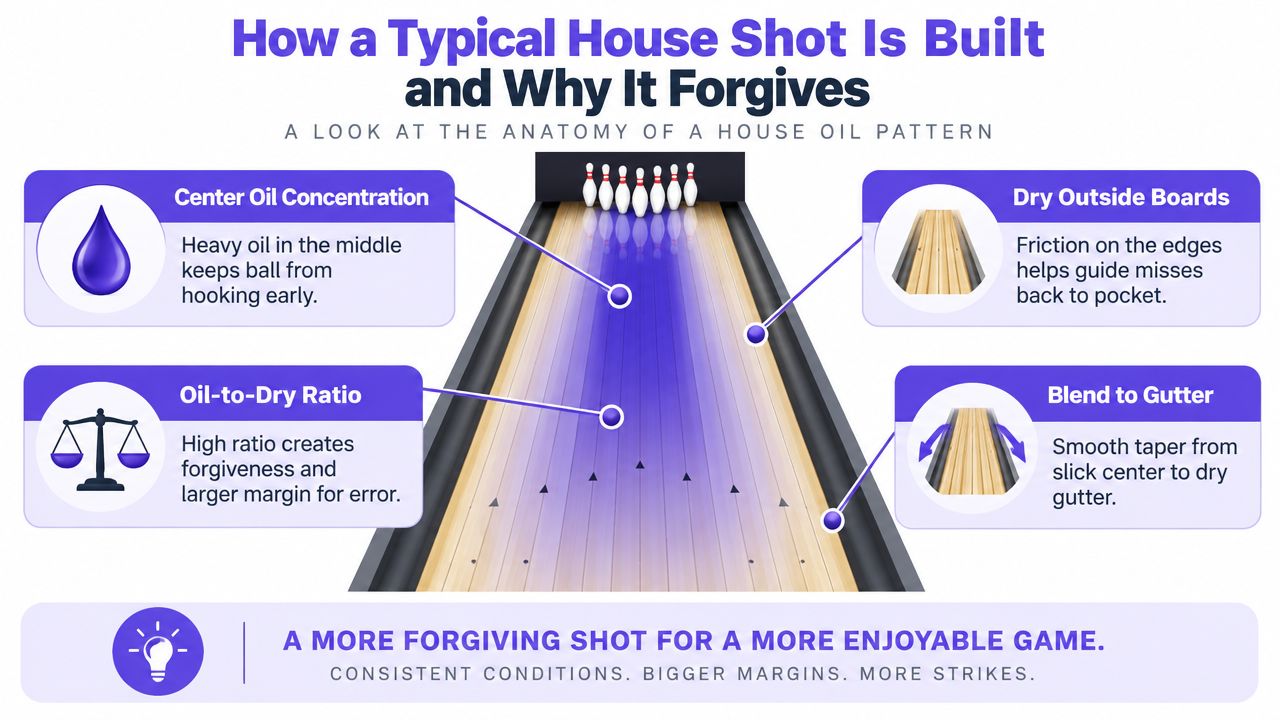
A house shot generally places more conditioner in the middle of the lane and less toward the outside boards. A common oil-to-dry ratio is around 10:1, so the middle can carry roughly ten times as much oil as the outside boards, as described by the National Bowling Academy's explanation of oil distance and volume. That creates a natural relationship between skid in the center and friction near the edge.
The practical effect is a funnel. A shot that misses slightly inside sees more oil and tends to skid longer. A shot that misses slightly outside encounters friction and can turn back toward the pocket. The lane doesn't make every bad shot good, but it gives bowlers more recovery room than a flatter pattern.
Reading the pattern in practical lane terms
House patterns are commonly described as roughly 36 to 42 feet long, with total conditioner often in the neighborhood of 18 to 25 mL, and several references clustering around 22 to 24 mL, according to the National Bowling Academy source linked above. Sport patterns are often cited at 25 to 32 mL or more, while The Sport of Bowling's oil-pattern overview also describes house shots as using substantially more oil in the middle third than on the outside boards.
Those figures matter because they point toward a specific motion shape. You generally want the ball to clear enough of the front, read the midlane without hesitation, and continue through the pins after using the outside friction. A ball that is too weak may skid beyond the useful friction. A ball that is too strong may burn up before it reaches the pocket.
The house shot rewards controllable hook, not maximum hook. That's why medium-strength reactive balls are such common starting points for league play. They provide enough traction to read the center oil while allowing the bowler to use the dry boards without creating an uncontrollable sideways move.
Why the strongest ball often misses the point
An aggressive asymmetrical ball can look impressive on the fresh, especially if it creates a large move at the breakpoint. But large movement isn't the same as useful movement. If the ball starts too early, it can lose continuation. If it responds too sharply, small targeting errors become amplified as the lane dries.
A smoother benchmark shape gives you better information. It shows whether you need to move your feet, change your target, add surface, or switch to a cleaner cover. That feedback is more valuable than raw hook when the condition is forgiving but constantly changing.
What Makes a Benchmark Ball Ideal for House Shots
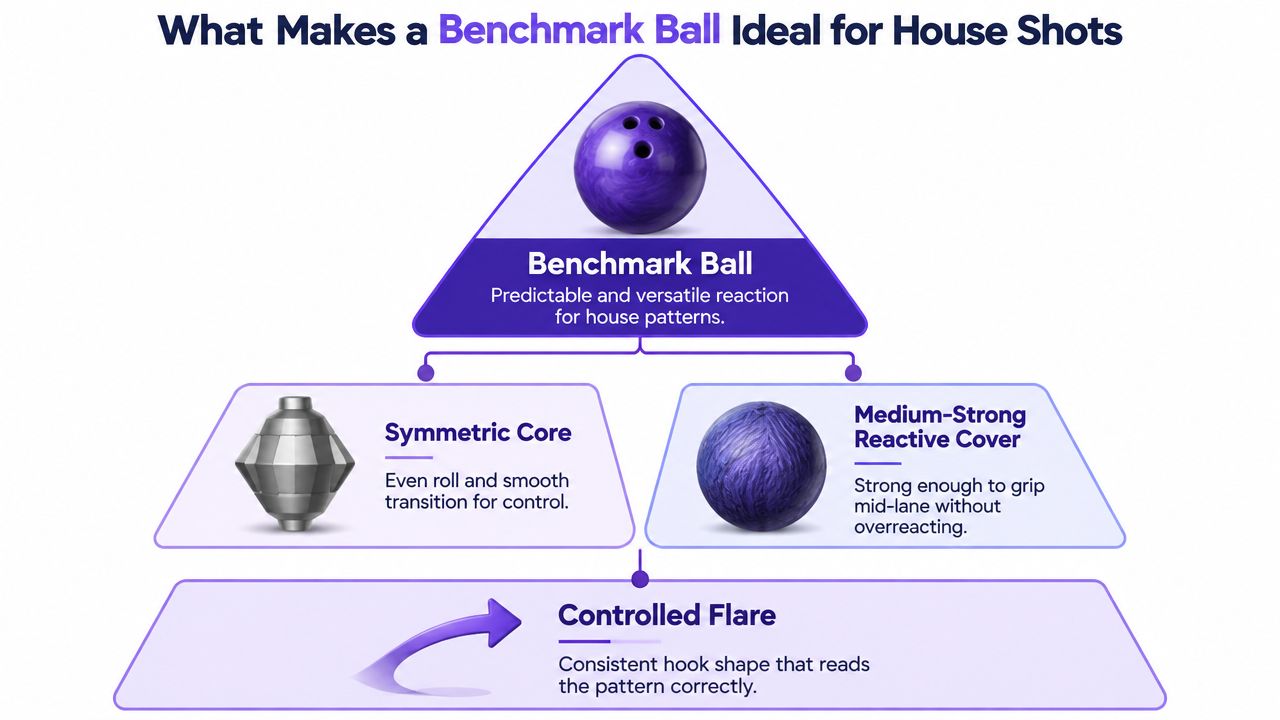
A benchmark ball earns its place by giving you a clear read, not by producing the most hook. On a typical house shot, it should clear the front cleanly, read the midlane without hesitation, and continue through the pins after using the outside friction. That predictable shape helps you judge whether the next move should involve your feet, target, surface, or ball change.
For many league bowlers, a symmetric core paired with a medium-strong reactive coverstock is a practical starting point. The symmetric core usually produces a smoother, more even roll, while the cover creates enough traction to read the midlane. That combination reduces the sudden skid-to-flip reaction that can make dry outside boards difficult to control.
The numbers that help you evaluate the slot
For a 15-pound ball, useful benchmark targets often fall near 2.48 to 2.52 RG and approximately 0.045 to 0.052 differential, with surface preparation around 2000 to 4000 grit, according to Storm's arsenal-building resource. Treat those figures as selection ranges, not guarantees. Layout, cover chemistry, release, speed, and lane surface still determine the reaction you see.
RG describes when the ball tends to begin revving. A lower RG generally supports an earlier start, while a higher RG usually creates more length. Differential describes flare potential. A higher differential can produce more flare and overall hook, provided the cover and layout allow the ball to use it.
Surface is the easiest variable to adjust. More texture helps the ball read earlier and smooths the response. A cleaner or more polished finish preserves energy through the front and delays the response. The right surface depends on your rev rate, speed, and how quickly the fronts transition. Too much texture can create early roll and leave weak continuation. Too little can send the ball too far before it finds the pocket.
A benchmark checklist
Use these points when comparing a ball or discussing options with a pro shop operator:
- Core shape: A symmetric design is usually the safer starting point for predictable house-shot motion.
- Cover strength: Medium-strong reactive material should grip the midlane without creating an oversized move off friction.
- RG fit: Choose earlier or later revving characteristics based on your speed and rev rate.
- Differential fit: Moderate flare can provide useful traction without making the ball overly sensitive to dry.
- Surface range: A finish between 2000 and 4000 grit gives you room to tune midlane read and backend response.
The right benchmark ball is the one that keeps the lane readable as your matchup changes. A higher-rev player may need a smoother, earlier read, while a speed-dominant player may need more traction or a lower-RG option. Start with the ball that shows a controllable shape, then use RG, differential, and surface to fine-tune when the house shot begins to transition.
Detailed Comparison of House Shot Ball Types and Motion Shapes
The three most useful house-shot slots differ less by marketing category than by where and how they create motion. A benchmark reactive ball blends traction and continuation. A cleaner pearl or hybrid stores energy for transition. A stronger solid or aggressive hybrid starts sooner and can stabilize the lane for bowlers who create more speed than hook.
| Ball slot | Cover and core profile | Ideal surface and motion | Best house shot moment |
|---|---|---|---|
| Benchmark reactive | Medium-strong solid or strong hybrid cover, commonly paired with a symmetric core | Medium surface, smooth midlane read, controlled backend | Fresh condition and first-ball evaluation |
| Cleaner transition ball | Pearl or cleaner hybrid cover, with a core selected for length and response | Cleaner surface or polish, longer skid and faster breakpoint | When the fronts begin to hook and the benchmark loses energy |
| Stronger early-read option | Strong solid or aggressive hybrid, often with more flare potential | More texture, earlier traction, smoother total shape | Fresh oil, higher speed, or players needing help creating hook |
| Weaker control option | Lower-friction reactive or urethane-style construction | Smoother response with reduced total hook | Dry friction, jumpy backend, or high-rev players |
Benchmark reactive
This is the most useful general-purpose slot because it gives you a stable baseline. A symmetric benchmark with moderate differential can read the center without forcing you too far inside. The trade-off is that it may become too early once the heads dry, especially for bowlers with strong rev rates or high axis rotation.
Cleaner pearl or hybrid
The transition ball clears the front more easily and saves energy for the breakpoint. It works when the benchmark begins to hook before the intended breakpoint or rolls through the pins without enough continuation. The cost is reduced traction on fresh oil. If you start with a cleaner ball before the lane has opened, it may skid too far and leave weak pocket hits.
A cleaner ball fixes early hook only when the front of the lane is the problem. It won't fix a poor launch angle or a release that sends the ball into the wrong part of the pattern.
Stronger solid or hybrid
The stronger option helps bowlers who have high speed, lower rev rate, or difficulty creating enough midlane traction. It can also provide a useful fresh-lane shape when a benchmark ball never establishes a readable roll. The downside is carrydown sensitivity and energy loss. On a drying house shot, stronger equipment can start hooking too soon and cost pin continuation.
Bowlers comparing a reactive option with a lower-friction choice should also review the practical differences discussed in this urethane bowling ball guide. Urethane-style shapes can calm down the backend, but they aren't a universal substitute for a reactive benchmark ball. The correct choice depends on whether you need earlier control or later recovery.
Matching Balls to Your Speed Rev Rate and Style
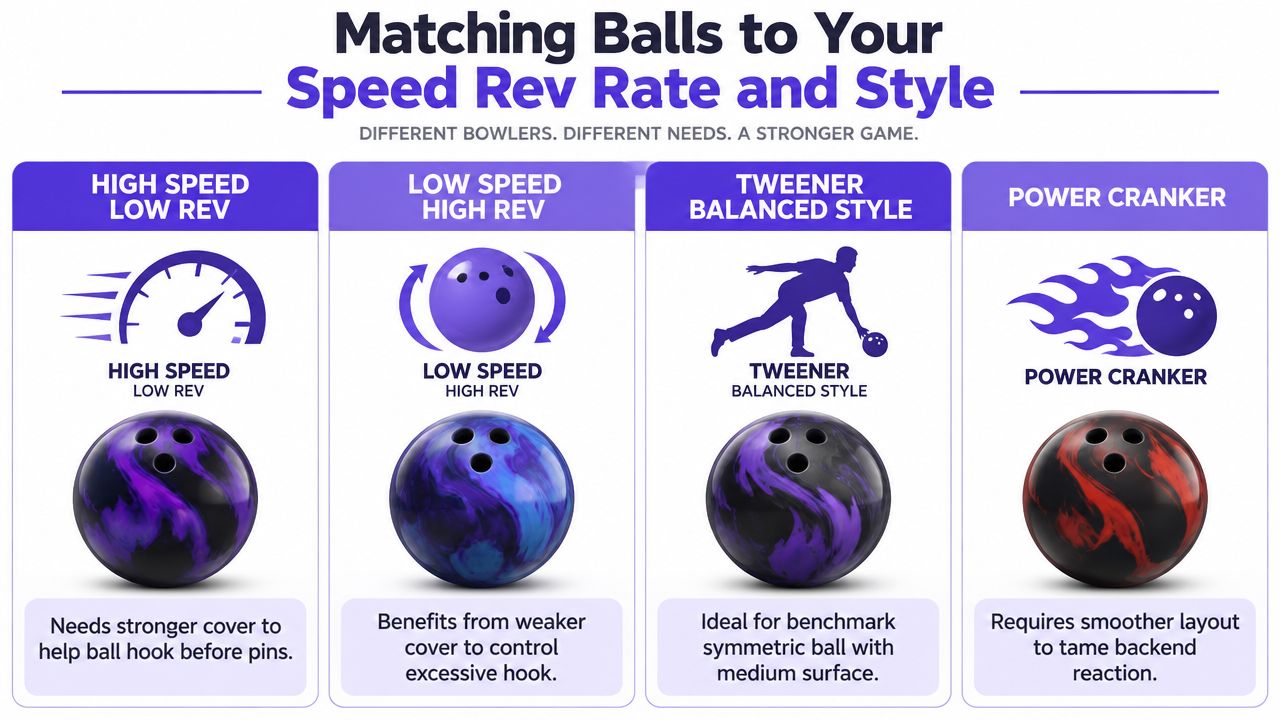
The same ball can look lazy for one bowler and uncontrollable for another. Speed determines how long the ball stays in the oil. Rev rate determines how quickly it changes direction and how much friction it can create. Axis rotation influences whether that stored energy produces a smooth arc or a sharper breakpoint.
Lower-rev stroker
A lower-rev player often needs help creating traction. A benchmark reactive with some surface is a sensible starting point because it can read the midlane without requiring an extreme launch angle. If the ball skids past the breakpoint, a stronger solid or a lower-RG option may provide the missing read.
That choice fails when the bowler's speed is lower than expected or the outside boards are already dry. In that situation, the stronger cover may hook too early and roll out. Reduce surface or move into a cleaner hybrid before changing your entire line.
Balanced tweener
A balanced tweener usually gets the clearest information from the standard benchmark slot. A symmetric core, medium-strong reactive cover, and moderate surface give this player a predictable shape on the fresh. The ball should let the bowler play a stable line, then move gradually as friction develops.
This style often benefits from adding a cleaner transition ball rather than buying a second heavy-oil piece. The cleaner option handles front-lane breakdown while preserving a familiar breakpoint shape. Layout selection can further refine that reaction, and the practical differences are covered in this bowling ball drilling layouts guide.
Higher-rev cranker
High-rev players create their own friction, so a strong ball can become too much very quickly. A cleaner hybrid, polished weaker reactive, or controlled benchmark surface may offer better pocket control. The goal isn't to eliminate hook. It's to delay the hook enough that the ball retains energy.
A high-rev bowler should be cautious about low RG and high differential combinations. Those specifications can increase early revving and flare, which may produce an exciting look for a few shots and then disappear as the heads burn.
High speed with low revs
Speed-dominant players often need a stronger cover or more traction to prevent the ball from floating through the lane. A solid benchmark with surface can create a better midlane read than a shiny pearl. If the ball still doesn't turn over, a stronger early-read option is reasonable.
The warning is simple. Don't keep adding strength after the ball begins to roll out. Once the ball is using too much energy before the pins, move to a cleaner shape or adjust your line before buying more hook.
Beginners should prioritize a controllable benchmark over a highly angular ball. Forgiveness comes from a shape that recovers without overreacting, not from the largest possible hook rating.
Setting Up Surface and Adjusting as Lanes Transition
Start with the ball's box finish, but don't treat that finish as permanent. A benchmark ball that reads too late may need more texture. One that grabs the lane too soon may need a cleaner surface or light polish. The right adjustment depends on whether the problem appears in the midlane or at the breakpoint.
Verify the first game
Watch three parts of the reaction:
- Front-lane read: Does the ball clear the heads, or does it begin hooking before it reaches the intended target area?
- Breakpoint shape: Does it respond smoothly, or does it jerk when it reaches dry boards?
- Pin continuation: Does it drive through the pocket, or does it roll forward and lose energy?
Make one change at a time. Move your feet and target before changing balls if the ball is still reading the lane correctly. A small move inside can help you find more oil while preserving the same shape.
Respond to the transition
As the front dries, the benchmark may begin hooking early. Move inside and direct the ball through a little more oil. If the ball still reads too soon, try a cleaner surface or switch to the pearl or hybrid transition slot.
Carrydown creates the opposite problem. The ball may skid too far, then respond late or leave weak corners. A small move toward friction, a speed adjustment, or more surface can restore the midlane read. If the backend becomes jumpy, a weaker cover or calmer shape may improve carry even if it produces less total hook.
The key question is whether the ball is too strong or whether you're standing in the wrong place. Stronger equipment isn't a replacement for lane movement. On a house shot, changing your feet and target often preserves more control than immediately reaching for the most aggressive ball in your bag.
Our Top Recommendations for Every House Shot Need
For most league bowlers, start with a benchmark symmetric reactive ball featuring a medium-strong cover, moderate differential, and surface that creates a smooth midlane read. A practical benchmark range is 2.48 to 2.52 RG with approximately 0.045 to 0.052 differential in a 15-pound ball. Treat those numbers as a starting framework, not a promise of identical motion.
Choose the most repeatable benchmark shape you can control. Beginners gain more from predictable reaction while learning speed, targeting, and release consistency than from maximum flare or dramatic backend movement.
Your matchup depends on rev rate, ball speed, and when the lane transitions. If the benchmark begins hooking before the breakpoint in later games, a cleaner pearl or hybrid transition ball can clear the worn front and retain energy. That same ball may skid too far on the fresh, where a stronger read is needed.
Higher-speed bowlers or players who struggle to create midlane traction may need a stronger solid or early-read hybrid with suitable surface. High-rev bowlers often need the opposite response, such as a weaker reactive or smoother option when the backend becomes too quick. RG, differential, and surface let you tune these choices without changing your entire approach.
Keep a value-conscious setup focused on problems you encounter. Start with one benchmark, then add the ball that addresses your most common transition issue. For broader planning across changing environments, consult this guide to bowling balls for all lane conditions.
Bowling Gear Reviews publishes independent bowling-ball comparisons and practical buying guides covering coverstock, core design, surface, motion shape, and lane-condition fit. Visit Bowling Gear Reviews to compare house-shot equipment based on your game rather than a hook rating.
