

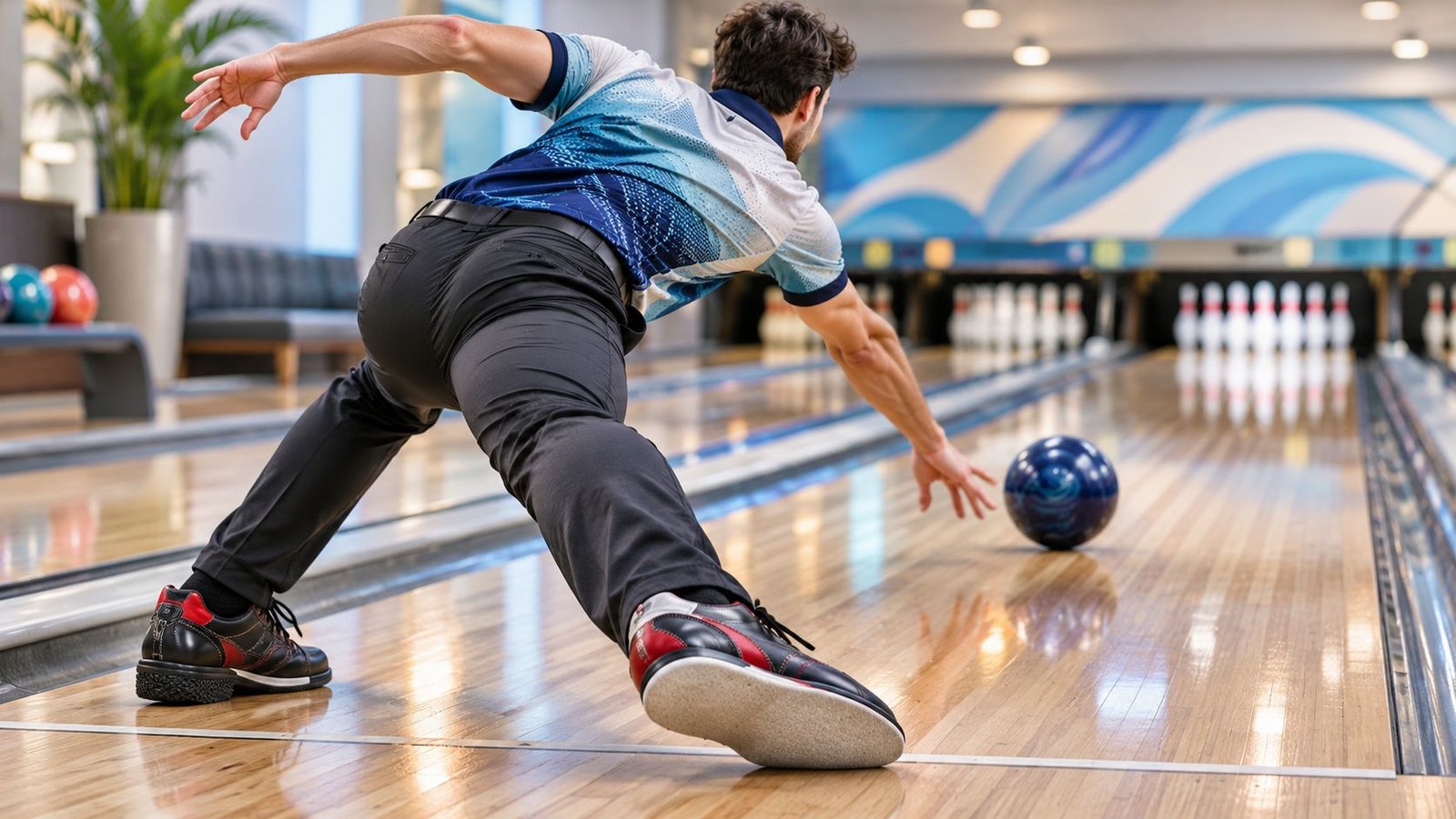
If your bowling shoes fit, why does the last step still feel wrong?
Most buying advice starts with size. For a left-handed bowler, that's the wrong first question. The slide foot decides whether the finish is smooth or a fight. A pair that is merely universal, or merely the right length, can still wreck the approach, which is the gap most comparison guides skip.
A conventional left-handed delivery finishes with the right foot moving under the body and the left foot braking. Left-handed bowling shoes exist so those two jobs stay on the correct feet. What follows walks through the layout, the shoe types people mix up, fit, and how to match a slide pad to the approach in front of you.
Table of Contents
- Which Foot Does What in a Left-Handed Shoe
- Does Handedness Really Change Bowling Shoe Design
- Handed, Universal and Convertible Shoes Compared
- How Fit Changes Slide and Stopping Control
- Diagnose Slide Problems and Match a Pad
- Choosing Your Left-Handed Pair Before You Buy
Which Foot Does What in a Left-Handed Shoe
In a left-handed delivery, the right foot becomes the slide foot, and the left foot supplies push-off and braking.
That is the mirror of a right-handed finish. You don't change the physics of the approach. You change which shoe has to keep moving and which shoe has to hold. USBC coaching guidance treats the inside edge of the right shoe as the alignment reference for left-handers, because that edge travels with the slide.
| Foot | Role in a left-handed finish | Shoe component | Problem if reversed |
|---|---|---|---|
| Right foot (slide foot) | Slides under the body as the ball is released | Slick slide sole or interchangeable slide pad | Sticks if it grips, or over-slides if too slick |
| Left foot (support foot) | Pushes off and brakes the finish | Rubber heel or higher-friction traction sole | Lateral drift and an unstable finish |
| Alignment reference | Inside edge of the right shoe, per USBC coaching | Guides the approach line | Crosswise alignment errors on the approach |
Why the slide has to keep moving
The slide foot has to continue under your body while the ball leaves the hand. If it stops early, the shoulders tip and the release gets late. The support foot does the opposite job. It resists sideways slip so the hips stay stacked instead of wandering toward the foul line.
A purpose-built left-handed performance shoe puts the slide sole on the right and the higher-friction traction sole or braking heel on the left. Wear a right-handed shoe and those parts flip. The grippy piece can meet the floor during the slide, which is how a clean approach turns into a stick. The foot that should brake may have nothing but a slick sole under it, so the finish has no anchor.
Say you take a five-step approach and the right shoe grabs on step five. The ball is still in the hand, the hips have already stopped, and you muscle the release to catch up. That isn't a timing problem you can fix with more practice. The sole is doing the support foot's job.
A three-point check on any lane
Before you blame timing, run one pass and write down three things.
- Finish: Do you stop in balance, or do you hop to stay up?
- Slide length: Does the right foot stop abruptly, or does it coast past your balance point?
- Hips: Do they drift toward the foul line instead of staying over the slide foot?
If any of those three fail, check the sole layout before you change size or width. A longer shoe won't put the slide sole on the correct foot.
Does Handedness Really Change Bowling Shoe Design
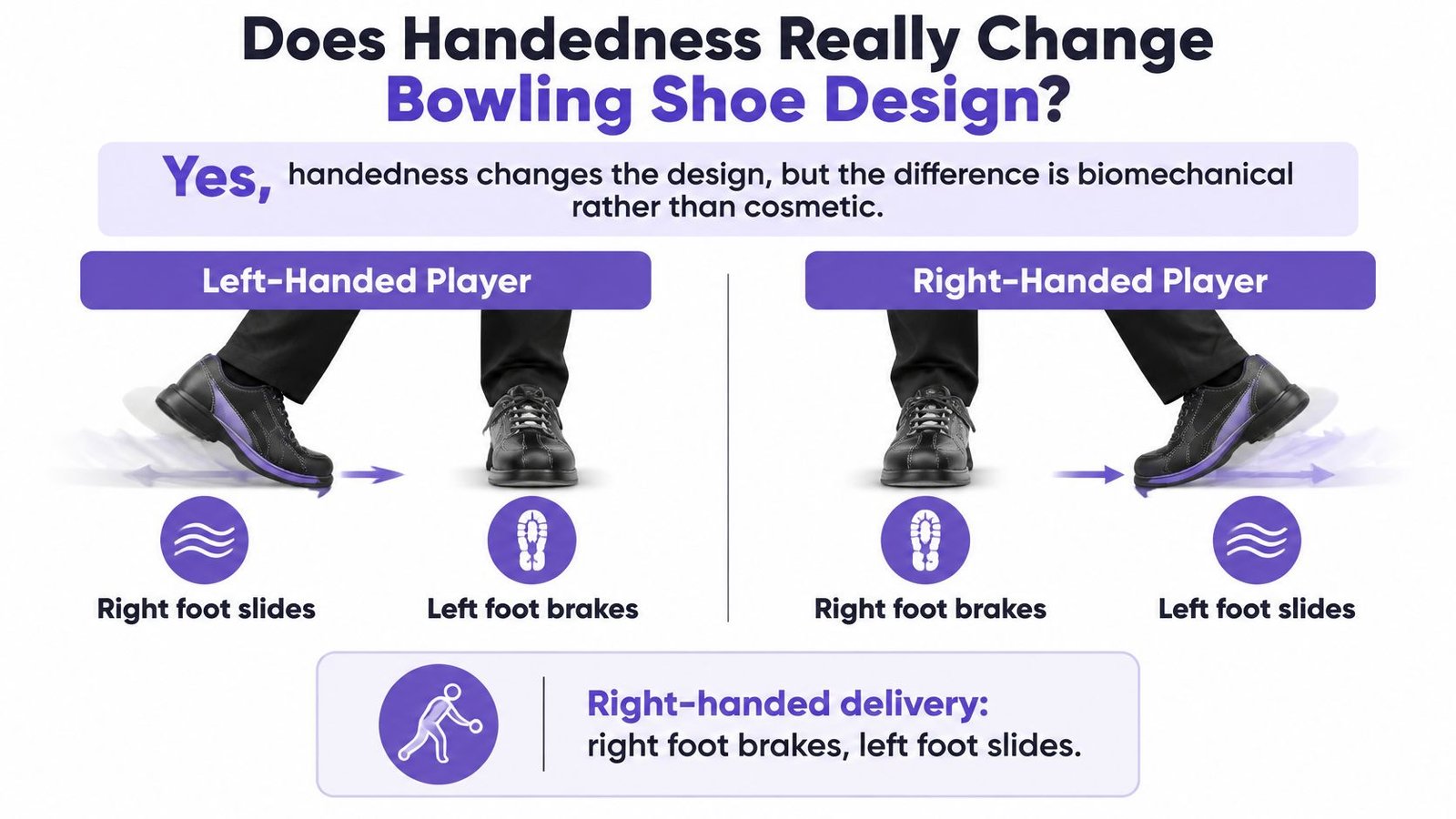
Yes. Handedness changes the design, and the difference is biomechanical, not cosmetic.
A left-handed delivery generally finishes with the right foot sliding while the left side supports the release, so a left-handed model places the sliding and traction parts on the opposite sides from a right-handed model. Bowling shoes aren't ordinary athletic shoes. They pair a slick sliding sole with a rubber heel for controlled braking. Swap those parts and the last step behaves differently, even if the uppers look identical.
Think of a left-handed glove or a left-handed guitar. The shape follows the hand's job, not the color of the leather. A mirrored bowling shoe does the same for the feet. Two pairs can share a brand, a size, and a price, and still send the slide in opposite directions.
The market is large enough to justify dedicated pairs. A 2020 meta-analysis that combined 262 datasets from 200 published studies covering 2,396,170 people estimated global left-handedness at 10.6%, with estimates from 9.3% to 18.1% depending on how left-handedness was defined. In 2025, left-hand bowling shoes represented 19.2% of the bowling-shoe market, according to Dataintelo.
A shoe whose layout matches the delivery lets a beginner work on a repeatable four- or five-step approach instead of correcting for the shoe.
That's the practical payoff. Predictable braking matters most while the steps are still being learned. Once the soles match the hand, practice time goes into the approach, not into fighting a shoe that wants the other foot to slide.
Handed, Universal and Convertible Shoes Compared
Universal shoes slide on both feet, while a handed performance shoe puts the slide sole on the right foot and the traction sole on the left.
"Works for either hand" is not the same claim as "optimized for either hand." The first describes a sole that glides no matter which foot leads. The second describes a sole layout built for one finish.
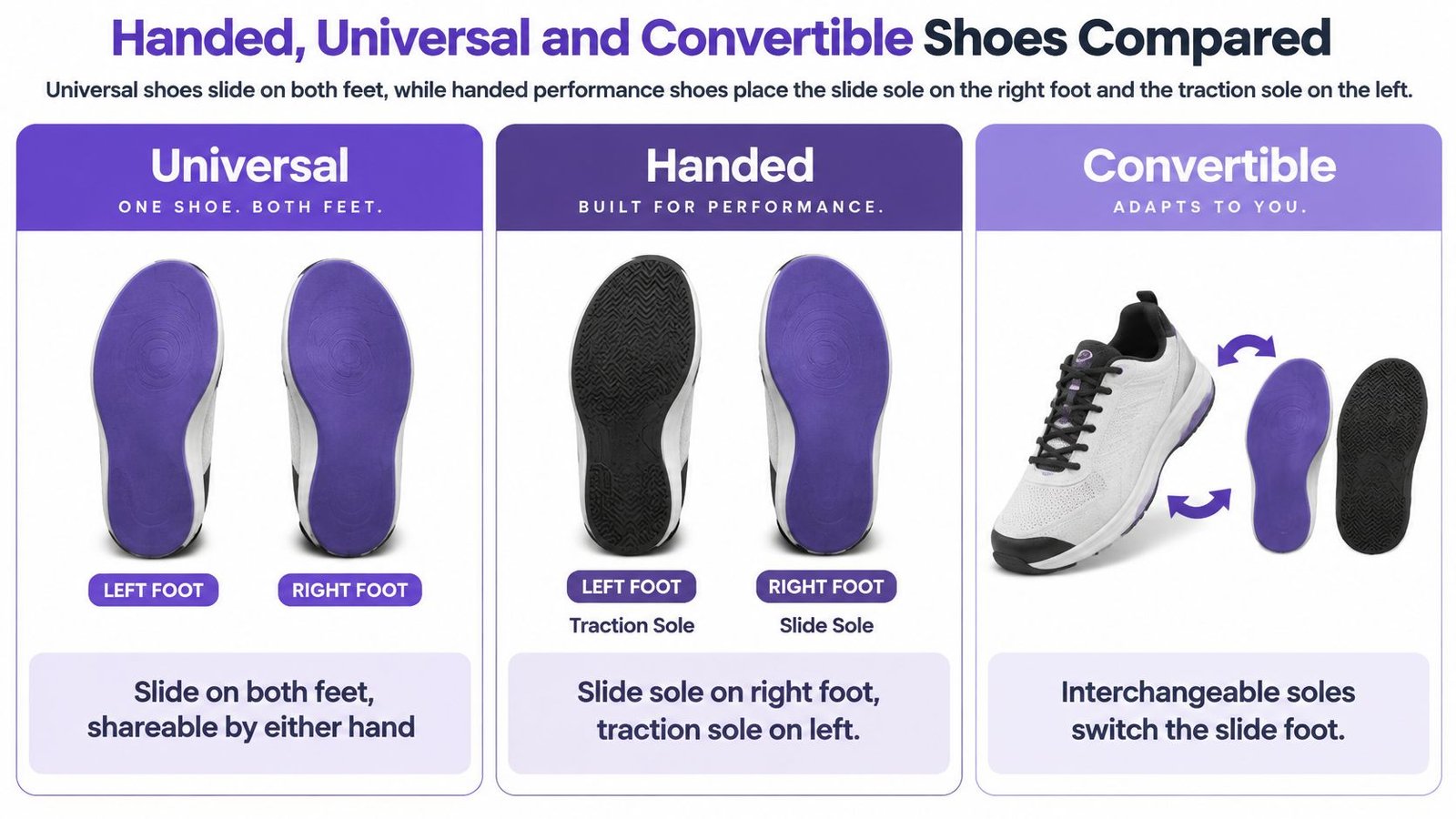
| Shoe type | Slide and traction setup | Best fit for | Main trade-off |
|---|---|---|---|
| Left-handed performance shoe | Slide sole on right, traction sole and heel on left | Conventional one-handed left-handers | Often sold in fewer sizes and widths |
| Universal shoe | Slide sole on both feet | Beginners, children, two-handed bowlers | Less braking security on the support foot |
| Convertible shoe | Swappable slide and traction components | Households, pro shops, bowlers who alternate styles | Pads and setup add expense and time |
| Right-handed shoe worn by a left-hander | Reversed slide and traction layout | Temporary use only | Mismatched function that size changes cannot fix |
Who should pick which
A conventional one-handed left-hander should choose the handed shoe, because the left foot keeps dedicated traction for push-off. Bowling.com's shoe notes point out the trade-off guides often skip. Bilateral sliding can help beginners, children, and two-handed bowlers, but it can reduce push-off security for a one-handed left-hander, since the non-sliding foot has no dedicated traction.
Universal pairs are a fair start for those groups, and they're a practical fallback when left-handed stock is thin. They aren't an optimized finish for someone who plants one foot and slides the other.
Convertible shoes, where the slide and traction parts can be swapped, suit a household, a pro shop, or a bowler who alternates styles. Some symmetrical designs let the parts move between feet. That feature isn't on every model, so read the spec before you assume you can flip the pair. Pads and the extra setup add cost and time. If you want the difference between a slide piece and a traction piece spelled out, our guide to bowling shoe soles covers how those surfaces are built.
A right-handed shoe on a left-hander is a stopgap. Changing the size can't correct a reversed sole layout, and the mismatch may force compensatory footwork until the right pair shows up.
Practical rule: If the support foot doesn't hold the finish, the shoe type is wrong for that bowler, whatever the size tag says.
How Fit Changes Slide and Stopping Control
A correct right-foot slide layout can still fail if the shoe doesn't hold the foot.
The fit targets are short, and each one changes the slide in a different way.
- Snug midfoot and heel: The foot shouldn't swim inside the upper.
- Toe room: Toes shouldn't jam, but extra length isn't a comfort feature.
- No heel lift: The heel stays down through the whole slide.
A loose shoe over-slides even when the sole is right. An unsuitable heel can stick. A narrow foot in a broad athletic last loses side-to-side stability, so the finish wobbles even though the layout is correct. Bowling shoe fit guidance stresses those three checks, and they're what separate a matched layout from a repeatable slide.
Size, width, and the house you bowl in
Size the shoe for the foot that sets the length, then confirm the fit targets on the other foot. A shoe that's too loose on the smaller foot still over-slides. If a model is too wide to hold the heel, reject it even when the length looks right.
Women and bowlers with narrow heels often meet a short list of widths in left-handed models. Prioritize heel and midfoot hold over extra toe room, and check heel retention in the store before you buy. Our bowling shoe size notes show how to measure both feet so one long foot doesn't set a sloppy fit on the other.
Humidity, approach material, and sole wear all change how far you travel. Compare a new pad with a worn one after a league-length session, and write down the distance rather than trusting the feel of one shot. Replaceable slide pads can be swapped when the surface changes. Fixed soles can't. A hand label on the box doesn't guarantee the same traction from one center to the next.
Fit faults get mistaken for timing errors all the time. If the heel lifts on the third step, fix the shoe before you rewrite the approach.
Diagnose Slide Problems and Match a Pad
The lead foot sticking at release is the complaint that shows up first. A grippy slide sole, or a tacky approach, stops the right foot before the ball is gone.
The sole that meets the approach is the part you can change without rebuilding the whole delivery.

Numbered slide pads use a simple scale. Lower numbers give more grip and a shorter slide. Higher numbers give more glide and a longer slide. Available systems can run from about S2 through S10, though compatibility is model-specific, as BowlersMart's sole and heel guide explains. On a tacky approach, install a higher-slide pad on the right shoe so the lead foot doesn't grab. On a slick approach, a lower-slide pad shortens the travel and makes the stop more predictable. Leave the left shoe's traction sole or braking heel in place unless the model is explicitly convertible.
| Symptom | Likely cause | Fix |
|---|---|---|
| Lead foot sticks at release | Grippy slide sole or tacky approach | Install a higher-slide pad on the right shoe |
| Overslide past the foul line | Slick approach or loose fit | Use a lower-slide pad and tighten midfoot and heel |
| Unstable finish or drifting hips | Support foot lacks braking, or wrong shoe handedness | Check the foot layout, then test a traction-matched setup |
| Heel lift during approach | Shoe too large or loose at the heel | Re-fit for a snug heel and midfoot |
| Slide roughens on new soles | Crosswise or excessive brushing | Brush toe to heel in the direction of travel |
One change, then a log
Change one variable at a time. A pad swap or a tighter lace can show up in a single session. A week of notes on slide distance, balance at the foul line, and the number of corrective steps tells you whether the change held across different approaches.
New slide soles need a controlled break-in. Brush from toe toward heel, in the direction of travel. Crosswise or heavy brushing roughens the surface and shortens the life of the pad. The same sequence is laid out in our break-in steps for new bowling shoes.
USBC Rule 12 prohibits substances or materials that transfer from footwear and deface the approach. Tune with approved interchangeable parts and ordinary brushing, not loose powders or anything that rubs off onto the lane.
A short clip of the slide meeting the foul line is useful as a picture of the finish, not as a pad number to copy. Then go back to your own log.
Choosing Your Left-Handed Pair Before You Buy
Use this order in a shop or while you compare models online. Each step answers a different question, so don't skip ahead to color or price.
- Name the finish you use. If the right foot is the slide foot, you're a conventional left-hander and you want a handed layout. If you bowl two-handed, or you're still learning and both feet need to glide, a universal shoe is a reasonable option. If you alternate styles or share the pair, choose a convertible.
- Confirm the parts, not the label. Right foot slides, left foot brakes, or the universal or convertible design is set up to match that delivery. A tag that says "left" doesn't help if the pads were installed the other way.
- Measure both feet. Set the length from the longer foot, then check that the shorter foot still meets the snug-heel test. One measurement isn't a size.
- Check hold before you walk the approach. Midfoot and heel should feel snug, toes should have room, and the heel shouldn't lift when you rock forward. If the heel pops, the length is irrelevant.
- Pick a starting pad for the house you bowl in most. A higher-slide pad for a tacky approach, a lower-slide pad for a slick one, and a mid-range pad when you don't know the approaches yet. You can change it later. You need a starting point tonight.
- Test several approaches and change one thing. Log slide distance, balance at the foul line, and how many corrective steps you take. If two things change at once, you won't know which one fixed the finish.
Bowling Gear Reviews publishes reviews of bowling balls, shoes, and accessories, and the gear is tested in real bowling conditions. Compare any shortlisted pair against this checklist before you decide, especially if the model comes in both a fixed sole and a swappable one.
You can start the test on your next practice game. Mark where the right foot stops, note whether the left foot held, and only then decide whether the pair in your bag is the pair you should keep.
Bowling Gear Reviews tests bowling shoes on real approaches and publishes plain reviews of fit, slide soles, and traction setups, including pairs built for left-handed deliveries. If you're sorting a first pair or replacing one that sticks or over-slides, the shoe guides and comparisons are written for that decision. Visit Bowling Gear Reviews and match a shortlisted pair to the slide foot you use.
