

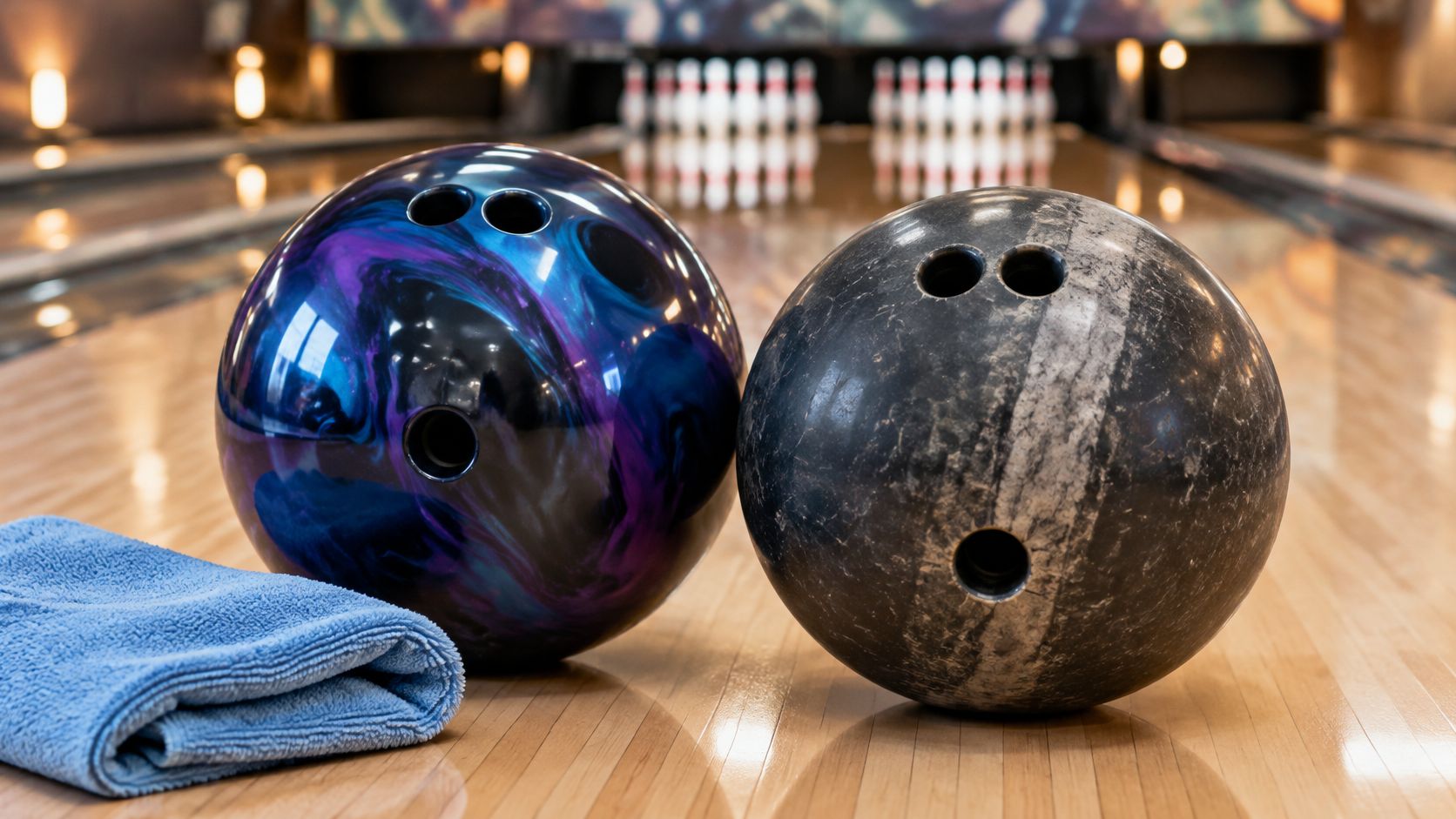
With routine care, most modern bowling balls stay effective about 5–10 years, often 100–300 games, but lost reaction can arrive long before cracks. The useful question isn't just whether your ball still rolls, it's whether it still gives you the motion you can trust.
A ball can look presentable, fit your hand, and survive every trip through the ball return while becoming harder to read on the lane. To decide whether yours needs maintenance or replacement, count the games and watch the reaction rather than judging its birthday.
Table of Contents
- What Lasting Actually Means for a Bowling Ball
- Lifespan Ranges by Coverstock and How Often You Bowl
- Why One Ball Dies Early and Another Keeps Hooking
- A Game-Count Care Routine That Adds Seasons
- How Long Balls Last for Four Kinds of Bowlers
- Resurface, Extract, or Replace This Ball
What Lasting Actually Means for a Bowling Ball
Say you bring an older ball to league night. The shell looks sound, your fingers fit comfortably, and nothing rattles or separates, but your usual shot no longer turns the corner with the same authority.
Has the ball worn out? Structurally, perhaps not. As a strike ball for your usual conditions, it may need attention.
Structural life means the ball remains physically sound. Reaction life means its cover still produces a useful, predictable response to the lane. Those aren't interchangeable, and neither can be judged from shine alone.
Think tire tread, not birthday
A bowling ball's cover is more like tire tread than a calendar. You care about the working surface, not merely how long ago someone manufactured it.
A bowler who practices frequently puts a different workload on equipment than someone who bowls occasionally. Maintenance and storage further separate those ownership experiences, even when both people bought the same model.
Practical rule: A ball isn't finished just because it's old, and it isn't healthy just because it hasn't cracked.
Before evaluating your ball, separate these questions:
- Is it safe and sound? Inspect the shell, bridge between the holes, and edges around inserts.
- Is the motion still useful? Watch where the ball starts changing direction and how it continues toward the pins.
- Is the comparison fair? Consider lane conditions, release quality, and surface preparation before blaming age.
When readers ask, “How long do bowling balls last?” they're often asking whether they should buy again. Start instead with what the ball can still do. A dependable older ball can remain valuable, even if its current role differs from the one you originally bought it for.
Lifespan Ranges by Coverstock and How Often You Bowl
How long bowling balls last by type and use
| Ball and use | Calendar estimate | Game estimate | What usually ends it |
|---|---|---|---|
| Reactive resin, league or tournament | Use condition and workload, not a birthday | Typical published performance window below | Oil absorption and persistent loss of useful reaction |
| Urethane, league | Keep while sound and predictable | Track surface condition rather than a fixed total | Track wear and surface change |
| Polyester spare ball | Keep while undamaged and properly fitted | Physical condition matters more than oil exposure | Cracks, drilling changes, or unacceptable damage |
| House ball in a busy center | Follow the center's replacement schedule | Heavy shared use, no personal game count | Damage or scheduled retirement |
| Recreational personal ball, occasional use | Published recreational estimates below | Log actual use rather than guessing from age | Neglect, poor storage, or an unrestored surface |
| Neglected reactive, no wipe or clean | Don't assign a dependable calendar life | Inspect reaction before assuming games remain | Oil in the cover and an unmaintained track |
Storm's ball-care guidance, reported by BowlingLife, gives a typical game lifespan of 100–300 games, with maintenance helping preserve performance toward the upper end. Treat that as a performance-planning range, not a warranty or an instruction to discard every ball at the same count.
Reactive resin is the performance reference
Reactive resin is the cover most likely to make you notice changing hook before obvious physical damage. If you bought it for traction and continuation, a persistent change in either can matter even while the shell remains intact.
The calendar estimate becomes less helpful as your workload increases. A tournament player can use up a ball's useful performance window much faster than an occasional bowler without either owner doing anything wrong.
Urethane needs its own evaluation. Don't assume that it has the same maintenance needs or replacement timing as a porous reactive cover. Watch its track and the repeatability of its motion rather than promising yourself a particular number of seasons.
A polyester spare ball has a different job again. You're usually asking it to travel predictably with little hook, so losing an aggressive backend isn't a meaningful retirement test. Fit, cracks, and physical damage deserve more attention.
Our bowling ball coverstock guide can help you identify which cover you own before choosing a maintenance strategy.
Calendar estimates need context
For recreational equipment, Dataintelo's bowling-market report says recreational bowling balls typically maintain performance for 3–5 years with proper care, while The Pool & Lawn gives an average of approximately 5–7 years with regular use and proper care. These are broad estimates, not coverstock-specific guarantees.
Shared house balls belong in a separate category because multiple bowlers contribute wear, and the center controls maintenance and retirement. A neglected personal reactive ball also deserves its own row, but there's no defensible universal deadline for neglect.
Choose the row that matches both your ball's job and your use. Don't transfer a spare ball's apparent durability to a strike ball whose value depends on a specific hook shape.
Why One Ball Dies Early and Another Keeps Hooking
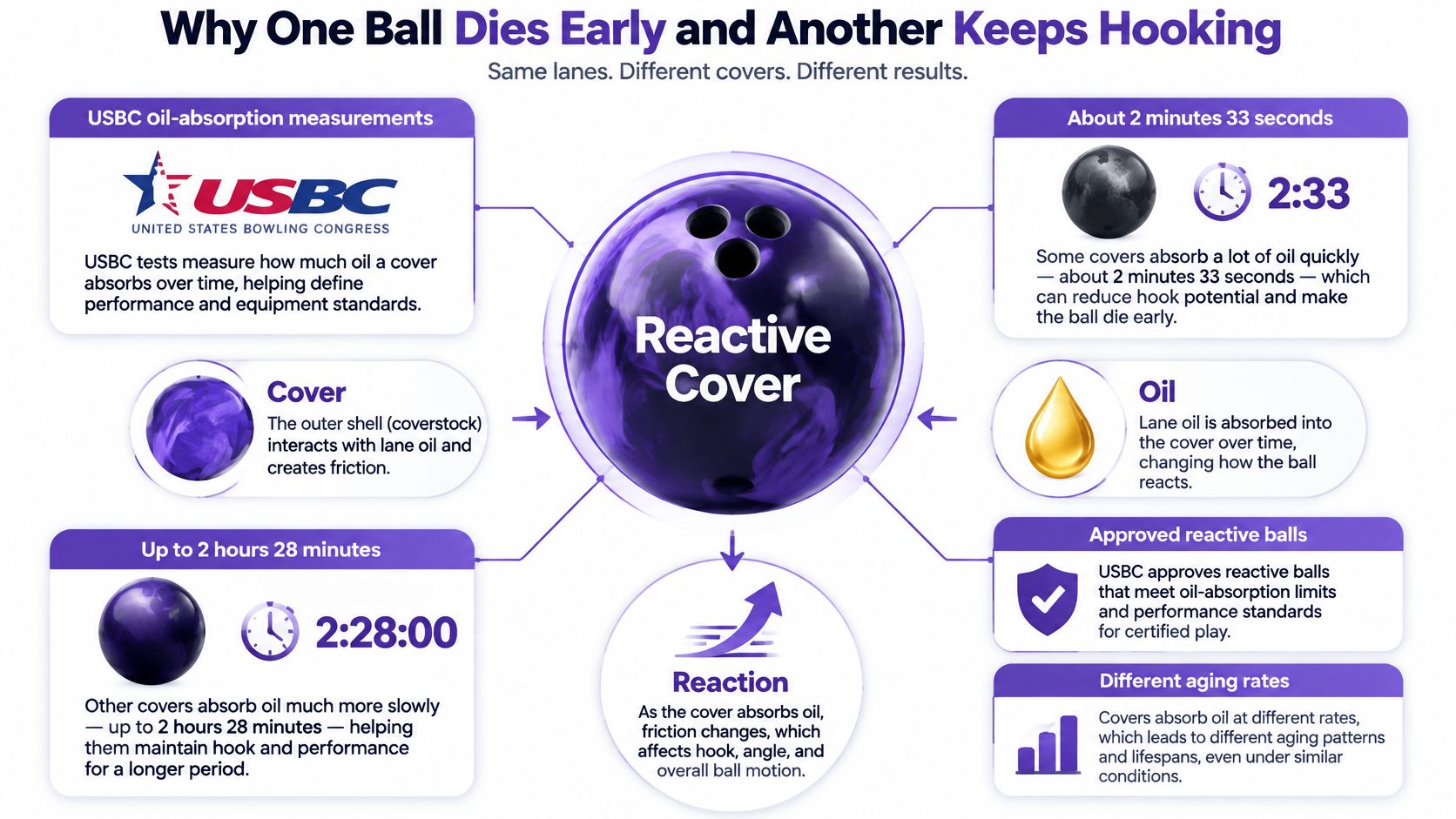
Two reactive balls can meet approval requirements yet absorb oil at very different rates. The USBC Equipment Specifications Manual records measured absorption times for approved reactive-resin balls ranging from approximately 2 minutes 33 seconds to 2 hours 28 minutes 37 seconds.
That contrast helps explain why matching maintenance to the individual cover makes more sense than giving every ball the same treatment. Those measurements aren't countdowns to failure, and they don't tell you exactly when a ball will stop hooking.
The relationship starts at the cover.
Porosity changes the maintenance burden
A faster-absorbing reactive cover generally has a more porous shell. That can support strong friction, but it also makes oil exposure an important part of ownership.
A slower-absorbing cover resists penetration longer. That doesn't automatically make it a better choice, because you still need enough traction for your speed, release, and lane conditions.
Polyester absorbs very little oil, so its owner usually has a different concern: whether the ball remains physically sound and fits correctly. Urethane should also be assessed on its own surface behavior rather than treated as interchangeable with reactive resin.
The trade-off is straightforward:
- More demanding reactive covers: Monitor oil exposure and changes in motion closely.
- Slower-absorbing covers: Match surface preparation to the traction you need.
- Polyester spare balls: Prioritize damage, fit, and dependable straight-line control.
Surface condition can imitate a dead ball
Oil isn't the only reason a familiar ball changes. Repeated contact with the lane alters the working surface, so the texture you paid for doesn't remain untouched.
Be careful with the word dull. A ball can look dull yet lack the effective texture it needs, while a shiny-looking track can indicate that a sanded surface has smoothed. Appearance is a clue, not a measurement of remaining life.
Lane conditions complicate the diagnosis further. A strong cover that reads early and uses its energy before reaching the pins can look weak at the backend without being worn out.
Less visible hook doesn't always mean less friction. Watch where the ball starts working, not just how sharply it turns at the end.
We test bowling gear in real bowling conditions because useful performance depends on the relationship between equipment and the lane. For your own checks, use a familiar condition and watch the whole motion before deciding that the cover is spent.
A Game-Count Care Routine That Adds Seasons
Maintenance is normal ownership, not evidence that you bought a bad ball. Bowlingball.com's life-expectancy guidance estimates roughly 5–10 years of effective use with routine care, with some balls providing 10 or more years, and recommends surface checkpoints around 10, 30, and 60 games, with a broader 60–80-game resurfacing interval.
Use those checkpoints as prompts to inspect and maintain your equipment, not as reasons to change a surface that's working without considering the consequences.
Bowling ball care by games bowled
| Action | When | What it protects |
|---|---|---|
| Wipe oil off the surface | After use, before bagging | Removes fresh lane oil from the track |
| Clean the coverstock | After each session | Limits oil remaining on the cover between outings |
| Light polish or scuff | At the light-refresh checkpoint | Maintains the intended finish |
| Heavier texture adjustment | At the intermediate checkpoint | Corrects a track that has changed substantially |
| Full resurface and finger-insert check | At the full-service checkpoint | Addresses deeper surface wear and worn grips |
| Oil extraction | When diagnosis supports absorbed oil | Addresses oil already inside the cover |
| Room-temperature storage | Every time the ball is stored | Reduces exposure to extreme heat or cold |
Build a repeatable routine
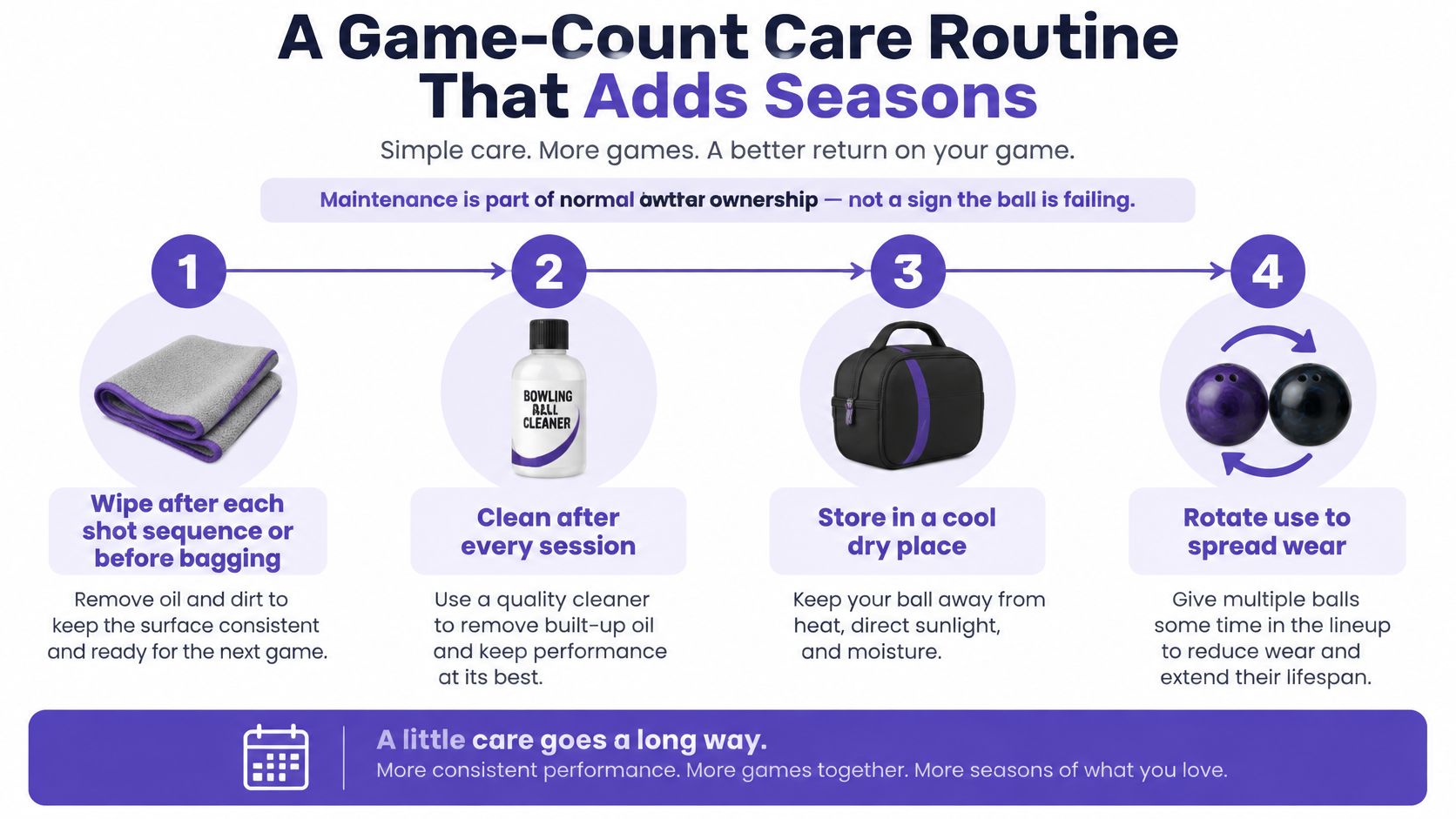
- Wipe before the oil sits. Use a dry microfiber towel or bowling shammy across the track during play and before bagging. A quick pass over one visible patch isn't the same as wiping the working surface.
- Clean after the session. Use a cleaner intended for bowling balls and a clean towel. Work around the entire cover rather than soaking the holes or leaving cleaner pooled around inserts.
- Refresh toward a target finish. Use bowling-ball abrasive pads for a sanded surface or an appropriate polish for a polished finish. Don't polish a traction ball simply because shine looks newer.
- Let the pro shop handle full restoration. Ask for a defined surface finish and an insert inspection so you leave with a repeatable reference.
The daily habits are easy to visualize.
Log the ball, not just your attendance
Keep a notebook or phone note for each ball. Record games used, cleaning, surface changes, extraction, and grip work, especially when you rotate equipment.
Store the ball at ambient room temperature rather than leaving it in a hot trunk or freezing garage. Don't use a household oven or direct heat as a substitute for controlled extraction.
Our bowling ball maintenance guide explains the care choices behind this routine. The aim is to preserve a useful reaction and recognize changes early, not repeatedly chase a factory-new appearance.
How Long Balls Last for Four Kinds of Bowlers
Your schedule determines how quickly maintenance becomes relevant. These examples show how to apply the same lifespan principles without pretending that every owner puts an identical workload on a ball.
Match your habits to the closest example.
The weekly league bowler
You use a benchmark reactive ball for league, then bring it along for practice. Because it comes out of the bag so often, it's easy to underestimate its workload if you count league nights but forget practice.
Make the ball's log part of packing up. Your action is to track actual use and book surface work before inconsistent motion becomes your normal reference.
The tournament bowler
You bowl extended blocks and switch balls as conditions change. A ball sitting in your tournament bag isn't accumulating lane wear, while the benchmark you reach for repeatedly may need attention sooner than its purchase date suggests.
A rotation helps you match conditions rather than force a tired or unsuitable reaction. Your action is to track each ball separately and plan maintenance around competition, leaving time to verify the restored motion before an important event.
The accompanying video offers another viewing point for evaluating your equipment.
The casual personal-ball owner
Your ball may spend more time stored than rolling. That makes a dramatic replacement deadline less useful than checking its condition when you take it out.
Pay attention to a changed fit, damaged hole edges, and unfamiliar motion after a long break. Your action is to inspect the ball before returning to play, then judge it on a sensible lane condition rather than replacing it because you haven't used it lately.
The busy bowling center
A house ball serves many hands, releases, and sessions. According to QubicaAMF's house-ball resources, busy centers should replace house balls every 3–5 years, or sooner if damaged.
That's an operating guideline for shared equipment, not a personal reactive-ball performance promise. The center's action is to retire damaged balls early; the bowler's action is to choose a sound ball with a usable fit rather than accept sharp chips or visible cracking.
Resurface, Extract, or Replace This Ball
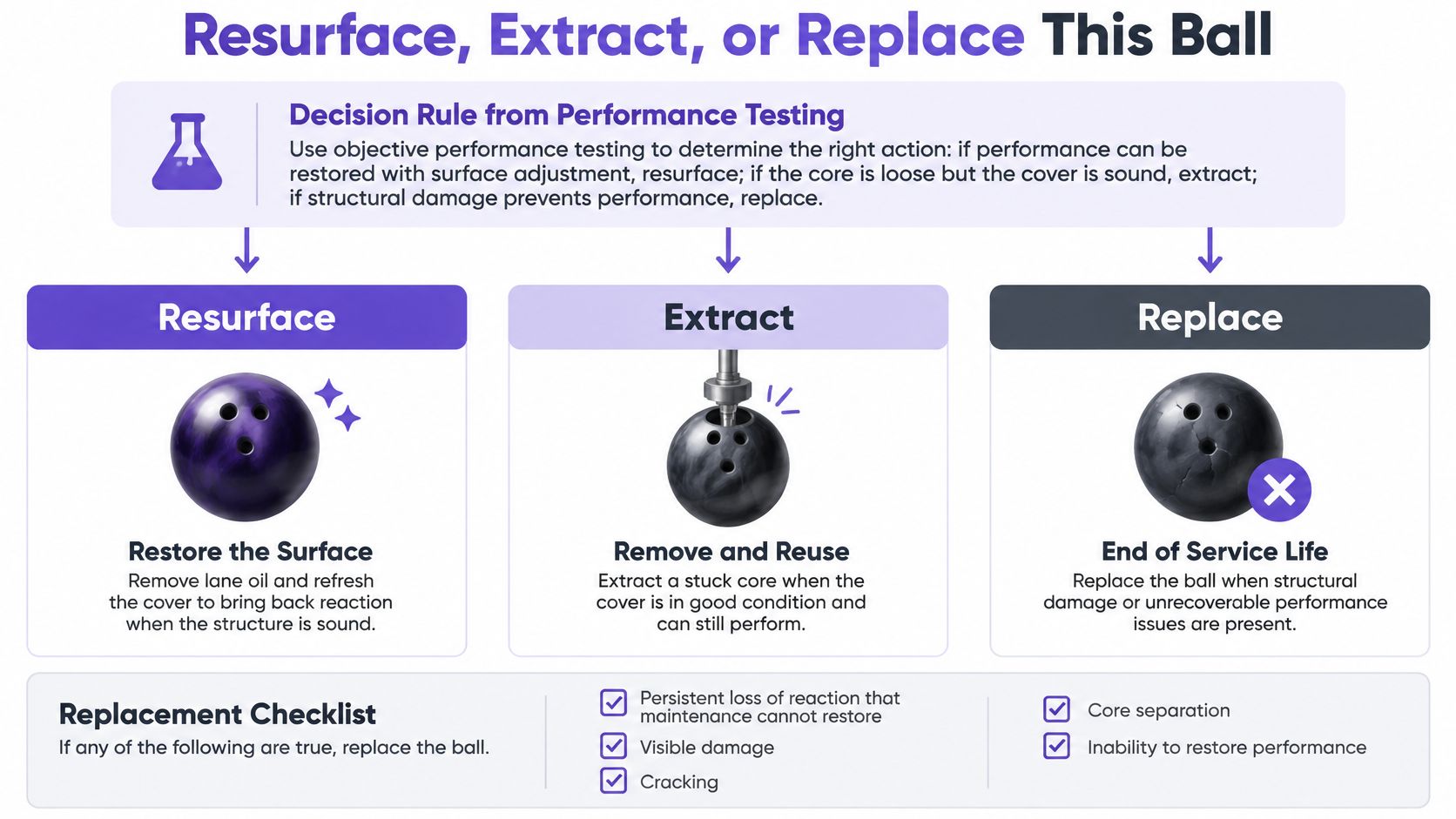
Replace a ball for unresolved performance loss or structural failure, not just because another calendar year has passed. Surface restoration and extraction are reasonable options when the shell is sound, but neither repairs a separating cover or makes a cracked ball trustworthy.
A USBC technical paper on bowling-ball performance and life found that a reactive ball with 100 games of use produced less friction and total hook than a comparable control ball. That makes the milestone a useful historical performance checkpoint, not an automatic replacement date.
Resurface, extract, or replace
| What you notice | Likely cause | Next action |
|---|---|---|
| Changed track and less hook, shell intact | Surface wear | Resurface before replacing |
| Ball stays oily and backend dies | Possible absorbed oil | Diagnose, extract if appropriate, then restore the surface |
| Grips spin or feel sloppy near the service checkpoint | Worn finger inserts | Replace inserts, keep a sound ball |
| Small chip at a hole, no running crack | Localized drilling damage | Ask a pro shop about repair or plugging |
| Hairline crack, bridge crack, or cover lifting | Possible structural failure or separation | Stop use and have it inspected for replacement |
| Motion remains unsuitable after proper resurfacing and extraction | Persistent cover-performance loss or a poor condition match | Replace for strike use; consider spare use only if safe |
Resurface when the working texture has changed
Resurfacing restores the working surface. It's the logical starting point when the track has changed and the shell remains sound.
Give the pro shop a useful description: whether the ball skids farther, reads earlier, or stops continuing through the pins. “It doesn't hook” is less helpful because several different motions can produce that impression.
Ask the shop to document the finish. Afterward, test the ball on a familiar lane condition and compare its shape with what you wanted, not just whether it hooks more.
Spend on a diagnosis before a replacement: A changed surface, a worn grip, and a failed cover are different problems with different fixes.
Resurfacing also removes cover material. It's a maintenance tool, not a process to repeat indefinitely whenever a shot misses the pocket.
Extract when oil is part of the diagnosis
Oil extraction addresses absorbed oil, not worn grips, poor fit, or an unsuitable lane match. A ball that feels oily can justify investigation, but that symptom alone doesn't prove the entire cause of a weak reaction.
Our bowling ball oil-extraction guide explains the distinction between cleaning the outside and treating oil inside the cover. A pro shop can use controlled equipment and then restore the intended surface so you're evaluating a complete maintenance job.
Don't expect extraction to recreate an unused ball. Its value is whether it returns enough predictable motion to justify keeping that ball in its role.
The decision starts with condition, then moves to recoverable performance.
Replace when repair no longer solves the problem
Cracks and cover lifting aren't surface-preparation problems. Stop using the ball and have a pro shop inspect it rather than sanding over the evidence or assuming it's safe because it still rolls.
A small localized chip may be repairable. A running crack, separating material, or other structural failure requires a different decision, particularly around the bridge and drilled holes.
For performance alone, avoid inventing a fixed number of restoration attempts. Compare the cost and outcome of further work with a replacement that better suits your conditions.
Use this final verdict:
- Keep it: The shell is sound, the fit is comfortable, and its motion remains repeatable for a useful role.
- Restore it: The symptoms point to surface wear or absorbed oil, and there's a clear maintenance treatment worth trying.
- Replace it: Structural damage makes continued use questionable, or appropriate restoration no longer produces a dependable strike-ball reaction.
A structurally sound ball that no longer suits strike duty might still have another role, but it isn't automatically a good spare ball. Test whether it gives you the control you need rather than keeping it only to avoid admitting it's finished.
For the next purchase, match the ball to your workload and conditions. Weekly league bowlers need a dependable benchmark; heavy competitors benefit from complementary reactions; occasional bowlers should prioritize comfortable fit and straightforward care.
Bowling Gear Reviews offers experienced-bowler reviews and practical care guidance to help you decide whether to restore your current ball or replace it. Visit Bowling Gear Reviews to compare equipment suited to your lane conditions, and use Gary's personalized recommendations to match your next ball to your style and goals.
