

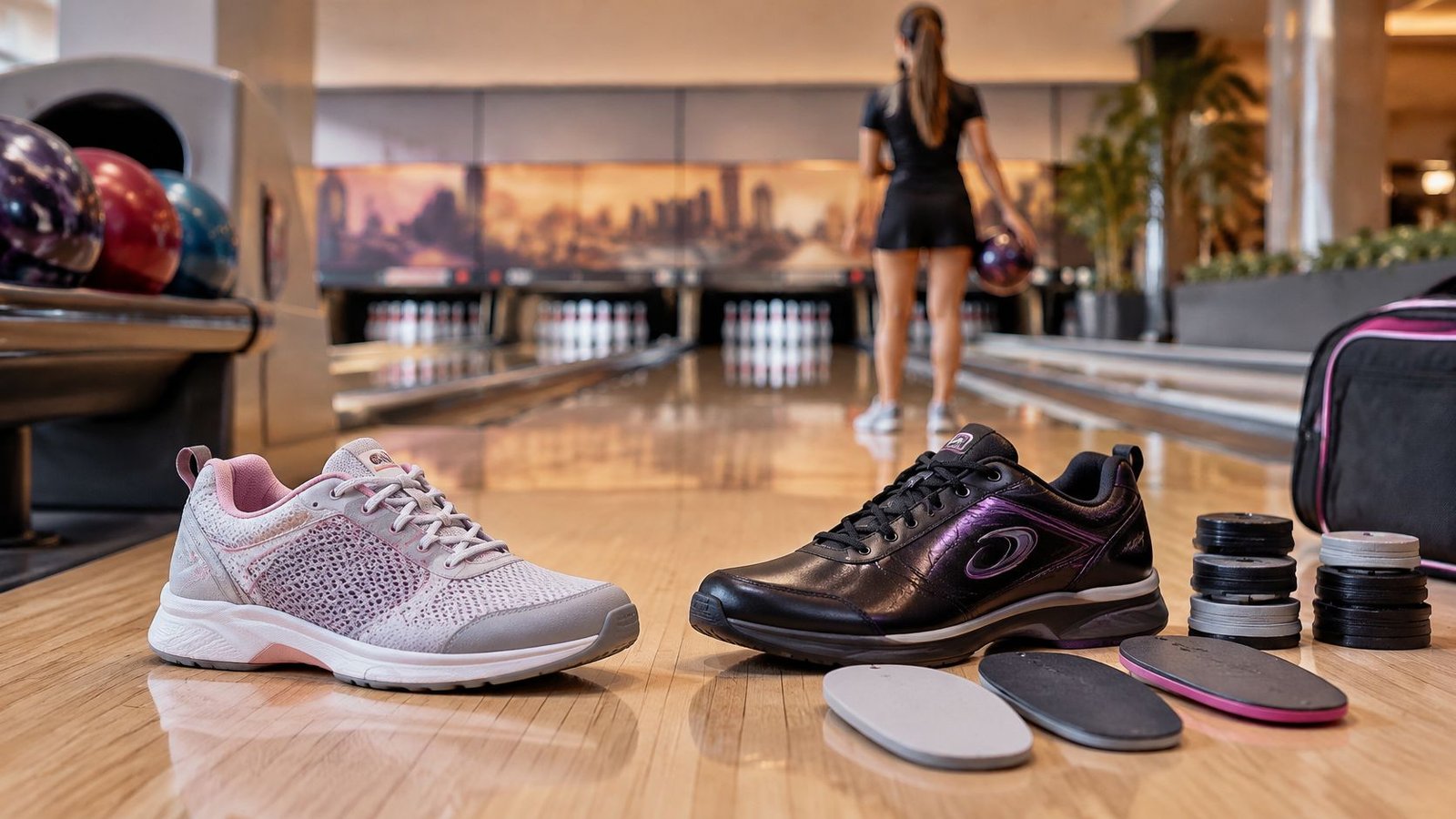
You've been renting house shoes for a season, and every week the slide feels different: one night your left foot stops dead a foot short of the foul line, the next night it carries you into a stumble. So you start shopping, type 3g womens bowling shoes into a search bar, and find two shoes under one badge that look nothing alike on paper. One is a light athletic shoe with a slide sole glued to both feet. The other is a right-hand-only kit with a bag of interchangeable soles and heels.
The gap between them isn't a quality ladder, it's two different answers to the same question about friction. Women's footwear has become a real equipment category rather than a colorway exercise: one market estimate put women's bowling shoes at 31.4% of the bowling-shoe market in 2025, roughly $565 million in revenue, according to Dataintelo's bowling shoes market report.
Table of Contents
- 3G Women's Bowling Shoes Compared Side by Side
- Getting the Right Fit in 3G Women's Sizing
- What 3G Women's Shoes Cost in 2026
- How the Tour Ultra/C Slide System Changes Your Approach
- What the Kicks Line Does Differently
- Durability and Care Through a League Season
- Match the Shoe to Your Game
3G Women's Bowling Shoes Compared Side by Side
| Model | 2026 street price | Slide setup | Sizing and width | Best for |
|---|---|---|---|---|
| 3G Kicks (women's) | About $48-$60 | Universal slide soles on both shoes | Medium width; a separate wide version is sold for this model | Recreational and beginner bowlers who want light, low-cost footwear |
| 3G Kicks II (women's) | About $50-$65 | Universal slide soles on both shoes | Medium width; a reviewer reported it runs small | Bowlers who want a cushioned, flexible athletic feel for league night |
| 3G Tour Ultra/C (women's) | About $110-$200 | Interchangeable slide soles and heels on a buckskin frame, right hand only | Women's sizes 5-11 including half sizes | League and tournament bowlers who tune slide to the approach |
| 3G wide-fit Kicks (women's) | Same entry bracket as the medium-width Kicks, sold as a separate wide listing | Universal slide soles on both shoes | Wide width | Bowlers with a wide forefoot who find medium widths tight |
What the slide column decides for you
Read the third column as a decision about how much control you want over stopping. Both Kicks rows give you the same contact material under each foot, so the shoe behaves the same whichever foot you slide on, and you accept whatever friction that material happens to produce on the night. The Tour Ultra/C row gives you a parts box instead: you choose the slide material and the heel profile, then change them when the approach changes.
That's the whole trade. A universal setup asks nothing of you and gives you nothing to adjust. A modular setup asks you to learn what each sole does and to carry spares.
Who each size run suits
The two Kicks rows and the wide variant are the ones to look at if your foot doesn't match a standard medium last, because the wide version exists only in the older Kicks. The performance row runs a women's size ladder with half sizes, which matters more than it sounds: half sizes are how you fix a shoe that's slightly long without crushing your forefoot into a narrower part of the last.
The Tour Ultra/C is built for right-handed bowlers only. If you slide on your right foot, the modular tier isn't a purchase you can make in this line, no matter what the price does.
The price column is street pricing, not list pricing, and it moves. The retailer-by-retailer breakdown comes further down, along with why the same colorway can appear at two very different numbers in the same month.
Getting the Right Fit in 3G Women's Sizing
Sizing is where most 3G buying mistakes happen, and the listings don't help much. Several 3G models are described as medium-width shoes or use unisex sizing, a separate wide version is sold for the older Kicks, and the 3G Kicks II product listing at BowlingWorld is typical of what you get: no consistent model-specific conversion chart, no insole measurement, no toe-box dimension, and no official word on whether to size up.
That absence matters because width mismatch isn't a comfort footnote. Footwear research on women with foot problems found shoes were often narrower than the wearer's feet, with shoe-width mismatch associated with hallux abductovarus, and the researchers identified width as needing patient-specific assessment rather than a generic label. A women's tag tells you something about the last's proportions. It doesn't tell you whether your heel is narrow, your forefoot is wide, or both.
The four-step fit test
- Measure both feet late in the day, standing. Put a sheet of paper against a wall, heel to the wall, weight on the foot, and mark the longest toe. Then measure across the widest part of the forefoot with a tape. Write down both numbers for each foot, because they're rarely identical, and fit the larger one.
- Compare your numbers against the listed width, then read reviews for shape complaints. Look specifically for narrow-heel or wide-forefoot reports rather than star ratings. Our bowling shoe sizing guide walks through the same measurement routine with the conversion pitfalls that trip up unisex listings.
- Try them on in the socks you bowl in. Bowling socks are usually thicker than everyday socks. Walk, then check three things: does the heel lift when you flex, does the little toe press against the upper, and does the arch support sit under your arch or forward of it.
- Bowl two games before you commit. Feet swell. Re-lace and re-check tightness after the second game, and note whether the forefoot feels tighter than it did in the shop.
One review is a data point, not a rule
A single 2025 review of the Kicks II Lavender reported that the shoe ran small and felt inflexible, per the BowlingWorld Kicks II listing feedback. Treat that as a reason to measure carefully, not as proof that every Kicks II runs short. Other listings offer only broad comfort and durability claims, which resolve nothing.
If your sneaker always pinches at the sides, going up a length makes the shoe longer, not wider, and your heel starts moving during the slide. Hunt the wide version instead.
Separate the two problems in your own head before you order. A narrow heel needs a tighter closure and a snug heel box. A wide forefoot needs a different last. Buying a bigger medium solves neither.
What 3G Women's Shoes Cost in 2026
Retail prices separate 3G's two engineering philosophies fast. The Kicks line sits in the low bracket, built around a simpler women's-labeled shoe. The Tour Ultra/C is a right-hand-only modular performance platform, and the price gap reflects that extra slide control.
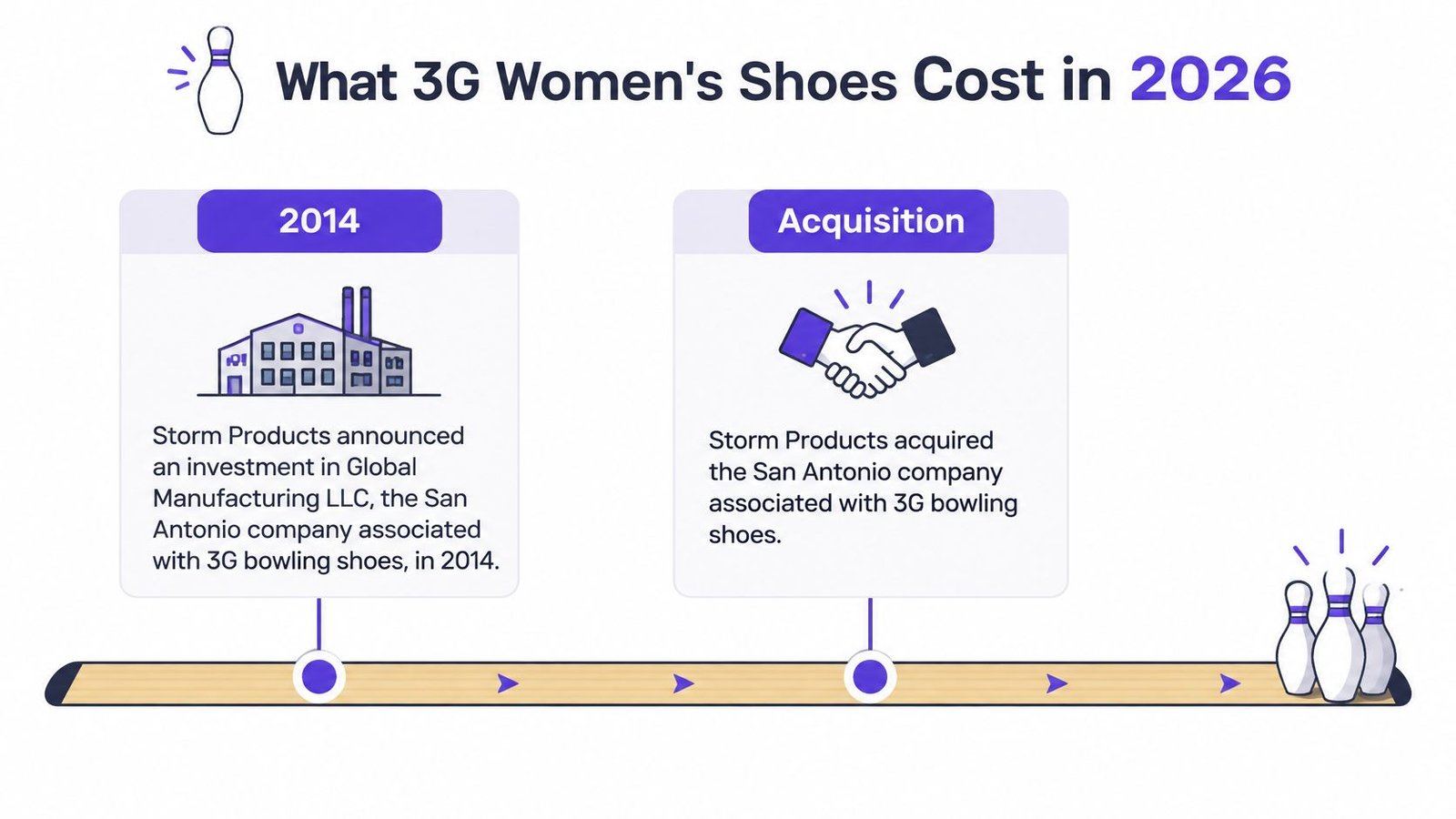
Storm Products announced an investment in Global Manufacturing LLC, the San Antonio company associated with 3G bowling shoes, in 2014, then acquired all of Global Manufacturing's assets on September 29, 2020, folding 3G into a portfolio that already carried 900 Global and Roto Grip, according to the Storm Products company history. That consolidation explains why one badge spans a Kicks listed around $59.99 before discount and a performance Tour Ultra/C listed at $299.95 before discount, as the same history records.
The corporate path from investment to full ownership is short and worth seeing in one line.
What retailers were actually asking
| Retailer | Model and colorway | Listed price | Note |
|---|---|---|---|
| Bowling.com | Kicks Black/Pink (women's) | $47.99 | Sale price, reduced from $59.99 |
| Discount Bowling Supply | Kicks II Lavender (women's) | $49.95 | Reduced from $64.95 |
| BowlerX | Tour Ultra C White/Mint (women's) | $109.95 | Reduced from $199.95 |
| InsideBowling | Women's Tour Ultra/C White/Mint | $199.99 | 13 women's sizes, 5 to 11 including half sizes |
| BowlingShopEurope | Kicks Black/Silver (women's) | €74.95 | Seven 3G women's models listed on the site |
| CheapBowlingBalls.com | Women's 3G collection | Up to $96.95 | Real listed prices only |
Reading the spread without chasing the lowest number
The two Kicks families cluster together in the same low bracket, while the modular shoe sits well above them at full price. For a league bowler who wants a predictable shoe with fewer moving parts, that lower tier makes sense. For a player who changes slide surfaces, works on approach length, or wants the sole to match the lane, the Tour Ultra/C price starts to look like equipment rather than decoration.
The Tour Ultra/C listings show the trade-off clearly. One White/Mint pair was listed at $109.95 after reduction from $199.95, while another was listed at $199.99 with 13 women's sizes, 5 to 11 including half sizes. That spread comes from colorway age, remaining sizes, and how many spare soles and heels ship in the box. A previous-season colorway can put the modular system close to half its original ticket. For a right-hander who already knows adjustable friction matters, that is where paying roughly double the Kicks money becomes rational.
Here's a walkthrough of the women's 3G range if you want to see the models side by side before you commit.
Two cautions before you click buy. Check that your size is in stock at the cheaper retailer, because a discounted listing with no half sizes left is a shoe that won't fit. Confirm the current price and size run on the product page, since each figure here is a snapshot that shifts through the season. A women's label also does not guarantee the last will suit your heel and forefoot. Measure the foot, match the shoe family to the job, then judge the price.
How the Tour Ultra/C Slide System Changes Your Approach
The performance shoe isn't a shoe with a nice sole. It's a frame you attach friction to. The 3G Tour Ultra/C Women's listing at BowlingMonkey specifies an authentic buckskin slide frame for repeatable contact and durability, plus a 50% larger EVA wedge that gradually increases toward the heel to improve slide-foot positioning and comfort.
The supplied parts cover a wide friction range: interchangeable slide soles and heels in chrome leather, deerskin, backskin, flat, rippled and cleated configurations, along with a rubber traction sole, replaceable toe protection, vented inner soles, shoe trees and a cleat pick, all listed in the same specification. Because the build is right-hand-specific, the entire slide system sits on the slide foot and the other shoe grips. That's the point of buying it.
Diagnosing the approach, then swapping one part
| Approach feel | Likely cause | Option to try |
|---|---|---|
| Slide foot grabs and stops early | Tacky, humid or dirty approach | Chrome leather sole for smoother glide |
| Slide carries past the intended finish point | Fresh, fast or dusty approach | Cleated or rippled sole for added braking |
| Slide changes from lane to lane in one centre | Mixed surface conditions | Flat sole as baseline, with a second sole carried in the bag |
| Bump or hesitation at the end of the slide | Heel friction or profile mismatch | A different heel profile to reshape the slide-to-finish transition |
| Non-slide foot slips during push-off | Universal slide sole on the traction foot | Tour Ultra/C rubber traction sole instead of a bilateral slide setup |
Use that table as a symptom chart, not a shopping list. Start every session on the flat sole so you have a baseline you can compare against, then change one element at a time. If you swap the sole and the heel together and the slide improves, you've learned nothing you can repeat next week.
Log combinations, not warm-up frames
Write down the centre, the lane pair, the sole, the heel and how the finish felt, and keep that note in your bag or your phone. Our guide to bowling shoes with interchangeable soles covers how to build that log so it's usable across houses. Warm-up frames lie, because the approach hasn't been walked on by twenty other bowlers yet.
Two sole sets turn this into a different shoe. Judge the combination you bowled, never the model name on the box.
The cleat pick is the small tool that makes the whole system practical. It lets you pull sole hardware out cleanly instead of prying at the frame with a screwdriver and tearing the buckskin. Keep it with the spares, and keep the spares dry.
What the Kicks Line Does Differently
Kicks II solves the same problem by removing the decision. Where the Tour Ultra/C line hands you a modular slide system and asks you to tune it, the Kicks II fixes both feet at one slide. Its outsole is a lightweight athletic build with flex pods and Rebound Grooves for cushioning, a breathable mesh upper, removable insoles and universal slide soles on both shoes. There is no sole or heel kit to swap, so the friction you feel on day one is the friction you get every league night.
Bilateral soles are a genuine advantage in two situations. A beginner who hasn't settled into a consistent release doesn't need a hand-specific shoe yet, and a household sharing one pair can't use a hand-specific shoe at all. The trade-off is tuning. You can't set the slide foot and the traction foot independently, and a universal sole gives less braking bite than a dedicated rubber traction sole when you push off hard. For a bowler who plants that foot and drives, the modular shoe is the right tool. For a bowler who just wants predictable slide, the Kicks II is enough.
What the flex pods buy you, and what they don't
The pods and grooves target forefoot flexibility and impact comfort, which is what you notice standing at the ball return and bowling several games back to back. That is a real benefit for a recreational bowler. It isn't a performance claim about your ball.
Independent footwear research backs that distinction: changing midsole construction produced no significant differences in hip, knee or ankle angles, stride length, linear ball velocity, or peak vertical ground-reaction-force ratio in the ISBS bowling footwear proceedings paper. So don't buy cushioning expecting a faster ball or a cleaner release. Buy it because your feet feel better in game three.
The case for this shoe rests on fit, consistent friction and comfort over a full session. When you test it, log three things after league rather than after warm-ups: lateral stability during the slide, whether the slide distance repeated, and how your feet felt walking to the car.
Durability and Care Through a League Season
The two families fail in different places, so inspect them differently. On the performance shoe, the buckskin frame is the durable structure and the leather soles are the consumable. They polish smoother with use and lose the friction you bought them for, which is exactly why a second sole belongs in the bag from week one rather than after the first bad night.
Replaceable toe protection takes the drag from the trailing foot, the vented insoles and shoe trees handle moisture between sessions, and the cleat pick keeps hardware changes from damaging the frame. On the athletic build, the wear points sit elsewhere: the mesh upper and flex pods crease at the forefoot, the removable insoles compress flat, and the lightweight outsole scuffs fast on concrete walkways outside the centre.
Monthly inspection list
- Sole thickness at the ball of the foot: run a thumb across it and feel for thin spots or a glazed patch.
- Heel edge wear pattern: uneven wear usually points at a slide problem, not a defective shoe.
- Stitching at the toe drag: trailing-foot abrasion starts here, and it's cheap to catch early.
- Insole flatness: pull it out and check whether the forefoot pad has gone hard and thin.
- Wedge height feel: note whether the heel lift still feels the same under your slide foot.
Care is short enough to do. Brush the slide sole after league, never wear either pair outside, air-dry them out of the bag rather than sealing them in it, and store the performance pair with the shoe trees in. Our routine for how to clean bowling shoes covers what to use on leather versus mesh.
Write down the wear state at the start of the season and again at the end. A planned replacement in the off-season costs less than a mid-season failure that leaves you sliding on a worn sole during a playoff week.
Match the Shoe to Your Game
If you bowl once a week for fun and want comfort at a low price, take Kicks II and stop shopping. You don't need a parts box to enjoy a Tuesday night.
If your slide foot grabs on humid nights or carries too far on fresh approaches, the modular shoe earns its price, because a sole and heel swap fixes a symptom that more practice won't touch. Left-handed bowlers and anyone holding a firm budget ceiling stay with the Kicks family. A wide forefoot should chase the wide-fit Kicks rather than buying a longer medium and hoping.
Tournament bowlers who visit several houses should buy the performance kit, carry a second sole and heel, and log which combination worked in each centre. That log becomes the most valuable thing in your bag.
Our shoe reviews come from gear tested in real bowling conditions, and brands don't influence them. Gary shares personalized recommendations to help bowlers find equipment that fits their style and goals, so bring him your foot measurements and your slide symptom rather than a model name. Then buy one pair, bowl a full league session, and record whether your slide repeated. That test beats any spec sheet.
We test bowling shoes on real lanes and publish fit notes for narrow heels and wide forefeet, so you can see how the 3G Kicks and Tour Ultra/C behave across a full league session before you spend anything. Bring your foot length and forefoot width measurements plus the approach problem you're trying to fix, and Gary will point you to the model and width that suits your game. Visit Bowling Gear Reviews for the women's 3G shoe reviews and the sizing guides that go with them.
