

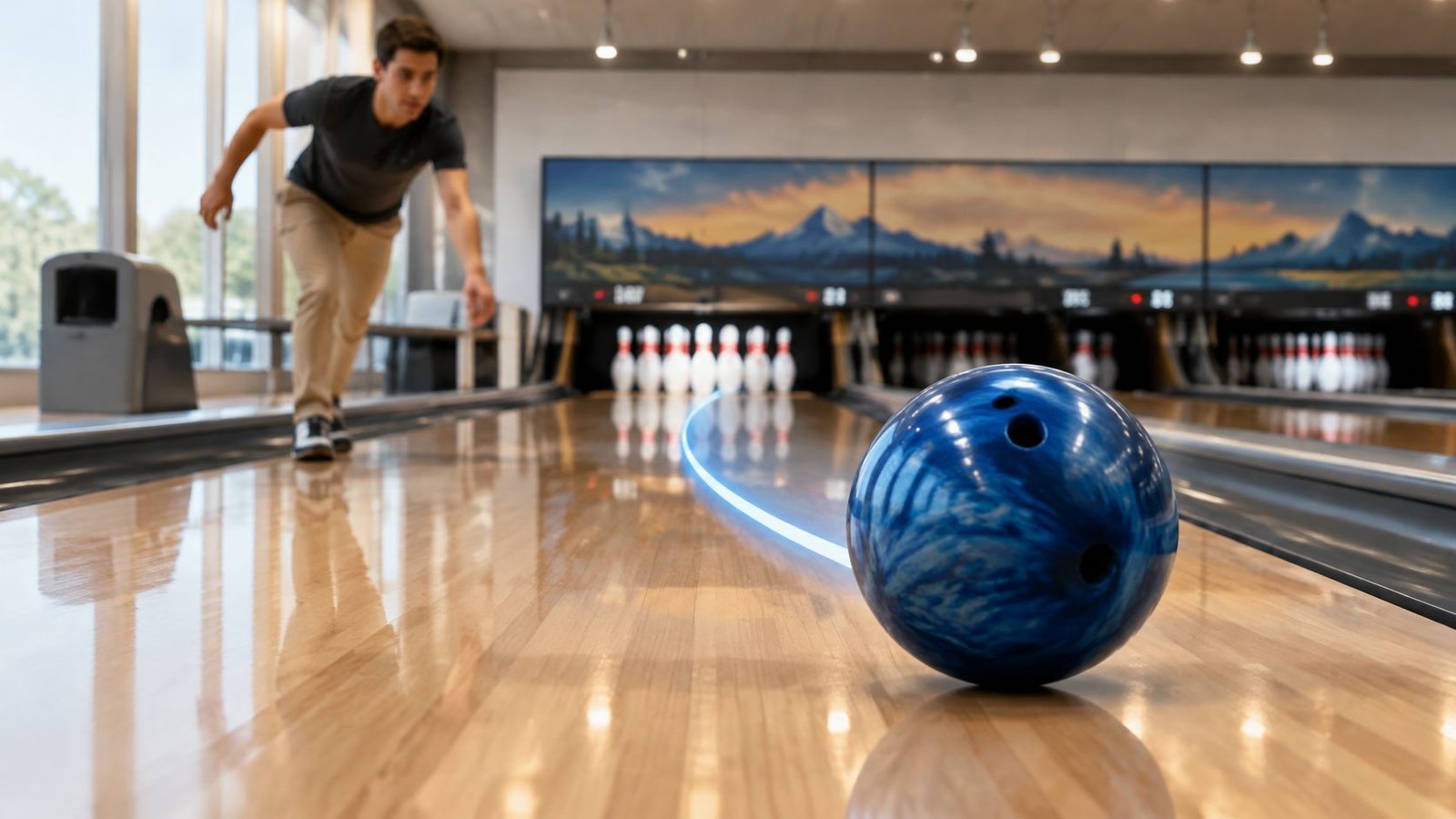
Buy an entry-level symmetric reactive ball at a medium or polished factory finish, have a pro shop drill it to your hand, and keep the weight at or under the USBC maximum of 16.00 pounds. In most cases the weakest cover you can still see move is the right first hook ball, not the strongest solid in the display case.
The advice you'll hear from every league bowler at the counter is to buy as much hook as you can afford. It's the wrong advice, and it costs beginners a full season of progress. A sanded solid built for heavy oil starts hooking at the arrows on a typical house shot, which forces you to throw harder just to keep it on the lane. Now your strike ball is a timing exercise and your spare shooting has no reliable straight option.
Your job in year one is not maximum backend. It's a ball that finishes near the pocket when your release is late, your speed is inconsistent and the lane has been open-played since noon. That means matching three things in order: the cover to the friction you bowl on, the weight to the swing you can repeat without pain, and the surface to how early or late the ball reads.
Table of Contents
- Best Beginner Hook Balls by Situation
- Why Lane Friction and Cover Create the Hook
- Choose a Weight You Can Repeat
- When a Stronger Ball Becomes Uncontrollable
- Three Beginner Setups on Real Lanes
- Why Your Hook Ball Changes Over Time
- Set Up Your First Hook Ball
Best Beginner Hook Balls by Situation
The right beginner hook ball is often the weakest reactive ball that still moves on your center's lanes. Match it to your release and the oil you bowl on, then choose a weight you can deliver with the same timing from shot to shot.
| Bowler and lane | Ball to start with | Weight band | Expected motion |
|---|---|---|---|
| Low rev or inconsistent release, typical house shot | Polished entry reactive, or one finished around 1500 to 2000 grit | 12-14 lb | Gentle, readable arc with miss-room |
| Average rev, medium house oil | Symmetric reactive at factory medium finish | 14-15 lb | Skid, then a smooth midlane move |
| Higher speed, heavier house oil | Pearl or mild hybrid, still symmetric | 15 lb, 16.00 lb only if pain-free | Longer skid and a later but controllable move |
| Dry recreational lanes | Weaker entry reactive, not a strong solid | Comfortable 12-15 lb | Mild early read instead of a snap |
| Youth or light frame | Same cover logic as the matching lane row | About 10-12 lb | Shorter, easier-to-see hook window |
For a low-rev or inconsistent release on a typical house shot, start with a polished entry reactive in the 12 to 14-pound range. Its readable arc gives you a clearer look at your release and leaves more room for small errors. A stronger ball can turn those errors into missed targets.
An average-rev adult on medium house oil can start with a symmetric reactive in the 14 to 15-pound range, at its factory finish. The goal is a smooth move, not extra hook for its own sake.
If you throw the ball faster and bowl on heavier oil, try a symmetric pearl or mild hybrid at 15 pounds. Use 16.00 pounds only if you can swing it on time without pain. On dry open-play lanes, choose the weaker entry reactive; a stronger cover may grip too early and lose its drive before reaching the breakpoint.
For youth and lighter frames, apply the same lane-and-release match at about 10 to 12 pounds. Choose a weight the bowler can repeat comfortably rather than chasing hook with a heavier ball.
Circle the row closest to your ball speed, release and usual lane conditions, then confirm the weight and surface before buying.
Why Lane Friction and Cover Create the Hook
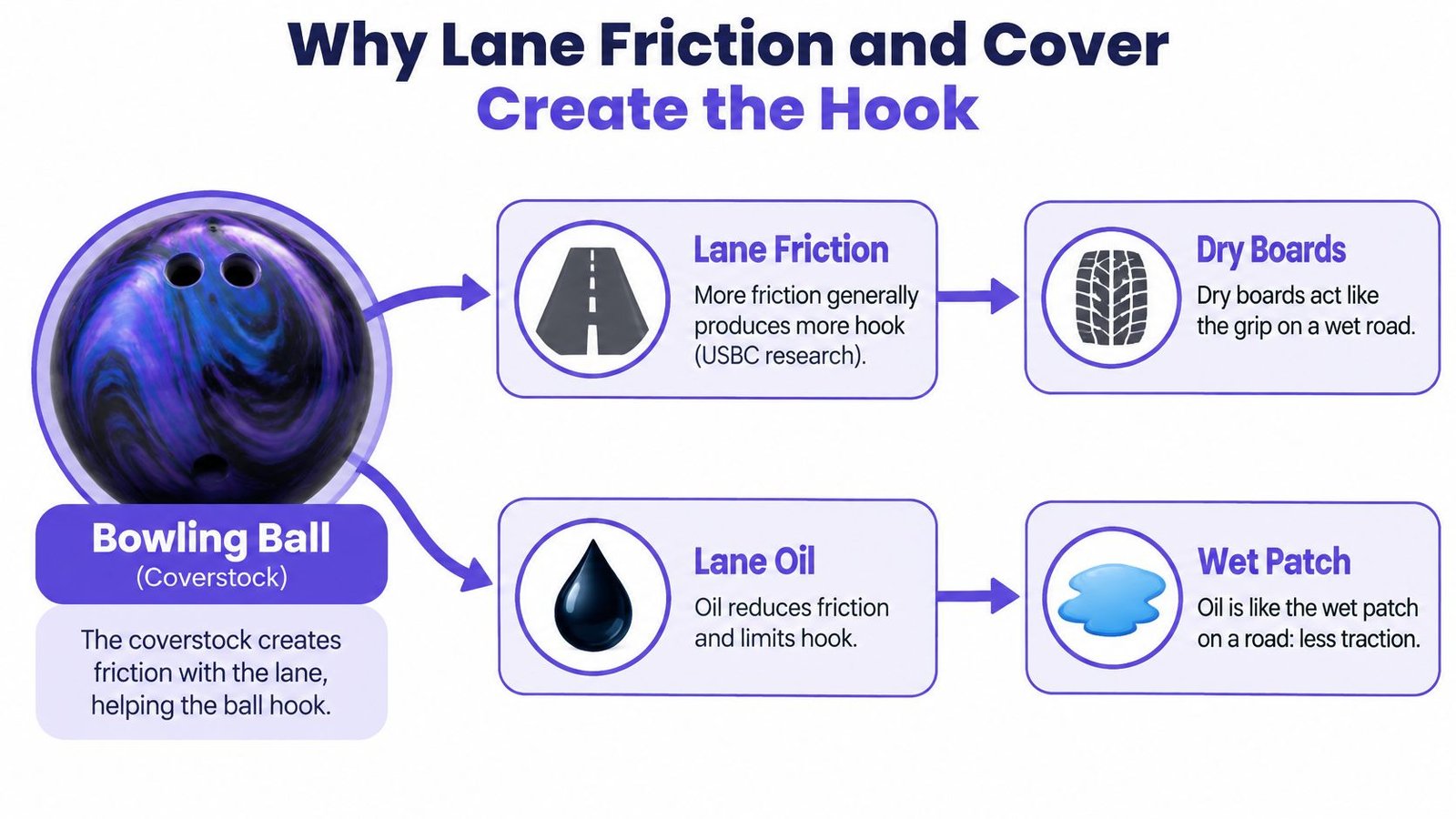
Drive a car across a wet patch and the tyres stop biting. The same car on dry tarmac turns the instant you ask it to. A bowling ball obeys the identical physics: oil is the wet patch, dry boards are the grip, and the ball only changes direction where the surface underneath it changes.
The USBC research on how lanes and balls interact states the rule plainly, that more friction generally produces more hook, while lane oil reduces friction and therefore limits hook potential. That is why the box label can't tell you how a ball will behave in your building.
Why the same ball looks tame in one building and wild in another
The same USBC work makes two points that beginners routinely miss. Oil patterns change the difficulty of a lane, so identical equipment can produce noticeably different motion from one center, or one session, to the next. And certified competition historically required at least 3 units of oil on each lane board, which tells you lane conditioning is measured rather than described as "oily" or "dry" by feel.
Skid, hook, roll
Every shot runs through three phases. The ball skids while it's still on oil, travelling fairly straight and retaining energy. It hooks where friction rises, usually near the end of the pattern, and that's where the direction change happens. Then it rolls into the pocket, and the quality of that roll decides carry.
Your equipment only changes the length of each phase. More surface or a rougher cover shortens the skid and starts the hook earlier.
Cover and surface beat core marketing
The USBC ball motion study identifies coverstock-related variables, including surface roughness, lane coefficient of friction and oil absorption, as leading predictors of reaction. A porous reactive cover absorbs or displaces oil and keeps dry surface contact, which adds friction and hook. A smoother, less absorbent cover skids farther before it turns.
| Cover | Oil behavior | Best first use | Start surface | Control risk |
|---|---|---|---|---|
| Entry reactive | Moderate absorption and friction | Default first hook ball on a house shot | Factory medium-fine finish | Low if not sanded aggressive |
| Strong solid reactive | High absorption and early traction | Only high speed on heavier oil, rarely a first ball | Leave the dull factory surface | Early hook and little miss-room |
| Pearl or mild hybrid | Cleaner through the fronts, later move | Faster beginners on medium to oily lanes | Factory polish | Backend can jump if revs suddenly rise |
| Urethane | Less absorption, smoother and earlier read | Very dry centers when control matters more than hook | Factory sheen | Less total hook than reactive |
| Plastic | Almost no traction | Spare ball only, not the hook ball | Polish | Will not create the hook they want |
Lower-grit surfaces create friction earlier; higher-grit or polished surfaces reduce early traction and promote skid. For a beginner on typical recreational or medium oil, an entry reactive with a factory medium-fine finish is more useful than a heavily sanded ball, because excessive early hook forces you to add speed and lose the pocket.
Practical rule: Keep the factory finish for at least three or four sessions. Adjust surface only through a pro shop, and only after you know the ball's shape. If you want to understand how each shell type is built, this bowling ball coverstock guide walks through the materials.
Roughen the ball only when it skids too long and never reaches the breakpoint. Polish it when it reads the midlane far too early. That's the whole tuning loop: match ball friction to lane friction.
Choose a Weight You Can Repeat
A ball that swings freely and arrives on time is a better first hook ball than one you can barely control. The USBC equipment specifications manual sets the maximum at 16.00 pounds, but that is a ceiling, not a beginner target. Choose a weight you can repeat with a relaxed shoulder and consistent timing alongside your slide foot.
A workable starting point is about a tenth of your body weight, then adjust based on your swing. If the ball pulls you forward at the top of the backswing, it is too heavy. If your arm races ahead of your feet, it is too light.
| Weight | Who it usually fits | If the weight is wrong | Rule |
|---|---|---|---|
| 10-12 lb | Youth, lighter adults, and sore or brand-new swings | Too light can race the arm and reduce consistency | Legal and under the cap |
| 12-14 lb | Many beginners and smaller adults | Aim for a free swing without forcing ball speed | Legal |
| 14-15 lb | Adults who can repeat a swing at this weight | Often a useful balance of control and carry | Legal |
| 16.00 lb | Bowlers who can swing it pain-free and on time | Late timing can pull the shot off target | USBC maximum, not a target |
| Over 16.00 lb | Not permitted in USBC-sanctioned play | Cannot be used in certified competition | Not permitted |
Drilling affects fit and release consistency. Under the USBC equipment specifications manual, drilled holes may not exceed 1 9/16 inches in diameter or 4 1/2 inches in depth. A properly fitted ball makes it easier to repeat your release and create the rotation that produces hook. All products on the Bowling Gear Reviews list are legal for sanctioned competition, so focus on fit.
Don't soak or bake a ball to change its reaction. Soaking can lower a urethane ball's hardness and temporarily increase its hook. That added reaction fades as the ball's hardness recovers.
Before you buy, throw ten shots with the candidate weight. Keep your forearm relaxed, your elbow steady, and the ball in front of your body. If your timing breaks down or you cannot reach the pocket, drop a pound. This guide to choosing a bowling ball weight for beginners covers the swing checks in more detail.
When a Stronger Ball Becomes Uncontrollable
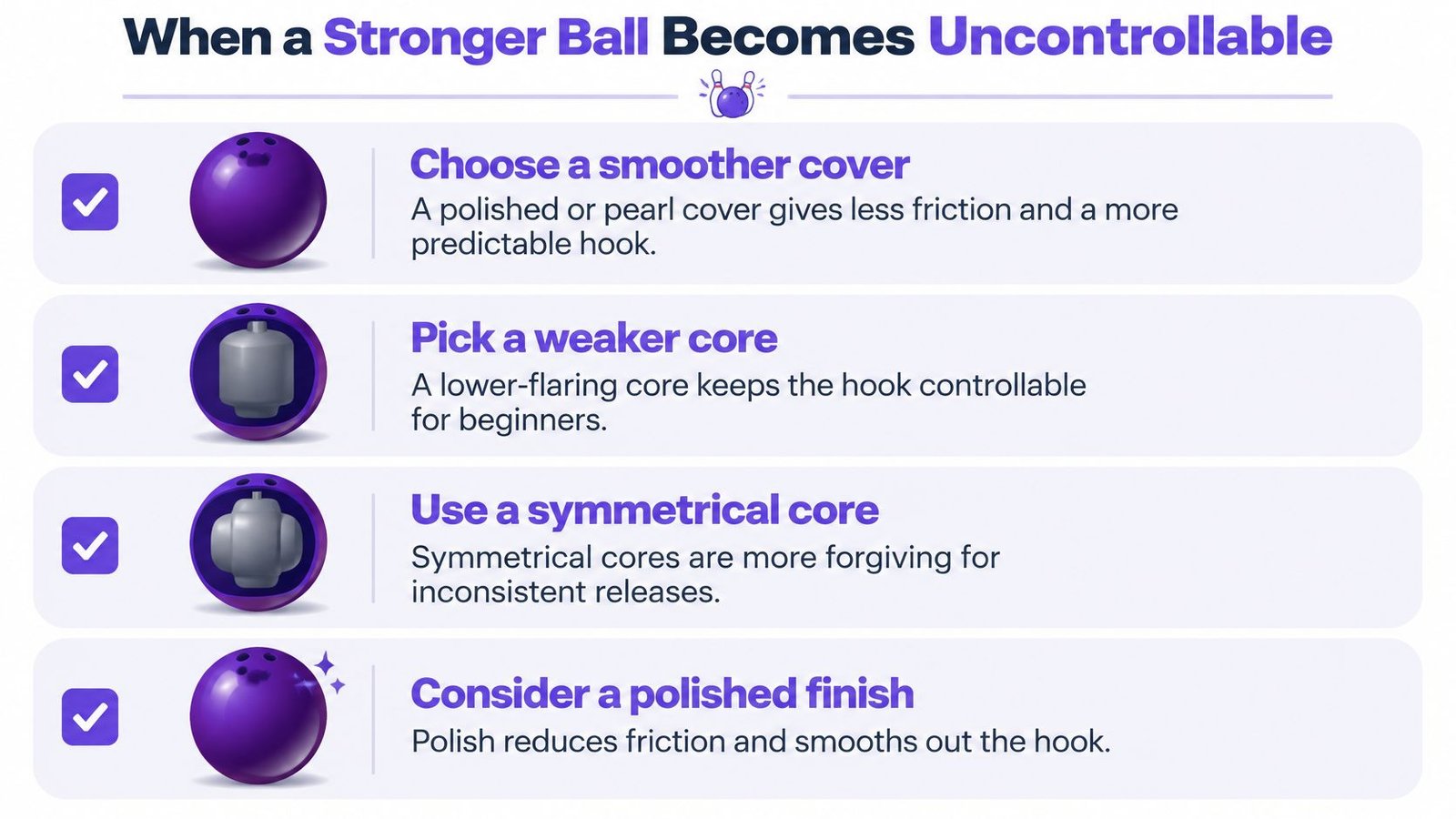
If you want visible hook and you can't yet repeat your release, buy the smoother, weaker, polished ball. It will beat the strong ball in the only place that counts, which is the pocket.
The USBC ball motion analysis shows why. Hook depends on interacting variables rather than a brand or core label. Higher differential RG generally increases flare, while higher RG delays the transition. Coverstock friction, surface roughness, oil absorption, release speed, rev rate and lane oil all materially affect motion.
That same testing found faster oil-absorbing balls can deplete more oil and force bowlers farther inside as a session progresses. For a beginner, that's a moving target. The line that worked in game one is gone by game three, and you don't yet have the tools to chase it.
The three-stage progression
Stage one is where almost every beginner belongs: a weaker, polished entry reactive while your release wanders or your rev rate is low. You're buying control, not drama.
Stage two starts when your breakpoint repeats on a house shot. That's the moment to add a medium symmetric reactive sanded to a light factory finish, not before.
Stage three is a stronger cover, and only after you can change speed and hand position on purpose. If you can't deliberately throw the same ball 1 mph slower, a stronger ball just gives you a new problem to solve.
The signs you overbought
Watch for three things. The ball hooks at the arrows instead of the breakpoint. You're adding ball speed every week just to hold the line. And your carry gets worse while your hook increases, which is the tell that the ball is burning energy before it ever reaches the pins.
Judge a ball by breakpoint shape, miss-room and pocket hits. Not by the biggest backend move in a slow-motion clip. If your ball is already past that line, this piece on fixing a bowling ball that hooks too much covers the surface and line adjustments.
Three Beginner Setups on Real Lanes
Criteria on a page become useful only when you see them on a lane. Here are three composite bowlers, each with one ball, one plan and one correction.

Maya is a new adult with slow speed and low revs on dry-to-medium open play. She throws a 13-pound polished entry reactive, stands near the dots and targets just right of the second arrow. Expect a gentle move of a few boards, not a snap. Her bad sign is early rollover short of the arrows, which means the ball is spending everything it has too soon. The fix is a small move right or a polish check, never a stronger ball.
Jordan is new to league, average speed, and repeats his release in most frames on a medium house shot. He throws a 15-pound symmetric reactive at a factory 1500 to 2000 finish. He stands a board or two left of the dots and lets the ball skid to the midlane before it starts arcing. His bad sign is no movement at all, and his checklist is speed first, clean cover second, surface change third. Buying a bigger hook is the last option, not the first.
Priya is athletic and new, with enough ball speed to blow through lighter oil. She throws a 15-pound mild pearl, still symmetric. Her bad sign is a violent backend that misses right of the pocket, and her correction is two league nights of patience before any surface change. Persistent over-skid is the only thing that justifies a small scuff or a move left.
A pro shop can mark a starting layout for any of these three, but no drilling angle rescues a ball that doesn't match the lane. The ball choice comes first, every time.
Why Your Hook Ball Changes Over Time
Three months after you buy it, the ball that once snapped back to the pocket starts finishing flat. Nothing about your release changed. The cover did.
Reactive shells are porous and they load up with oil every shot. Once the surface is saturated and the track has worn smooth, the ball stops gripping the dry boards the way it did in week one. Your motion gets longer, your carry drops and you start blaming yourself for a ball problem.
Clean it first
Wipe the ball between shots and clean it after every league night. A dirty ball with oil sitting on the surface reads late and inconsistently, and cleaning is the cheapest fix you'll ever make. Use a proper bowling ball cleaner, not household spray.
Resurface it second
If cleaning doesn't restore the shape, the texture is gone. A pro shop resurface brings the cover back to a known grit and typically brings the reaction back with it. Ask for the factory-equivalent finish, not the most aggressive one available.
Then accept the wear
Some decline is permanent. A cover that has worn won't hook like new no matter what cleaner you use or what your pro shop does. That's when the ball becomes your dry-lane option and you start looking at a replacement.
Test that separates the three: Track your breakpoint over five sessions. A steady, gradual loss of shape points to cleaning and surfacing. A sudden change after one night points to oil or a lane condition change, not dead equipment.
Judge the ball after league-length use, not on the honeymoon. Beginners who log shape instead of score catch the decline early and fix it for the price of a resurface.
Set Up Your First Hook Ball
Here's the decision, in order.
- Pick your row. Choose the situation that matches your center and your release from the comparison table, and write it down before you walk into a shop.
- Confirm weight with a swing, not a chart. Ten pain-free shots, no muscling, and nothing above 16.00 pounds.
- Buy an entry or medium reactive that's legal for sanctioned play, and have a pro shop drill the fit within USBC limits. Don't accept a used layout built for someone else's hand.
- Bowl several sessions at the factory finish. No sanding, no polish, no experiments. Learn the ball's shape first.
- Clean it after league. This is the step beginners skip. USBC research found modern reactive balls remove substantially more oil than reduced-reactive or urethane equipment, with reduced-reactive balls removing 96% as much oil and urethane removing 62% as much in the cited testing, per the USBC study on ball performance and ball life. A loaded cover changes motion.
Before the fitting, write down your ball speed, your rev rate, the typical house-shot volume at your center and the weight that passed the ten-shot test. Ask the pro shop to mark the starting layout from the matching setup above, and bring the ball you intend to test.
Book the fitting with the weight and cover already decided. Bowling Gear Reviews tests gear in real bowling conditions and offers guides on choosing the right ball, weight and style, and some links on our site are affiliate links, which may earn us a commission at no extra cost to you. That keeps the ball decisions honest and the recommendations independent.
You don't need a stronger ball. You need a ball that matches your speed, your release and the oil at the center where you bowl, drilled to a hand that can repeat the swing. Bowling Gear Reviews tests bowling balls on real lanes and publishes plain-English breakdowns of coverstock, weight and surface, so you can walk into a pro shop knowing exactly what to ask for. Visit Bowling Gear Reviews before you book the drilling.
