

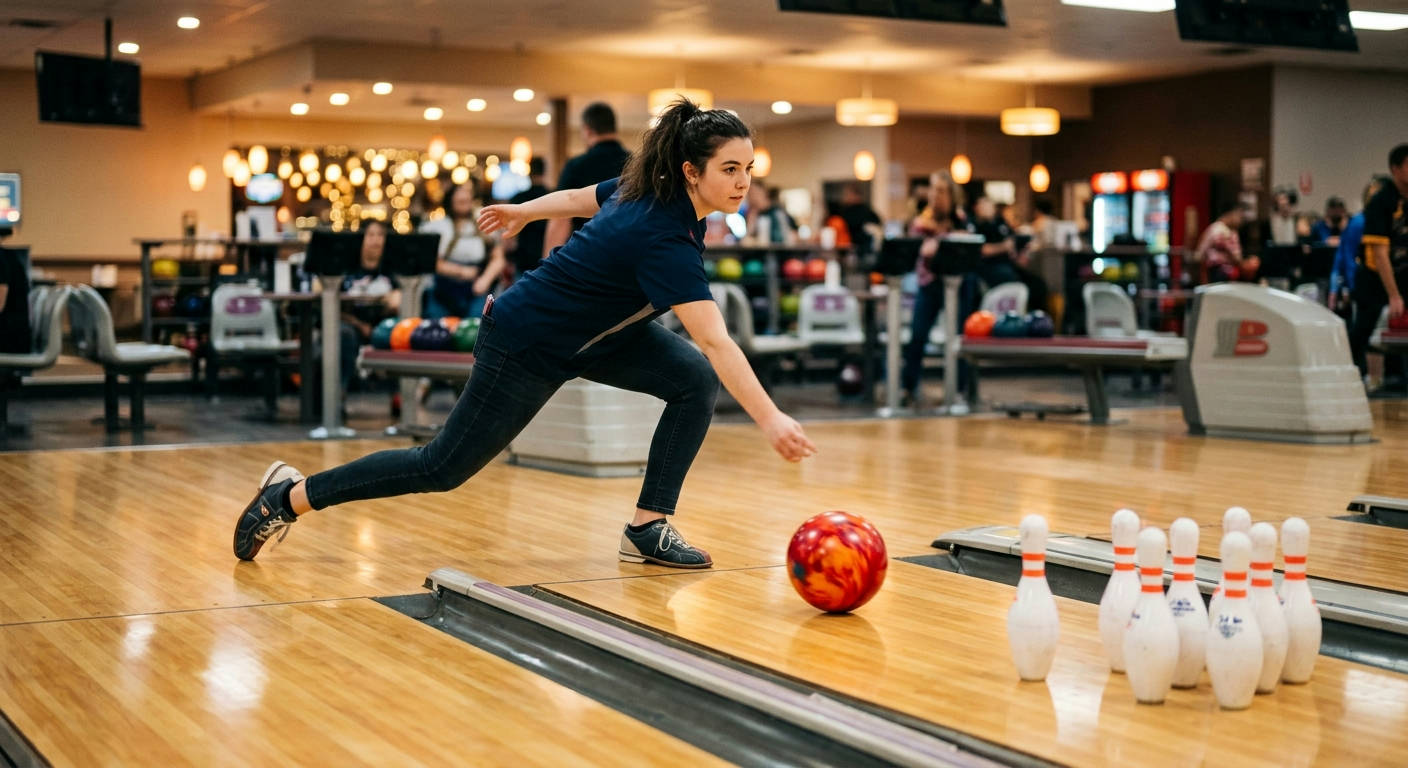
So, you searched for “how to bowl a strike every time beginner” and landed here. Let’s get one thing straight: nobody, not even the pros on TV, bowls a strike every time. That’s a perfect 300 game, and it’s rare for a reason. But can you learn the fundamentals to throw consistent, powerful strikes that will dominate your league and impress your friends? Absolutely. The difference between randomly knocking down pins and methodically smashing the pocket is technique and the right equipment. Here at Bowling Gear Reviews, we live and breathe this stuff, and we’re going to break down the exact mechanics you need.
Forget luck. Strikes are built on a foundation of physics, form, and a smart approach to the lane.
Deconstructing the Perfect Strike: It’s Not Just Luck
A strike isn’t about blasting the headpin into oblivion. Hitting the front pin dead-center often results in a nasty split, like the 7-10. A true strike is a controlled chain reaction.
The Pocket is Your Target
Your one and only goal is to hit the “pocket.” For a right-handed bowler, this is the sweet spot between the 1 and 3 pins. For left-handers, it’s between the 1 and 2 pins.
Hitting this target is non-negotiable. The ball’s entry sends the 1-pin directly into the 2-pin, the 2 into the 4, the 4 into the 7. On the other side, the ball drives through, taking out the 3, 6, and 10 pins, while the 3-pin takes out the 5 and 9, and the 5-pin clips the 8. It’s a beautiful cascade of destruction.
Pin Action and Carry
“Carry” is the term bowlers use to describe the pin action that results in a strike. You want your ball to enter the pocket at a slight angle, driving through the pins instead of deflecting off them.
A ball with good energy retention and the right entry angle will send pins flying sideways into other pins. A weak, deflected shot sends pins flying backward or straight up, leaving corner pins standing. This is where your ball’s coverstock and core, combined with your release, make all the difference.
Gear is Half the Battle: You Can’t Throw a House Ball and Expect Miracles
Showing up to the alley and grabbing a random, chipped-up house ball is a recipe for frustration. Those balls are plastic, designed for durability, not performance. They don’t hook, and they aren’t drilled to fit your hand.
Your First Real Bowling Ball
Investing in your own ball is the single biggest step you can take. You need a ball that is drilled specifically for your hand’s span and finger size. This provides a comfortable, repeatable grip that is essential for a consistent release.
For beginners, a reactive resin ball is the gold standard. Unlike the plastic house balls that just slide, reactive balls are designed to grip the oily part of the lane and then make a strong turn towards the pocket on the drier backend. Check out our in-depth guide on How To Choose Bowling Ball to find the perfect entry-level option.
Why Bowling Shoes Are Non-Negotiable
Those rental shoes are not doing you any favors. Proper bowling shoes have a “slide sole” on one foot and a “brake sole” on the other. This allows you to slide smoothly on your final step, creating a stable platform for your release.
Trying to bowl in sneakers will cause you to stick or stutter, throwing your entire body off balance and killing your accuracy. You don’t need to spend a fortune; a solid pair like the Dexter Turbo II Bowling Shoes will change your game overnight.
Essential Accessories
To keep your new gear in top shape, a few accessories are crucial. Oil from the lane builds up on your ball’s surface, reducing its hooking power over time.
A simple microfiber towel to wipe your ball before every shot is a must. After a session, a dedicated ball cleaner is vital. You can find complete packages like a 2026 Bowling Ball Cleaning Kit that have everything you need to maintain that out-of-the-box performance.
The Four-Step Approach: Your Foundation for Consistency
A smooth, repeatable approach is the engine that powers your shot. Most beginners find success with a simple four-step approach. The key is to sync your feet and your arm swing into one fluid motion.
Step 1: The Stance
Before you even move, get set. Stand with your feet together, shoulders and hips square to your target down the lane (we’ll cover targeting later). Hold the ball comfortably between your waist and chest, with your non-bowling hand supporting its weight. A relaxed, athletic posture is what you’re after.
Step 2 & 3: The Push-Away and Swing
Timing is everything. On your first step, you “push” the ball away from your body, out and down into the swing. This should be a single, coordinated movement—as your right foot steps forward (for a righty), the ball moves forward.
Let gravity do the work. The backswing should feel effortless, like a pendulum. Don’t try to muscle the ball up; a high backswing comes from momentum, not brute force. Your arm should be straight and relaxed.
Step 4: The Slide and Release
Your final step is a slide on your non-dominant foot (left foot for a righty). As you slide, the ball should be coming forward. The release happens as the ball passes your ankle. Not before, not after.
This is the moment of truth. You should be in a balanced, athletic position, with your trail leg kicking back for counterbalance. If you’re falling off to one side, your shot is already compromised.
## How to Bowl a Strike Every Time Beginner: Mastering the Release
The perfect approach is useless if you fumble the release. This single moment determines the ball’s speed, rotation, and ultimate path to the pins. The goal is to impart axis rotation on the ball, which is what creates a hook.
“A great bowler can feel the shot in their fingertips. The release isn’t a throw; it’s a transfer of energy and intention from your hand to the ball.”
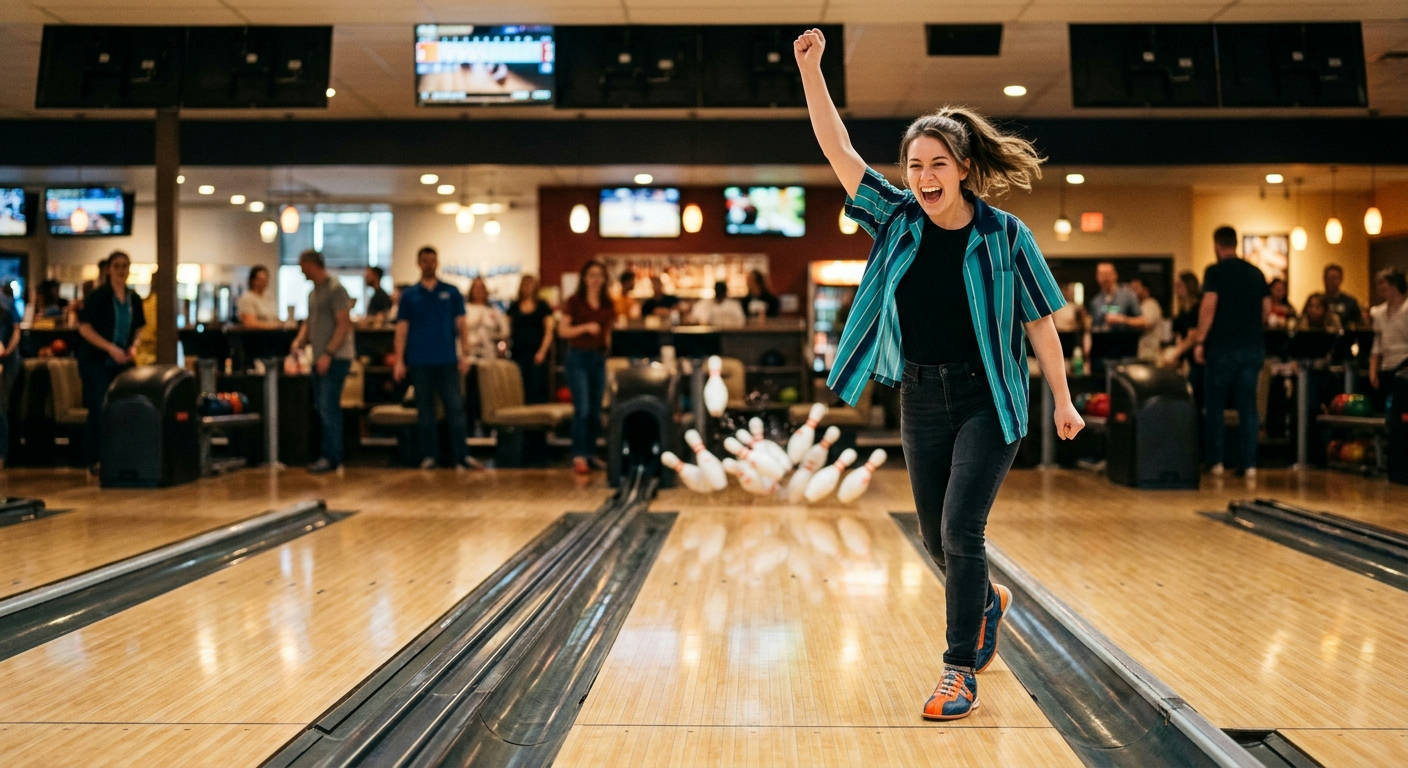
The Handshake Release
This is the simplest and most effective release for a beginner. As the ball comes forward and reaches your ankle, your hand should be in a position as if you’re about to shake hands with the pins.
Your thumb exits the ball first. This is critical. As the thumb comes out, you lift through the ball with your middle and ring fingers. This is what creates the spin that will make the ball hook down the lane.
### How to Bowl a Strike Every Time Beginner: Follow-Through is The Secret Ingredient
Where your hand goes after the release dictates where the ball goes. Your arm should continue in a straight line, up towards your target, finishing high—often above your head. Don’t stop your arm swing at the foul line.
A good follow-through ensures you stay behind the ball and direct its energy forward. A “short-arm” or sideways follow-through will cause inconsistent shots every single time.
Avoiding Common Beginner Mistakes
Watch out for these classic errors. Squeezing the ball with a death grip will ruin your release. You want a firm but relaxed grip.
Another common mistake is dropping the ball onto the lane instead of rolling it. This causes the ball to bounce, lose energy, and roll inconsistently. The release should be a smooth roll from your hand onto the lane surface.
Targeting Systems That Actually Work
Stop looking at the pins. They are 60 feet away, making them a terrible target. The secret to accuracy is to aim for something much closer: the arrows or the dots on the lane. This is called spot bowling.
Arrow Targeting
About 15 feet down the lane, you’ll see a set of seven arrows. Your goal is to roll your ball over a specific one. For a right-handed bowler trying to hit the 1-3 pocket, a common starting point is to roll the ball over the second arrow from the right.
By focusing on a target just 15 feet away, your margin for error shrinks dramatically. Hitting a small target close by is infinitely easier than hitting one far away.
Spot Bowling vs. Area Bowling
Spot bowling is picking a single board to hit at the arrows. Area bowling is aiming for a general zone, like “between the second and third arrow.” As a beginner, you must learn to spot bowl. It forces precision and gives you immediate feedback. Did you hit your board? If not, why? This is how you learn and adjust.
Adjusting Based on Ball Reaction
Bowling lanes are not uniform surfaces; they have specific oil patterns that affect how your ball moves. A simple rule for adjusting is to move your feet in the direction of your miss.
If your ball is hooking too much and missing the pocket to the left (for a righty), move your starting position on the approach a few boards to the left. If the ball isn’t hooking enough and missing right, move your feet to the right. It seems counterintuitive, but you are changing the angle of your shot to compensate for the lane condition.
Practice Drills to Ingrain the Muscle Memory
Reading about technique is one thing; executing it is another. These drills are designed to isolate specific parts of the shot so you can build proper muscle memory.
The One-Step Drill
Start just one step back from the foul line. From here, take your final slide step and execute a full release and follow-through. This drill removes the complexity of the first three steps and forces you to focus entirely on your balance and release. Do this for 10-15 minutes at the start of every practice session.
The Foul Line Drill
This drill removes the feet entirely. Kneel on one knee at the foul line (the one corresponding to your trail leg) and simply practice rolling the ball onto the lane. Focus on getting that “handshake” position and lifting with your fingers. You’ll get instant feedback on your ball’s rotation.
The Balance Drill
After every single shot you make with your full approach, hold your finishing position. Don’t move a muscle until the ball has hit the pins. Are you perfectly balanced on your slide foot? Is your trail leg back? Is your arm held high in the follow-through? If you’re wobbling or falling over, you know your foundation is weak.
“You don’t practice until you get it right. You practice until you can’t get it wrong.”
Reading the Lanes and Making Adjustments
The oil on the lane is your invisible opponent. Understanding its basics is crucial for consistency. The oil’s purpose, as defined by sources like Wikipedia’s entry on the bowling lane, is to protect the lane surface and create a strategic challenge.
Understanding Oil Patterns (The Simple Version)
Think of it this way: oil causes your ball to skid, and friction (the dry part of the lane) causes it to hook. Typically, there is more oil in the middle of the lane and less on the outside. Your goal is to throw the ball through the oil so it retains its energy, then have it hit the dry part of the lane to make its turn toward the pocket.
What is “Transition”?
As you and others bowl, your balls act like tires, picking up oil and moving it around. This process is called “transition” or “breakdown.” The shot that worked for you in the first game might not work in the third because the oil pattern has changed. Being a good bowler means learning to recognize this and adjust.
Achieving the goal of throwing a strike every time is about building a repeatable, powerful shot. It begins with the right mindset and is executed with proper technique and optimized equipment. The path involves understanding the physics of pin carry, mastering a fluid four-step approach, and developing a precise release. It’s a journey of continuous improvement, where every frame is a new opportunity to refine your craft. Get the right gear, drill the fundamentals, and the strikes will come. To learn more about our process and who we are, check out our About page.
