

A 2024 study in Frontiers in Bioengineering and Biotechnology tested a laser-textured ceramic coating and found it raised the average coefficient of friction for one tested surgical glove by 86% compared with the study's other coating surfaces (the Frontiers friction study). That study has nothing to do with bowling, and it still explains the thing bowlers get wrong about gloves. Grip is a measurable property of one material against another surface. It can be engineered, it can be tested, and it can disappear.
Bowling makes that measurement repeatable and unforgiving. You throw the same motion forty times a game, three or four games a night, and the same palm meets the same ball with the same tack every time. The glove that feels locked in at the pro shop counter is often the one skating in the eighth frame of game three, once sweat and lane residue have reached the contact patch.
That's why gloves with the best grip aren't the tackiest ones on the rack. They're the ones that hold a repeatable hand position from the first frame to the last, and then hold it again next week. Three things decide that, and maximum tack isn't one of them: where the friction material sits, whether the wrist structure keeps its angle, and how the palm behaves once it gets damp.
Table of Contents
- Best-Grip Glove Types Compared at a Glance
- Why Bowling Grip Is Judged on Repeatability
- Materials and Design Features
- Wrist Support Features That Keep the Hand Steady
- How to Test a Glove's Grip Before You Buy
- Grip Problems Under Sweat and Fit, and Their Fixes
- Confirm Your Grip Choice Before You Buy
Best-Grip Glove Types Compared at a Glance
No single glove grips best for every bowler, and a list that promises otherwise is selling a feeling rather than a fit. The right pick depends on the problem you're solving: a palm that goes slick when you sweat, a wrist that collapses at the bottom of the swing, or a hand that needs protection more than it needs feel.
Glove grip comes from one of five sources, and each one asks you to give something up. The table sorts them by where the grip is created and what that costs you across a session.
Glove types by grip source and trade-off
| Glove type | Grip source | Main trade-off |
|---|---|---|
| Tacky palm-and-finger glove | Super-tacky barrier between skin and ball, as on the Storm Xtra-Grip | Friction can fall when the palm gets damp |
| Adjustable wrist-support glove | Palm strap, forearm strap and cup or angle dial, as on the Storm C2 | Needs fitting time and can be excessive for beginners |
| Elastic wrist-wrap glove | Elastic wrap for tendon support plus palm contact material | Support complements contact; it does not replace it |
| Ventilated mesh glove | Open mesh with a textured palm | Comfortable and cool, but less protection from sweat reaching the palm |
| Thick padded glove | Padding and heavier palm material | Comfort and protection, but can dull feel and release sensitivity |
Read the middle column before the price tag. The grip source is what you're buying, and two gloves that look identical on the shelf can behave nothing alike once the ball is rolling. A padded glove and a thin tacky glove share a display case and solve opposite problems.
The two Storm models bracket the range well. The Xtra-Grip spends its effort on a super-tacky contact surface built into a thin, breathable frame, so the palm does the holding while your fingers keep their read on the ball. The C2 spends its effort on structure: a palm strap, a forearm strap and a cup dial that hold the wrist where you set it, which matters when hand position drifts late in a session.
Practical rule: Decide which trade-off you can live with before you spend anything. Extra fitting time is annoying once. A palm that loses grip in game three is annoying every week.
Whichever type you lean toward, the deciding question stays the same. Can you feel the ball leave your hand the same way twice, on the twentieth shot as clearly as on the second?
Why Bowling Grip Is Judged on Repeatability
A peer-reviewed study of 39 elite tenpin bowlers found that 74.4% used a fingertip grip and that every participant used a heavy bowling ball. Symptoms ran through the group: 59.0% reported wrist pain, 28.2% reported ring-finger pain, 17.9% reported thumb pain and 15.4% reported middle-finger pain (the elite tenpin bowler study). Repetition under load, not one bad shot, is the stressor.
The headline numbers explain why grip consistency is worth measuring at all.
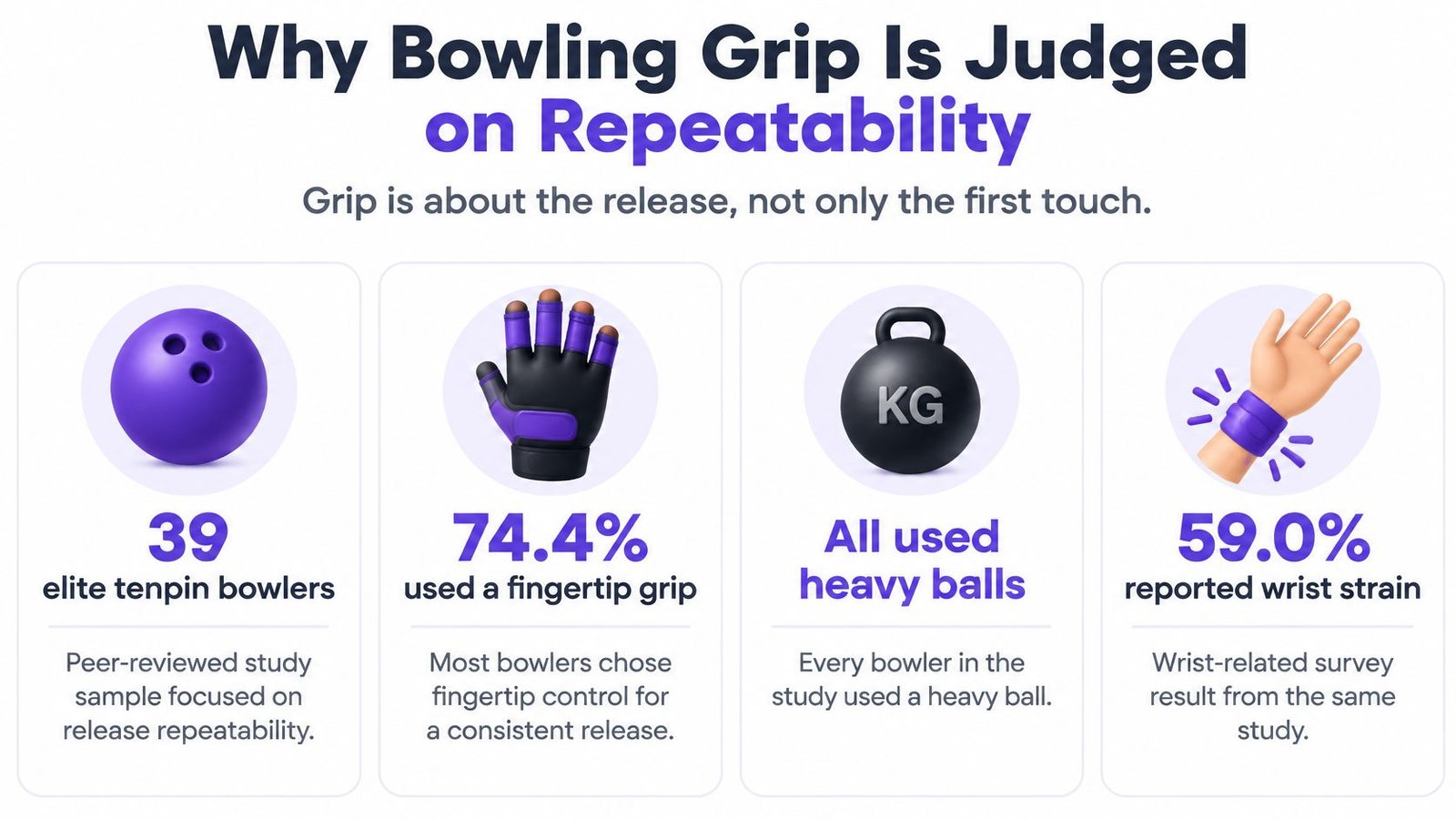
The distribution is narrower than most bowlers expect. 53.8% of the 39 athletes, 21 in total, had de Quervain's tenosynovitis, and 42.9% experienced pain after training rather than only during it. Grip style showed up in the data too: every athlete using a conventional grip was symptomatic, compared with 86.2% of those using a fingertip grip.
None of this proves a glove prevents injury or adds pins. What it does is define the conditions a glove has to survive: a hand repeating the same motion at speed, under load, for a full session. Judged that way, tack is a starting point and repeatability is the actual product.
Three tests a glove has to pass
- Contact through repeated releases. The palm should sit where you put it on shot 20 the way it did on shot 2. A glove that only holds when it's factory-fresh is a one-game glove.
- Support without restriction. Wrist structure should guide motion, not lock it into an angle you can't adjust, and not leave it so free that it breaks at the bottom of the swing.
- Comfort across a league night. Check the thumb, the finger roots and the wrist after three games, not after ten seconds at the counter.
Fit overrides all three. A glove that creates a pressure point at the base of the thumb, or that shifts the ball's position in your span enough to change your release timing, can cancel out every bit of traction it adds. That's the argument for buying snug, testing in the shop, and treating a new glove as a two-week trial rather than a finished decision.
Materials and Design Features
Grip is friction at the contact patch. Raise friction where the palm and fingers meet the ball and the hand stops micro-slipping through the swing, which keeps your release position repeatable without a harder squeeze.
Judge a glove where your palm touches the ball. That is the only area worth scoring.
How friction fails during a swing
Storm's Xtra-Grip design places a super-tacky barrier between the skin and the ball while keeping a thin, breathable construction that preserves tactile feedback (the Storm Xtra-Grip product page). The thin build is the part bowlers overlook. A glove that adds tack and kills feel trades one release problem for another.
When a surface won't hold, the instinct is a tighter grip. Excessive grip pressure restricts wrist motion and reduces release consistency, so a glove that forces you to squeeze is worse than one you forget you're wearing. An elastic wrist wrap can add tendon support, but it backs up the contact material rather than substituting for it. If the palm won't hold, no amount of strapping fixes the slip.
Sort out your grip before you shop for a glove. If you're still weighing a fingertip release against a conventional or two-handed one, the guide to bowling grip types covers how each changes span and hand position, and that decides which glove shape can fit you at all.
Grip materials and design features
| Material or feature | Effect on grip | Trade-off |
|---|---|---|
| Super-tacky palm barrier, as on the Storm Xtra-Grip | Raises palm and finger friction and cuts micro-slip so the hand stays put without a hard squeeze | Friction can fall when the palm is damp or coated with lane residue |
| Thin breathable build | Keeps tactile feedback for the release | Less cushion and protection than a padded glove |
| Elastic wrist wrap | Adds tendon support beside the palm material | Adds bulk at the wrist and contributes no contact friction |
| Textured or silicone palm | Adds surface friction when the hand is moist | The raised texture picks up lane oil and wears smooth, so grip fades across a long session |
| Open mesh | Improves airflow and comfort | Less material between hand and ball, so sweat reaches the contact patch sooner |
| Thick padding | Adds comfort and protection | Can dull feel and release sensitivity |
| Finger gussets | Let the fingers hinge through the swing so the hand keeps its set position | Seams bunch at the flex points if the fit is wrong |
What to check before you pay
- Palm coverage. The gripping compound should sit on the zones that touch the ball, not just the centre of the palm.
- Seam position. A seam across the palm gives you a slick line and a pressure ridge at the same time.
- Knuckle flex. Gussets should let your fingers hinge through the swing without pulling the palm off the ball.
- Ventilation where it counts. Breathability at the palm keeps perspiration from cutting friction late in a session.
- Wrist wrap fit. The wrap supports tendons. It should never be the reason the glove stays on the ball.
The thickest glove isn't automatically the grippiest. A thin tacky surface suits bowlers who read the ball off their fingers, while heavier padding is a comfort and protection choice with a feel cost attached. Whichever build you pick, the standard stays the same: the friction you feel on the first shot should still be there when you pack up.
Wrist Support Features That Keep the Hand Steady
Wrist structure decides whether the palm material can hold the position it finds. Get the structure wrong and even a fresh tacky surface slides out of place on the downswing.
The Storm C2 shows how the pieces fit together: a palm strap, an adjustable wrist-and-forearm strap, and a wrist-cup and angle adjustment dial (the Storm C2 wrist brace). That combination lets you tune wrist flexion and lateral alignment instead of accepting one fixed angle. Two bowlers with near-identical hands can need different settings, and the dial exists because of that.
The repeatability benefit is straightforward. A secure palm and forearm interface limits unwanted wrist extension during the downswing, which keeps the hand from opening early. The cup setting then changes how firmly your hand stays behind or under the ball. Neither adjustment makes you stronger. They make the same release easier to repeat.
Fit rules that matter more than the dial
- Snug, not tight. A wrist support should be snug, with enough room to comfortably slide a finger under the straps. If you can't get a finger in, the straps are doing damage rather than work.
- Watch the span. When straps run too tight, they push the thumb and fingers out of their natural span. You'll feel it as a release that suddenly arrives late.
- Numbness ends the experiment. Tingling fingers or a cold hand mean restricted circulation. Loosen and start again.
- Legality is simpler than people expect. Wrist supports and gloves are permitted in sanctioned play as long as their design has no moving parts or materials that would unfairly alter the ball's surface.
Support has a ceiling. A light fabric wrist support does not provide the necessary reinforcement for significant wrist pain or a tendency to collapse at the release. If your wrist gives way at the bottom of the swing, an elastic sleeve won't fix it, and a structured brace is the honest answer.
Beginners often buy that structure too early. While your swing is still forming, you can't yet tell whether a cup setting helped or whether you threw a better shot, so a heavy adjustable brace can mask progress instead of supporting it.
If you tape before you glove up, our guide to wrist support tape covers where tape earns its place and where it just adds bulk under a strap.
Adjustment discipline: Change one thing at a time. Straps first, then cup, then lateral angle, with a set of shots in between so you know which change did the work.
How to Test a Glove's Grip Before You Buy
Most glove write-ups describe the palm and stop there. Typical best-bowling-gloves roundups mention breathable mesh, moisture-wicking fabric, silicone palms and sweat resistance, but they seldom report the test conditions or how friction changes after repeated games (a representative glove roundup). You can run a better test yourself in an hour at a pro shop or on league night.
Here is the sequence I'd use, in order, because each step removes a variable that hides slip.
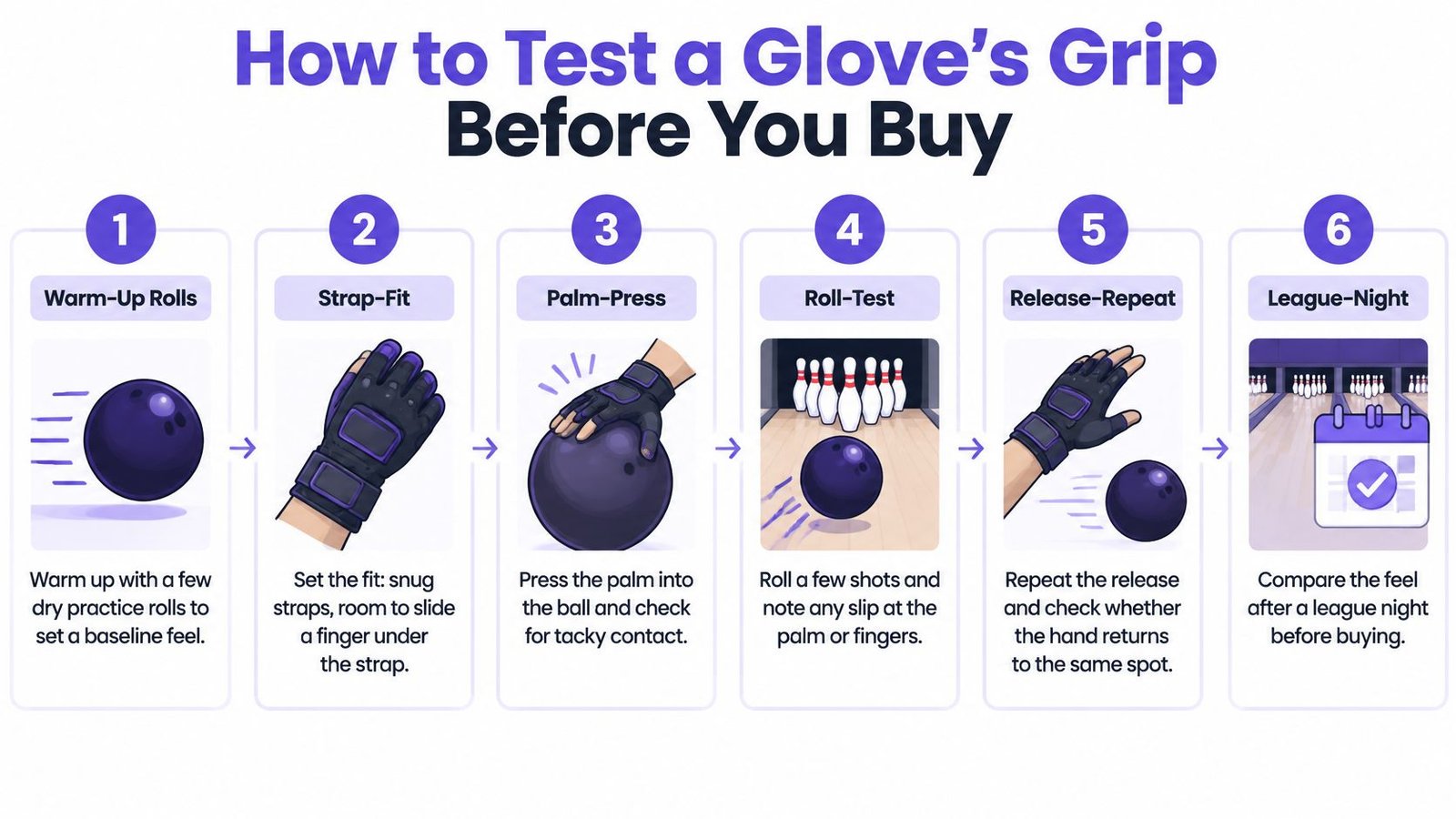
- Warm up dry. Throw a few practice rolls with your current setup to set a baseline feel. Without a reference point, every new glove feels either fine or wrong for reasons that have nothing to do with friction.
- Set the fit before you judge the grip. Straps snug with room to slide a finger under them, thumb span natural, no pressure at the base of the thumb. A loose glove slides and a tight one numbs, and both read as bad grip when the fault is fit.
- Run a foul-line drill. Twenty shots at the same target, same speed, same line. A controlled drill strips out the variables, like a pulled shot or a changing lane, that disguise whether the palm held.
- Check the contact patch after each set. Palm dampness, whether the glove has rotated on your hand, and whether the ball sat in the same place in your span. Note whether you changed any glove settings between sets, because if you did, the comparison is void.
- Repeat across three games. Log dampness, slip, drying time, odor, seam wear, and whether you found yourself squeezing harder as the session went on. The last one matters most, since a squeeze is your hand telling you the friction is gone.
- Compare game one with game three. If the glove holds through game three, it's a candidate. If it only works when fresh, it isn't, no matter how good it felt on the first frame.
Add a towel break and a consistent hand-drying routine between games, then keep the same routine for every glove you compare. Without that control you're measuring your towel habits rather than the glove.
Keep the results in a small notebook in your bag: date, lane condition, games bowled, dampness, slip, and whether you adjusted anything. Three lines per session is enough, and after a month you'll have something no product page gives you, which is how a specific glove behaves in your specific house on your specific hands.
What to distrust: a review that praises initial tack without stating how many games were bowled, in what humidity, and whether the palm was dried between them.
Grip Problems Under Sweat and Fit, and Their Fixes
The palm goes first. Two games into a league night, moisture builds between your hand and the ball, and the surface that felt secure at the counter starts to skate. Most bowlers then blame the glove's quality when the fault is either contamination or fit.
Diagnose before you replace. The table pairs the common symptoms with likely causes and the fix that addresses each one.
Grip symptoms, likely causes and fixes
| Symptom | Likely cause | Fix |
|---|---|---|
| Palm slips after one game | Sweat reducing friction on the palm | Towel-dry between games; choose a textured, ventilated palm |
| Glove slides on the wrist | Straps set too loose | Snug the straps so a finger slides under them |
| Numb fingers or thumb | Straps too tight or thumb span altered | Loosen straps and reset the thumb span |
| Grip fades after cleaning | Washing degrades the palm treatment | Hand wash in cool water, air dry, replace when grip is gone |
| Release drifts late in session | Wrist fatigue and cup setting | Recheck the cup and angle; add structured support |
| Glove deforms or tacky surface fails | Machine washing or tumble drying | Never machine wash or tumble dry |
Some of these fixes take a single session. Towel-drying between games, resetting straps, and rechecking a cup setting cost you nothing and can restore a glove you were ready to retire. Others take longer, like replacing a glove whose palm no longer holds no matter how carefully you dry it.
The material choice sets the ceiling on all of it. A sealed tacky surface feels secure at first and turns inconsistent once moisture or lane residue reaches it, while open mesh stays comfortable but gives sweat a direct path to the palm. That's a trade you accept at purchase, not a fault you fix later.
Care that keeps the palm working
For fabric and neoprene wrist supports, hand washing with mild soap and cool water, followed by air drying, is the best care method. Wrist supports should never be put in a washing machine or dryer, because that damages the materials and can leave a brace that no longer holds its shape. For metal wrist supports, wipe the metal components down and hand wash any fabric pads or straps.
Repeated washing can degrade the grip treatment on a glove, so treat the palm as a wear item. When a freshly cleaned glove still slips on a dry palm, the treatment is gone and no care routine brings it back.
If your hands run damp regardless, a rosin bag is the stopgap, and our notes on rosin bag use in bowling cover how to apply it without turning your palm into a sticky mess that picks up lane dirt.
Confirm Your Grip Choice Before You Buy
Injury surveillance makes the case for a secure, repeatable hold rather than peak tack. A U.S. epidemiological study of bowling injuries presenting to emergency departments from 1990 through 2008 estimated 375,468 bowling-related injuries nationwide during that period, with fingers the most commonly injured body part at 19.0% (the bowling injury surveillance study). Sprains and strains accounted for 42.7% of diagnoses.
Age shifts the risk, and it should shift your glove choice with it. Seniors aged 65 or older had a markedly higher proportion of injuries involving falls, slips or trips at 72.4%, compared with 38.3% for younger bowlers. That's a handling problem more than a friction problem, and a glove that helps you hold and set down the ball safely is worth more than one that adds tack at the cost of control.
Glove feature priorities by bowler profile
| Bowler profile | Priority | Feature to prioritize |
|---|---|---|
| Beginner | Dependable hold and easy adjustment | Moderate palm contact with simple straps |
| League or intermediate | Palm contact that holds through a session | Tacky palm with ventilation |
| Tournament bowler | Repeatable friction over three games | Tacky palm and adjustable wrist structure |
| Older bowler or wrist pain | Secure support and controlled ball handling | Snug adjustable support with comfort padding |
| Late-session wrist drift | Stable wrist position at release | Adjustable cup and angle dial |
Beginners should spend one evening getting a dependable hold they can repeat, then stop fiddling. Moderate palm contact and simple straps beat a cup-and-dial brace while the swing is still forming, because a beginner can't separate a good setting from a good shot yet.
League and intermediate bowlers have the clearest brief: friction that survives sweat. A thin tacky palm that keeps contact while venting beats a sealed surface that starts sticky and then lets go in the fourth frame. Tournament bowlers add the third requirement, holding that friction from game one through game three, and that's where an adjustable structure earns its place.
Older bowlers and anyone managing wrist pain need the priorities in a different order: secure support, controlled handling, comfort padding. If your wrist is drifting late in a set, treat it as a structure problem rather than a palm problem, and add support instead of buying another glove. Fit questions are worth asking out loud, too. Gary shares personalized recommendations to help bowlers find equipment that fits their style and goals.
Shortlist two or three gloves that match your profile, run the three-game comparison on each, and keep the one that holds your hand position without a harder squeeze. A glove that asks you to grip tighter has already failed the only test that matters.
Bowling Gear Reviews tests gloves and wrist supports on real lanes, scoring them on material and durability, support and adjustability, comfort and fit, and performance impact, so you can compare how a design holds up across a session rather than how it feels in the box. Our glove and wrist support reviews dig into the fit details that decide whether grip survives three games, from palm materials and seam placement to strap and cup settings. Visit Bowling Gear Reviews before your next league night to compare current gloves and supports side by side.
