

The ball that hooked like a dream in October is sitting in your bag in February, and it looks fine. Then league night comes, the ball slides through the breakpoint, and the reaction you built your whole line around is gone. You wipe it with the towel from your bag, nothing changes, and you start wondering whether the bottle of rubbing alcohol under the kitchen sink would sort it out in ten minutes.
It might. It could also leave a film that changes how the coverstock reads the lane, or break a rule you didn't know existed once the first ball is thrown for score. What follows is the routine I'd run on my own ball at home, the supplies I'd pay for, and the test that separates a ball that looks clean from one whose reaction is back.
Table of Contents
- Supplies and Cleaners Worth Buying for Home Care
- How to Clean Your Bowling Ball Step by Step
- Deep Cleaning a Heavily Soiled Ball at Home
- League and Tournament Rules That Limit Home Cleaning
- Check Whether Cleaning Restored Reaction
Supplies and Cleaners Worth Buying for Home Care
Bowling ball cleaning at home starts with a short shopping list, and most of it costs less than a league night. Two commercial cleaners set the reference points. In 2026, Bowling.com listed Brunswick's Big B at $10.99 for an 8-ounce bottle, and Tac Up at $27.99 for a 32-ounce bottle. That works out to roughly $1.37 an ounce against $0.87, so the cheaper bottle at the register is the more expensive one across a season.
Price is the easy part. What the product does to the shell is the harder question, and that's where approval earns its place. The USBC Equipment Specifications and Certifications Manual caps an approved cleaner at a 2-point change on the Durometer-D hardness scale and requires it to come off completely before competition, with no residue that pushes the ball's Fourier-transform infrared spectroscopy reading past at least 95% spectral similarity (a 5% maximum deviation). A product that softens the coverstock or leaves a detectable film fails that bar even when the ball gleams. Buy from the approved list and look for the USBC Approved Before/After logo on the label.
Everything else on the bench is household. A stack of clean microfiber towels does the actual work, so buy enough that you never reuse a dirty face. Add a soft brush for the finger holes and a bucket with a small amount of mild dish soap for a warm soak when the surface gets grimy. If you'd rather start from a tested product, the Storm Reacta Clean bowling ball cleaner review walks through one approved option.
What stays in the garage: abrasive pads, sanding material and polishing compounds. Those change surface roughness and ball reaction, which makes them surface preparation rather than routine cleaning.
| Item | Best use | Price or cost | Notes |
|---|---|---|---|
| Brunswick Big B bowling ball cleaner | Routine surface cleaning | $10.99 for 8 oz (2026) | Confirm USBC approval before league use |
| Tac Up bowling ball cleaner | Routine surface cleaning | $27.99 for 32 oz (2026) | Confirm USBC approval before league use |
| Warm water with a small amount of dish soap | Heavy buildup between pro shop visits | Household cost | Warm soak, then dry thoroughly |
| Microfiber towels | Applying and wiping cleaner | Low cost, sold in multipacks | Use a fresh side for each pass |
| Abrasive pads, sanding material or polish | Not for routine cleaning | Skip, not a routine purchase | Can change surface roughness and ball reaction |
Buy this first: one approved cleaner and a pack of microfiber towels. Get the routine right on a single product before you add a second bottle or a polishing kit you don't need yet.
How to Clean Your Bowling Ball Step by Step
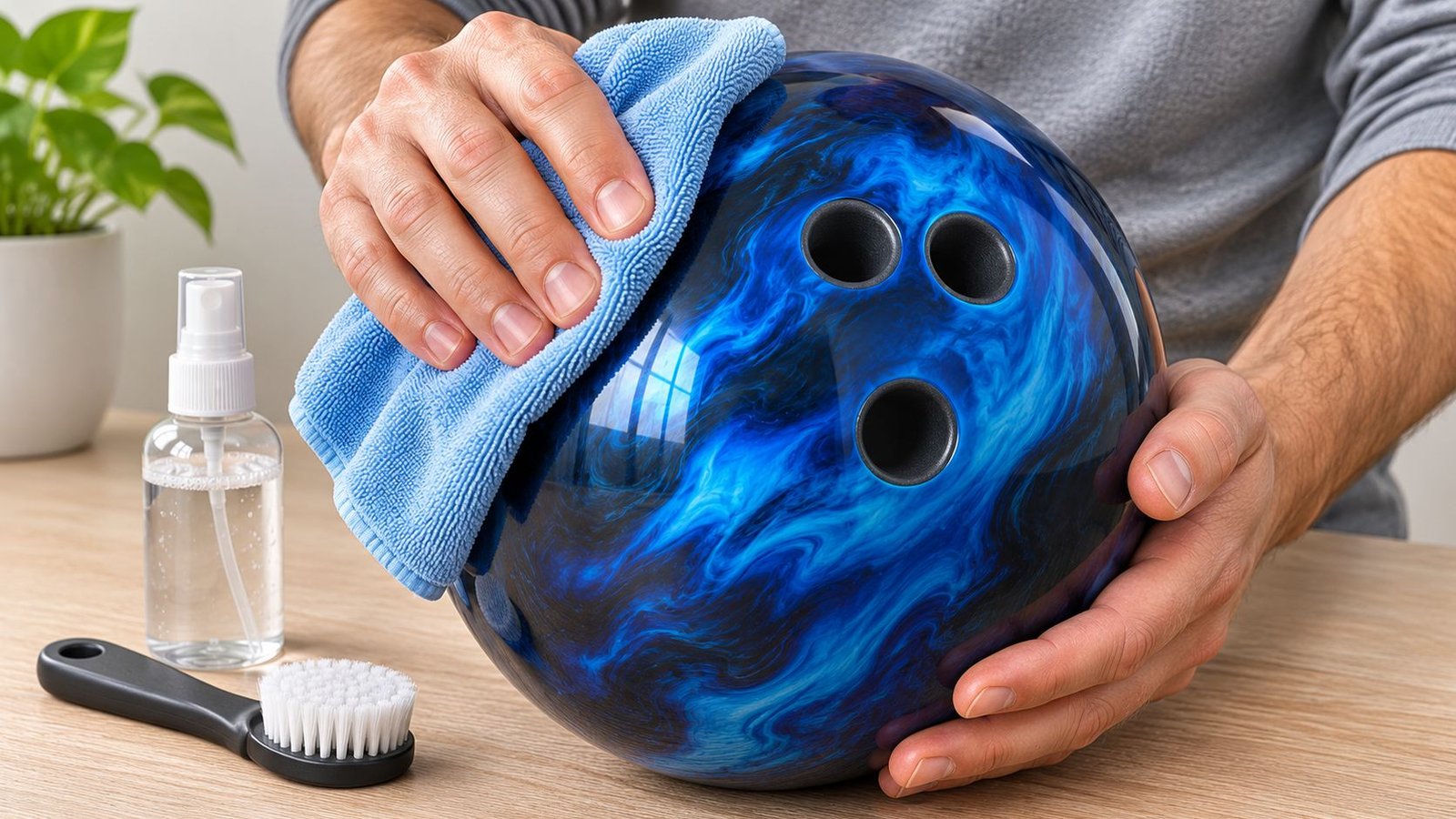
A wipe restores a clean look, not absorbed-oil reaction, so treat the two outcomes as separate from the first pass. The home routine below handles what sits on the coverstock. Four stages cover it.

- Set up away from water and heat. Lay a towel on a stable table, set the ball on it, and check the surface for loose grit before anything else. Grit picked up and smeared by a cleaner cutting into the coverstock.
- Wipe the whole ball dry first. A dry microfiber towel lifts dust and lane debris before any product touches the shell. Skip it and you're pushing grit around with a wet cloth.
- Clean one manageable section at a time. Apply a small amount of approved cleaner and leave it on the surface for about 10 seconds, the contact time BowlingLife advised for home users in 2025. Pooling on too much product leaves residue a towel can't lift.
- Wipe with a clean face of the towel. Turn to a fresh side for every pass and keep wiping until no colour transfers. A towel that comes away grey on the third pass is telling you the ball was dirtier than it looked.
- Work the whole surface, then clear the holes. Repeat around the ball, keeping cleaner out of the finger holes, and finish them with a dry brush. Cleaner pooled in a hole softens the plug and drips back onto the coverstock later.
- Dry and rest before storage. Finish with a fully dry towel and let the ball sit uncovered for a few minutes. A damp ball zipped into a bag holds moisture against the shell and picks up odour.
The check: the towel should come away clean on the final pass and the ball should feel uniformly dry across the entire surface, not tacky in one spot and dry an inch away.
The most common slip isn't the product, it's the amount. Two sprays on a cloth cover more ground than a soaked ball, and a soaked ball pushes liquid into the holes and the label. Keep the ball spinning in your free hand as you wipe so each section gets the same pass count, and swap towels halfway through the ball rather than at the end.
None of this reaches oil that's already inside the shell. Whether the routine brought your hook back is a separate question, and it's worth answering before you blame the layout.
Deep Cleaning a Heavily Soiled Ball at Home
A league bowler throws the same reactive ball three nights a week for two months, notices it hooking less, and finds that wiping no longer brings it back. That's the point where a surface wipe stops earning its keep. A warm bath with a small amount of mild dish soap, soaked for 20 to 30 minutes, is the heavier clean BowlersMart's home-maintenance guide recommends between pro shop visits.
Here's how I'd run it. Fill a bucket with warm water, not hot, and add a small amount of mild dish soap. Set the ball in, leave it for the stated time, and don't extend the soak hoping for more, because the coverstock gains nothing from sitting longer. Pull it out, dry it thoroughly with a clean towel, check the finger holes for trapped soap, and let it air-dry before it goes back in the bag.
Then be honest about what the soak did. Warm water clears surface grime and lifts some oil near the surface. It does not extract the oil that has soaked into the pores of a reactive coverstock, and that's the oil that flattens the reaction on a porous ball. If the ball still goes long and lays off after a proper soak and a full dry, the oil is inside, and the next step is professional rather than another bucket.
A soak buys you time. It doesn't buy you a new ball.
That's where bowling ball oil extraction comes in, either on a pro shop's machine or with a warming device built for the job. Avoid swapping in household solvents as a shortcut. A stronger chemical isn't a deeper clean, and on an expensive ball the downside lands on the coverstock.
Set a cadence: wipe after every session, soak every few weeks of heavy use, and book the pro shop when the reaction check fails after a soak and a complete dry.
League and Tournament Rules That Limit Home Cleaning
A ball cleaned at home is ready for play, but the rules change once competition begins. Under Rule 18, the USBC playing rules allow a ball to be cleaned, sanded or polished before league or tournament play starts. During competition, bowlers generally may not clean the ball with liquid, use an abrasive, or leave foreign material such as powder, rosin, marker or paint on its surface. A ball cleaned or altered contrary to the rule must be removed from competition.
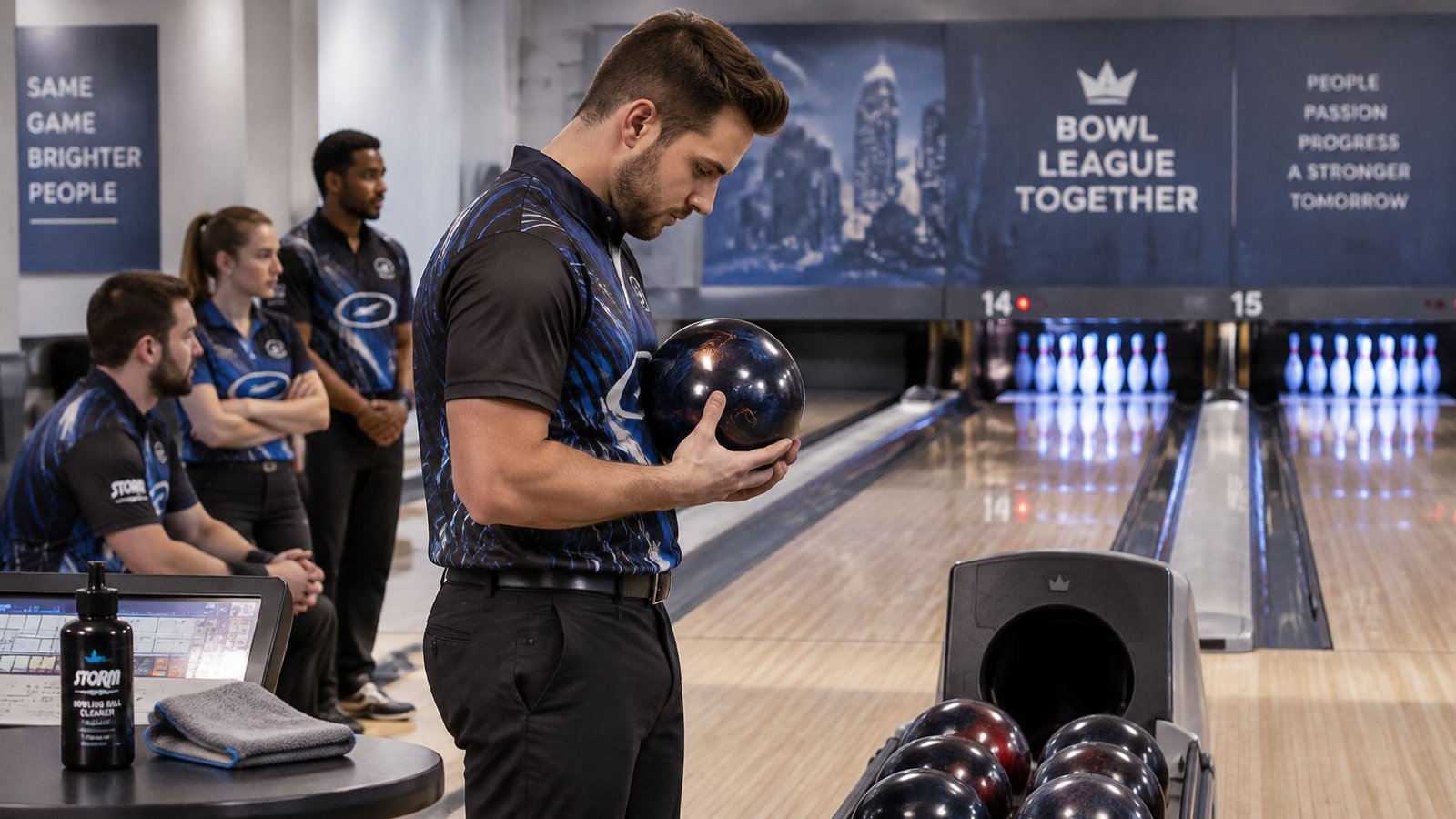
Clean and prepare the ball before you leave, then use a dry towel during play unless a league officer or tournament official authorizes an approved cleaner to remove contamination that cannot otherwise be removed. The restriction applies even to a ball you have not thrown yet once competition is underway. Putting a second ball into play does not create an exception.
For example, clean and dry your ball at home on Thursday, then wipe it with a dry towel between games on Saturday. Spraying cleaner on it in the middle of game two violates the rule, whether or not anyone notices.
Sanding and polishing are surface-preparation actions to do before competition, not quick adjustments between games.
Pre-event checklist
- Done the night before: clean, soak if needed, dry fully, and pack the ball.
- In the bag: two dry microfiber towels, no spray bottle.
- At the lanes: use a dry towel and ask the league officer if something is stuck to the surface.
- Never during play: liquid cleaner, abrasives, powder, rosin or marker.
Check Whether Cleaning Restored Reaction
Three jobs hide under the word cleaning, and only one of them happens with a towel: lifting lane residue and dust off the surface, pulling absorbed oil out of the coverstock, and restoring the texture the shell needs to grip the lane. Wiping does the first. It does nothing for the second and nothing for the third.

Here's where a lot of home care fails. USBC research reports that a dry towel was ineffective at removing oil's effects from the ball, and USBC's testing procedures treat oil absorption as a measurable coverstock property: a controlled amount of oil goes on and the time it takes to soak in gets measured. Absorption is a physical change in the shell, not a smudge you can buff off. A spotless ball can still carry the performance loss.
That's the gap between clean-looking and restored. On porous reactive-resin balls it's the whole story.
Four steps that answer the question for your own ball
- Record the baseline. Before you clean, note where the ball starts hooking and how it carries on a lane condition you know, at a center you bowl often.
- Run the routine and watch the towel. If the towel still picks up visible oil after the final pass, the surface oil isn't fully gone and a wipe has more work to do.
- Repeat the lane test after the soak and a complete dry. Same line, same ball speed, same target. Compare it to the baseline rather than to your memory of October.
- Log both results with the date. A written record turns "it feels flat" into a decision about whether to book a pro shop session or leave the ball alone.
If you want to see the surface work in motion before you try it on your own ball, this walkthrough covers the same ground.
A ball that comes out of a soak looking perfect and still won't finish through the pocket has told you something useful: the oil went deeper than water reaches. Household solvents won't reliably reverse that, and heat you can't control is a risk to the shell rather than a fix for it. Professional extraction exists for exactly this outcome. Gary, the equipment expert behind Bowling Gear Reviews, shares personalized recommendations to help bowlers find equipment that fits their style and goals, which is worth a conversation before you spend on a replacement ball.
If extraction restores the motion and it fades again within a few weeks, the surface itself may be worn rather than oil-soaked. How often to resurface a bowling ball covers the intervals that separate a refresh from a full resurface.
| Symptom | Likely cause | Next step |
|---|---|---|
| Towel comes away clean and reaction returns | Surface residue removed | Keep the current schedule |
| Towel still picks up oil after wiping | Surface oil not fully removed | Repeat the wipe with a fresh towel or do a soak |
| Reaction stays off after a proper soak and dry | Oil absorbed into coverstock | Book pro shop extraction or resurfacing |
| Uneven surface or visible damage | Coverstock damage | Stop cleaning and get a professional assessment |
Bowling Gear Reviews tests balls, shoes, bags and accessories on real lanes and publishes the findings so bowlers can match equipment to how they play. If your ball still reads flat after a proper soak and dry, the Bowling Gear Reviews guides on ball motion, surface prep and oil extraction will help you decide whether the fix is maintenance or a new ball. Start with the cleaning routine, log the reaction, and you'll know within a couple of sessions which one you're dealing with.
