

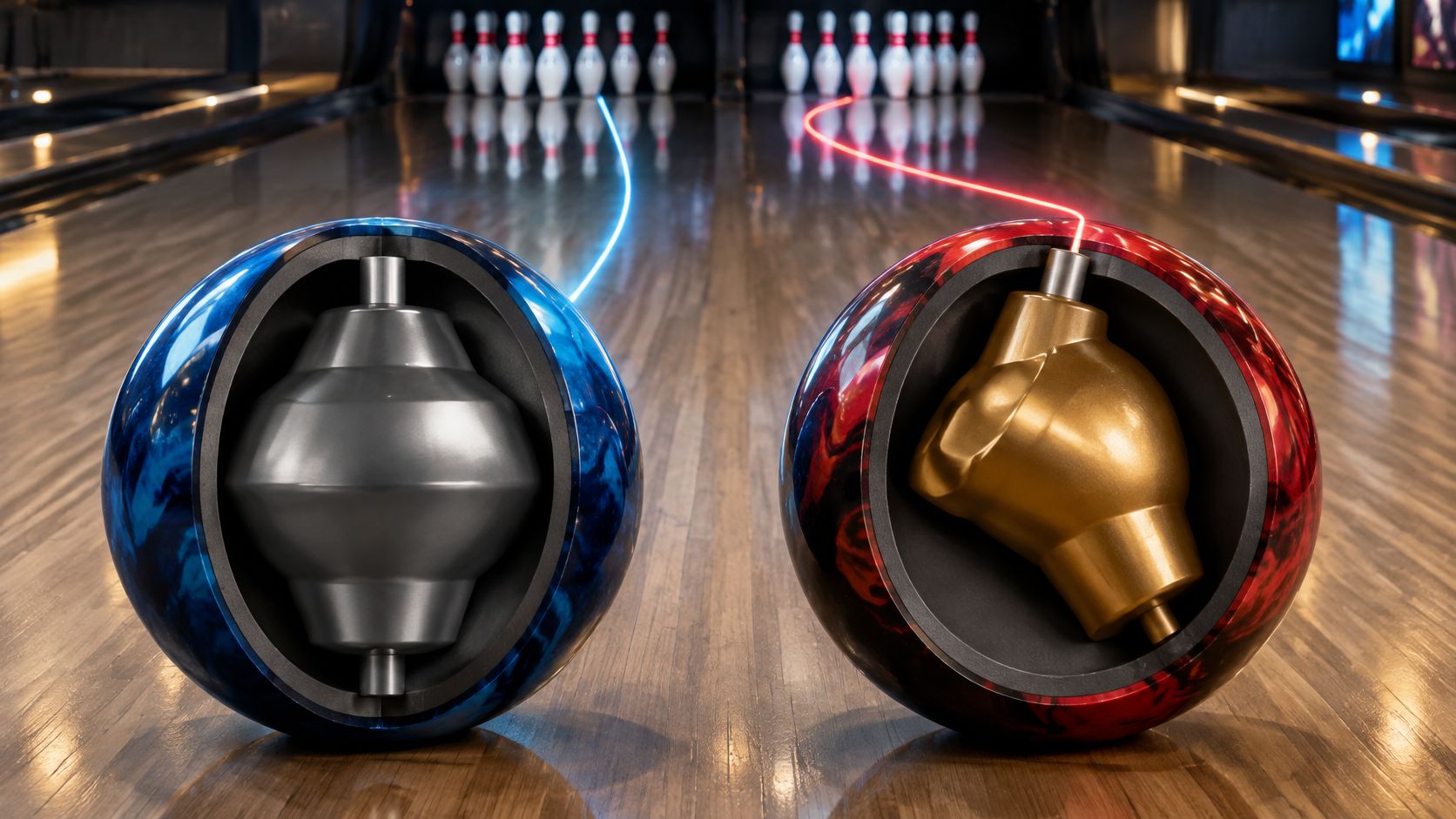
You buy a ball advertised as high performance, take it to league night, and watch it hook before you wanted it to. You move your feet, change your target, and try throwing harder, but you still can't find a comfortable line. The ball may be capable equipment, just poorly matched to the motion you need.
Understanding bowling ball core types helps you move beyond that label. The useful question isn't which core is strongest. It's which combination of core measurements, coverstock, and layout will give you a readable reaction on the lanes you bowl.
Table of Contents
- Core Types, Their Origins and Construction
- How RG and Differential Predict Ball Motion
- Symmetric vs Asymmetric Cores and What Changes
- Matching a Core to Your Lane and Style
- Why Two Balls with the Same Core Roll Differently
- Pick Your Core Before You Buy
Core Types, Their Origins and Construction
A core is the internal weight structure that helps determine how a ball rotates. Its shape matters because engineers use shape and material density to distribute mass, but a dramatic-looking cutaway doesn't tell you exactly how the finished ball will roll.
Start by separating construction descriptions from measured performance. Pancake, elliptical, and lightbulb describe physical arrangements or shapes. Symmetric and asymmetric describe rotational properties. A combination core can also be symmetric or asymmetric, so these families overlap rather than forming separate performance tiers.
Core Types Compared by Construction and Motion
| Core type | Construction | Typical RG and differential pattern | Typical motion |
|---|---|---|---|
| Pancake | Small dense weight block inside a spherical construction, surrounded by less-dense material | Confirm the finished ball's specifications; the shape alone supplies no reliable range | A control-oriented application is possible, but coverstock and measured properties establish the reaction |
| Symmetric | Mass arranged symmetrically around a principal axis | Matching high-RG axes, with total differential possible between high- and low-RG axes | Can support a readable arc, including substantial flare when total differential is higher |
| Asymmetric | Mass distribution produces distinct principal-axis properties | Total differential plus measurable intermediate differential | Additional layout-sensitive shaping potential, not automatically an earlier or larger hook |
| Dynamic or combination | One core shape and density placed inside another | Engineered for the model and weight; check published measurements | Designed to produce a targeted reaction in combination with the cover |
| Elliptical or lightbulb | Stretched, rounded, or tapered internal shape | Geometry alone doesn't establish RG or differential | Exact read requires specifications, surface information, and lane testing |
A symmetric core does not necessarily have equal RG on every axis. That description would fit a fully spherical mass distribution, not the general category of modern symmetric performance cores. Symmetric balls can have meaningful total differential and track flare.
Why Modern Cores Became More Complicated
The bowling-ball construction overview describes the shift around 1990 from traditional construction toward spherical, elliptical, lightbulb-shaped, and combination cores, followed by increasing use of computer-aided design from approximately 1993. Earlier construction placed a small amount of dense material inside a spherical mold and surrounded it with less-dense material, producing the familiar pancake-like arrangement.
Combination designs give engineers another way to position mass. By nesting materials of different shapes and densities, they can adjust rotational properties without relying on the outside silhouette of a single weight block.
That flexibility also explains why the core pictured in an advertisement may not represent every available weight. Manufacturers may change the internal design when producing a lighter version, rather than shrinking the same core.
Buying safeguard: Treat the cutaway illustration as a construction guide, not a promise of ball motion.
Use the table to identify the kind of design you're considering, then check the finished ball's specifications at your intended weight. Don't assume that a familiar core name, an unusual shape, or a premium label guarantees the reaction you're missing.
How RG and Differential Predict Ball Motion
Think of a figure skater pulling their arms inward. Moving mass closer to the rotation axis makes rotation easier to accelerate. Radius of gyration, usually shortened to RG, describes how far from an axis the ball's mass is effectively distributed.
A lower-RG ball tends to rev up sooner. A higher-RG ball generally retains more length before transitioning. Neither description tells you whether the ball will make a sharp turn, because timing and reaction shape aren't the same thing.
The USBC symmetric-ball RG measurement procedure treats RG measurements as axis-specific physical properties measured in inches. Compare certified specifications at the same ball weight, rather than comparing a lighter model with a heavier candidate.
Reading RG, Differential and PSA Values
| Measurement | Lower value tends to | Higher value tends to | What to check |
|---|---|---|---|
| RG, radius of gyration | Promote earlier rev-up and energy release | Preserve length before transition | Exact ball weight and published specification |
| Total differential | Allow less track flare | Allow more track flare and total hook potential | Coverstock strength, surface, and intended layout |
| Intermediate differential | Indicate less separation between the relevant high-RG axes | Indicate greater asymmetry and additional layout sensitivity | Don't translate it directly into midlane motion without testing |
| Preferred spin axis, PSA | Not a lower-is-better measurement | Identifies an axis, not a hook score | Manufacturer's axis marking and drilling documentation |
Total differential is the gap between maximum and minimum RG. Greater separation permits more track migration, meaning successive rotations can bring fresh coverstock into contact with the lane. That increases hook potential, but it doesn't guarantee a particular breakpoint shape.
Intermediate differential describes another part of the core's rotational properties. Don't read it as an independent measure of midlane strength. Likewise, PSA position is something a driller uses when orienting an asymmetric ball, not a numerical rating you can rank from weak to strong.
Read the Measurements Together
A low-RG, high-differential design paired with an aggressive, rough cover can produce more early traction than you need. If your current ball already uses up its motion too soon, buying that combination just because it promises more hook may worsen the problem.
A higher-RG, lower-differential option can be a useful direction when you need length and less flare. Our guide to low-RG bowling balls helps distinguish situations where earlier rev-up is useful from situations where it becomes excessive.
Before buying, locate RG, total differential, and intermediate differential where published. Check the manufacturer's PSA marking information for an asymmetric candidate. Treat missing specifications as unknown, not as an invitation to estimate from the core picture.
Symmetric vs Asymmetric Cores and What Changes
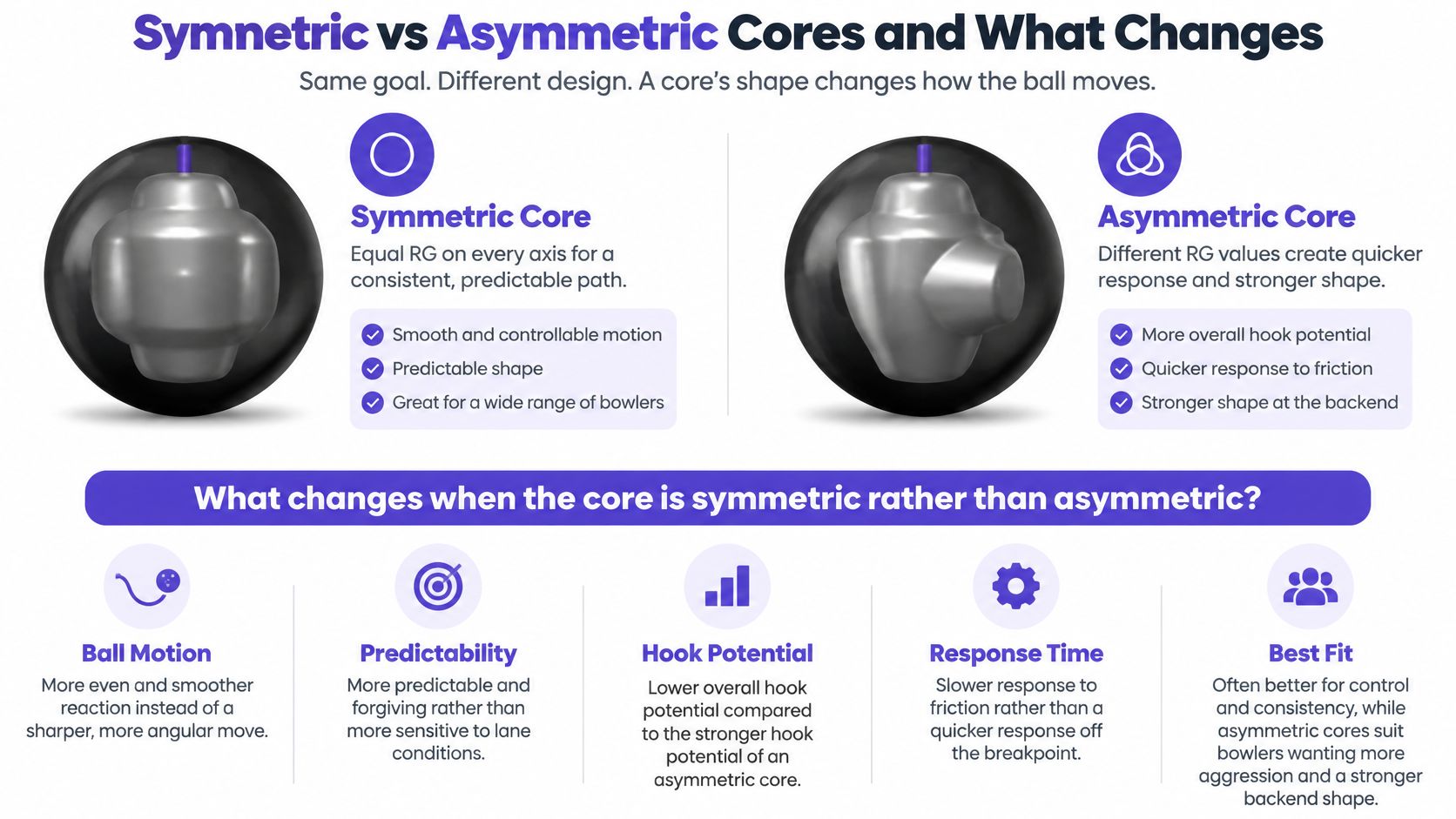
What changes when a core is symmetric rather than asymmetric? The meaningful difference is the rotational structure available to the driller, not a simple division between beginner equipment and advanced equipment.
Use this visual comparison as a starting point, with one technical qualification: modern symmetric performance cores can have total differential, so symmetry doesn't mean identical RG on every possible axis.
Control Versus Additional Shaping Options
A symmetric ball is often a sensible starting point when you want an uncomplicated, readable reaction. But don't confuse readable with weak. A symmetric design with substantial total differential and an aggressive cover can still create plenty of motion.
An asymmetric ball introduces another meaningful axis relationship for layout decisions. That can help a skilled driller tailor the transition, but it also makes broad claims such as asymmetric always hooks earlier unreliable. Coverstock and surface can easily change that comparison.
BowlersMart's core directory reported 64 symmetric cores and 52 asymmetric cores in its broader inventory in 2026. That inventory illustrates the breadth of both categories, not a performance advantage for either.
A Same-Weight Comparison
Say you're comparing a symmetric ball you control comfortably with an asymmetric candidate at the same weight. The candidate changes direction too abruptly when it reaches friction. The solution may involve a different layout, a surface adjustment, or a different cover, rather than rejecting every asymmetric design.
Compare the actual problem:
- Need a readable baseline: Start with a symmetric candidate whose overall specifications suit your conditions.
- Need a different transition shape: Consider an asymmetric option and discuss its axis orientation with your driller.
- Need more hook: Compare total differential and cover strength rather than choosing by symmetry alone.
Watch the motion demonstration with those distinctions in mind.
Choose the reaction, not the category's reputation. Neither construction guarantees carry, and neither can compensate for a ball that encounters friction in the wrong place.
Matching a Core to Your Lane and Style
| Lane pattern and style | Core direction | Reason |
|---|---|---|
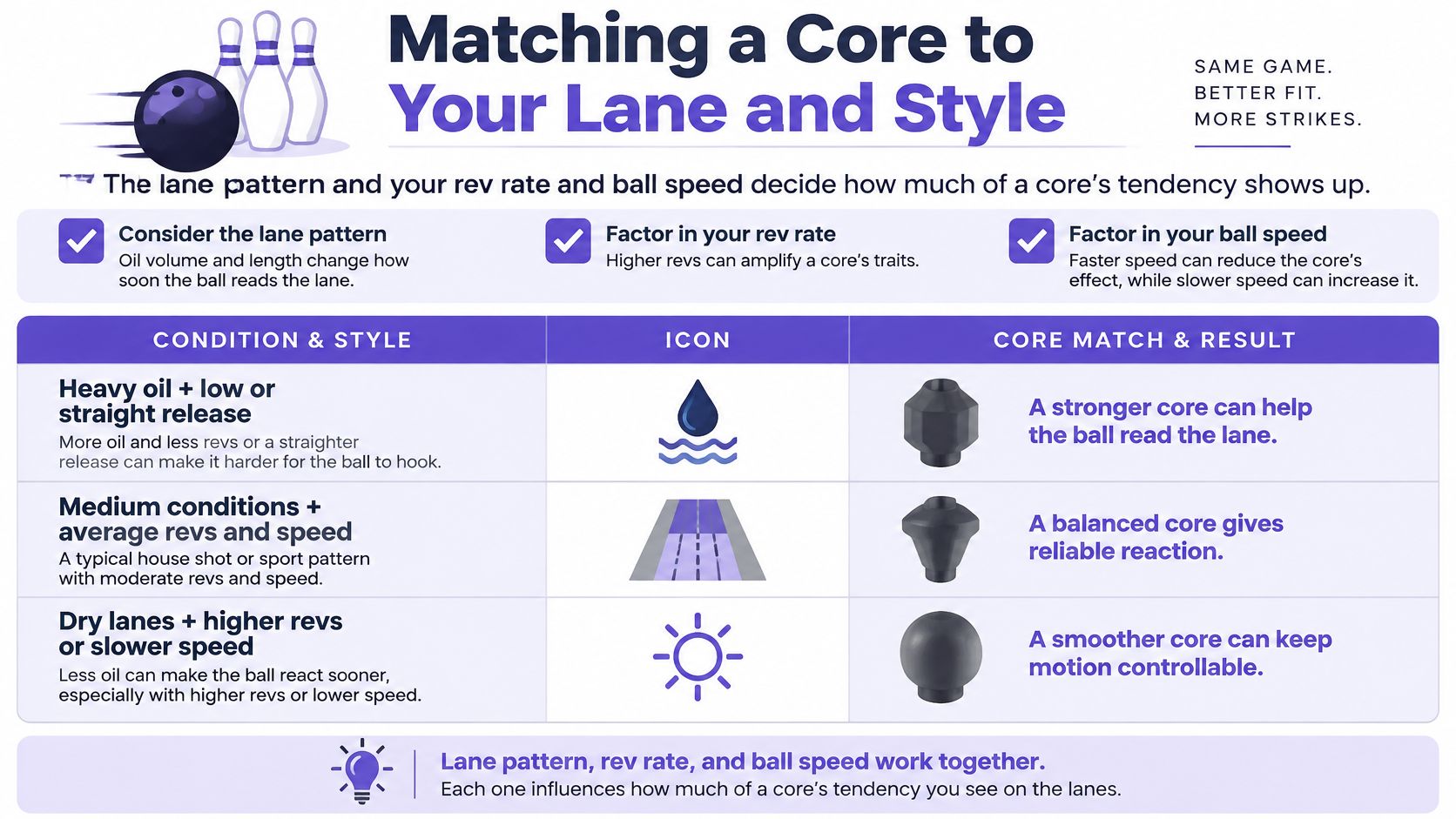
| Heavy oil, low or straight release | Consider lower RG and sufficient differential, paired with a cover that can establish traction | Helps address a ball that skids too far without developing useful motion |
| Medium oil, moderate rev rate | Start with balanced RG and moderate differential relative to your current equipment | Provides a practical baseline for evaluating midlane control and flare |
| Dry or transitioning lanes, high rev rate | Consider higher RG and lower differential with a suitably mild cover | Helps preserve length and reduce excessive flare or early traction |
These are testing directions, not automatic prescriptions. A higher-RG, low-differential ball may get through the front easily, but that isn't helpful on heavy oil if your main problem is already excessive skid. Similarly, a low-RG, high-differential ball isn't the default answer for a high-rev bowler on dry lanes.
Use this lane-and-style guide to connect the visible reaction with a sensible equipment direction.
Diagnose the Miss Before Choosing the Core
Start with the lane information you can obtain from the bowling center or event sheet. Oil volume, pattern length, and distribution affect where the ball encounters usable friction. Our explanation of bowling oil pattern types can help you interpret those descriptions without treating every oily lane as the same condition.
Then record what your current ball does. A ball that starts hooking too early presents a different problem from one that skids comfortably but turns too sharply downlane. Both may finish high, yet they don't necessarily call for the same equipment change.
Use a phone recording from behind the approach, placed safely out of other bowlers' way. Watch the ball's path rather than relying only on the pin leave. Note whether your release speed and rotation remain reasonably consistent between attempts.
A Checklist for the Lane
- Identify the condition: Record the posted pattern when available. Otherwise, describe the reaction you observe rather than guessing the oil volume.
- Describe your delivery: Note whether you're speed-dominant, rev-dominant, or reasonably matched. A coach's observation is more useful than labeling yourself solely from how much the ball hooks.
- Mark the transition: Record where the ball begins changing direction and where its outward travel ends.
- Choose a correction: Decide whether you need earlier traction, more length, less flare, or a less abrupt response.
- Compare suitable candidates: Keep ball weight consistent and evaluate the complete core-and-cover package.
For a medium-condition league bowler, the best upgrade may be a modest change rather than a dramatic move toward maximum differential. For a high-rev bowler watching the fronts dry out, reducing flare potential may create a more usable line.
Don't prescribe more hook until you know whether the ball needs to hook earlier, later, or less sharply.
If you overreact, include smoother core options in your comparison, but don't assume a core purchase should come before a surface adjustment. Diagnose with your existing equipment first. A reversible preparation change may clarify the problem before you commit to another ball.
Why Two Balls with the Same Core Roll Differently
The common assumption is straightforward: identical core specifications should produce identical motion. It fails because core numbers describe mass distribution, not the complete interaction between ball, release, and lane.
The USBC core-properties document explains the physical framework of RG, differential, and the preferred spin axis. Those properties are useful, but they aren't a complete prediction of a drilled ball's reaction.
Say you compare balls with similar RG and differential. One has a polished surface and the other a rougher finish. They can respond to friction at different points even though their core measurements look nearly interchangeable.
What the Spec Sheet Leaves Out
Cover chemistry, roughness, oil absorption, and maintenance condition affect the contact between ball and lane. Release speed, rev rate, and axis rotation affect how that contact develops into motion. Drilling changes the finished ball's mass properties and the relationship between the core and your release.
That's why matching the printed layout notation isn't always enough, especially when comparing symmetric and asymmetric equipment. Use your measured positive axis point and discuss appropriate bowling ball drilling layouts before treating a comparison as controlled.
A Repeatable Comparison
- Standardize the preparation. Have both surfaces prepared with the same abrasive process and cleaning routine. Record whether polish was used.
- Control the layout. Use comparable layouts referenced to your measured positive axis point, with a driller accounting for each core's characteristics.
- Keep the delivery comparable. Alternate balls while trying to maintain speed, rev rate, target, and release orientation. Flag obvious execution errors.
- Record motion, not just strikes. Log breakpoint position, midlane read, entry angle, continuation, and visible flare rings.
- Repeat through transition. Compare across several games and, where possible, another session under similar starting conditions.
Matching preparation and layout reduces confounding influences; it doesn't eliminate cover chemistry or create a laboratory isolation of the core. Alternating shots also helps prevent you from crediting a ball for a lane change that happened while you were using the other one.
A useful test tells you which ball solves your problem. It doesn't need to prove that the core alone caused every difference.
Keep the conclusion narrow. If a candidate produces a more stable breakpoint on your usual condition, that's a meaningful buying result, even when you can't assign the improvement to a single specification.
Pick Your Core Before You Buy
Choose a core whose published properties fit the motion you need, then confirm that the complete ball suits your usual lanes. Don't purchase until you've checked the specifications for the exact weight you intend to use.
Make These Checks in Order
First, identify your normal condition. Write down the pattern information you know and the problem you're trying to solve. Be specific: skids past the intended breakpoint, hooks in the fronts, or changes direction too abruptly is more useful than doesn't carry.
Next, decide what kind of control you're missing. You may need less flare, an earlier start to rotation, or additional layout options. Don't turn that decision into symmetric for consistency and asymmetric for power, because individual balls can cross those expectations.
Finally, verify the candidate. Check the manufacturer's RG, total differential, and published intermediate differential at your chosen weight. For asymmetric equipment, confirm the PSA marking and relevant layout guidance rather than assuming that information will appear on every retail spec sheet.
Bring Evidence to the Decision
Take your current ball's model, weight, surface condition, and layout information with you when discussing a candidate. Add your motion notes or a short video. That gives the driller something concrete to work with instead of a request for the strongest available ball.
At Bowling Gear Reviews, we test bowling gear in real bowling conditions, and Gary shares personalized recommendations to help bowlers find equipment that fits their style and goals. That approach matters here because a specification becomes useful only when you connect it with the reaction you're trying to achieve.
Keep coverstock, surface preparation, fit, and drilling in the same conversation as the core. If a candidate overlaps equipment you already control well, ask what distinct job it would perform before adding it to your bag.
This week, write down your usual lane condition and your current ball's breakpoint behavior. Take that note, along with the exact-weight specification sheet for any candidate, to your pro shop before you buy.
At Bowling Gear Reviews, we offer hands-on equipment reviews and clear explanations that connect core design, coverstock, and surface preparation with lane suitability. Visit our ball guides and comparisons with your motion notes in hand to build a shortlist that fits your delivery and the conditions you bowl most.
