

If a house shot is supposed to be forgiving, why can the same bowling ball look dependable at your regular center and almost uncontrollable somewhere else?
The missing detail is that a bowling house shot describes a general pattern design, not one precise lane condition. To choose equipment and make useful adjustments, you need to understand where your ball finds friction, how that changes during play, and which parts of your game the pattern might be helping.
Table of Contents
- What a House Shot Oil Pattern Actually Is
- How Oil Contrast Steers the Ball
- Why Two Centers Play the Same Shot Differently
- Choosing Equipment for House Conditions
- How to Adjust Your Angle and Breakpoint
- Turning House Shot Scores Into Real Skill
- Confirm Your Center's House Shot Before You Buy
What a House Shot Oil Pattern Actually Is
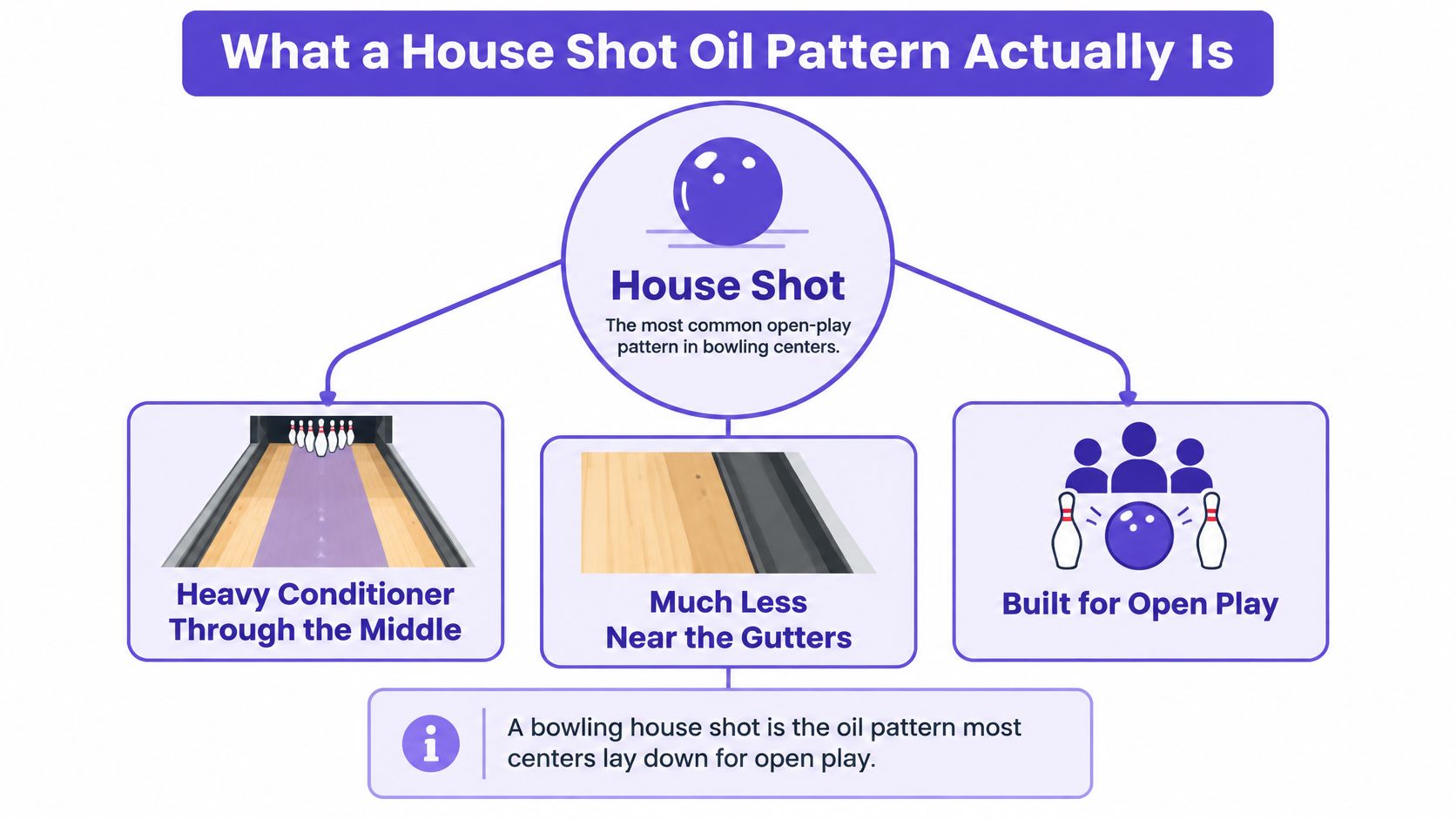
A bowling house shot is the oil pattern most centers use for open play and recreational league bowling. Lane staff apply more conditioner through the middle of the lane and less near the gutters, creating a condition intended to offer room for error.
The word pattern matters. Staff aren't just coating the lane evenly. They're controlling where the oil goes, how far it extends, and how much separates the heavily conditioned middle from the relatively dry outside.
This diagram shows the basic arrangement.
Reading the specifications
An inside-to-outside oil ratio compares the concentration of conditioner in the middle with that farther outside. USBC's sport bowling information describes the high-contrast recreational design, commonly referenced at approximately 10:1, with house-shot descriptions also using 8:1 or higher and a pattern length near 40 feet.
That ratio doesn't mean the middle contains a deep puddle or that the outside is completely bare. It describes a relative difference in conditioner distribution, which changes how much friction the ball encounters along different paths.
Typical house shot specifications
| Specification | Typical House Shot | Why It Matters |
|---|---|---|
| Inside-to-outside oil ratio | High concentration inside, substantially less outside | Sets the contrast between inside hold and outside recovery |
| Pattern length | Medium-length recreational pattern | Helps locate where the ball can encounter more downlane friction |
| Total oil volume | Center-specific conditioner application | Influences skid, but doesn't describe where the oil sits |
| Oil per lane, 1980s league conditions | About 8 mL, documented in the USBC study below | Explains why older equipment advice came from different conditions |
| Oil per lane, modern centers | About 24 mL in the USBC study below | Shows why historical house-shot advice needs context |
The USBC bowling technology study reports approximately 8 milliliters per lane for standard league conditions during the 1980s, compared with about 24 milliliters in the modern centers described by the study. Those are historical observations, not a promise about the lane you'll bowl on tonight.
What the numbers don't tell you
The defining traits are inside hold, outside friction, and a recovery area between useful paths to the pocket. Their practical value comes from how they work together, not from any specification by itself.
A ratio doesn't identify the best starting board. Total volume doesn't tell you whether the fronts have already dried out. Pattern length doesn't reveal how your release and ball surface will interact with the lane.
Treat the specifications as a baseline for asking better questions. Before comparing bowling balls, find out what your center applies and whether you're testing on freshly conditioned or already used lanes.
How Oil Contrast Steers the Ball
Think of the house shot as a funnel, but not a physical channel. The ball doesn't know where the pocket is, and oil doesn't push it toward the pins. Differences in friction change when and how the ball responds to its rotation.
The ball path below illustrates that relationship.
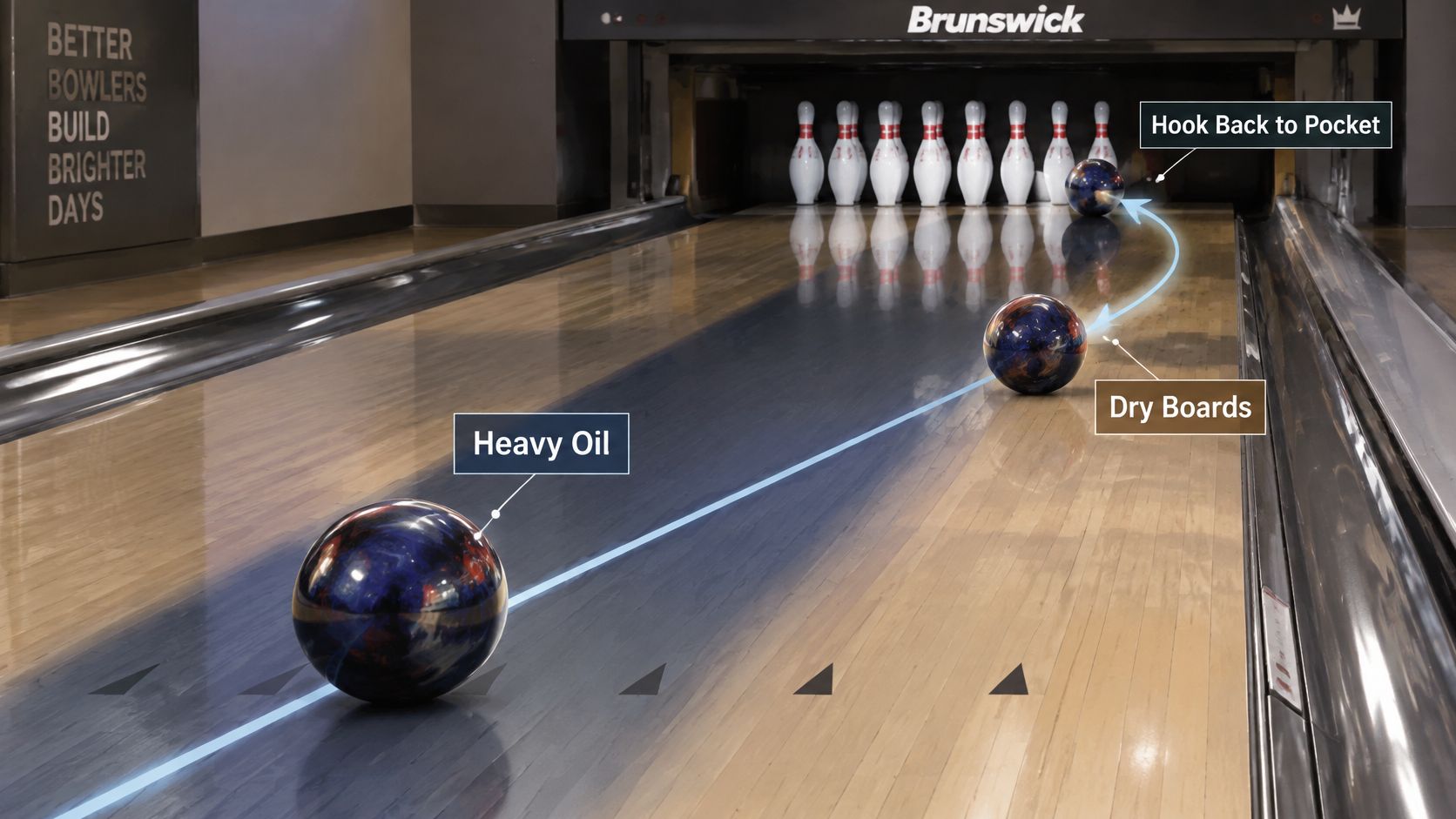
National Bowling Academy's explanation of the house shot describes the complementary effects: heavier center oil provides hold, while the drier outside boards provide friction that can help the ball recover toward the pocket.
Hold means an inside miss may slide longer rather than immediately changing direction. Recovery means an outside miss may encounter enough friction to turn back toward the intended entry point. Neither effect guarantees a strike, and neither can rescue every delivery.
Follow the ball through its motion
During skid, the ball travels through the front of the lane without fully converting its sideways rotation into a change of direction. As friction increases, the ball enters its hook phase. It then transitions toward roll as it approaches the pins.
Say a right-hander sends a delivery slightly inside the intended line. If that path keeps the ball in heavier conditioner, the ball may delay its change of direction and avoid crossing excessively high.
Now consider a delivery sent farther outside. If the ball reaches usable friction with enough rotational potential remaining, it can turn back toward the pocket. A left-hander can apply the same reasoning in reverse.
The following video offers another visual reference for watching lane reaction.
Where forgiveness stops
The breakpoint is the farthest-outside part of the ball's path before it turns toward the pocket. It isn't necessarily the exact location where the oil ends or where hooking first begins.
A useful breakpoint sits in friction your ball can handle repeatedly. Too much early friction can make the ball change direction prematurely and finish weakly or at an unsuitable angle. Too little useful friction can leave it sliding past the intended recovery point.
Watch the change of direction, not just the size of the hook. A dramatic move isn't helpful if you can't repeat where it happens.
The familiar over/under reaction appears when a small inside miss skids too long while a small outside miss hooks sharply. More hook won't necessarily solve that mismatch.
Use our beginner's guide to reading bowling lane oil patterns to connect the lane map with the motion you can observe. Your equipment decision should start with the location and shape of that motion.
Why Two Centers Play the Same Shot Differently
Calling both conditions a house shot doesn't make them the same. It tells you the general intention behind the oil distribution, but leaves out much of what determines your ball's response.
The USBC lane-condition explanation published by SAUSBCA describes the inside-heavy recreational design without establishing a universal house-shot specification. A center can follow that general approach while using different conditioner, lane surfaces, and maintenance settings.
Lane variables and how to check them
| Variable | What It Changes | How to Check It |
|---|---|---|
| Pattern length | Where the ball encounters the end of the applied pattern | Ask for the pattern sheet or programmed length |
| Total oil volume | The amount of conditioner available along the ball's path | Ask for milliliters per lane; conditioning time alone doesn't reveal volume |
| Inside-to-outside ratio | Contrast between inside hold and outside friction | Request the ratio or cross-lane graph |
| Lane surface and finish | How readily the ball develops traction | Ask the lane technician about surface material and maintenance |
| Conditioner type | How the applied oil behaves and transitions | Ask which conditioner is used and whether it changes between sessions |
| Machine settings | Placement and consistency of conditioner application | Ask whether the same program and machine are used |
| Traffic and game stage | Where bowlers remove or redistribute conditioner | Compare early-session and late-session reaction |
Separate the pattern from its condition
A pattern sheet describes what staff intend to apply. It doesn't fully describe what remains after bowlers have used the lane.
Balls remove conditioner from their paths, and some conditioner can move farther downlane. Bowlers also concentrate traffic in particular areas. The resulting lane transition means the same line can become less suitable as a session progresses.
For example, a ball might clear the front comfortably when play begins, then start hooking before your intended breakpoint later. Another ball might look less impressive initially but remain easier to control after that early friction develops.
That's why initial reaction and transition behavior are different tests. A ball that looks excellent on a fresh lane isn't automatically the best choice for an entire league session.
Ask questions the staff can answer
You don't need to interrogate the front desk about every machine setting. Start with the lane facts that affect your interpretation:
- Pattern length: Ask what pattern is scheduled for your league or practice session.
- Oil volume and ratio: Request the pattern sheet if staff have it available.
- Conditioning time: Find out when the lanes were last cleaned and oiled.
- Conditioner changes: Ask whether staff use the same oil and program between sessions.
If those details aren't available, record what you can observe rather than inventing an explanation. Note whether your ball starts earlier, slides farther, or changes direction more sharply than usual.
Center maintenance and lane evolution can matter as much as coverstock or core design. Don't label a ball unsuitable until you've separated its characteristics from the condition on which you're using it.
Choosing Equipment for House Conditions
Peak hook is the wrong buying test. Equipment mistakes get expensive when bowlers purchase a stronger ball to solve a problem that comes from too much early traction.
Start by describing the problem precisely. Does the ball slide beyond the intended breakpoint, start hooking too early, or react sharply whenever it reaches the outside? Those observations lead to different equipment choices.
Ball setup and reaction on a house shot
| Ball Setup | Typical House Shot Reaction | When to Use It |
|---|---|---|
| Polished solid | Usually clears the front more easily than the same cover with a rougher finish, but can still respond strongly to dry boards | When a familiar solid starts too early and needs additional length |
| Rougher-surfaced solid | Develops traction sooner through conditioner | When the ball skids too far through the middle |
| Pearl or hybrid | Can provide cleaner front-lane travel and usable downlane response | When a stronger solid reads the available friction too aggressively |
Cover categories aren't guarantees. A pearl can be stronger than a solid, and polish doesn't erase the underlying coverstock chemistry or core characteristics. Compare the complete ball and surface preparation, not the label alone.
Match traction to the available lane
BowlersMart's explanation of oil patterns gives typical house-shot references of approximately 38–42 feet and 18–24 mL of oil. Its Rule of 31 example estimates a breakpoint near board 9 for a 40-foot pattern, which leaves approximately 20 feet before the pins.
Treat that breakpoint estimate as a starting reference, not a mandatory target. Your ball, delivery, and actual friction can make a different location more effective.
A shorter pattern exposes the ball to downlane friction sooner. Strong equipment can therefore begin its transition earlier than you want, especially when you also send it across a dry outside area.
Change the surface for a reason
A rougher surface is useful when you need earlier traction. It isn't automatically useful when you want a larger-looking backend move. Earlier traction can produce a smoother shape rather than a sharper finish.
A cleaner or polished surface can help retain length when the lane supplies too much early friction. But if the ball already slides beyond the recovery area, adding polish can make the original problem worse.
Equipment check: Choose the setup that gives you a readable, repeatable transition, not the one that makes the biggest turn during practice.
Make surface adjustments away from active competition and follow the rules of your event. Use a consistent abrasive pad and preparation method so you know what changed.
Our gear testing takes place in real bowling conditions. When using a bowling ball comparison, pay attention to the tested surface, lane condition, and reaction shape rather than treating an overall hook description as a universal ranking.
Record pattern length, oil volume when available, surface grit or polish, ball speed, axis rotation, and carry percentage. Also note when each ball was tested. Otherwise, you may credit a ball change for a reaction caused by the lane changing underneath it.
How to Adjust Your Angle and Breakpoint
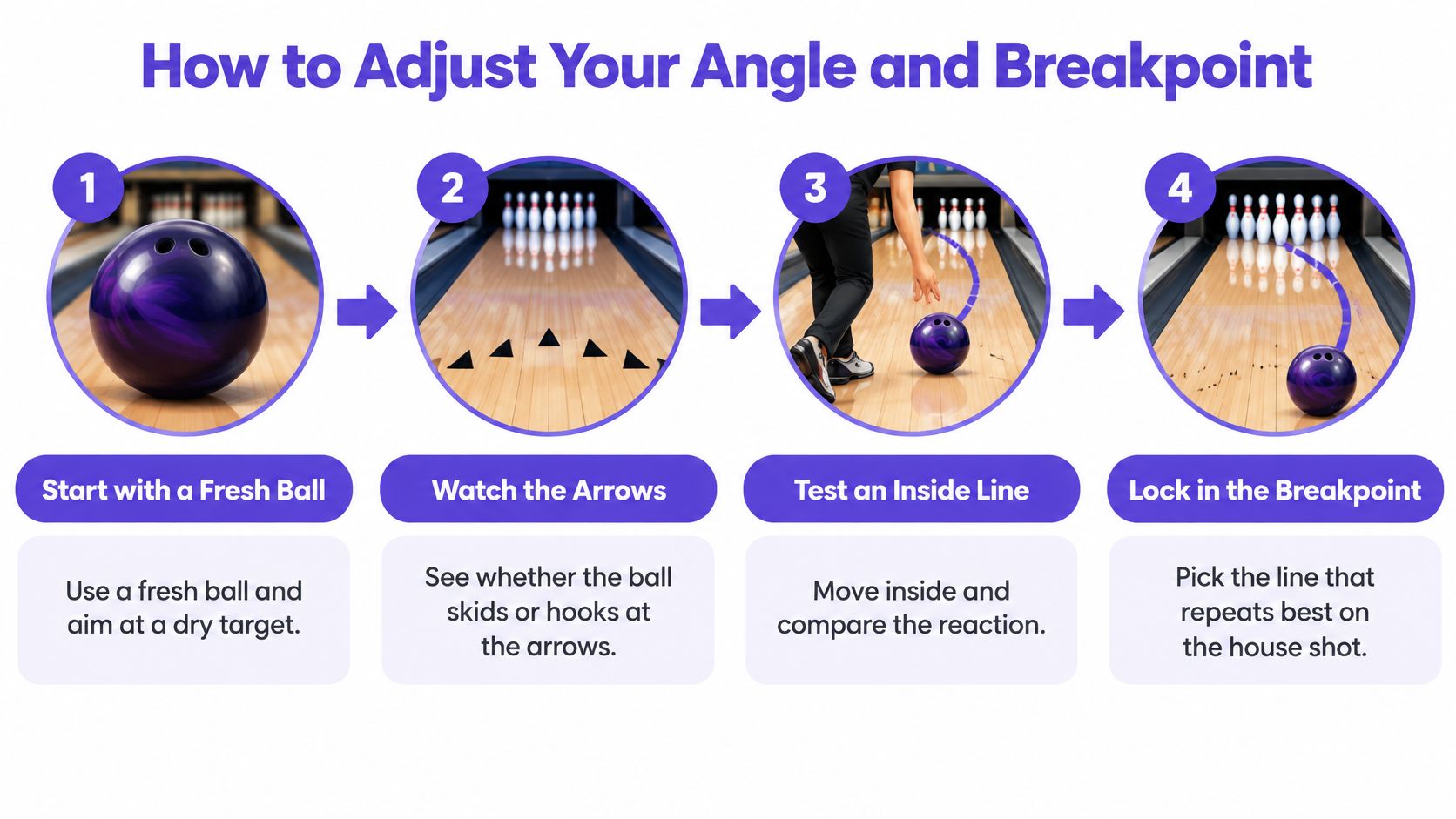
A useful adjustment routine separates what you intended from what the ball did. Keep a small notebook or phone log, and describe the motion before deciding how to fix it.
Use this visual as a reminder of the observation process.
Run a controlled line test
Begin with a clean, familiar ball. Choose a visible arrow target and an intended downlane friction area, then watch how the ball travels through both. Don't assume the arrow itself is dry, and don't confuse a clean ball with a freshly conditioned lane.
Compare inside and outside paths. Keep your speed and release as similar as possible while deliberately changing the path. The common mistake is throwing the outside test harder, which makes it difficult to separate angle from speed.
Test earlier access to friction if the ball skids long. Shift your intended path slightly outward and observe whether the ball makes a more useful turn. Moving your feet without checking the launch direction can send the ball somewhere you didn't intend.
Seek more oil if the ball starts too early. Move the target inward or reduce how sharply your path crosses the dry area, coordinating your feet with the new launch line. Don't automatically move farther outside, where you may find even more early friction.
Isolate the variable you're testing. Keep the same ball while evaluating a target change, then hold the line steady if you compare equipment. Changing the ball, speed, and direction together may produce a strike without telling you why.
Record the breakpoint and the miss. Note the approximate board where the ball reaches its farthest-outside point, along with whether it turns too early, too late, or too sharply. Recording only the arrow board misses what happens farther downlane.
Repeat the test as the session develops. Revisit your reference line after substantial play and compare its reaction with the opening shots. Don't keep forcing the original line merely because it worked when you arrived.
Decide whether the adjustment helped
A successful change gives you a more stable pocket entry across comparable deliveries. Watch the ball's direction through the pocket, not just whether the pins happened to fall on a single attempt.
If your bowling ball is hooking too much, distinguish an early start from an excessively sharp downlane response. They can look similar at the pins but call for different changes.
Carry matters, but use it alongside pocket contact and motion. You're looking for a line that remains understandable when you miss slightly, not a spectacular shot you can't reproduce.
Turning House Shot Scores Into Real Skill
A high league average can create a misleading sense of readiness. You may be scoring well while the lane condition compensates for mistakes you haven't learned to recognize.
USBC's guidance on choosing lane conditions for entry-level bowlers describes historical comparisons in which sport-condition averages were at least 18 pins lower than house-condition averages. That isn't a universal conversion formula or a prediction of your tournament average. It shows why scores from different conditions need context.
The useful question isn't whether your house-shot scores count. They do. The question is whether you can identify the delivery and decision-making skills behind them.
Measure what transfers
A forgiving condition can conceal inconsistent launch angles, changing speed, poorly controlled breakpoints, and equipment that responds too aggressively. If you only record the final score, you won't know which of those problems appeared.
Compare the same bowler, ball, and intended line across different conditions as an initial diagnostic. Don't insist on keeping that line once the comparison shows it doesn't fit.
Track pocket percentage, strike percentage, single-pin conversions, and score. Pocket contact helps distinguish line control from carry, while spare conversion shows whether you can finish frames when strikes become less available.
Practice with a purpose
- Move the target deliberately. Predict how the ball should respond before you throw it, then compare the result with that prediction.
- Reduce dependence on outside recovery. Practice a controlled path that doesn't require a large bounce off the dry edge.
- Give spare shooting its own attention. Use a repeatable alignment and release rather than treating spare attempts as interruptions.
- Classify each miss. Record short, long, inside, or outside, and separate a missed target from an unexpected ball reaction.
These habits are especially useful for beginners preparing for tournaments. Coaches and parents can also use them to judge progress without assuming a high league score proves all-condition readiness.
A recovered miss can still be a useful warning. Record the delivery you made, not just the strike it produced.
You don't need to abandon house-shot bowling to improve. Use its margin for error to rehearse deliberate adjustments, consistent speed, and dependable spare decisions. The goal is to arrive on less forgiving lanes with a process you trust, rather than a favorite hook shape you hope will work.
Confirm Your Center's House Shot Before You Buy
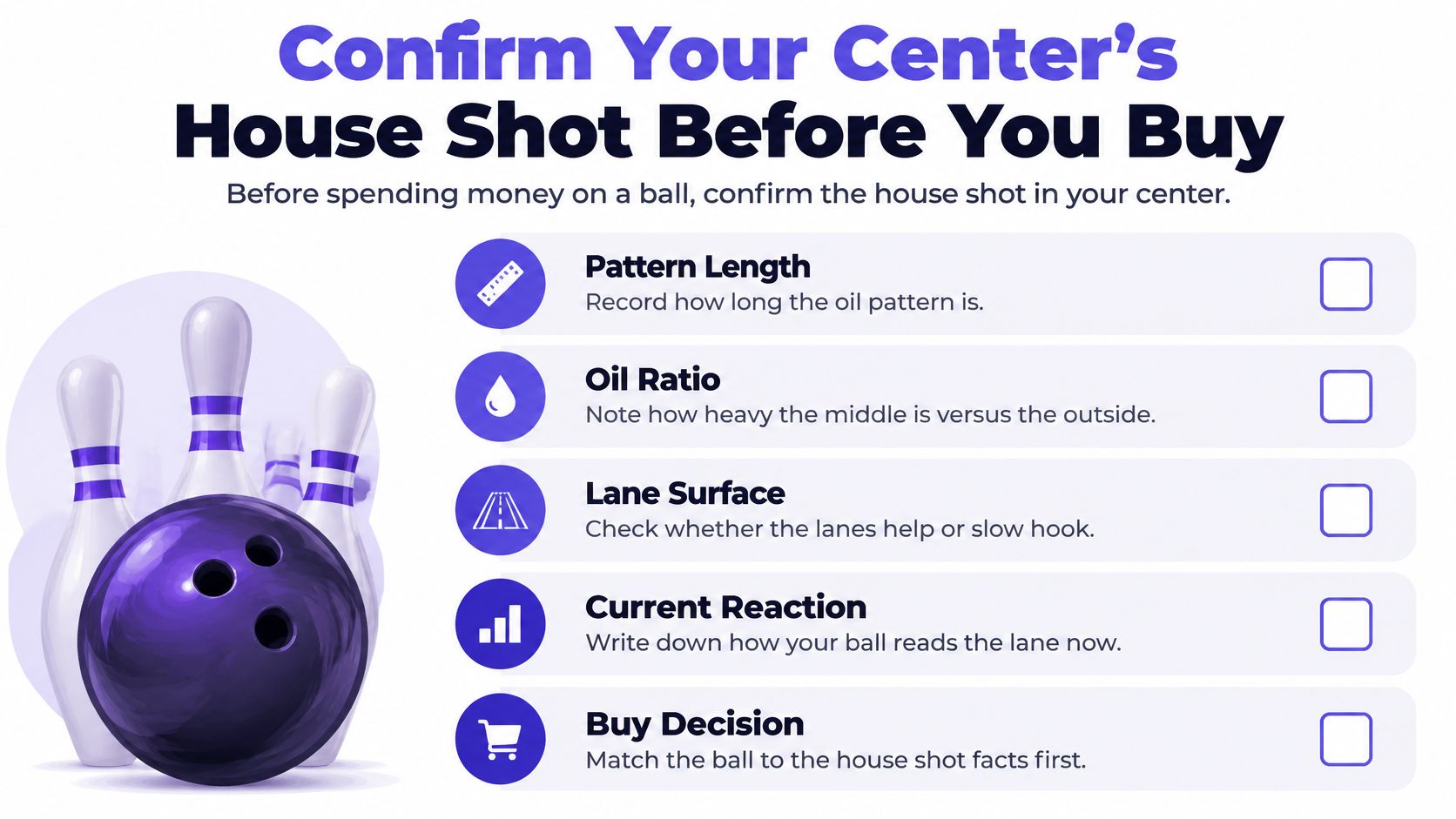
Before spending money on a ball, collect the facts that describe your regular lane: pattern length, oil ratio, total volume, and when it was last conditioned. Add the lane surface if staff can confirm it.
Then run a controlled test with a ball you already understand. Try an inside path and an outside path with a comparable release, and record the breakpoint, pocket contact, and carry early and late in the session.
Use this checklist to keep the buying decision tied to the lane.
Buy for the reaction you need
Compare your observations with the equipment options. A ball that slides past usable friction suggests a different surface choice from one that starts hooking before you want it to.
Don't assume you need a new core or coverstock before evaluating the surface of your current ball. A pro shop can help you make a controlled preparation change and assess whether the resulting shape fits your regular condition.
Run the test where you bowl most often, and repeat it when maintenance or your usual reaction changes. A successful result at another center isn't enough to establish what belongs in your bag.
We only recommend products we believe offer value to our readers. For a house-shot purchase, that value starts with solving an identified reaction problem, not buying extra hook without a purpose.
We publish reviews of bowling balls, shoes, and accessories, along with practical guidance for matching equipment to your game. Visit Bowling Gear Reviews with your lane notes and current ball reaction in hand, then compare options that address the motion you need.
