

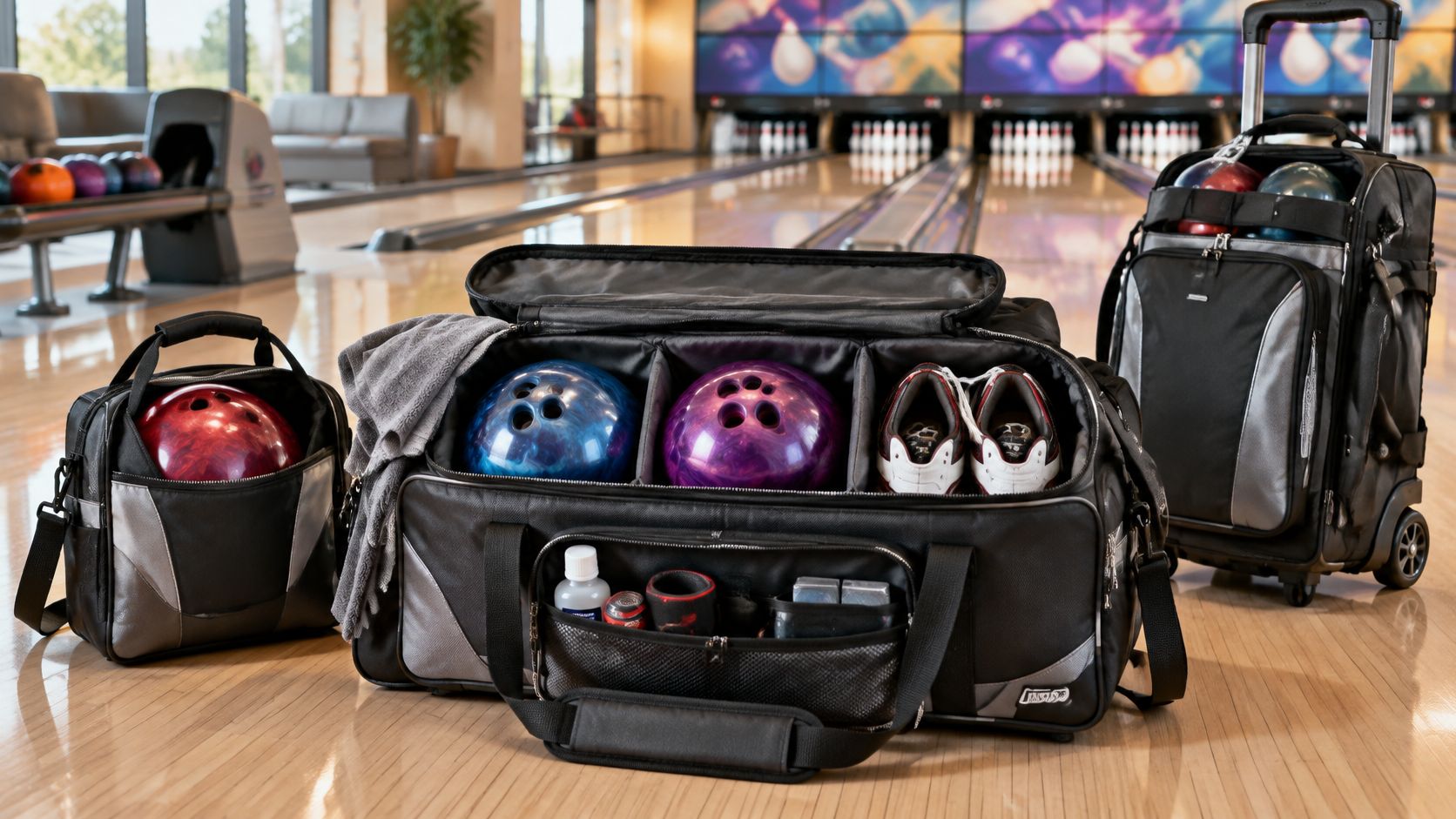
A bowler bag is luggage designed specifically to carry bowling balls and the gear around them, not a general sports bag or a fashion handbag. If a bag looks right but can't safely support the ball inside, is it suitable for bowling?
That question matters more than the rounded shape, color, or logo. A useful equipment bag needs to hold a concentrated load securely while keeping your shoes and smaller supplies accessible. Understanding that difference makes choosing your first bag much simpler.
Table of Contents
- What a Bowler Bag Is and Why It Matters
- Five Bowler Bag Types and What Each Carries
- Fashion Bowler Bags Versus Equipment Bags
- Compartments, Protection, Capacity and Wheels to Check
- Which Bowler Bag Suits Your Game
- Pack, Check and Choose Your Bag This Week
What a Bowler Bag Is and Why It Matters
A bowler bag is defined by its construction and intended use, not its appearance. You might carry it by hand, wear it over your shoulder, or pull it behind you. Those are transport options, not proof that it's suitable for bowling equipment.
The United States Bowling Congress Open Championships rules require bowling bags to be manufactured specifically for transporting bowling balls, which can weigh up to 16 pounds. That concentrated weight explains why a proper ball compartment matters more than an attractive exterior.
A typical league-night trip
Say you arrive for league carrying your playing ball, a spare ball, shoes, and a towel. Without dedicated storage, the balls can move against your other equipment, and finding your tape means rummaging around heavy objects.
A purpose-built bag gives each ball a supported position. Your shoes go in a separate space, while tape, a wrist support, and cleaner stay accessible in smaller pockets. You can unload what you need without emptying everything onto a bench.
The bag doesn't change how you bowl. It makes getting ready less awkward and gives your equipment a more suitable place to travel.
The jobs a bowling bag should do
- Protect equipment: Support the balls and help prevent contact with loose gear during transport.
- Organize accessories: Keep towels, tape, cleaners, and supports where you can reach them.
- Make transport manageable: Provide a practical way to move equipment between home, the pro shop, league, and tournaments.
You don't need to recognize every bag style to make an initial judgment. Start with the inside, not the product photograph.
First check: Does it have a compartment built specifically for a bowling ball?
If the listing doesn't answer that clearly, don't assume that a roomy main compartment is an adequate substitute.
Five Bowler Bag Types and What Each Carries
Bowling bag names describe a mixture of capacity and carrying style. That's why categories overlap: a tote can have a shoulder strap, while a roller can have lifting handles. Treat the name as a starting point, then check the actual compartment layout.
Bowler bag types by ball count and carry style
| Bag type | Balls carried | Carry style | Best for |
|---|---|---|---|
| Single-ball tote | One designated ball compartment | Top handle and short shoulder strap | Beginners and casual bowlers |
| Two-ball bag | A dedicated compartment for each ball in a pair | Shoulder strap or handle | League bowlers |
| Roller bag | Multiple dedicated ball positions, commonly a trio or more | Two wheels and pull handle | Tournament players |
| Backpack | Only the number of dedicated ball positions specified by the manufacturer | Padded shoulder straps | Juniors and commuters |
| Tote | The rated ball count, not loose space around the ball well | Carry handles only | Short trips with accessories |
A single-ball tote is a straightforward starting point when you own a ball and want to bring your own shoes. Check that the shoe compartment is usable with the ball installed. An empty bag can look spacious even when its loaded layout leaves little room for footwear.
For a league bowler carrying a playing ball and a spare ball, a two-ball bag provides a separate position for each. A shoulder strap can free a hand, but carrying comfort depends on the loaded bag, not how soft the strap feels when empty.
Carrying versus rolling
A roller becomes useful when the route includes long corridors, large parking lots, or extended tournament travel. Look beyond the telescoping handle: you still need secure lifting handles for loading the bag into a vehicle.
A backpack keeps your hands available, but it doesn't remove the weight. Choose a model explicitly built for bowling balls, and assess whether you can put it on and take it off without twisting awkwardly. An ordinary school backpack isn't equivalent.
A handle-only tote can suit a short, direct trip. The word tote doesn't guarantee a soft bag, a shoe pocket, or a particular capacity, so read the specifications rather than relying on the category name.
- For stairs: Consider how you'll lift the bag when rolling isn't possible.
- For a crowded vehicle: Check the loaded exterior dimensions and handle position.
- For compact equipment transport: Compare dedicated ball storage with accessory space, especially when browsing a three-ball bowling bag tote guide.
Count the balls you take with you, rather than choosing capacity for equipment you might eventually buy. Pick the smallest practical format that also accommodates your shoes and regular accessories.
Fashion Bowler Bags Versus Equipment Bags
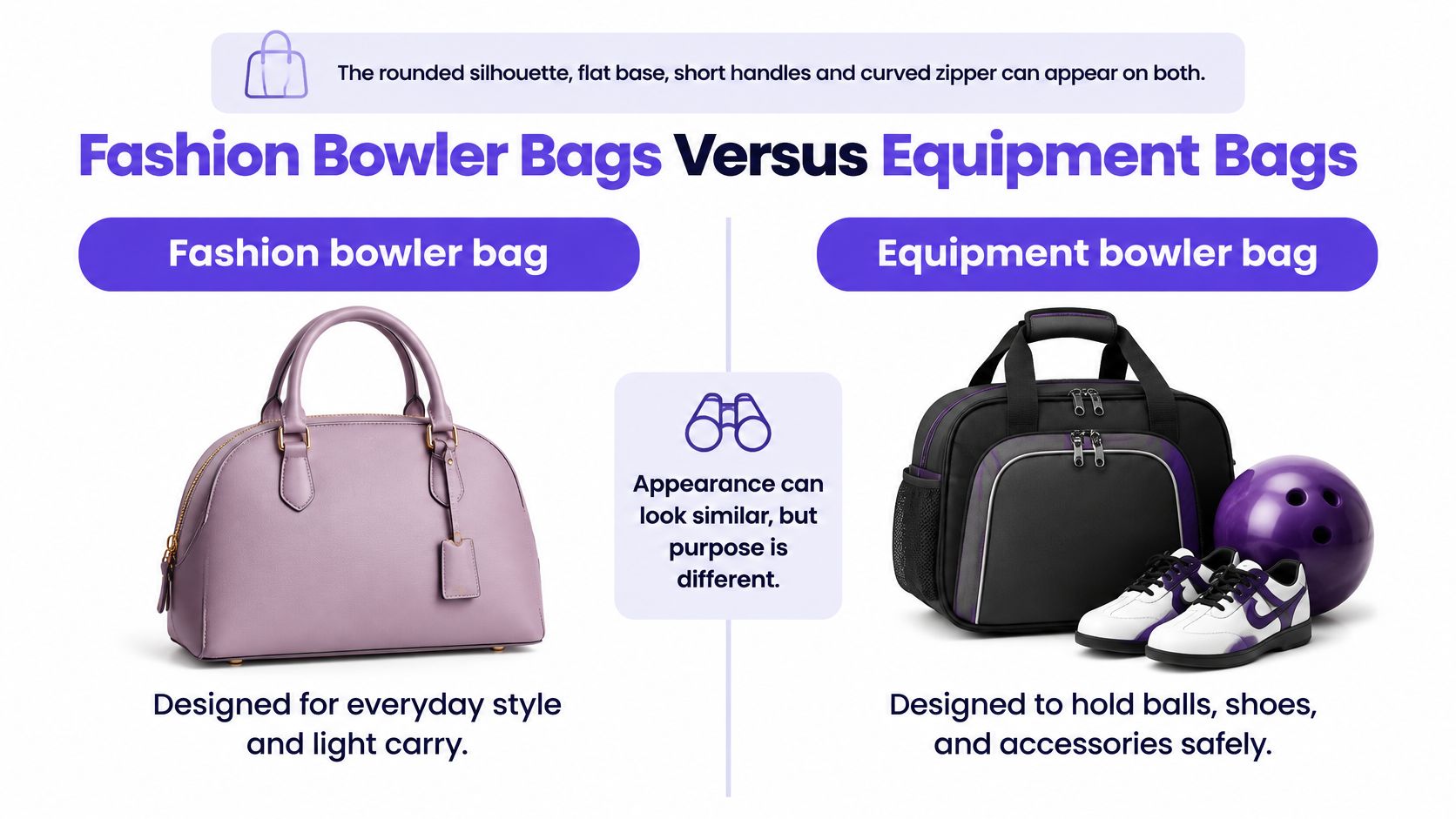
The rounded silhouette, flat base, short handles, and curved zipper can appear on both fashion handbags and bowling equipment bags. Shared styling doesn't mean shared load-bearing construction.
Foley & Corinna's explanation of bowler bags highlights the ambiguity between the fashion silhouette and the equipment carrier. A handbag may be designed around everyday personal items rather than the concentrated weight and support requirements of a bowling ball.
Read the listing for function
A fashion listing might describe leather, lining, hardware, and styling. An equipment listing should identify bowling-ball storage directly and explain how the bag supports its contents.
Look for these details:
- Ball accommodation: A stated ball capacity and photographs of the dedicated interior.
- Load-bearing construction: Reinforced attachment points, supported handles, and suitable strap hardware.
- Protection: Padding or a ball cradle, rather than an unstructured cavity.
- Loaded stability: A base designed to support the ball without collapsing or tipping.
If dimensions, capacity, or load information are missing, ask the seller for clarification before buying. A photograph of a ball beside the bag isn't evidence that the bag can carry it.
Why the distinction matters
Putting a bowling ball in an unsuitable handbag can place stress on handle stitching, the lining, and the base. Even if the zipper closes, that doesn't establish that the seams or hardware can handle repeated transport.
Appearance can be similar. Intended use and internal support are the deciding differences.
There's nothing wrong with choosing a bowler-shaped handbag for style. Use it for everyday belongings, and carry your bowling ball in luggage designed for that job. For gift buyers in particular, confirming which meaning the recipient has in mind can prevent an expensive mismatch.
Compartments, Protection, Capacity and Wheels to Check
A useful inspection follows the load from the ball well through the base, handles, and wheels. Decorative panels tell you little about how the bag behaves when packed.
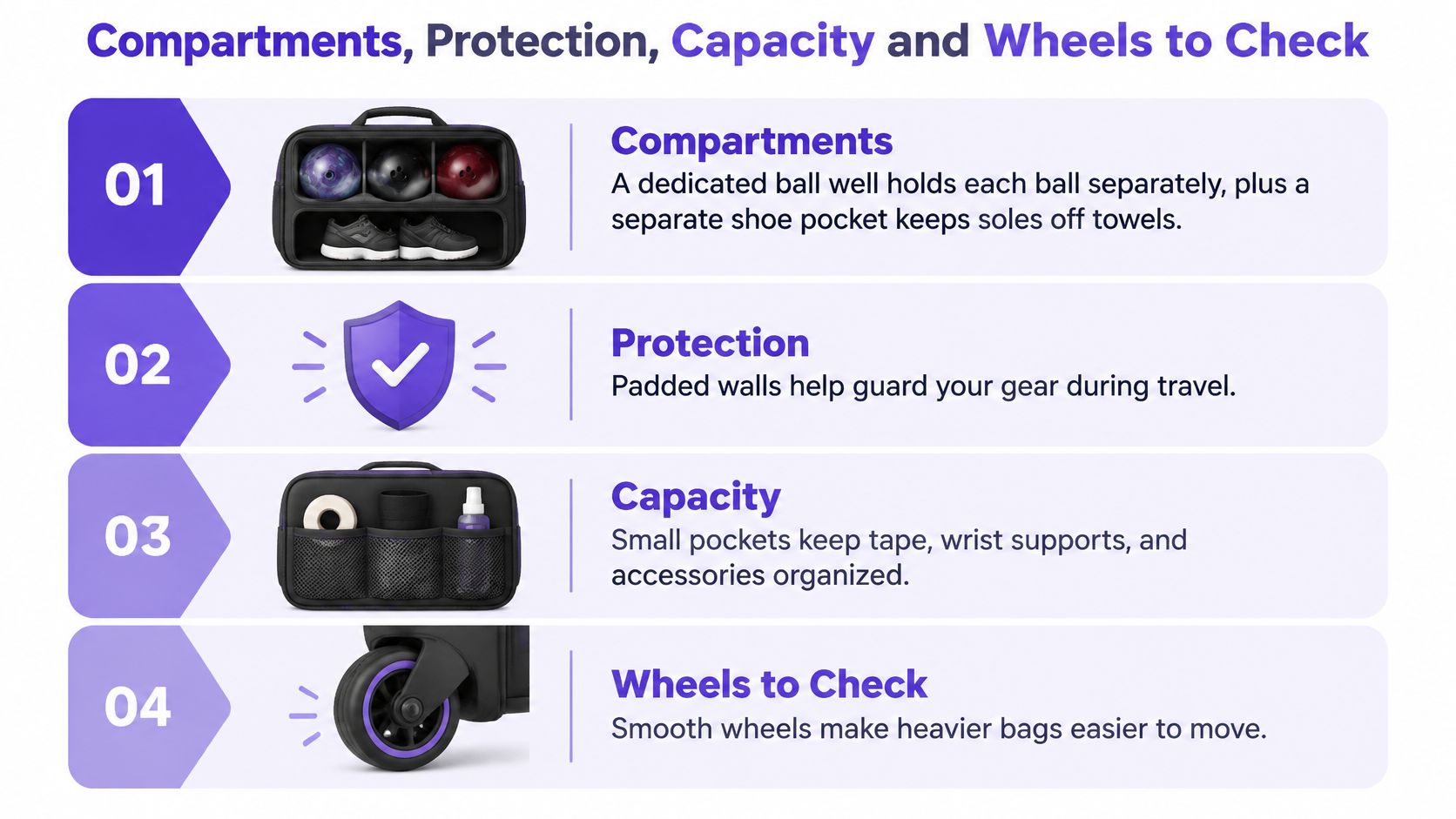
Compartments and protection
Open the ball compartment fully. Check whether each ball has a defined position and whether dividers remain between neighboring balls. With the store's permission, place a sample ball inside and confirm that the support surrounds it without forcing the zipper closed.
Next, inspect the shoe pocket with shoes inside. You want soles separated from clean towels and tape, not pressed into whatever space remains above the ball. Small pockets should hold supplies without allowing hard items to rub against the ball.
Inspect the base and padding together. A padded wall helps cushion contact, while a supported base carries the load. Neither feature replaces the other.
Lift the empty bag by its intended handle and examine the stitching where the handle joins the body. Look for loose threads, distorted seams, and hardware that catches or twists. Ventilation can help damp gear dry, but you'll still need to remove wet towels after bowling.
Capacity and moving parts
The USBC Playing Rules set the maximum ball weight at 16.00 pounds, so a pair at that limit totals 32 pounds before the bag, shoes, and accessories are added. Ball count alone therefore isn't enough to judge the complete load.
Check the manufacturer's maximum loaded weight where one is provided. If it isn't stated, seek confirmation rather than assuming that every pocket can be filled without limit. Event rules can also affect your equipment plan, so check the requirements of the competition you're entering.
For rollers, test more than whether the wheels rotate:
- Loaded stability: The base should remain supported without obvious sagging.
- Wheel movement: Roll the sample load and check for wobbling, scraping, or binding.
- Handle operation: Extend and retract the pull handle, checking that it locks securely.
- Lifting access: Confirm that you can reach the carrying handles without trapping your fingers.
A wheeled bowling ball bag comparison can help narrow the format, but an in-store loaded test answers a different question: whether that particular design suits your route and handling needs. Don't test a bag beyond its stated rating.
Which Bowler Bag Suits Your Game
Choose for the journey you make regularly, not the most demanding trip you can imagine. Someone crossing a small parking lot has different needs from a bowler navigating stairs and tournament corridors.
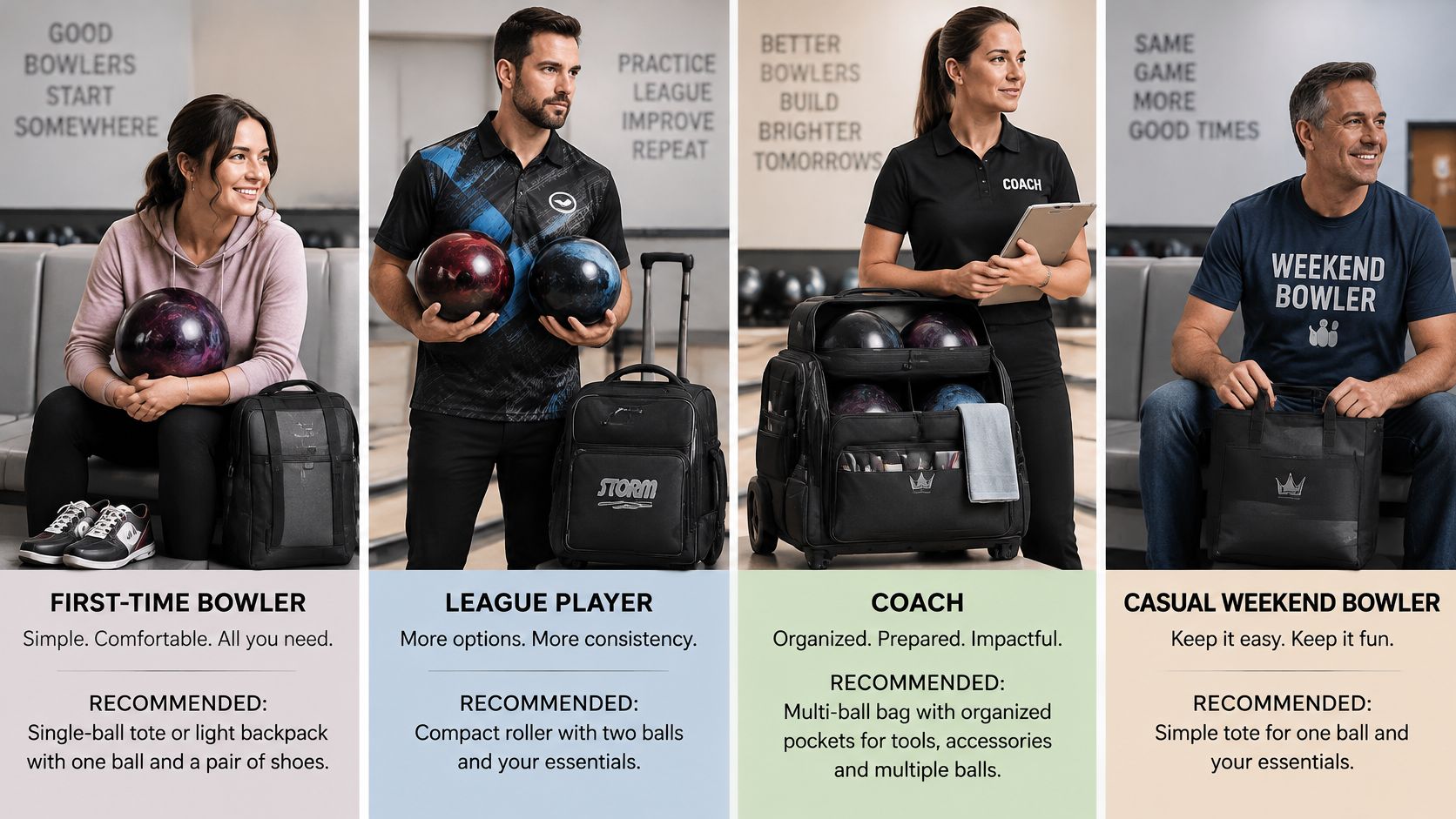
Match your usual bowling routine
For a new ball owner, a compact single-ball tote is a sensible starting point. You need secure ball storage, room for shoes, and somewhere to keep a towel. A bowling-specific backpack is another option if hands-free carrying is useful and the loaded fit is comfortable.
For a league regular, a bag that holds your playing ball and spare ball separately avoids juggling an additional carrier. Try the strap over the jacket you normally wear to bowling. A strap that slips during the walk from your car won't become more comfortable once you're in a hurry.
Tournament bowlers should plan around the whole travel route. A roller can simplify long walks, but stairs, vehicle loading, and accommodation access still require lifting. For air travel, check the airline's current baggage conditions before assuming that a bowling bag's capacity matches its allowance.
For a junior bowler, prioritize manageable handling over spare capacity. A backpack can keep the equipment close to the body, but an adult should assess the loaded fit and whether the junior can safely put it down. Check the event's equipment rules before packing extra balls.
Buying for someone else
A gift buyer should ask what the recipient currently carries and what bothers them about their existing setup. A broken zipper, uncomfortable strap, and lack of shoe space call for different solutions.
Don't use gender labels as a substitute for fit. When comparing women's bowling bags, examine the same practical details: loaded dimensions, accessible handles, strap adjustment, and equipment capacity.
Buying shortcut: Match the bag to the bowler's current equipment and regular route before choosing colors or styling.
These questions settle most purchases:
- What travels with you? Include shoes and the accessories you use.
- How far do you carry it? Consider parking, corridors, stairs, and transfers.
- How do you want to move it? Choose hand carrying, shoulder carrying, or wheels based on comfort and access.
If the recipient's answers aren't clear, don't guess at a larger bag. Confirm their preferred carrying style first.
Pack, Check and Choose Your Bag This Week
Good packing lets the bag's supports do their job. It also makes unloading easier because you don't have to dig beneath loose equipment to find the item you need.
Start on the floor or another stable surface. Open the compartments fully, check that the interior supports are seated correctly, and remove anything left loose from your previous visit.
Pack in a deliberate order
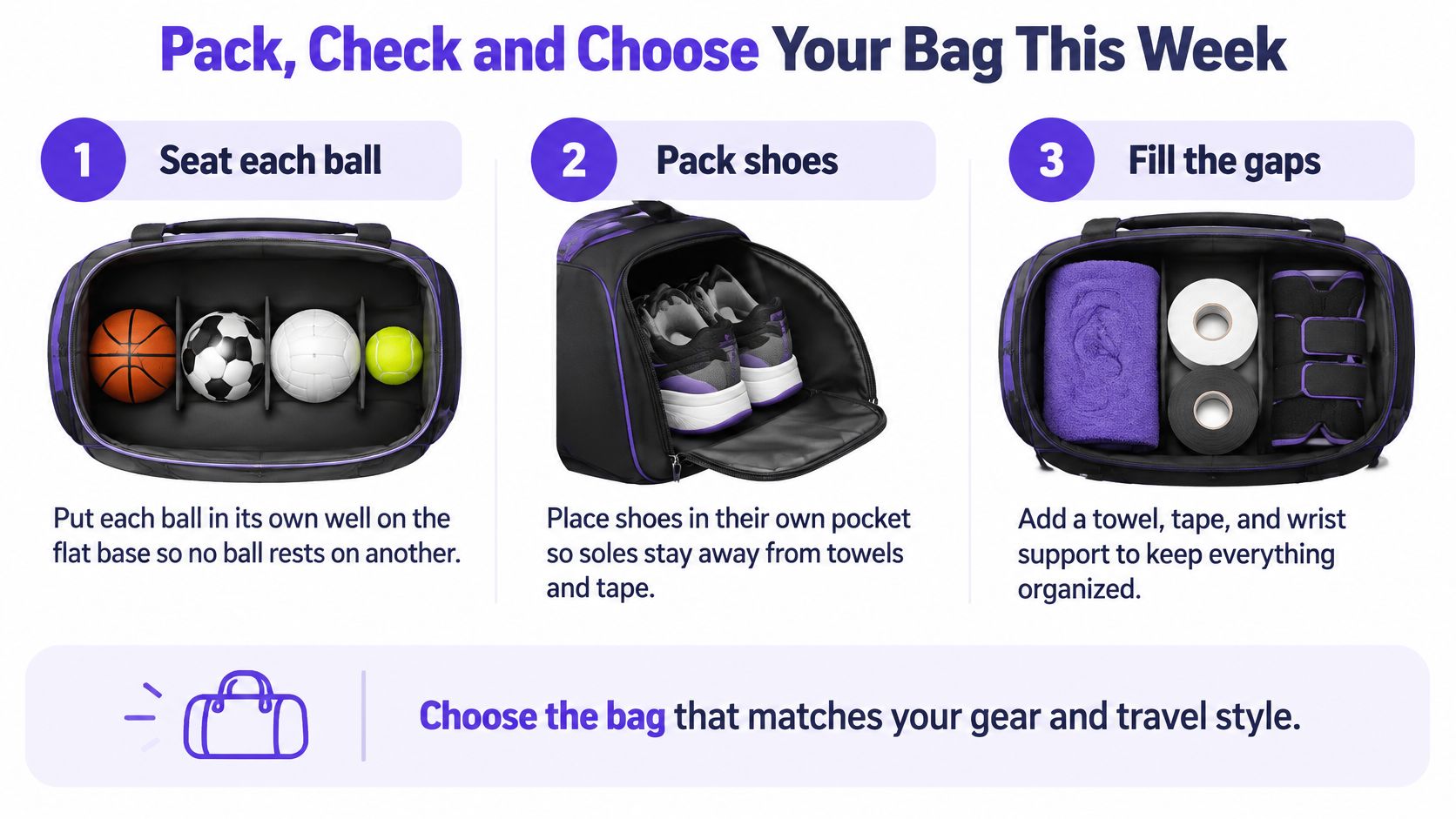
Seat each ball in its own well. Lower it onto the intended support rather than dropping it into the bag. Don't stack balls or use accessory space as an extra ball position. Check that any supplied retainers or dividers are positioned as the manufacturer intends.
Put shoes in their designated pocket. Keep the soles away from towels, tape, and other items you handle during play. If your shoes are damp, remove them for drying when you get home instead of leaving them enclosed until the next league night.
Organize the smaller supplies. Fold a towel into its storage space and put tape and wrist supports in accessible pockets. Keep cleaner upright with its cap secure and, where practical, inside a separate leak-resistant pouch. Don't wedge hard accessories against the ball to stop movement.
Close the compartments before moving the bag. Clear fabric and straps from the zipper path. If the zipper needs force, rearrange the contents rather than pulling harder. A closed zipper isn't a replacement for a properly seated ball or an internal retainer.
Lift using the intended carrying points. Keep the load close to your body and avoid twisting while raising it. For a heavy transfer into a vehicle, use secure lifting handles and support the base with both hands where practical. Never lift a loaded roller by its extended pull handle unless the manufacturer explicitly permits it.
Unpack damp items after bowling. Wipe the balls before putting them away, following the care instructions for the equipment and cleaner. Store the bag in a cool, dry place rather than treating a vehicle trunk as permanent storage.
A towel can separate soft accessories, but it shouldn't compensate for a missing ball cradle or damaged divider. If a ball moves substantially inside its assigned position, inspect the support system before carrying the bag again.
Check the bag you already own
You may not need a replacement. Empty your current bag and inspect the parts you rarely see: the underside, wheel mounts, interior supports, strap clips, and handle attachment points.
Work the zippers along their full paths. Remove grit from the wheel area and check for fabric caught near the axles. If a strap attachment is damaged or a base support has cracked, don't keep loading the bag while hoping the surrounding material will hold.
Use a short condition checklist:
- Keep using it: The supports are intact, closures work, and carrying points remain secure.
- Investigate a repair: A replaceable strap, wheel, or handle component is worn, and the manufacturer offers a suitable part.
- Stop loading it: A structural seam is opening, a handle attachment is pulling away, or the base no longer supports the contents.
Avoid improvised repairs to load-bearing parts unless a qualified repairer confirms that the repair is appropriate. Cosmetic wear and structural failure aren't the same problem.
Make a purchase checklist from your actual gear
Lay out what you take to a normal session. Separate the essentials from items that have stayed unused in the bag, then weigh the complete intended load with a luggage scale or household scale.
Take your shoe size and equipment list shopping. Compare the bag's exterior dimensions with your storage space and vehicle opening, not just the shelf where it looks compact. If you can try a sample load, practice the awkward part of your route: lifting, turning, or changing from rolling to carrying.
At Bowling Gear Reviews, we cover bowling balls, shoes, bags, and accessories, with gear tested in real bowling conditions. Our bag guides consider capacity, compartment layout, protection, and handling so you can compare designs against a practical checklist.
Affiliate disclosure: Bowling Gear Reviews participates in affiliate marketing programs. Some links on the site may be affiliate links, and we may earn a commission on purchases made through them at no additional cost to you.
This week, pack your usual equipment, weigh the complete load, and identify the least comfortable part of getting it to the lanes. Choose a replacement only when you can explain how its construction or carrying system solves that specific problem.
Visit Bowling Gear Reviews for bowling bag reviews, comparisons, and clear equipment-care guidance. Use your packed-gear checklist to compare tote and roller options, then choose a bag that supports your equipment and suits the trip you make.
