

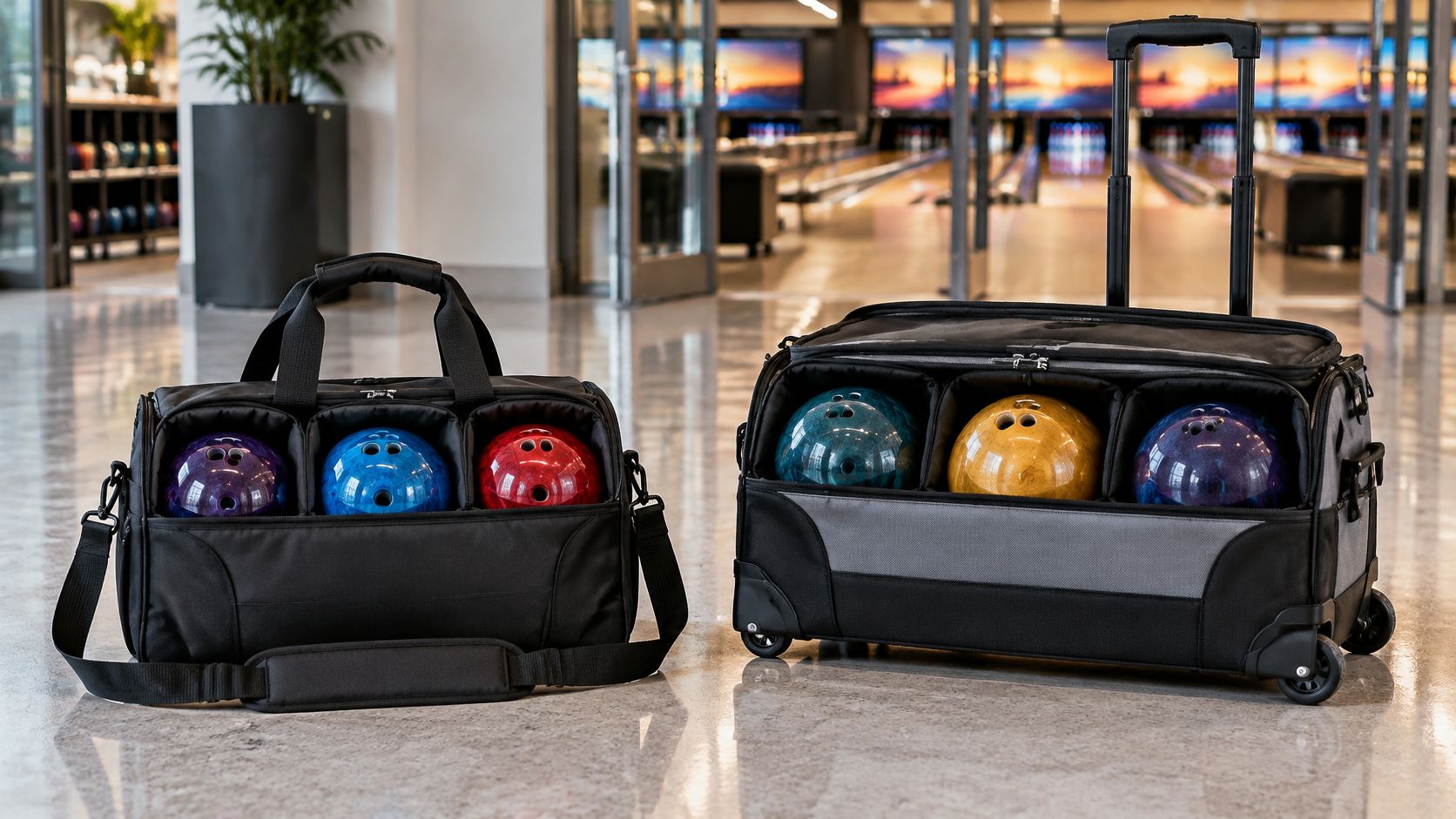
Buying for capacity first is poor advice. A 3 ball bowling bag tote can hold your equipment and still be the wrong bag if you can't lift it into the trunk, control it over a curb, or check it for your flight. Start with the trips you really make, then choose the carrying format and protection that suit them.
Table of Contents
- Three-Ball Tote Formats Compared at a Glance
- Capacity, Protection and Durability Checks
- Carry Versus Roller Formats and Where Each Wins
- Maneuverability and Lifting Limits for Loaded Totes
- Airline and Transport Rules for a Loaded Tote
- Budget Tiers and What Each One Buys
- Match the Tote to Your Bowling Profile
Three-Ball Tote Formats Compared at a Glance
A ball count won't tell you whether a tote suits your route. Compare its empty weight and shape with how far you carry it, how much you can comfortably lift when loaded, and whether the airline accepts it as checked baggage.
The MOTIV Ballistix product listing lists its tote at 28 × 10 × 10 inches and 4.8 lb. Treat the figures below as model-specific where given. A compact shape may pack neatly, while a wheeled frame adds weight but can reduce the effort of moving the loaded bag.
Three-ball tote formats by size and empty weight
| Format | External size (in) | Empty weight (lb) | Best fit |
|---|---|---|---|
| Compact hand-carry tote (Ballistix 3-ball tote) | 28 × 10 × 10 | 4.8 | Local league and short walks |
| Travel-focused compact tote (Storm Travel Tote Pro) | Check the model's listed dimensions | Check the model's listed weight | Airport and vehicle transport, subject to baggage approval |
| Three-ball roller tote (Epic) | Check the model's listed dimensions | Check the model's listed weight | Parking lots and tournament weekends |
| Typical three-ball roller (category range) | Varies by model | Varies by model | Frequent travel with heavier loads |
Read the dimensions against your route
A long, narrow tote may slide into a trunk beside other equipment. A taller roller may need to stand upright, taking space from shoes, luggage or a passenger's bag. Check the trunk opening as well as the space inside it.
For air travel, a compact shape can make packing easier, but it does not mean bowling balls are permitted in the cabin. Check baggage rules before choosing a tote for a flight.
Choose the format that fits your usual trip and your lifting tolerance. Wheels can help over longer routes, but they do not remove the need to lift the bag into a vehicle or handle it at the airport.
Capacity, Protection and Durability Checks
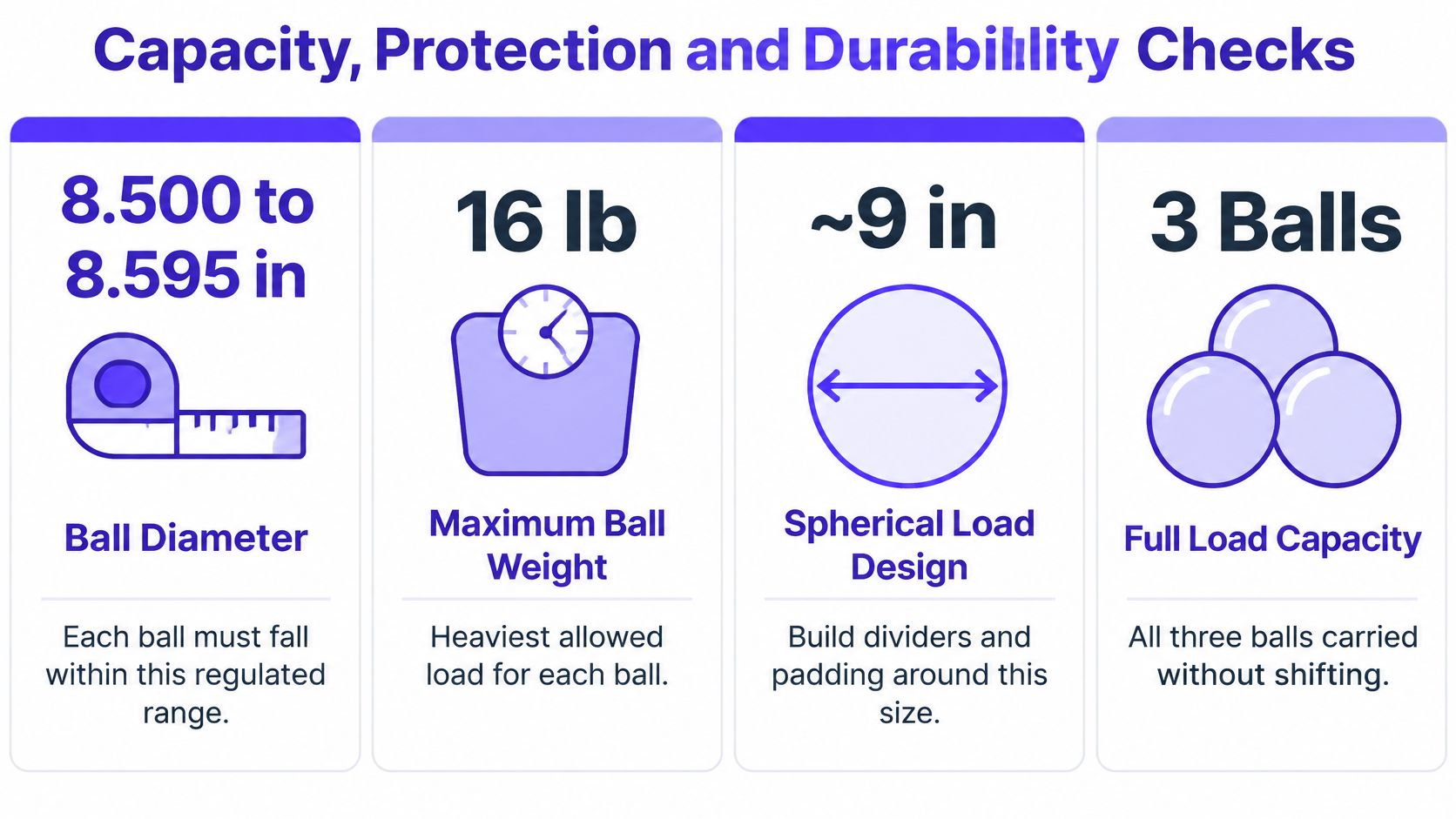
The PBA's equipment specifications set a regulation ball's diameter at 8.500–8.595 inches and maximum weight at 16 pounds; that means designing the wells around roughly 9-inch spherical loads, with a full three-ball load potentially reaching 48 pounds before the bag and accessories.
That load needs support underneath and separation around it. Thick fabric alone won't keep a ball from pressing into a zipper or collapsing a soft divider.
Check the wells before the pockets
A separate padded well for each ball keeps the surfaces apart and gives each load a defined position. A shared sleeve saves space, but without firm separators, the balls can knock together when the bag changes direction. Removable dividers are useful only when they lock back into position securely.
Bring your actual equipment to the fit check. Use a tape measure across each well at its narrowest point, including any intrusion from seams, pocket linings or the wheel housing. Then place a ball inside and close the lid without pushing down on it.
The zipper should close with the ball seated naturally. If you have to stretch the lid across the ball, the compartment isn't offering usable clearance, regardless of the advertised capacity.
- Separate the shoes: A dedicated shoe pocket keeps dirty soles and grit away from ball surfaces. Check that filled shoes don't bulge into the ball compartment.
- Contain maintenance supplies: Keep cleaner upright and secured, with tape and wrist supports in their own pocket. A loose bottle shouldn't become a hard object between the ball and outer wall.
- Check cleaning access: Removable liners make grit easier to remove. A separate bowling ball cleaning bag can organize maintenance, but it doesn't replace structural padding.
Inspect the load path
Start where your hand meets the bag, then follow the load through the body to the base. Inspect wheel hardware afterward, because a strong wheel assembly can't compensate for a base that folds around it.
Durability checks for a three-ball tote
| Check | What to inspect | Warning sign |
|---|---|---|
| Handle anchors | Box-pattern stitching or backed rivets where the strap meets the body | Single-line stitching, stretched holes or rivets pulling through fabric |
| Base panel | Reinforced, padded bottom supporting the balls and frame | A thin base that bows noticeably under your intended load |
| Zipper | Heavy-duty coil zipper, protected seam and accessible pulls | Teeth separating, a distorted track or fabric caught under tension |
| Wheel assembly (roller only) | Bearings, axle and housing secured through the reinforced base | Mount wobble, cracked housing or wheels rubbing against fabric |
| Divider padding | Resilient foam that separates and centres each ball | Flattened foam, torn attachment points or exposed hard surfaces |
Pull the handles gently in opposing directions while the bag rests on the floor. Watch the anchor fabric rather than just the strap. A strong strap attached to an unsupported patch is still a weak handle system.
Press the base with your palm, inspect its edges and look underneath for exposed fasteners. On a roller, check whether the axle housing attaches to that reinforced structure or merely to the outer fabric.
Protection rule: Each ball needs a supported seat, resilient separation and clearance from the zipper. Extra accessory pockets don't compensate for a missing part of that system.
Finally, load the bag unevenly. Leave some wells empty and check whether the occupied compartments hold their shape and keep the bag upright. Reject a bag with several warning signs rather than assuming you'll avoid problems by packing carefully.
Carry Versus Roller Formats and Where Each Wins
Hand-carry tote versus roller tote by use factor
| Factor | Hand-carry tote | Roller tote |
|---|---|---|
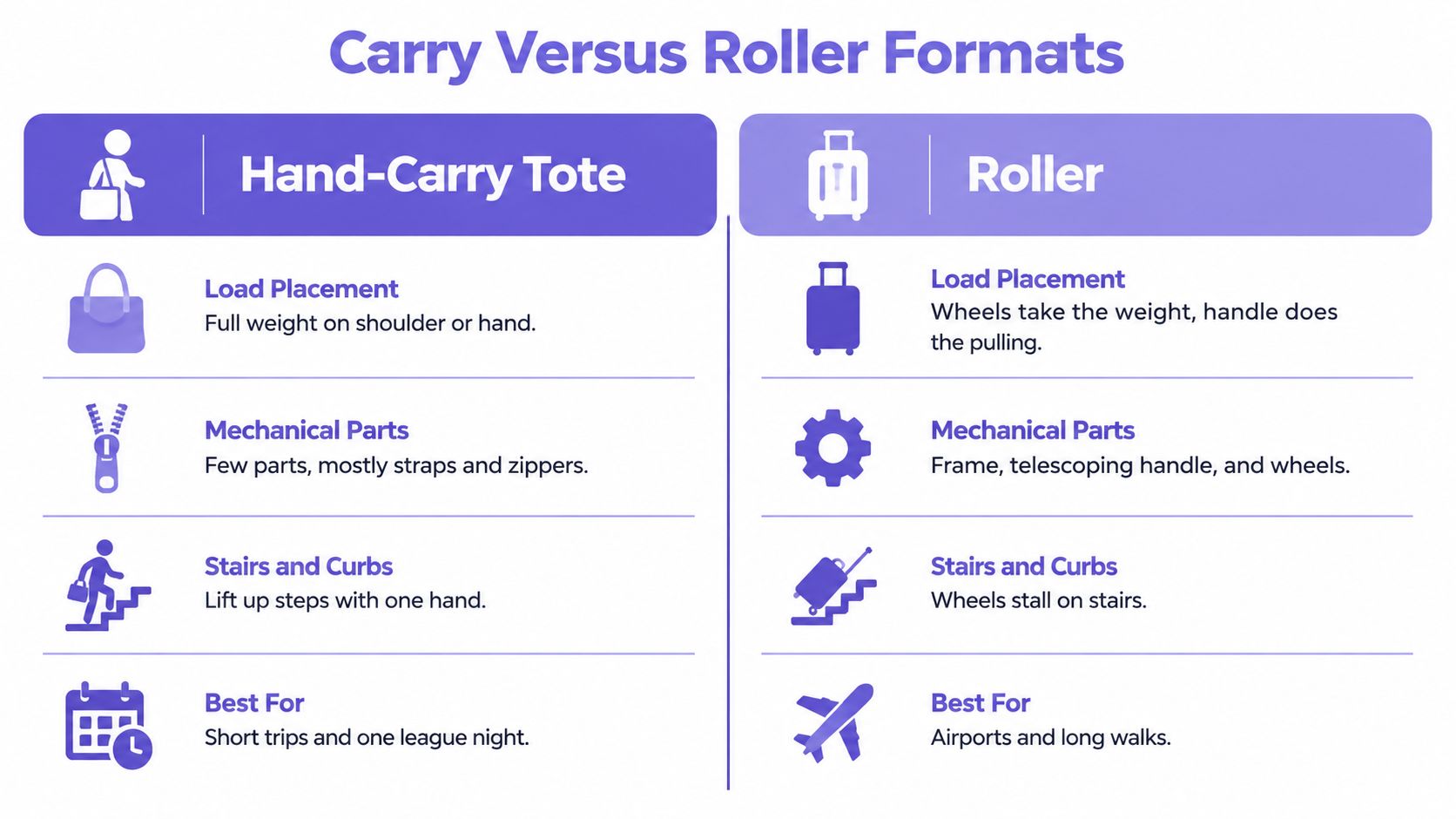
| Load on the body | Full weight on shoulder or hand | Weight shifts to the wheels on flat floors |
| Mechanical failure points | Primarily handles, seams and closures | Wheels, axles, frame, closures and telescoping handle |
| Stairs and curbs | Lifted by the carrying handles | Whole bag must be lifted when wheels can't clear the obstacle |
| Airports and long walks | Tiring over distance | Efficient on smooth floors |
| Vehicle fit | Soft body is easier to position | Frame and handle restrict placement |
| Best trip pattern | Short, frequent trips | Long walks across rollable surfaces |
The main distinction is where the load goes during the journey.
Choose for the awkward part of the trip
A hand-carry tote makes sense when you move directly from a nearby parking space to the lane. It has fewer moving parts, fits around other luggage more readily, and doesn't require you to extend and retract a handle at every stop. The trade-off is straightforward: you carry everything.
A roller becomes useful when the walking distance grows. Smooth terminal floors, venue corridors and paved approaches let the wheels do useful work. A sturdy pulling handle also keeps the bag away from your legs when you're moving through a crowded entrance.
A roller saves effort only on surfaces it can roll across. On stairs, high curbs or soft grass, its wheels and frame become extra weight to lift.
Don't confuse a compact roller tote with an upright luggage-style roller. Some compact designs use a towing strap rather than a rigid telescoping handle, so check how the bag follows you and whether it catches your heels.
Test the route, not the showroom floor
Ask to pull the loaded roller across a doorway threshold and turn it around a tight corner. Watch whether the wheels track cleanly or the bag leans onto its side. For a carry tote, check whether the joined handles sit comfortably in your hand without trapping your fingers against the lid.
Use the video as a visual supplement, not a substitute for handling the bag with your own equipment.
The right format should make the difficult part of your normal route manageable. A polished shop floor won't reveal how it behaves at your venue's entrance.
Maneuverability and Lifting Limits for Loaded Totes
The Bowling.com bowling-bag FAQ estimates empty three-ball rollers at 9–12 lb and loaded examples at roughly 35–40 lb or more. Those are category estimates, not a prediction for your equipment, and they're enough to challenge the assumption that more capacity always means better value.
A smaller roller with a separate accessory bag may be easier to manage than a compact tote carrying your entire arsenal. That matters particularly for children, older bowlers and anyone whose grip, wrist or shoulder limits comfortable lifting. There's no universal comfort threshold that makes a bag suitable for all of them.
Run a controlled handling check
Use the equipment you intend to carry and weigh the complete setup with a luggage scale. Test in a clear area, keep the load close to your body and stop immediately if you feel pain, lose balance or need to jerk the bag upward. Don't conduct a strenuous lifting test to prove that a purchase can work.
- Lift from the floor: Raise the bag toward the height needed for your trunk, keeping it close. Notice whether you can maintain a neutral wrist and secure grip.
- Walk your normal approach: Include the surface that gives you trouble, such as rough paving or a sloped entrance.
- Cross an obstacle: Check a safe step or curb with assistance available. Use carrying handles, not a roller's extended pulling handle, for lifting.
- Check pulling posture: Your arm should hang comfortably without forcing you to shrug, twist or shorten your stride.
- Try a partial load: Remove equipment and check whether the bag tips, twists or pulls to the occupied side.
Record the reason for rejection
Write down what failed: handle pressure, an uncomfortable reach, wheel drag, instability or an awkward trunk lift. That gives you a useful comparison when trying another model.
A bag that rolls beautifully but requires help at every loading point isn't an independent transport solution. Choose for repeated control, not a successful lift performed while fresh.
Airline and Transport Rules for a Loaded Tote
Three balls on the product page is the easy part. The true test is whether the packed tote stays inside the operating carrier's weight and size envelope, and whether you can control that load at the trunk, the curb and the check-in scale.
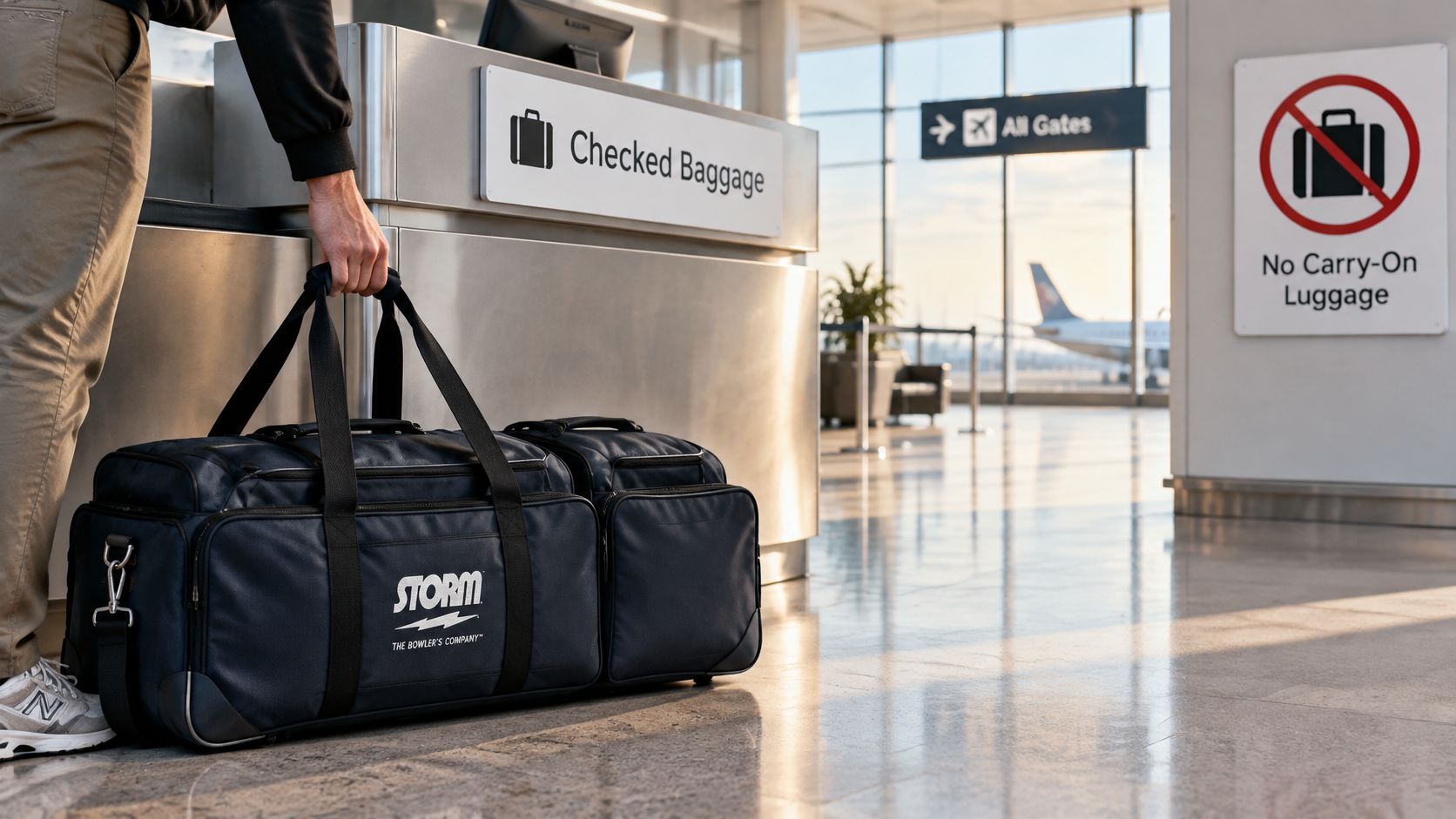
Security permission and airline baggage acceptance are different checks. A carrier can describe cabin or sports-equipment acceptance while the departure checkpoint still controls what enters the cabin. Treat any cabin wording as conditional until the security authority for your route permits the same equipment.
United's sports-equipment policy permits a bowling set containing a bag with up to three balls and shoes. Use that as one carrier example, then confirm how the operating airline classifies the complete packed set and what charges apply.
A tote intended for baggage handling needs protection beyond an easy trip from the car.
Carrier and security checks for bowling equipment
| Carrier or authority | What to verify | What it means for a three-ball tote |
|---|---|---|
| TSA (US security screening) | Checkpoint rules decide cabin entry for your departure | Airline cabin wording remains conditional |
| United | Published sports-equipment acceptance for a bowling set | Confirm item classification and charges for the whole packed tote |
| American | Cabin references do not settle security screening | Do not rely on cabin carriage without explicit approval |
| British Airways | Cabin allowances can be too small for a three-ball load | Measure the packed tote before assuming cabin acceptance |
| Southwest | Checked transport follows current baggage limits | Compare packed weight and dimensions before booking |
| Singapore Airlines | International itineraries can add packing and weight conditions | Confirm case requirements and total weight early |
Verify the complete itinerary
- Identify the operating airline. Check each flight segment, especially on a codeshare ticket.
- Measure the packed tote. Include wheels, handles and bulging pockets, then weigh the complete load.
- Resolve cabin restrictions. Check both airline requirements and departure-security rules before planning cabin transport.
- Calculate baggage charges. Include sports-equipment treatment, additional items and any applicable overweight or oversize fees.
- Protect and secure the contents. Use fitted padding, close internal restraints and secure loose straps without obstructing baggage inspection.
- Plan for checked transport. Consider cabin transport only when both the airline and applicable security authority explicitly permit your equipment.
International packing requirements deserve particular attention because a protective bag or hard case may change the loaded dimensions. The airline's per-item weight ceiling can also rule out a packing arrangement that otherwise looks convenient.
Keep the policy confirmation accessible and leave room in your travel plan to repack. Removing shoes or accessories is easier than discovering at check-in that your only carrying system can't be accepted.
Budget Tiers and What Each One Buys
Define tiers by construction and serviceability, not the price tag. A discount on a weak base doesn't make it suitable for regular heavy loading, and a premium label doesn't guarantee useful warranty coverage.
Buy the features you'll use
Budget totes tend to concentrate on basic storage: fixed separators, simple handles and limited accessory organization. The trade-off is less margin for repeated loading, particularly where thin padding or lightly reinforced seams are involved. Inspect those parts closely rather than rejecting every inexpensive bag.
Mid-range totes are worth considering when they add reinforced handle anchors, secure removable dividers and a genuinely separate shoe compartment. In rollers, look for a firmly mounted axle and accessible wheel hardware. You give up some empty-weight savings in exchange for more usable organization and support.
Premium totes should justify their position through a reinforced base, resilient padding, stronger transport hardware and meaningful after-sales support. Their main penalty is extra cost and potentially extra bulk. A longer warranty helps only if its terms cover the failures you're concerned about.
| Buying tier | What should justify it | Main compromise |
|---|---|---|
| Budget | Sound basic construction for occasional local use | Fewer protective and organizational features |
| Mid-range | Better reinforcement and everyday compartment layout | Added weight or bulk |
| Premium | Strong transport structure and serviceable hardware | Paying for capability you may not need |
Match spending to frequency
Occasional local use rarely calls for an elaborate frame. Regular leagues justify better handles and padding; tournament travel makes repairability and baggage protection more relevant.
If you're buying shoes and equipment together, compare the contents of a starter bowling bag set with shoes against what you already own. A bundle isn't good value when its bag needs immediate replacement.
Buying judgement: Spend first on the parts that carry and protect the load. Decorative panels and extra pockets come afterward.
Match the Tote to Your Bowling Profile
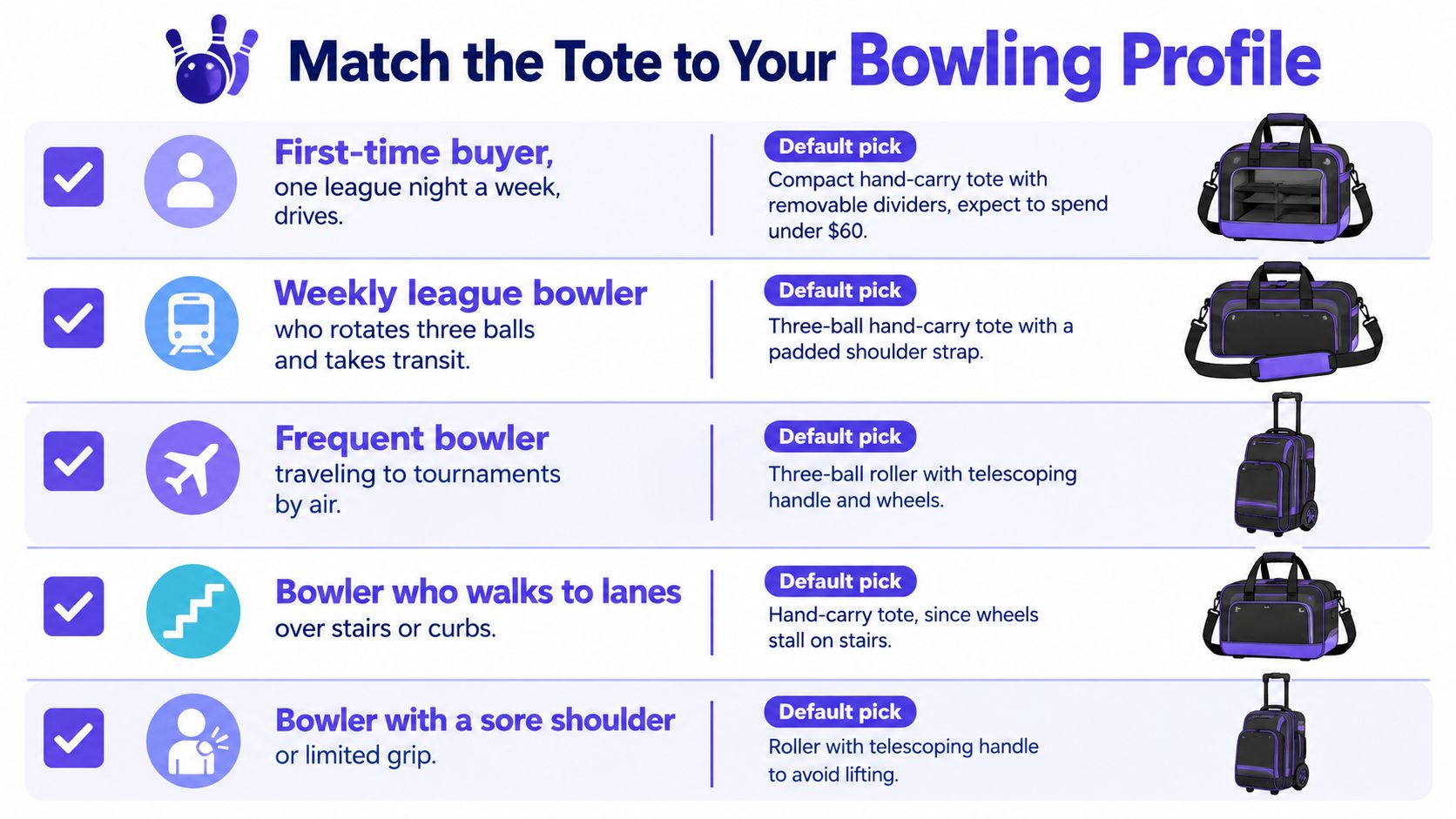
Choose a default format from your travel pattern, then adjust it for your equipment and handling ability. These are starting recommendations, not reasons to carry more balls than you need.
The profile guide offers a quick visual starting point; your loaded handling test should decide the final choice.
Driving to regular league sessions
For a beginner building an equipment setup, a compact hand-carry tote with removable dividers offers flexibility without a large frame. A mid-range model is a sensible starting point if you expect to keep it while adding equipment. Don't fill unused space merely because it's available.
For an established league bowler, prioritize a shoe pocket that remains usable when the main compartment is full. Choose a light roller instead if your usual parking arrangement involves a long approach. Check that the bag fits the vehicle with your other regular luggage already inside.
Traveling for competition or work
For a tournament bowler who flies, start with a checked-baggage plan and protective construction. A roller is useful for terminal movement, but detachable accessories and clear access to the main compartment can make inspection and repacking easier. Weigh the final arrangement before every departure.
For a coach or pro shop owner, a premium roller makes sense when equipment transport is a recurring task. Prioritize replaceable wear parts, secure compartment restraints and handles accessible from different loading positions. If you fly, confirm that your preferred packing arrangement meets the itinerary's requirements before buying around it.
Buying for someone with lifting constraints
For a child or a bowler with wrist or shoulder trouble, choose the lightest practical system that carries the equipment really required. A smaller roller and separate accessory bag may offer better control than a fully packed tote. Let the intended user test it rather than relying on another person's judgement of what feels light.
Independent bag assessments, including those from Bowling Gear Reviews, are useful alongside shop trials and manufacturer specifications. Look for measured empty and loaded weights, plus notes on stability and compartment layout, rather than capacity claims alone.
Before paying, measure the packed bag, complete the handling and route checks, and verify acceptance for any planned flight. Choose the construction tier last, once you know which format works.
Bowling equipment deserves a bag chosen for the journey, not just the number of compartments. Visit Bowling Gear Reviews for independent bag comparisons, equipment reviews and practical buying guides that help you compare protection, maneuverability and everyday fit.

1 Comment
Pingback: What Is a Bowler Bag? Types, Features and How to Choose