

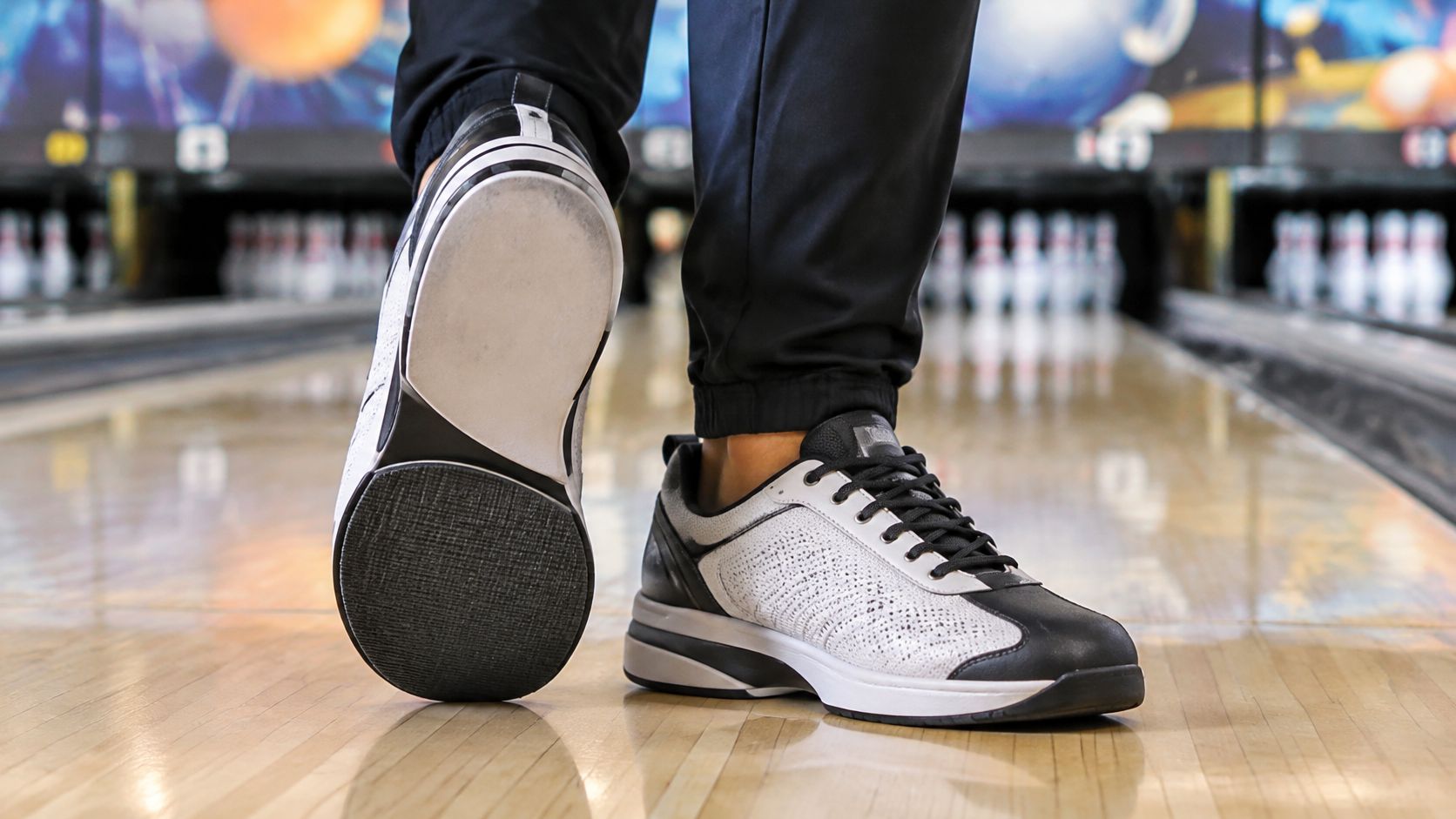
Buy the pair that feels best walking to the settee. That's the popular advice, and it's wrong.
A sneaker upper tells you nothing about the last step of your approach. Bowling shoes that look like sneakers earn their place only when the slide foot glides, the heel brakes progressively, and your foot doesn't twist inside the shoe at the foul line. If a soft, grippy sole stops you short or sends you sailing, the athletic styling is decoration. Judge the shoe by slide endpoint and heel lock, not by cushion, color, or how normal it looks at the snack bar.
Table of Contents
- Why the Sneaker Look Must Still Slide
- Five Constructions and Who They Fit
- Fit for Wide Narrow and Online Orders
- Slide Zones Traction and Replaceable Heels
- Picks by Hand Style and Foot Shape
- Run the Ten-Shot Test and Shortlist
Why the Sneaker Look Must Still Slide
Say a bowler buys a knit pair because it feels like his trainers. His first three steps feel great. On the penultimate step, the rubber under his lead foot grabs, his knee absorbs the stop, and the ball goes early because his feet finished before his swing did.
That failure is older than the current styling trend. Historical accounts trace bowling footwear in the United States to at least 1888, when leather shoes incorporating water-resistant material were introduced for bowling and other sports, according to Bowling for Beginners history of bowling shoe design. Early pairs were commonly black, low-profile, and visually similar to ordinary sneakers, while makers already adapted soles for controlled movement and experimented with designs intended to reduce slipping.
Modern athletic models keep that same hybrid. The upper borrows from street footwear. The outsole can't.
What success actually looks like
You need three outcomes, in this order. Your slide endpoint stays in a tight range shot after shot. Your heel slows you gradually instead of grabbing or skating. Your foot stays pointed where you planted it, with no rotation inside a stretchy upper.
Start with construction type before you compare models. Fit comes next, then friction zones, then a lane test. Walking comfort on the concourse proves none of it.
A sneaker-like upper is not evidence of a bowling slide. The sole split is the evidence.
Five Constructions and Who They Fit
Pick your row first. Model shopping comes after.
| Construction | Slide setup | Replaceable parts | Best for | Main risk |
|---|---|---|---|---|
| Interchangeable athletic bowling shoe | Low-friction pad on the slide foot, traction on the trail foot | Soles and heels swap for hand and approach | League bowlers who tune slide | Wrong pad sticks or overslides |
| Universal-slide sneaker style | Both feet can slide a short distance | Often fixed or limited pads | Two-handed and switch bowlers | Less precise brake than a dedicated slide foot |
| Classic low-profile bowling shoe | Traditional leather or microfiber slide | Common heel and sole kits | Bowlers who want control over looks | Looks least like a street sneaker |
| Knit or fashion upper with split outsole | Slide zone plus rubber traction zones | Check whether the heel actually swaps | Casual league play with a sneaker look | Stretch upper can loosen heel lock |
| Continuous rubber sneaker sole | High grip across the whole outsole | None | Walking only, not the approach | Suppresses the slide and throws timing |
| Center rental shoes | Generic worn universal sole | Not yours to change | One casual game | Inconsistent friction and poor fit |
The table lists six rows on purpose. The first five are sneaker-style constructions people confuse with each other. Rental shoes sit at the bottom as the one-game baseline to reject for league play.
How to read each row
Interchangeable athletic is the serious option. You get a dedicated low-friction pad under the slide foot and traction under the trail foot, plus soles and heels you can swap when one house runs sticky and another runs slick. If you bowl league weekly and your timing depends on a repeatable finish, start here and don't apologize for the price.
Universal-slide sneaker style lets both feet move a short distance. That suits two-handed bowlers and anyone who switches hands, and it's why entry models like an athletic KR Strikeforce Flyer use this layout. You trade braking precision for simplicity. That's a fair trade for a first owned pair, a poor one for a bowler chasing a long, controlled slide.
Classic low-profile still leads on control. A traditional leather or microfiber slide behaves predictably and replacement heels and soles are easy to find. If you want to understand what a real slide sole feels like before chasing sneaker styling, read up on leather bowling shoes and their slide characteristics and notice how little they care about looking athletic.
Knit or fashion upper with split outsole is the conditional pass. It's acceptable only when the slide zone is a genuine low-friction patch and the heel counter holds your foot still. Printed tread, faux suede panels, and color blocking don't count. Turn the shoe over. If you can't point to two clearly different friction zones, put it back.
The two rows to reject
Continuous rubber sneaker sole is not a bowling shoe, whatever the listing says. Grip everywhere fights the intentional slide and makes the penultimate step stick. House rules aside, it will wreck your timing and load your lead knee.
Center rentals give you a worn universal sole, an uncertain width, and friction that changes pair to pair. Fine for a birthday party. Useless as a reference for what your slide should feel like.
Practical rule: Flip every candidate over before you try it on. No visible slide patch, no try-on.
Construction tells you what's possible. Friction detail, fit checks, and a lane test decide whether a good-looking row is usable for your approach.
Fit for Wide Narrow and Online Orders
Your street size is a weak bowling size. General footwear guidance reports that only 28% to 37% of people wear shoes with the correct length and width, and it recommends trying both shoes, using normal sport socks, checking heel security, and leaving roughly one-half inch of toe space, according to American Academy of Orthopaedic Surgeons footwear guidance. Ordering your sneaker number and hoping repeats that error on a surface where fit controls your finish.
Measure in this order
Measure both feet later in the day, when they're largest. Fit the longer foot. Wear the socks you bowl in, not dress socks or the thin pair from the pro shop drawer. At home, trace each foot on paper, measure heel to longest toe, then measure across the ball of the foot.
Check forefoot width second. Side pinch at the ball means you need a wider last, not a longer shoe. Extra length lets the foot swim forward during the slide, and a swimming slide foot rotates.
For a full breakdown of length and width conversions before you order, use our bowling shoe size guide alongside your traced measurements rather than a brand's generic chart.
| Check | Target | If it fails | Do this instead |
|---|---|---|---|
| Length | About 1/2 inch of toe space in bowling socks | Toes jam or the heel slips | Measure both feet and fit the longer one |
| Forefoot width | Toes spread without side pinch | Pinch or a gap at the ball of the foot | Choose a wide or narrow last, do not only size up |
| Heel lock | Heel stays seated through the slide | Heel lifts and the foot rotates | Use a narrower counter or lace lock, not extra length |
| Arch and volume | Midfoot held, not crushed | Upper collapses or the foot swims | Try another last before an insole that changes slide height |
| Socks and time | Same socks as league, rechecked after warm-up | Fine in the store, loose after games | Do not trust one street size when width is unknown |
Wide feet, narrow feet, high insteps
Wide forefeet need a true wide last with a locked heel. Sizing up a standard shoe gives you toe room you didn't ask for and heel slip you can't lace away. Many wide models keep the same heel width and open only the forefoot, which is exactly the right split.
Narrow feet, and many women buying unisex sneaker lasts, face the opposite trap. Sizing down until the shoe feels snug jams the toes while the heel still lifts. Prioritize a narrow heel counter and use a runner's lace lock through the top eyelet before you blame your footwork.
Keep arch volume separate from width. A high instep needs midfoot room over the top of the foot, not a wide toe box. Forcing a high-volume foot into a wide last gives you a sloppy forefoot and a crushed instep at once.
The tradeoff and the online order
A roomy toe box feels better in game three. A loose heel costs you repeatability in every frame. When you must choose, protect the heel lock and get toe comfort from width, not length.
Recheck fit after the shoe warms up. Knit uppers relax and sweat reduces internal grip, so a pair that felt locked in the store can drift by the second game.
Ordering online, require three things. A stated width, not just a length. A return window that survives a home try-on of both shoes. Clear photos of the slide pad and heel so you can confirm the friction split before it ships. If any one is missing, skip the listing.
Slide Zones Traction and Replaceable Heels
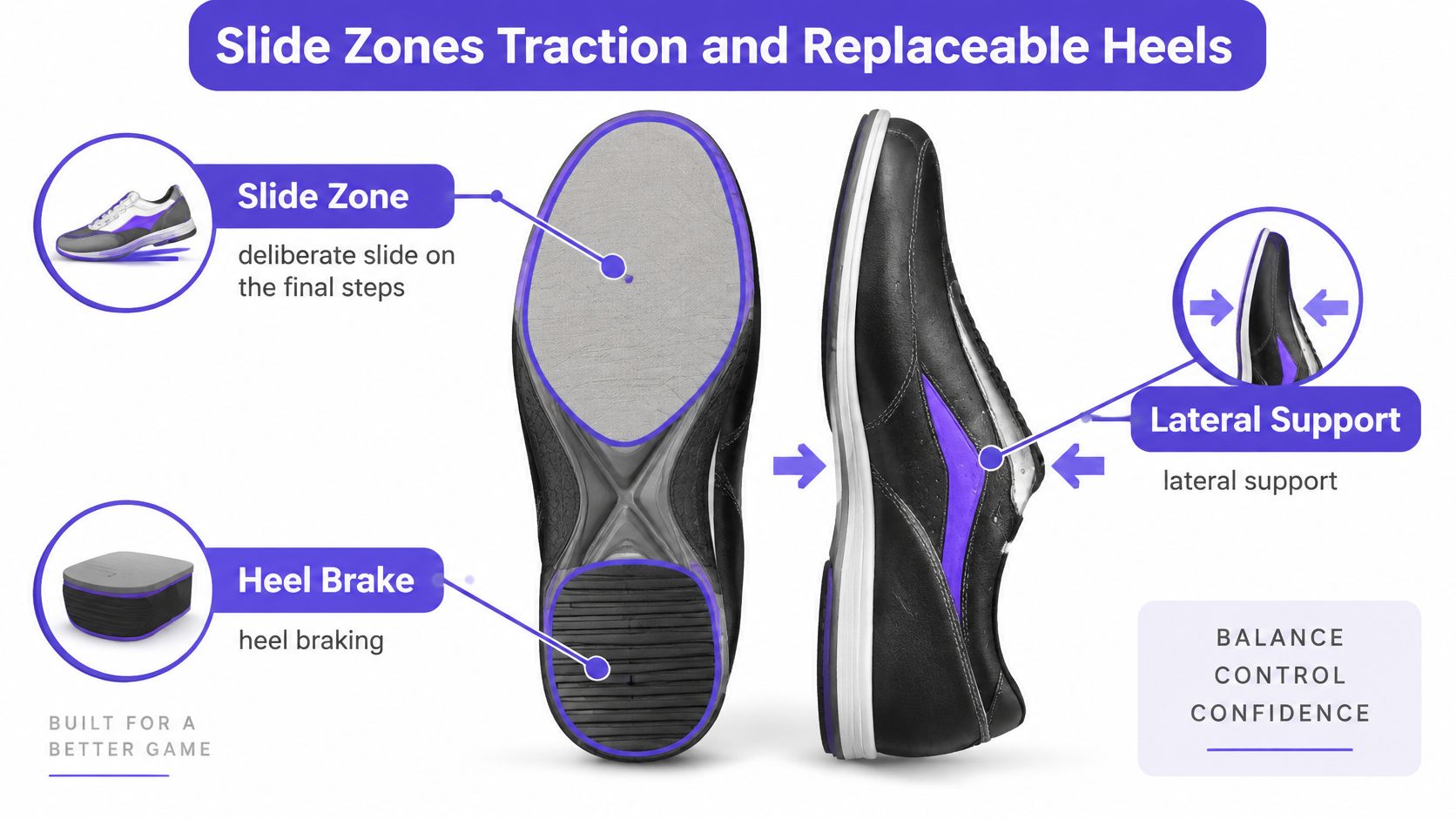
A sneaker-like upper tells you nothing about how the shoe slides. Judge the outsole by three things: lead-foot slide, trail-foot traction, and a heel that brakes predictably. A soft fashion sole with continuous rubber is the wrong choice for a bowler who needs a controlled finish.
Screen three zones on every pair
- Slide zone: A smooth, low-friction patch beneath the lead forefoot, often leather or microfiber. Rubber lugs interrupt the slide and make it less consistent.
- Traction zone: A higher-friction area beneath the trail foot, where you need grip to drive through the approach.
- Heel brake: A firmer heel that slows you progressively after the slide, rather than grabbing suddenly and pitching you forward.
These zones must suit your approach, not just look technical in a product photo. Compare the slide and traction zones on bowling shoe soles before choosing a sneaker-style pair.
Why a grip score is the wrong metric
Coefficient of friction, or CoF, describes frictional force relative to normal force. The ISO 13287 footwear slip-resistance standard sets out laboratory procedures for measuring footwear CoF under controlled conditions. ASTM F2913 assesses whole shoes in heel, flat-contact, and forepart modes. Neither standard measures bowling-slide performance, so those results are not a substitute for checking the shoe's slide pad and heel.
A high slip-resistance rating may suit walking and work against the controlled slide you need at the line. If a sneaker-style listing promotes grip but does not identify a slide surface, skip it.
Replaceable parts are approach insurance
Approaches vary from center to center. Interchangeable soles and heels let you adjust the shoe's friction to suit the conditions instead of changing your finish to compensate.
If you stick on the penultimate step, try a slicker slide pad. If you slide past your usual finish, choose a slower pad or a firmer, grippier heel. A fixed sole gives you no way to make that adjustment.
Check the parts for wear and movement. A peeling slide patch, a heel that rocks on a flat surface, or a hook-and-loop pad that creeps under load can change how the shoe behaves. A stretched upper can also let your foot shift inside the shoe, making the slide less repeatable.
A reliable setup separates sliding from braking with different materials or distinct pads. One continuous rubber sole cannot provide both jobs well.
Picks by Hand Style and Foot Shape
One sole configuration doesn't serve every bowler, and pretending otherwise is how people buy the right shoe for someone else's approach. Independent athletic-footwear research identifies performance, injury protection, and comfort as competing design needs, emphasizes that upper fit is especially important to comfort, and cautions that footwear features do not reliably prevent injury, supporting individualized, comfort-guided selection, according to athletic footwear research in PubMed Central. Buy for your hand and your finish, not for a feature list.
| Style | Lead foot | Trail foot and heel | Fit priority | Skip if |
|---|---|---|---|---|
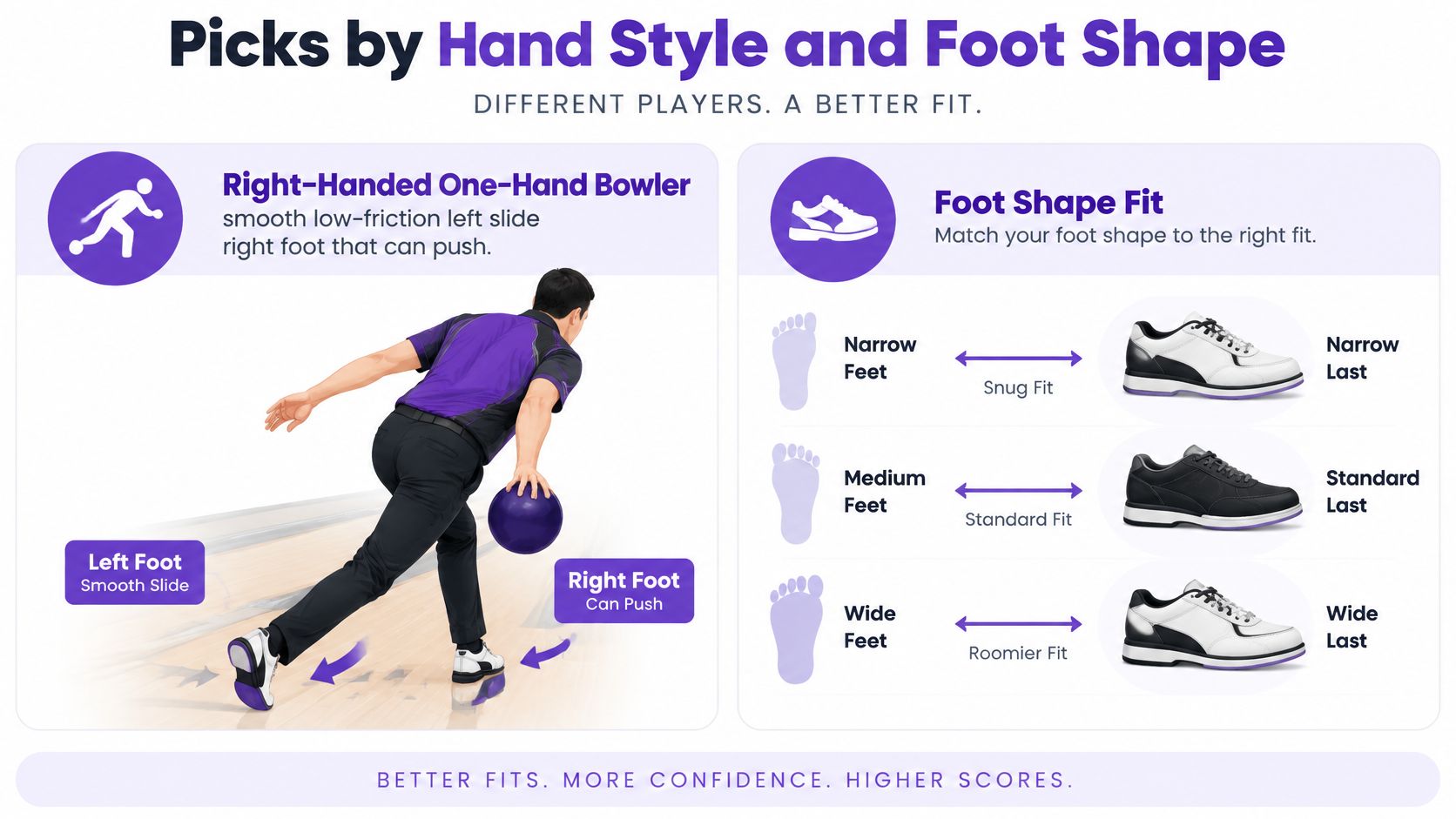
| Right-handed one-hand | Smooth low-friction left slide | Right foot pushes and the heel brakes | Locked left heel | The outsole is continuous rubber |
| Left-handed one-hand | Smooth low-friction right slide | Left foot traction | A right-slide or fully swappable pair | The shoe slides on the left only |
| Two-handed | Short controlled slide, often both feet | Even lateral support | Stable heel rather than max cushion | The heel stack feels soft and unstable |
| Plant or no-slide | Higher friction and little slide | Even grip | Secure midfoot | The slide sole is very slick leather |
| Inconsistent timing | Repeatable brake over max distance | Progressive heel contact | Containment over looks | Cushioning is the main selling point |
Buy and skip by approach
Right-handed one-hand bowlers need a smooth left slide, a right foot that pushes, and a heel that brakes. Buy interchangeable. Skip any continuous rubber sole, full stop on that category.
Left-handed one-hand bowlers need the mirror image. A right-only slide shoe is a wrong purchase even if the upper matches perfectly and the price is tempting. Fully swappable pairs solve this cleanly.
Two-handed bowlers usually finish with a shorter slide, sometimes on both feet, and load the shoe laterally. A universal slide fits that pattern. Pass on a tall, soft heel stack, because wobble at the line shows up as a wandering trail leg and inconsistent launch angles.
Plant bowlers should buy friction on purpose. A slick leather slide sole turns a planted finish into a skating accident. Choose a slower pad or a fixed, higher-friction slide and own your style.
Inconsistent timing is usually a fit and brake problem wearing a ball problem's clothes. Choose containment and a progressive heel over the longest slide you can find.
Foot-shape exceptions that change the pick
A wide forefoot on a right-handed slider still needs a locked left heel. Take the wide last in the interchangeable row rather than dropping to a roomy fashion shoe with a printed slide zone.
A narrow foot in a two-handed approach needs lateral containment most of all. A unisex sneaker last that looks right and slips sideways will undo the stability you bought the shoe for.
The most convincing "sneaker" design is not the softest one. Excess cushion that compresses unevenly at the foul line trades a good walk for a bad finish. Take your chosen row to the lane test before it goes anywhere near a tournament.
Run the Ten-Shot Test and Shortlist
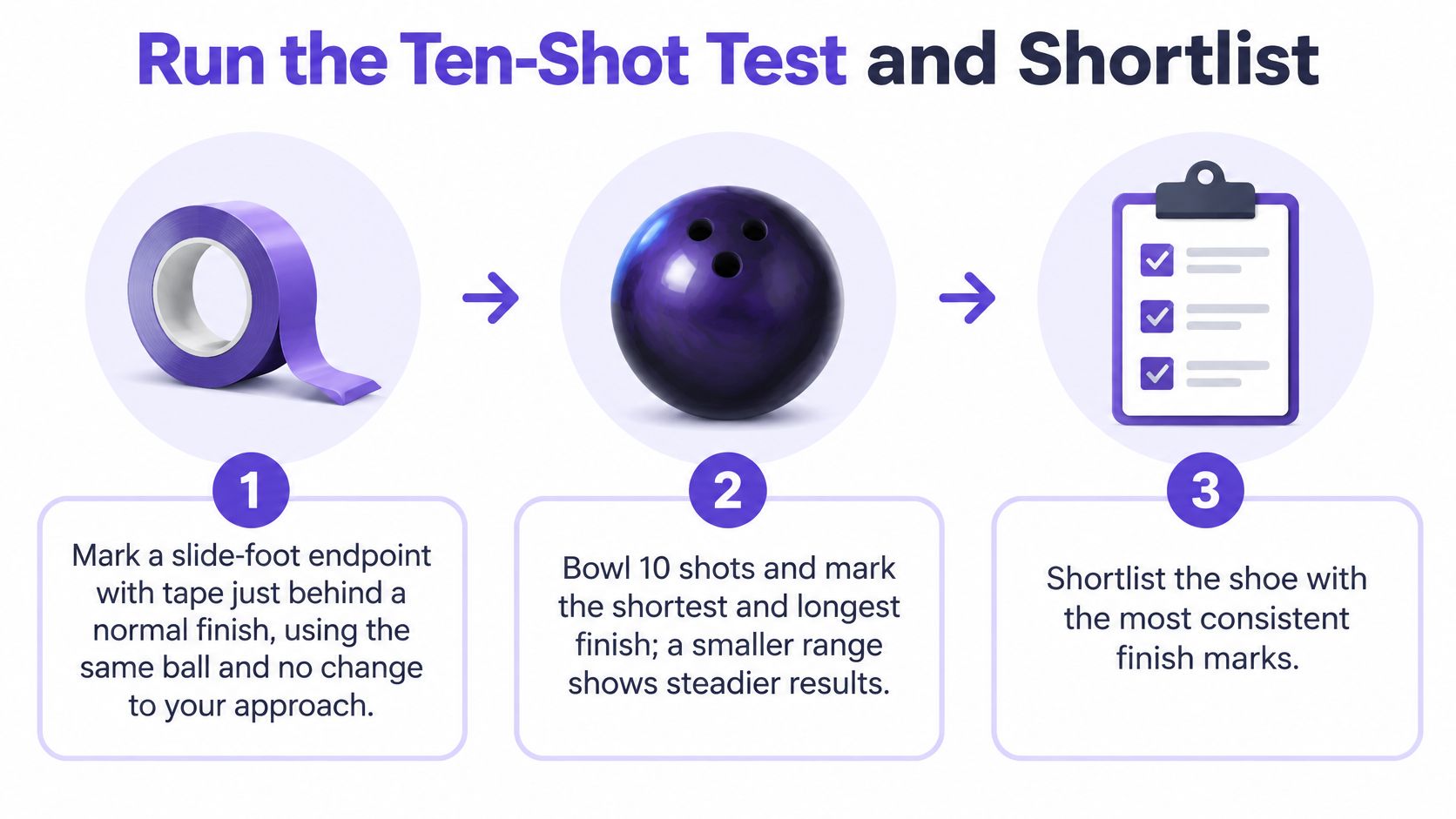
Don't shortlist from a fitting stool. Run this drill in one practice session, with your league ball, your league socks, and no changes to your approach.
The drill
- Mark your endpoint: Put a small tape strip on the approach just behind your normal finish position. Pass sign, you can see the strip without looking down mid-approach.
- Bowl 10 shots: Mark your shortest and longest finish against the strip. A smaller range means a more predictable brake, and that's your headline number.
- Log each slide: Note whether the shoe sticks on the penultimate step and whether the slide slows smoothly. One stick is dust. Three sticks is a pad problem.
- Watch the heel: Progressive contact feels like a dimmer switch. An abrupt grab that dumps you forward is a fail for that heel on that approach.
- Check balance and rotation: Note foul-line balance and any unintended foot rotation. Rotation usually traces to a loose heel, not your release.
- Repeat after warm-up: Run the set again once perspiration and lane dust build up, across at least a league-length block. Friction that shifts by game two will betray you in game three.
- Adjust once, retest: Sticking gets a slicker replaceable slide pad. Oversliding gets a slower pad or firmer heel. Then bowl another 10 before you judge.
Independent slip-testing guidance emphasizes that CoF depends on the footwear, test surface, contaminants, load, and test mode, and SATRA slip resistance testing guidance notes ASTM F3445-21 uses a minimum COF of 0.40 in specified heel and forepart slip modes for protective footwear. That threshold targets slip resistance, not bowling slide optimization, which is exactly why your own 10 shots outrank any lab number on a listing.
Pass, adjust, or reject
Shortlist it when the endpoint range stays tight, the heel brakes progressively, and the foot doesn't rotate after the shoe warms up. That's a shoe you can trust under league pressure.
Adjust it when one pad or heel change tightens the range. Change last width before length when the forefoot is the complaint, and retest after a full league block rather than five frames.
Reject it for competition when the range stays wide, the heel grabs, or the foot rotates after a pad change. No cushioning story rescues that result. A soft shoe that feels great casually can still wander at the line, and wandering is the whole problem.
Our shortlists follow this same standard. All of our reviews are created by bowlers with real experience and a deep understanding of the game, we only recommend products we believe offer value to readers, and Gary shares personalized recommendations to help bowlers find equipment that fits their style and goals. If a sneaker-style pair can't hold its endpoint through a league block, it doesn't make our list, however good it looks in photos.
Run the test on your top two candidates in the same session if the pro shop allows it. Buy the pair with the tighter range and the quieter heel. That's your shoe.
Stop guessing from product photos and start with slide, brake, and fit. At Bowling Gear Reviews, we test bowling shoes on real approaches through league-length sessions, compare interchangeable and universal sole systems side by side, and flag the sneaker-style pairs whose grip kills the slide. Bring your hand, your foot shape, and your ten-shot results, and use our shoe reviews and size guides to pick the pair that finishes in the same place every frame.
