

The most popular advice for a straight bowler is “buy plastic.” It's a good starting point, but it doesn't answer the questions that determine whether a ball stays on line: does it fit, does its surface suit your lanes, and can you repeat the shot late in a session? The best bowling ball for a straight bowler isn't automatically the heaviest or the cheapest. It's the one that gives you dependable direction and spare conversions without asking you to fight its reaction.
Use a 20-shot spare drill to compare candidates instead of choosing by color or hook rating. Track first-ball conversions, distance from your intended line at the pins, and whether misses consistently go to one side. Those results will tell you more about a straight ball's practical value than a product label will.
Table of Contents
- Quick Picks for a Straight Bowler at a Glance
- Coverstock and Core Specs That Keep the Line Tight
- Lane Oil, Pattern Fit and the Spare Drill
- How to Prep and Maintain the Surface
- Weight and Fit for Repeatable Delivery
- Choose Your Straight Ball by Budget and Experience
Quick Picks for a Straight Bowler at a Glance
| Ball type | Example model | Weight range | Reaction |
|---|---|---|---|
| Polyester | KR Strikeforce Polyester | 6, 8 to 16 lb | Straight |
| Polyester | Ebonite Maxim Peek-A-Boo Berry | 6, 8 to 15 lb | Straight |
The KR Strikeforce polyester ball, released in October 2025, is listed in 10 weights, 6 and 8 through 16 pounds, and the product page identifies its reaction as straight (KR Strikeforce product listing). The Ebonite Maxim Peek-A-Boo Berry product page lists weights from 6 and 8 through 15 pounds and also describes its reaction as straight. Both are polyester options, a sensible first look for bowlers who want low lane friction and a direct roll for strikes or spares.
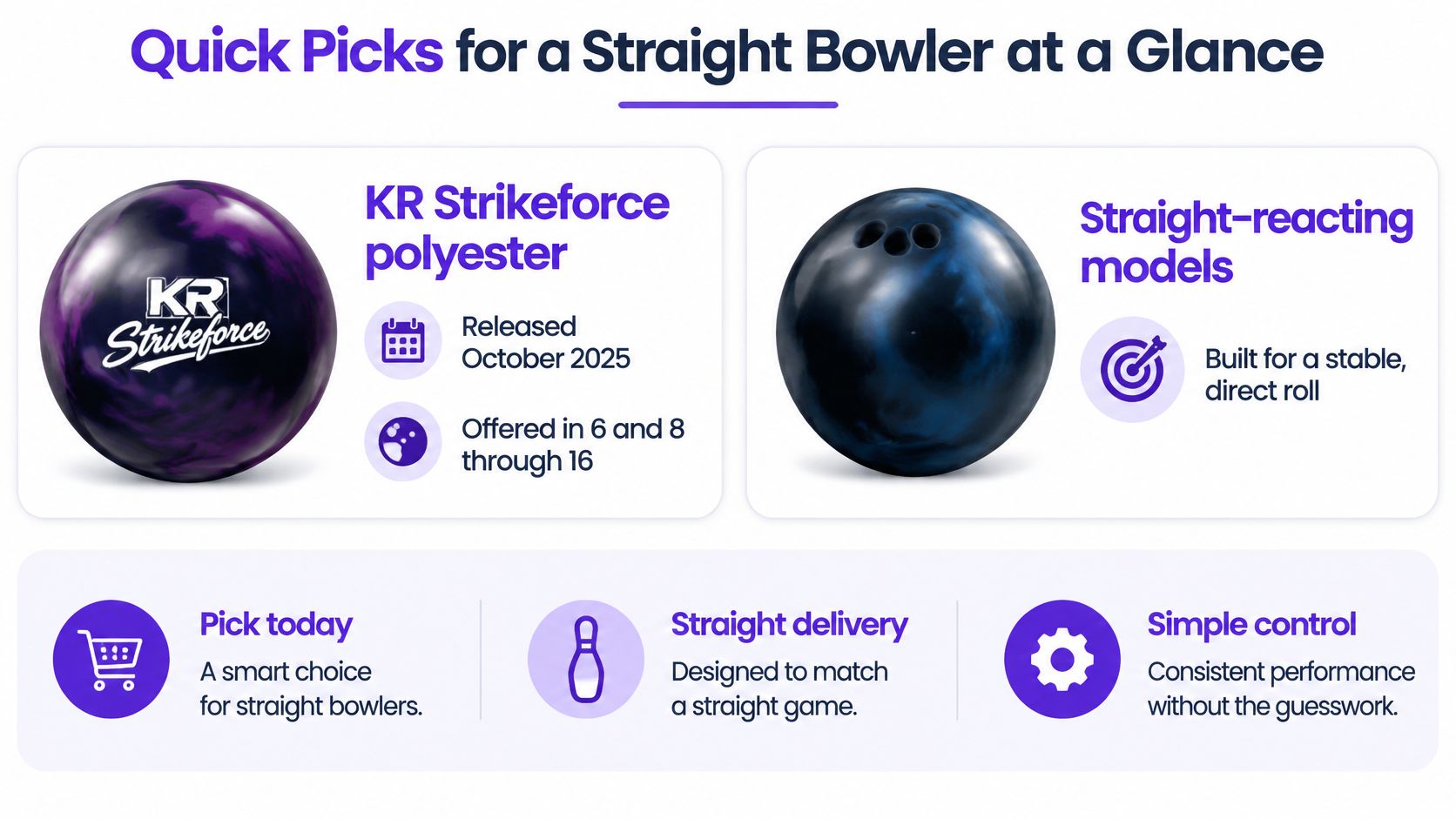
Scan the table in this order: first, find a weight that suits your hand and stays controllable through a full session. Next, match the reaction to the lane and the job. Polyester is the direct option. A low-performance urethane or mild symmetrical reactive ball can be worth testing if you want a small, controllable breakpoint or a gentler transition with a little more backend, but confirm the listed weights and surface finish on the product page before buying.
Rank your shortlist by first-ball conversions over the 20-shot spare drill, not by shelf appeal. A ball that holds its line for one release and lane condition may drift for another bowler, and the heaviest legal ball is the wrong pick when it costs you steady speed late in a session. Use these options to narrow the test, then let repeatability decide.
Coverstock and Core Specs That Keep the Line Tight
| Spec | Straight-bowler target | Why it matters |
|---|---|---|
| Coverstock | Polished plastic or polyester | Minimizes lane friction and early traction |
| Radius of gyration (RG) | High, near the upper legal range | Delays rotation, allowing a longer skid before hook |
| Differential RG | Near zero, well under the 0.060 in limit | Reduces track flare and hook potential |
| Surface finish | Factory polish or fine finish | Supports a predictable friction response |
| Drilled weight | Heaviest weight you can throw with steady speed | Prioritizes balance and control over raw weight |
| Core design | Compare on the same drill | The effect needs a side-by-side test |
For a straight delivery, start with the coverstock, not the advertised hook rating. USBC technical material explains that higher RG delays rotation, while higher differential RG increases track flare and hook potential; the USBC differential limit is 0.060 inches. Its guidance points straight bowlers toward a high-RG, low-differential ball with a plastic or polyester cover, a combination designed to keep motion subdued (USBC equipment specifications).
Ask for the numbers, not just the label
Before buying, ask the pro shop for the ball's RG, differential, cover material, factory finish, and drilled weight. A model's “mild” or “strong” hook label can help narrow options, but it doesn't tell you how your release will interact with that cover and core. For a custom ball, ask the shop to explain how the drilling is intended to affect your motion.
Don't assume a symmetrical core always makes a ball more predictable for a low-revolution player. Core and drilling can influence motion, but the useful answer for your game comes from comparing candidates with the same approach and target on the lane conditions you usually bowl. If you're buying a first ball, prioritize a comfortable fit and a manageable reaction over a complex core designed to create hook.
Read the warning sign on the lane
If the ball repeatedly exits your intended line, or starts turning more as the lane dries, its surface may be generating more friction than you can control. Test the ball with the same target and release before changing equipment. If it still pulls off target, ask the shop whether a smoother finish or a lower-friction cover would better suit your delivery.
Lane Oil, Pattern Fit and the Spare Drill
A straight ball does not get a free pass through oil. The shot still skids, may hook when it finds friction, then transitions toward roll near the pins. Lane patterns are commonly about 30 to 50 feet long, and in many public centers the middle can carry roughly eight to ten times more oil than the outside, so a ball that looks calm early can still jump when it exits the pattern (USC's explanation of bowling physics).
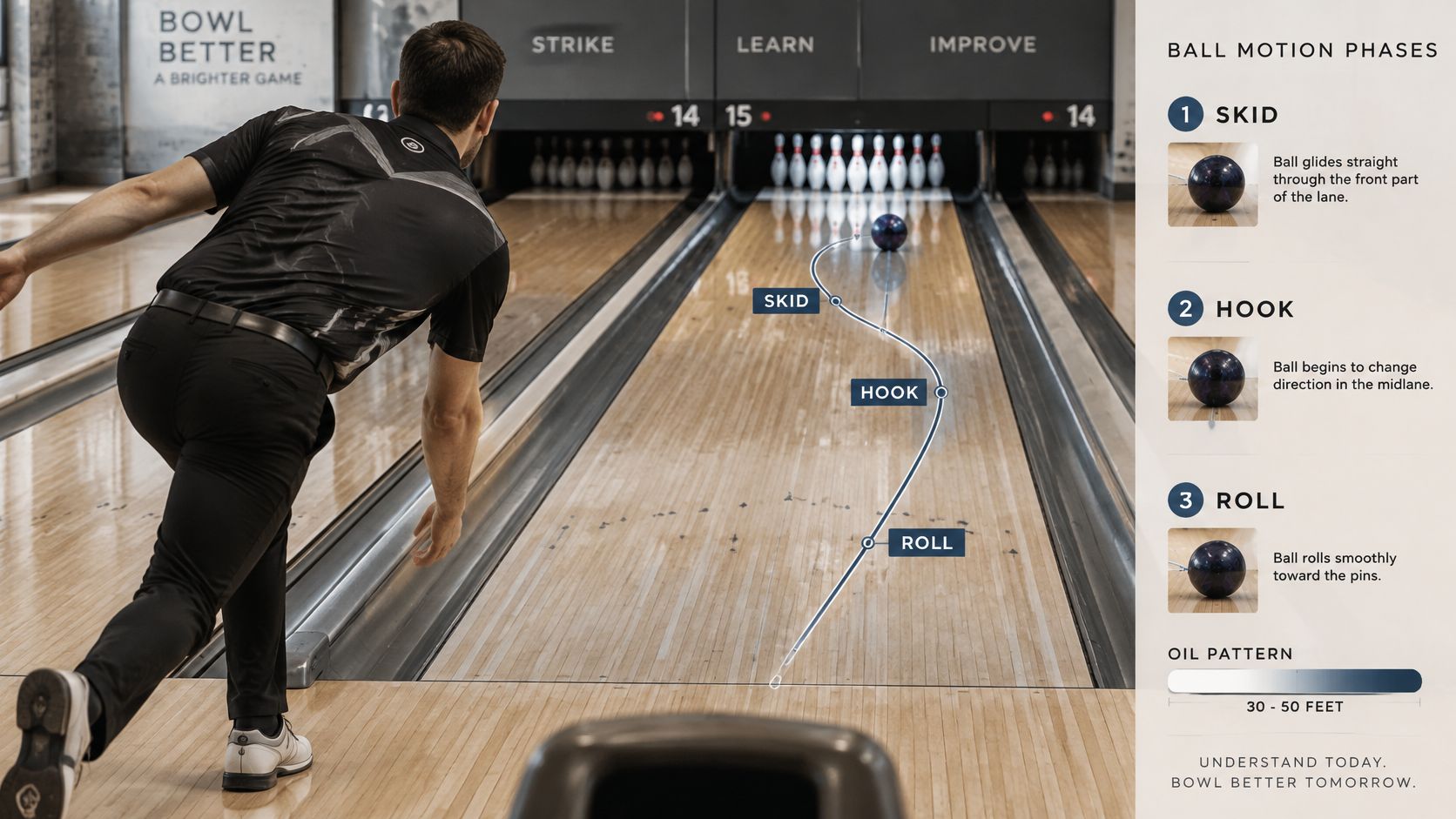
Take a polished polyester ball on your usual target. It can hold the line through the oil, then still move a few boards when the lane transitions and the dry boards grab the cover. A rougher, more reactive cover grips sooner and can pull farther off target. Straight doesn't mean frictionless: pattern length, volume, and distribution decide how far the ball travels before it bites.
| Lane condition | Ball behavior to expect | Test first |
|---|---|---|
| Longer pattern, toward 50 ft | Ball skids farther before it grips | Polished polyester with high RG |
| Shorter pattern, toward 30 ft | Earlier drift and breakpoint | Controlled-breakpoint candidate, verified by drill |
| Transition or dry boards near pins | Ball grips earlier and may pull off line | 20-shot spare drill on your house pattern |
On a longer pattern, polished polyester and high-RG construction remain the clean starting point for a direct line. On a shorter pattern, resist the urge to buy “stronger” right away; test a controlled breakpoint and keep it only if spare shooting gets easier, not merely more dramatic. For pattern shape and how length changes ball motion, use this guide to types of bowling oil patterns.
Make the spare drill the deciding test
The 3-6-9 system is a common approach for straight or slightly curving bowlers: keep the target line and move your feet to adjust for the spare. Run about 20 shots across several common spare targets, and log first-ball conversion, average miss distance at the pin deck, and directional bias. Rank candidates by conversion first, then by repeatability: how often the same foot position and target produce the same result.
Keep the ball that puts the majority of shots within one board of the intended pin line and changes trajectory least as the lane transitions. That benchmark matters more than maximum entry angle for a straight bowler. If the heaviest legal ball lowers conversion, widens the miss pattern, or turns a repeatable spare line into a timing problem, it is the wrong pick for this job.
How to Prep and Maintain the Surface
A ball can keep the same weight and core while changing its reaction. USBC ball-motion research has identified surface roughness as a major factor in ball motion, and a worn, dirty, or altered finish can change friction and traction, shifting when the ball moves from skid toward roll (USBC ball-motion and static-weights study). For a straight bowler, that drift matters more than it does for a hook player. Your margin is a board or two, while a curving shot can sometimes recover through its arc.
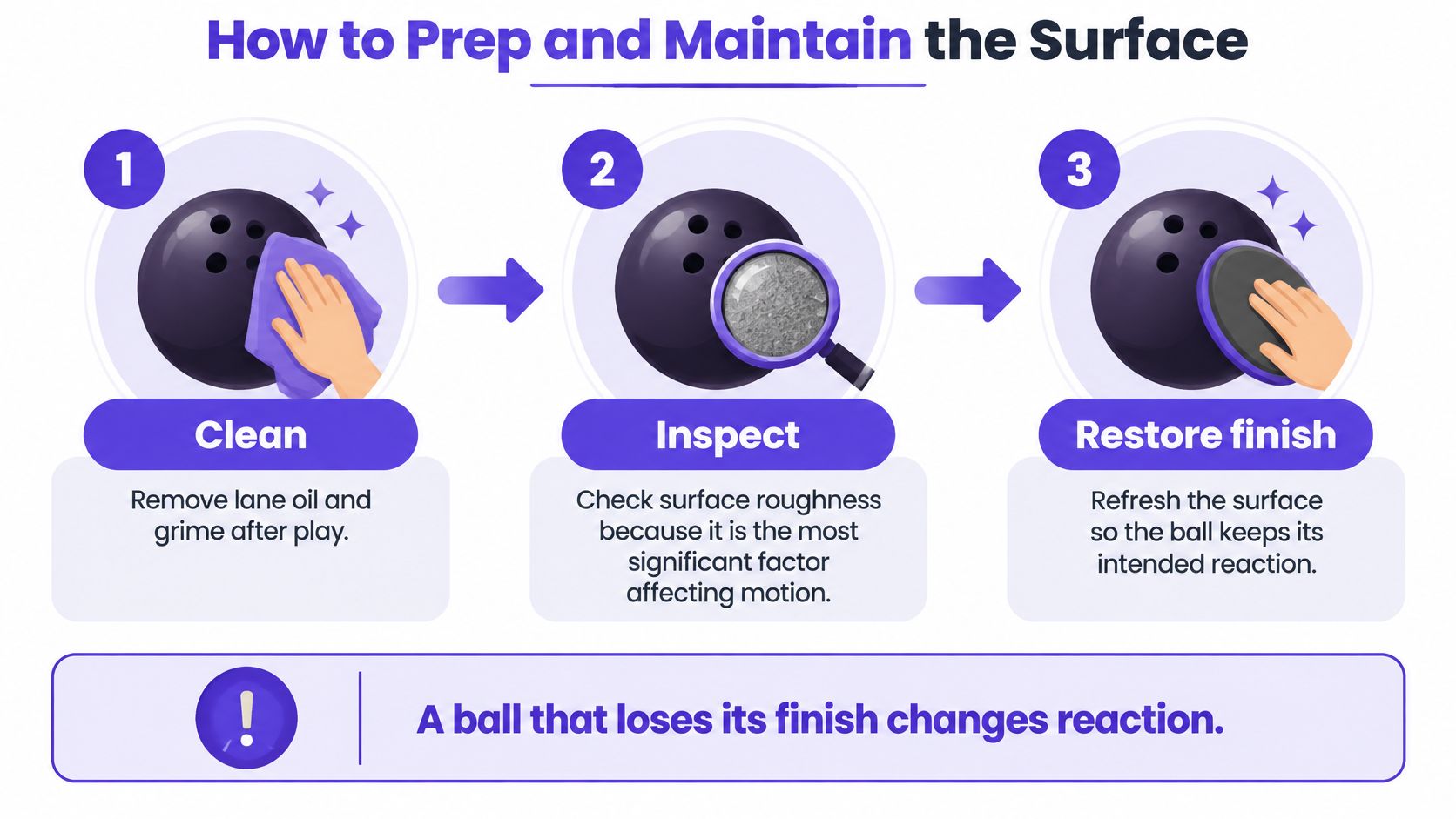
Treat surface work as scheduled upkeep with one job: preserve the finish that produced the reaction you chose. Follow this sequence:
Wipe the ball after every session with a dedicated bowling-ball cleaner and a clean microfiber cloth to remove oil and lane dressing. Residue left to build up changes the ball's friction long before the finish visibly wears.
Inspect the cover under good light. Look for scratches, flat spots, dull patches, and areas that no longer have a uniform sheen. A cosmetic scuff alone doesn't justify sanding the whole ball.
Resurface only when the reaction drifts. Work the cover with a fine abrasive pad, keeping pressure and movement consistent from edge to edge. Focusing on one spot leaves uneven texture that reads the lane unpredictably.
Restore a uniform finish with a finer polish that matches what the manufacturer applied. Sanding too often removes the low-friction finish that keeps a straight ball on line, so stop as soon as the sheen is even.
Check the result with 10 shots at the same target. Compare breakpoint and carry with your previous session, and keep your target and release unchanged during the test.
Check the ball after every session and make a closer surface assessment during the week before league play. If the reaction still matches what your spare drill recorded, clean it and leave the finish alone. For a fuller care routine, use this bowling-ball maintenance guide.
The video below demonstrates ball-care techniques you can compare with your own routine.
Weight and Fit for Repeatable Delivery
The heaviest legal ball isn't automatically the best ball for a straight bowler. USBC rules set a maximum certified-ball weight of 16 pounds, but a bowler's useful limit is the weight they can release with consistent speed, balance, and direction. When a ball is too heavy or poorly fitted, the player may change the swing or release to compensate, losing the repeatability a straight line requires.
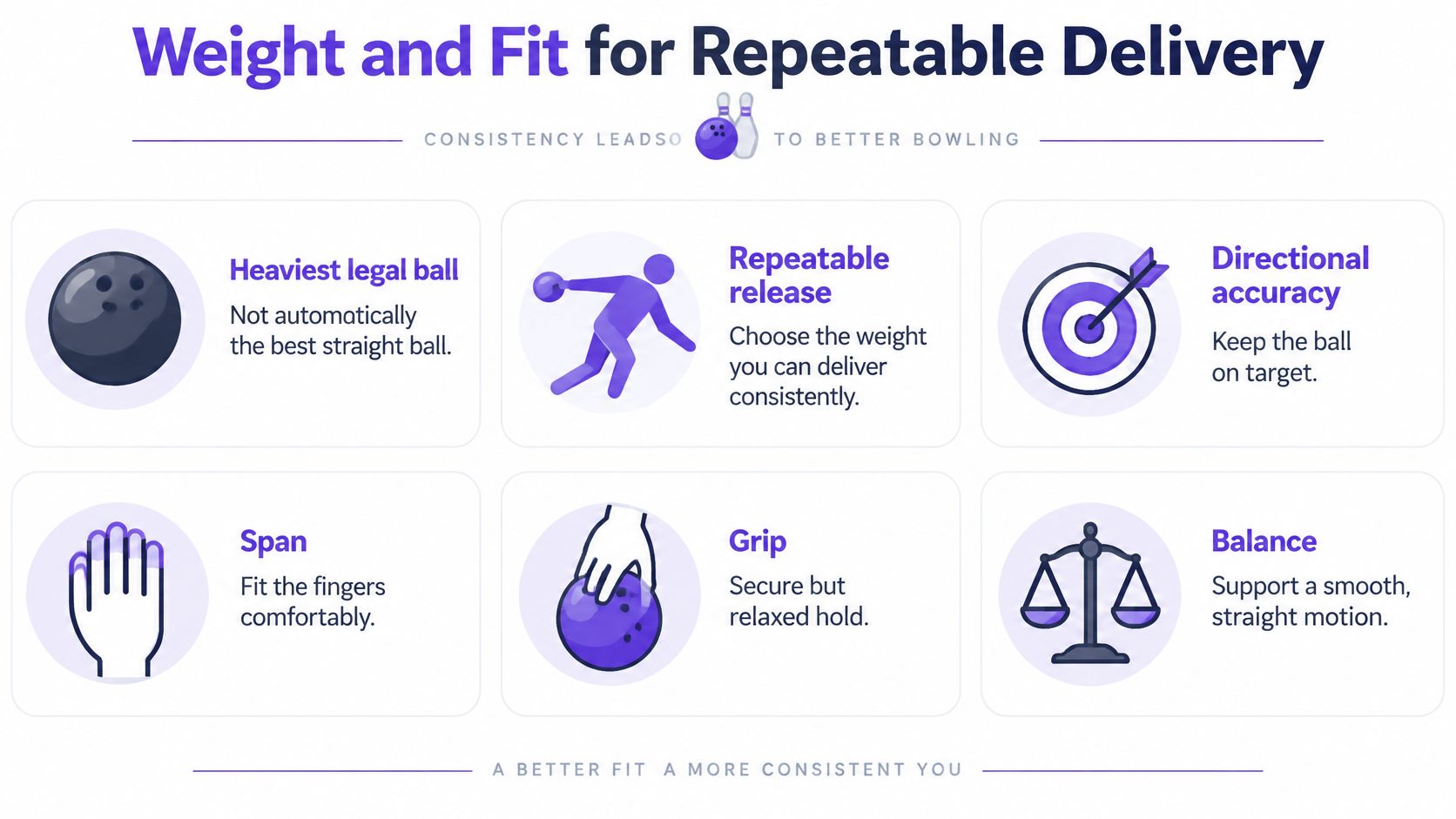
Fit starts with the span, the distance between the thumb and finger holes, and the size and shape of those holes. The grip should feel secure without requiring you to squeeze hard. Ask the pro shop whether finger inserts suit your hand and release; drilling should account for narrow or wide hands rather than forcing your fingers into a generic fit.
Test the weight over a full session
- Throw each candidate weight for a full league-length session. Short practice can hide fatigue that affects late-session control.
- Log accuracy, missed-target rate, release consistency, and discomfort. A score alone won't show whether your delivery is becoming less repeatable.
- Compare a house ball with a custom-drilled ball of similar weight. This helps separate weight from fit as the source of a control problem.
- Switch to a lighter candidate if speed or balance drops late in the session. The goal is a delivery you can reproduce, not a heavier swing at the start.
- Check the fit for your hand before drilling. Children, beginners, older adults, and bowlers with smaller hands may gain more from a lighter custom ball than a heavier ball that doesn't fit.
A lighter ball that you can release the same way throughout the session is a better choice than a heavier one that changes your timing.
For a more detailed weight-selection starting point, consult this guide to choosing the right bowling-ball weight. Then make the final call from your own session test, not a rule of thumb applied without regard to comfort or fit.
Choose Your Straight Ball by Budget and Experience
A straight ball earns its keep when it hits the same target with the same release, so rank candidates by first-ball conversion and repeatability over a 20-shot spare drill before price. The heaviest legal ball is the wrong pick if it changes your timing, shortens your follow-through, or fades late in a session.
| Budget band | Relative spend | Best starting use | Practical choice |
|---|---|---|---|
| Entry | Lowest of the three | First ball or occasional play | Polyester, fitted to your hand and controllable through a session |
| Mid | Middle | Regular league play | Polished polyester for spares or house-shot control; test urethane if needed |
| Premium | Highest of the three | Competitive comparison or a specific lane problem | Compare polyester with a controlled urethane or mild reactive option |
Treat Entry, Mid, and Premium as relative spending levels rather than quoted prices, because retail pricing changes by retailer, model, and time; compare current listings for each ball before you buy. Spend first on a ball you can control and a fit that supports a repeatable release. Add more reactive equipment only when you can identify the lane problem it needs to solve.
For a beginner or first custom ball, start with polyester and choose a weight you can deliver consistently through a full session. Get the span and finger-hole fit right before paying extra for features you may not need. A straight-reacting ball can serve both spare practice and direct strike attempts while you build a consistent target.
A league bowler with a steady release can use polished polyester with high RG and near-zero differential as a spare ball or a controlled house-shot option. Consider low-performance urethane only if the ball repeatedly drifts too early and a drill shows that a controllable breakpoint would help. Buy motion for a measured miss, label promises aside.
For competitive bowlers, compare two candidates on the same lane condition and separate spare-shot results from strike-ball performance. Record pocket-hit percentage, leaves, carry, and control at the speeds and release styles you use. The deciding question is whether a different ball earns its place by making a specific task more repeatable.
Move beyond polyester only for a measurable reason
Polyester reduces hook, but it can become limiting if a bowler needs a controlled breakpoint on a shorter pattern or wants more backend during a transition. A low-performance urethane or mild reactive ball is worth testing when polyester lacks that motion, not when the bowler just wants a more advanced ball. A 2026 participation report counted 29.8 million U.S. bowlers, with 71% classified as recreational participants; that broad audience is better served by choosing for a specific use case than by chasing one universal “best” model (2026 U.S. sports participation report).
| Use case | Ball type and specs | Check before buying |
|---|---|---|
| House-shot strike ball | Polished polyester, high RG, near-zero differential | Session repeatability on your house pattern |
| Spare ball | Polished polyester, high RG | 20-shot spare drill across common targets |
| Dry-lane ball | Polyester or a controlled urethane | Verify with a 20-shot drill on dry boards |
| Transition option | Low-performance urethane or mild reactive | Use only if the ball drifts too early or lacks backend |
Verdict: Buy polyester first if you want a direct, dependable line. Move beyond it only when your test shows a particular lane condition where a controlled breakpoint improves results without costing spare accuracy.
Book a fitting with a pro shop and run the spare drill on the house pattern you bowl most. Log conversions, miss distance, and directional bias in a simple table before you buy, so the ball earns its place through repeatability rather than appearance.
Bowling Gear Reviews publishes bowling-ball reviews, comparisons, and practical fitting and maintenance guides for bowlers at different experience levels. Visit the site to compare options for your straight delivery, then take your shortlist to a pro shop and test it on your usual lanes.
