

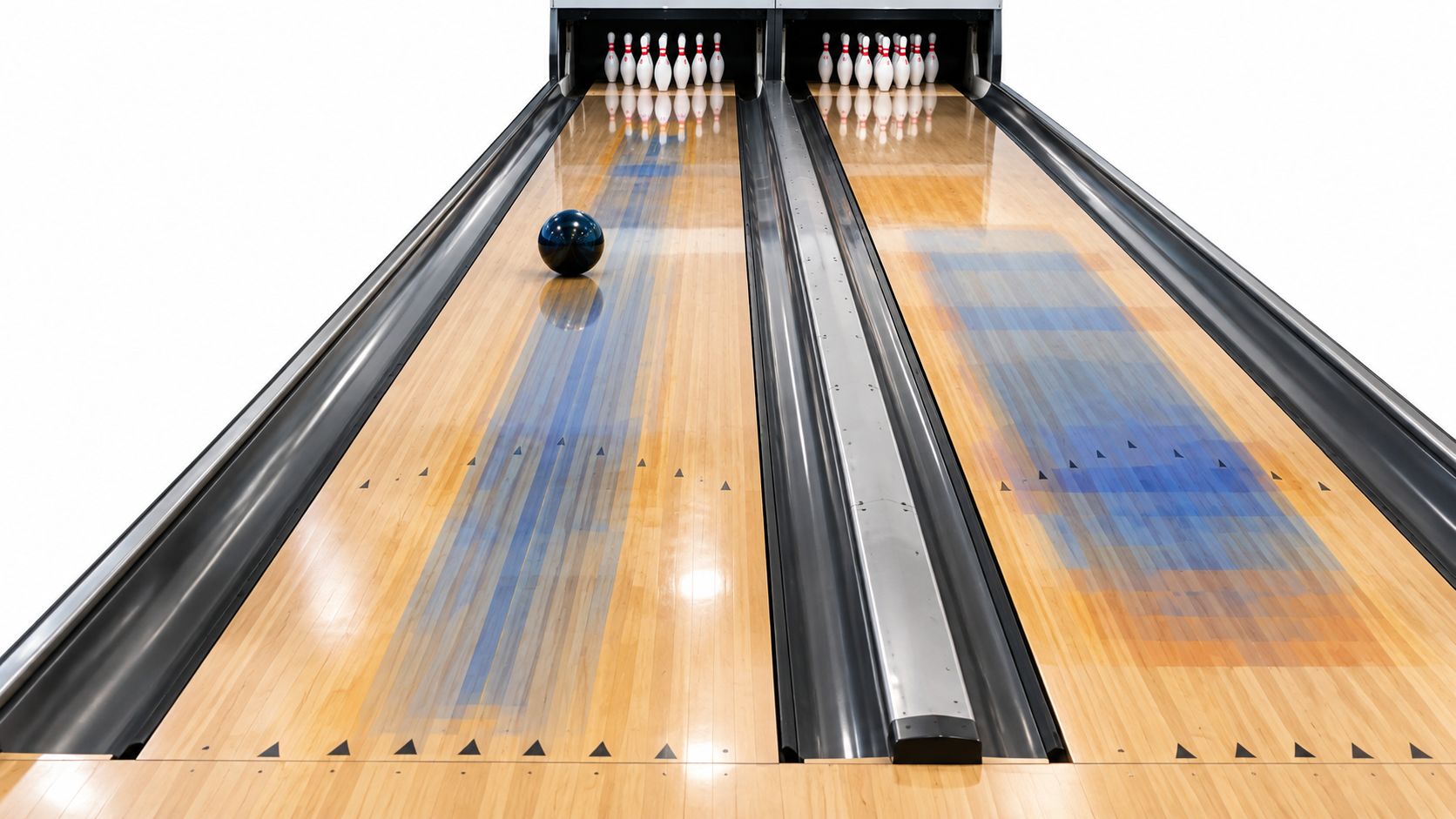
The most popular advice about bowling oil patterns is also the least useful on its own: call the lane dry, medium, or oily, then pick a ball to match. Those labels can point you in a general direction, but they don't explain why a ball hooks early on one lane and skids too long on another, even when the printed pattern information looks similar.
A better read starts with the pattern's length and oil volume, then checks what the ball does. The lane's surface, the equipment moving through the oil, and the rules of the event can all change how a pattern plays. Learn to separate those factors, and you'll make adjustments based on observable motion instead of guessing from a label.
Table of Contents
- How Oil Patterns Shape Ball Motion
- Measuring Pattern Length and Oil Volume
- Major Oil Pattern Types and What They Demand
- Diagnosing Reaction When Numbers Do Not Match
- Choosing Ball and Coverstock for Each Pattern
- Event Rules and Equipment Restrictions
- Putting Your Pattern Knowledge into a Routine
How Oil Patterns Shape Ball Motion
You step onto the approach, glance down the lane, and see a surface that looks almost bare. But your first shot slides well past the point where you expected it to turn. The lane looked dry. The ball says otherwise.
Think of the lane like a road after a light rain. A puddle lets a car glide with less grip, while dry pavement gives the tires more traction. Bowling oil works in a similar way: the ball slides through oiled areas and responds more strongly when it reaches friction. The pattern is the lane's designed map of those areas, not an even coat from foul line to pins.
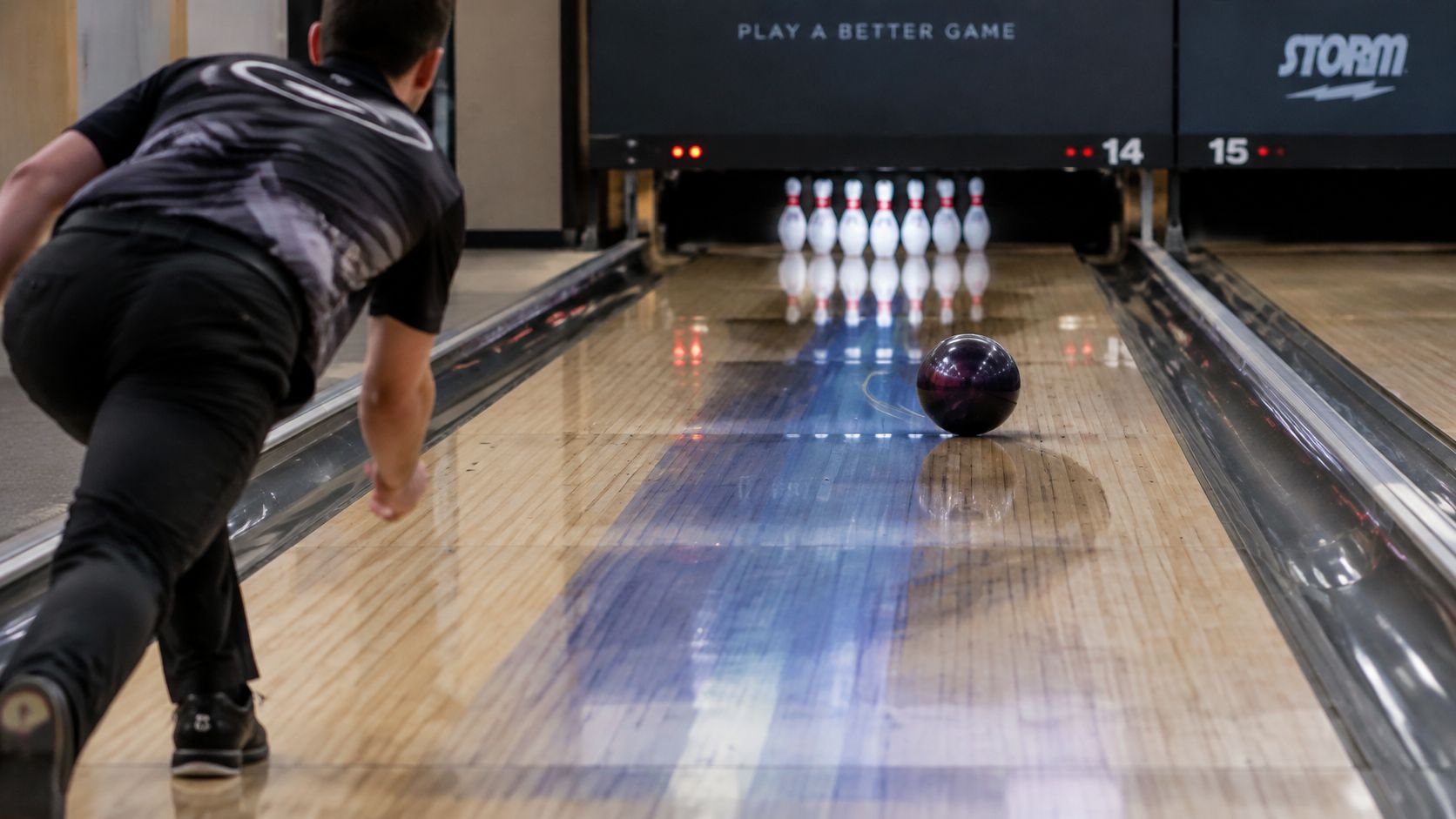
As your ball travels, it moves through a skid phase, where oil limits friction, and then begins to change direction as it encounters more grip. The area where it starts that turn is often called the breakpoint. The stretch where the ball finds enough friction to change direction is its friction zone. Together, those lane features shape the ball's reaction, the motion you observe on the way to the pocket.
That's why two lanes can look alike but produce different results with the same ball. The oil may be laid out differently, the lane surface may interact with the ball differently, or earlier shots may have changed the oil. Your eyes see a lane; your ball reads its friction map.
Coach's cue: Don't decide what the lane is doing from its appearance alone. Watch where the ball begins to turn, how sharply it changes direction, and whether it reaches the pocket with the shape you intended.
Reading that motion turns equipment choice and targeting into practical decisions. Instead of reaching for a ball because someone called the lane “oily,” you can ask a more useful question: where is the ball finding friction, and what is changing its path?
Measuring Pattern Length and Oil Volume
Pattern length and total oil volume give bowlers a starting point for understanding how a lane may play. A USBC coaching guide classifies short patterns as 36 feet or less, medium patterns as 37 to 41 feet, and long patterns as 42 feet or longer. The guide also categorizes oil volume as low when it's under 20 milliliters, medium at 21 to 26 milliliters, and high at 26 milliliters or more (USBC coaching guide to pattern length and volume).
| Measure | Category | Range as stated |
|---|---|---|
| Pattern length | Short | 36 feet or less |
| Pattern length | Medium | 37 to 41 feet |
| Pattern length | Long | 42 feet or longer |
| Total oil volume | Low | Under 20 milliliters |
| Total oil volume | Medium | 21 to 26 milliliters |
| Total oil volume | High | 26 milliliters or more |
Length helps you estimate where the ball may meet friction. A shorter pattern generally leaves more dry backend exposed, which can make the ball respond more sharply once it exits the oil. On a longer pattern, the usable breakpoint is pushed farther downlane, and the ball often has less room to recover if it drifts too far outside. These are tendencies, not guarantees: the pattern's oil distribution and the lane's condition also matter.
Volume offers a different clue. It affects how the lane changes as balls travel over it and remove or shift oil. A pattern with the same length can behave differently when the total volume or its distribution changes, so a length label alone can't predict your ball's motion.
For practice or competition, record the pattern's length, total volume, and lane surface condition when you can. Those details give you a more useful record than merely writing "dry," "medium," or "oily" in your notes.
Major Oil Pattern Types and What They Demand
Pattern names are useful shorthand, but they don't tell you exactly how to play. House patterns tend to offer a more forgiving path toward the pocket, while sport patterns typically ask for more precise targeting. PBA-style patterns are associated with a demanding competitive environment, but the label alone still doesn't tell you where your ball will find friction or how the lane will transition.
The length categories add another layer. Short patterns tend to bring friction into play earlier, so a bowler who sends the ball too far outside may see it turn sharply and miss high. Medium patterns can offer a more balanced combination of skid and hook. Long patterns keep the ball in oil farther downlane, so a bowler who drifts outside may find that the ball doesn't recover as expected.
A flat pattern spreads oil more evenly across the lane, leaving less obvious built-in help for a shot that misses its target. It can reward a repeatable line and punish a loose one. The type matters, but the bowler's reaction tells you what to do: watch where the ball leaves its skid, how much it changes direction, and whether it reaches the pocket with a controlled shape.
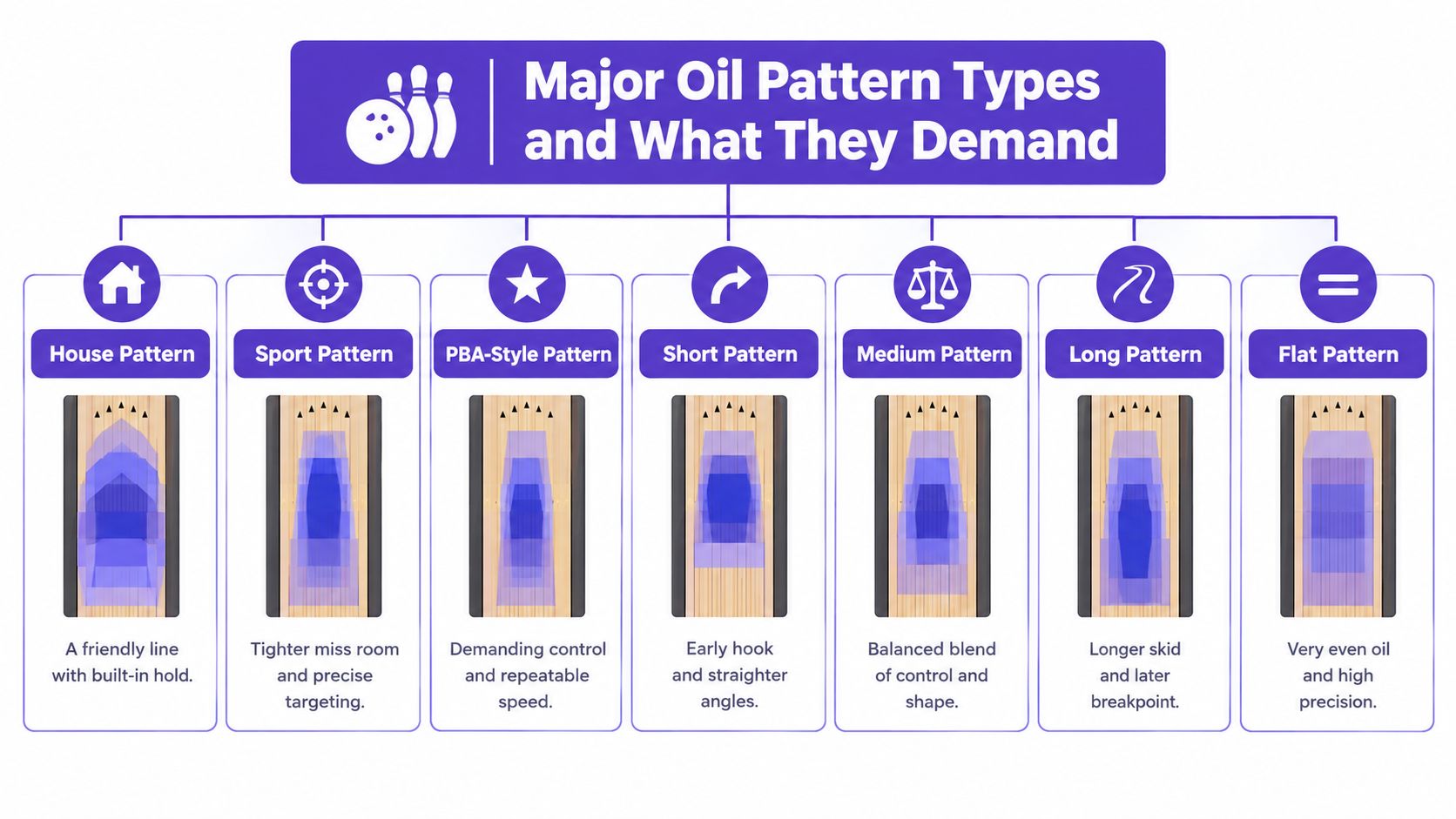
| Pattern type | Typical lane demand | Observable sign |
|---|---|---|
| House pattern | Use the built-in hold and recovery without assuming every miss will return | An outside miss may still recover toward the pocket |
| Sport pattern | Keep the target and release repeatable | Small misses can produce noticeably different results |
| PBA-style pattern | Manage speed, angle, and pocket entry with control | A powerful hook may not help if it misses its intended line |
| Short pattern | Control the early response and avoid over-hooking | The ball turns sooner than it does on a longer pattern |
| Medium pattern | Match the ball's shape to the available friction | The ball has room to skid and then change direction |
| Long pattern | Preserve a path to the pocket as the breakpoint moves downlane | An outside miss may skid too long to recover |
| Flat pattern | Repeat the shot and read small changes carefully | A miss may not receive much help from the oil distribution |
A bowler who over-hooks on a short pattern might try a straighter line and watch whether the ball stops jumping high. On a long pattern, a bowler whose ball skids past the expected breakpoint can test a line that keeps it closer to the usable friction, then judge the result at the pins.
Use the low-RG bowling ball guide as one equipment reference, but don't select a ball from a pattern name alone. The same category can call for different choices depending on the lane and the reaction you can observe.
The video below offers another visual way to think about lane play and ball motion.
Diagnosing Reaction When Numbers Do Not Match
A printed pattern can tell you its length and volume, but those figures don't fully explain why your ball starts hooking sooner, skids longer, or loses its shape as you keep bowling. USBC research shows that transition depends on the interaction among oil absorption rate, surface roughness, lane surface, oil, and cleaning conditions, not oil volume alone (USBC research on lane transition and ball interaction).
Start by separating three possible causes of a changing reaction:
- Oil carrydown: Oil has moved farther downlane, so the ball may skid longer before it finds enough friction to turn.
- Oil depletion: Traffic has removed oil from part of the lane, so the ball may encounter friction earlier and change direction sooner.
- Ball-cover contamination: Oil or dirt on the coverstock may affect how the ball responds, even if the lane itself hasn't changed in the way you expected.
Those causes can look similar from the pins. A ball that skids longer might reflect carrydown, a dirty cover, or another interaction with the lane. Don't label it from one shot.
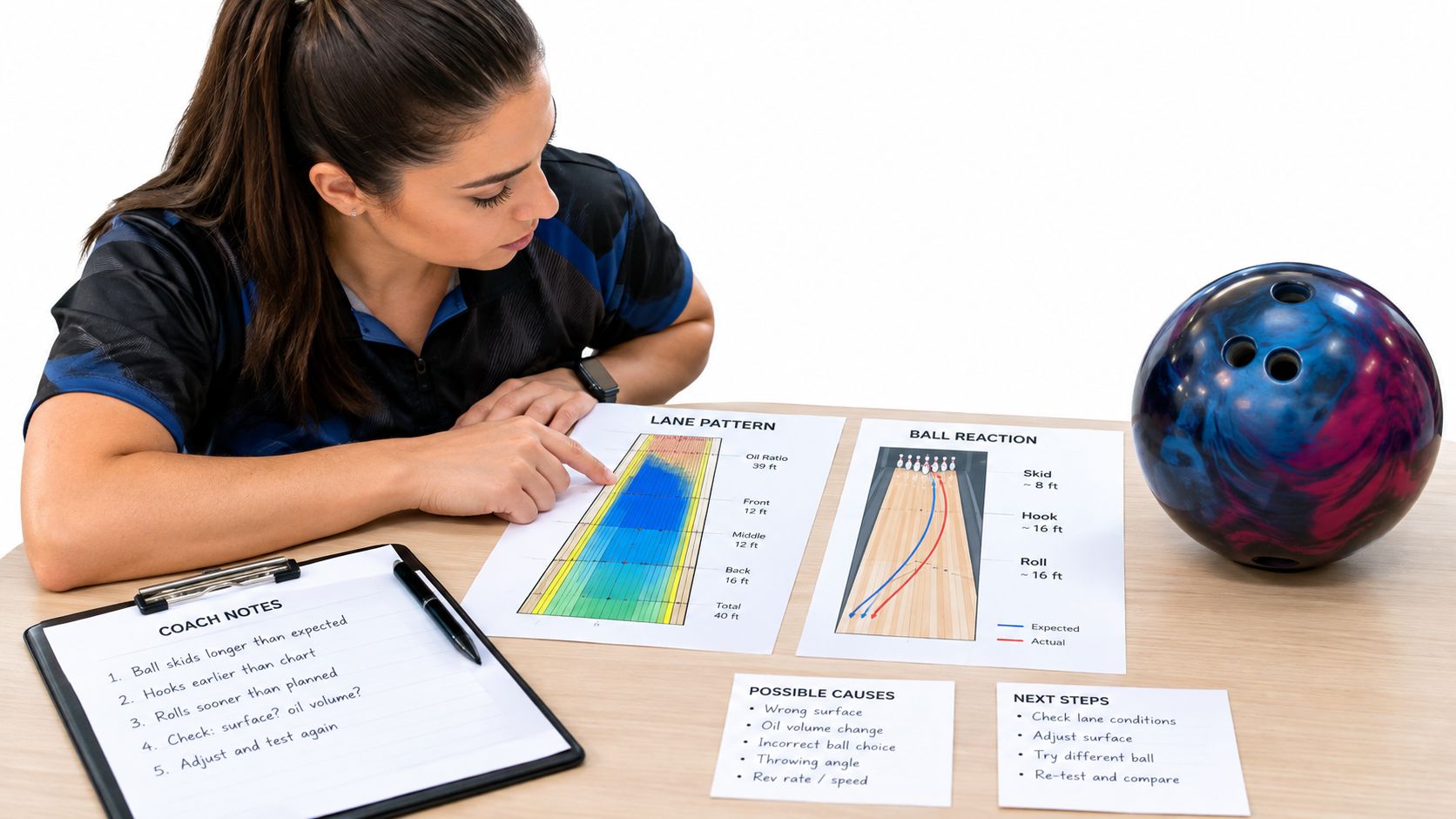
Build a useful lane log
Record the ball, surface condition, target, breakpoint shape, skid distance, entry angle, and ball speed. After each game, note any moves you made and whether the ball started to hook earlier or later. Keep the notes observable: “turns before the breakpoint I marked” is more useful than “lane feels weird.”
If the ball's response changes, clean it and compare its motion with your earlier notes. That test won't prove the lane is unchanged, but it helps you check whether the ball cover was contributing to the difference. You can also learn more about bowling-ball sanding and surface preparation before changing a ball's surface, so you can distinguish a planned adjustment from an untracked one.
A stronger oil-absorbing ball isn't automatically the fix when a shot fails to hook enough. Faster absorption can deplete oil more quickly and contribute to a pattern changing during play. Compare the same ball before and after cleaning, keep its surface consistent during your test, and look for repeatable changes across games rather than reacting to a single shot.
Choosing Ball and Coverstock for Each Pattern
Choose a ball to solve the motion problem you can see, not to match a pattern label. A ball that reads too early on a short, dry-looking lane may need a cleaner response or a different line. If a ball skids too long on a heavily oiled pattern, you can test a surface adjustment or a different coverstock, then check whether it begins to read the lane where you need it to.
Follow the reaction, then choose
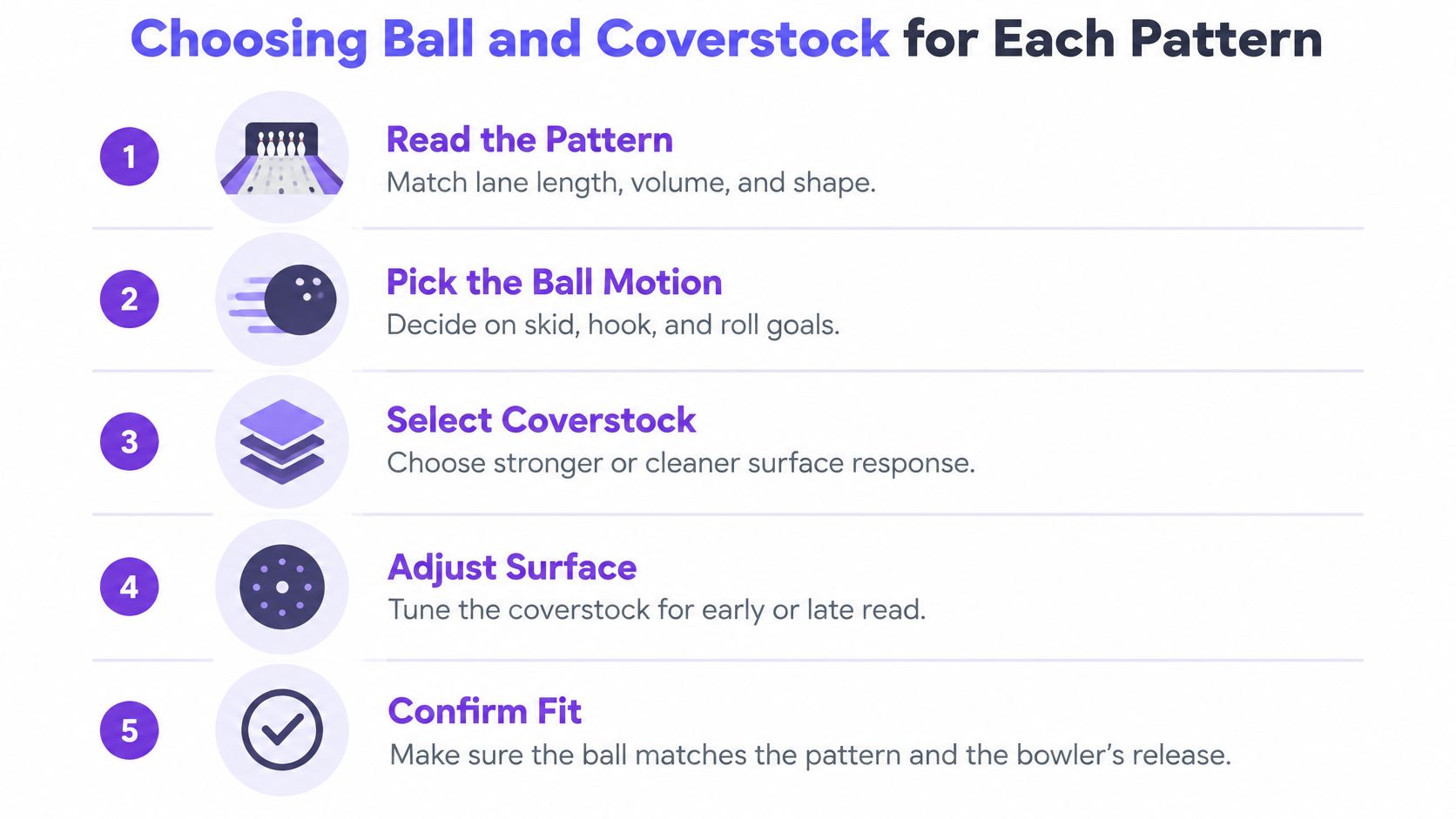
Read the pattern. Note its length, volume, shape, and lane surface when that information is available. The graph is a starting point, not a promise about ball motion.
Pick the motion goal. Decide whether you need the ball to skid longer, start hooking earlier, or produce a smoother transition. State the goal in terms you can verify by watching the breakpoint and pocket entry.
Select the coverstock. Compare how different coverstocks respond to the oil you're seeing. A stronger response may help a ball read earlier, but it can be counterproductive if the ball already changes direction too soon.
Adjust surface carefully. Surface preparation can change when and how the ball reads friction. Make a deliberate change, record it, and compare the result instead of making multiple adjustments at once.
Confirm the fit. The ball's core design, coverstock, surface, and motion must suit your release and speed. A ball that works for another bowler may not give you the same shape.
When comparing options, judge more than hook. Look for control through the lane, a repeatable shape, and pocket entry that gives you a reasonable chance to carry. A dramatic backend move can look impressive but still leave you with a poor angle or inconsistent results.
Bowling Gear Reviews tests bowling equipment on real lanes with repeatable drills and logs control, carry, and consistency, emphasizing observed results over manufacturer claims. Its bowling ball comparisons can help you weigh equipment options, but your own lane notes should guide the final choice.
Event Rules and Equipment Restrictions
A pattern's difficulty doesn't travel intact from one center to another. The same graph can play differently as lane surfaces, oil, traffic, and equipment interact. Before you judge a pattern or buy a ball for an event, separate what the graph prescribes, what the event allows, and what the lane does once bowlers start playing.
Equipment rules are part of that read. USBC materials state that slow oil-absorbing, high-performance balls with absorption times over 90 minutes face a new 78D hardness requirement for approval for sale in the United States after December 31, 2025. Certain national competitions restrict or prohibit these balls from January 1, 2026; the stated concern is that they can break down patterns in ways that undermine the designer's intent (USBC tournament rule changes for slow oil-absorbing high-performance balls).
Those restrictions don't mean every event applies the same rule to every ball. Check the current regulations for your competition, especially if you plan to use urethane or another slow-absorbing ball. Don't assume that approval for sale automatically means a ball is permitted in a specific event.
Check before you pack
- Event rules: Confirm which equipment restrictions apply to the competition you're entering.
- Ball approval: Verify the ball's approval status for the event and the relevant governing body.
- Hardness requirements: Check whether a hardness rule applies to the ball you plan to use.
- Urethane and slow-absorbing equipment: Look for explicit restrictions or prohibitions before league or tournament play.
A pattern graph describes the intended oil layout, but it doesn't tell you how equipment and traffic will shape the lane across the field. Treat legality as its own question, separate from whether a ball's motion suits the pattern. That prevents a promising equipment choice from becoming a rules problem.
Putting Your Pattern Knowledge into a Routine
A useful lane routine turns pattern information into notes you can act on. Start by recording the pattern's length, total volume, and surface condition if you know them. Add the ball and its surface preparation, then mark where you expect the breakpoint to be. You're making a prediction that you can compare with the shot, not trying to guess the perfect line before you bowl.
After your first shots, log the breakpoint shape, skid distance, entry angle, and ball speed. If you move, write down what changed and how the ball responded. When the reaction shifts, check whether the evidence points to carrydown, oil depletion, or cover contamination before changing equipment.
Make one adjustment at a time. If the ball begins hooking earlier, change your line or equipment only after you've checked that the ball is clean and compared the new motion with your notes. If it skids too long, test a change that may help it read friction sooner, then see whether the breakpoint and pocket entry improve. Keep the result, not the expectation, as your guide.
Before an event, add a rules check to that routine. The pattern's printed length and volume help you prepare; lane observation tells you how it's playing; event regulations determine which equipment you can use. Together, those checks make a better equipment decision than a dry, medium, or oily label can.
The next time you bowl, bring a small notebook or use a notes app to record your first reaction and each move. When you're ready to compare balls for the lane conditions you face, visit the reviews and buying guides at Bowling Gear Reviews.
Bowling Gear Reviews offers hands-on equipment reviews, comparisons, and practical buying guides that consider coverstock, core design, surface preparation, and lane-condition suitability. Use your lane notes to narrow the options, then visit Bowling Gear Reviews to compare equipment and find a choice that fits your pattern and your release.

4 Comments
Pingback: Best Bowling Ball for Curving: Picks by Lane and Speed
Pingback: Best Bowling Ball for Straight Bowler: Picks by Budget
Pingback: Best Bowling Balls on the Market in 2026
Pingback: Bowling Ball Hooking Too Much: How to Diagnose and Fix It