

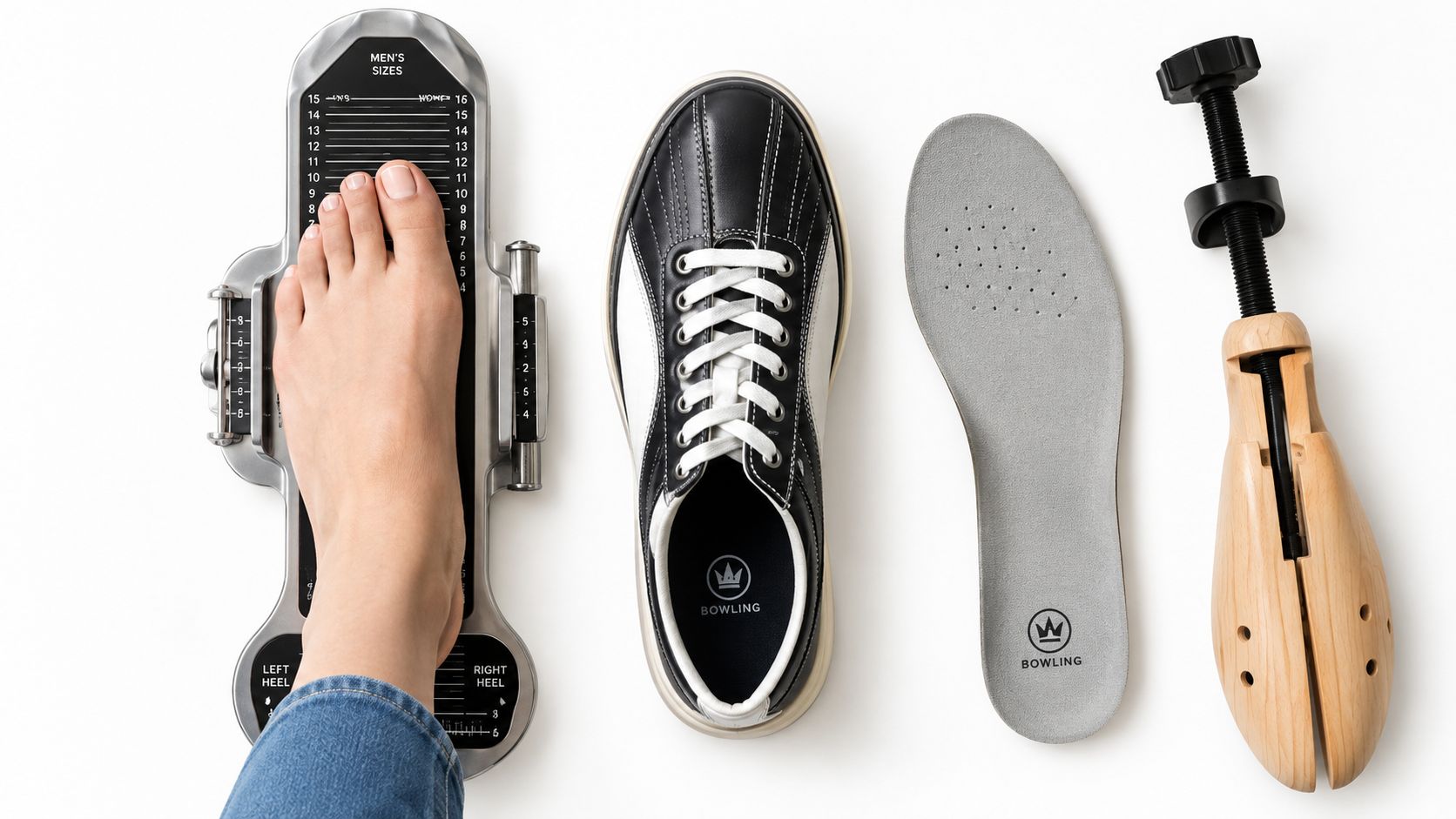
Wide feet cannot be permanently narrowed without surgery, and footwear cannot safely reduce bone structure. The practical target is better fit and proportion through measurement-driven sizing, suitable last selection, and controlled foot volume, not squeezing the forefoot.
The most popular advice on how to narrow wide feet usually starts in the wrong place. People suggest buying a smaller size, tightening the laces, adding a thick insole, or waiting for a stiff bowling shoe to “break in.” Those methods can make a shoe look tighter, but they don't make the foot narrower. They usually move pressure onto the toes, bunion area, fifth metatarsal, or nails.
I've watched league bowlers walk out of a pro shop convinced that a standard-width shoe would eventually mold around them. In practice, the opposite often happens. The upper creases against the wrong part of the foot, the heel shifts, and the bowler spends the session adjusting their slide instead of repeating a reliable approach.
Table of Contents
- Why Wide Feet Cannot Really Be Shrunken
- Measuring Both Feet the Right Way
- Choosing Last Shape and Toe-Box Depth Over Size Label
- Insoles and Lacing Tricks That Change Perceived Width
- Testing Bowling Shoe Fit on the Lane
- Reversible vs Structural Causes of Wide Feet
- Shoe Stretching and Modification Without the Foot Hype
Why Wide Feet Cannot Really Be Shrunken
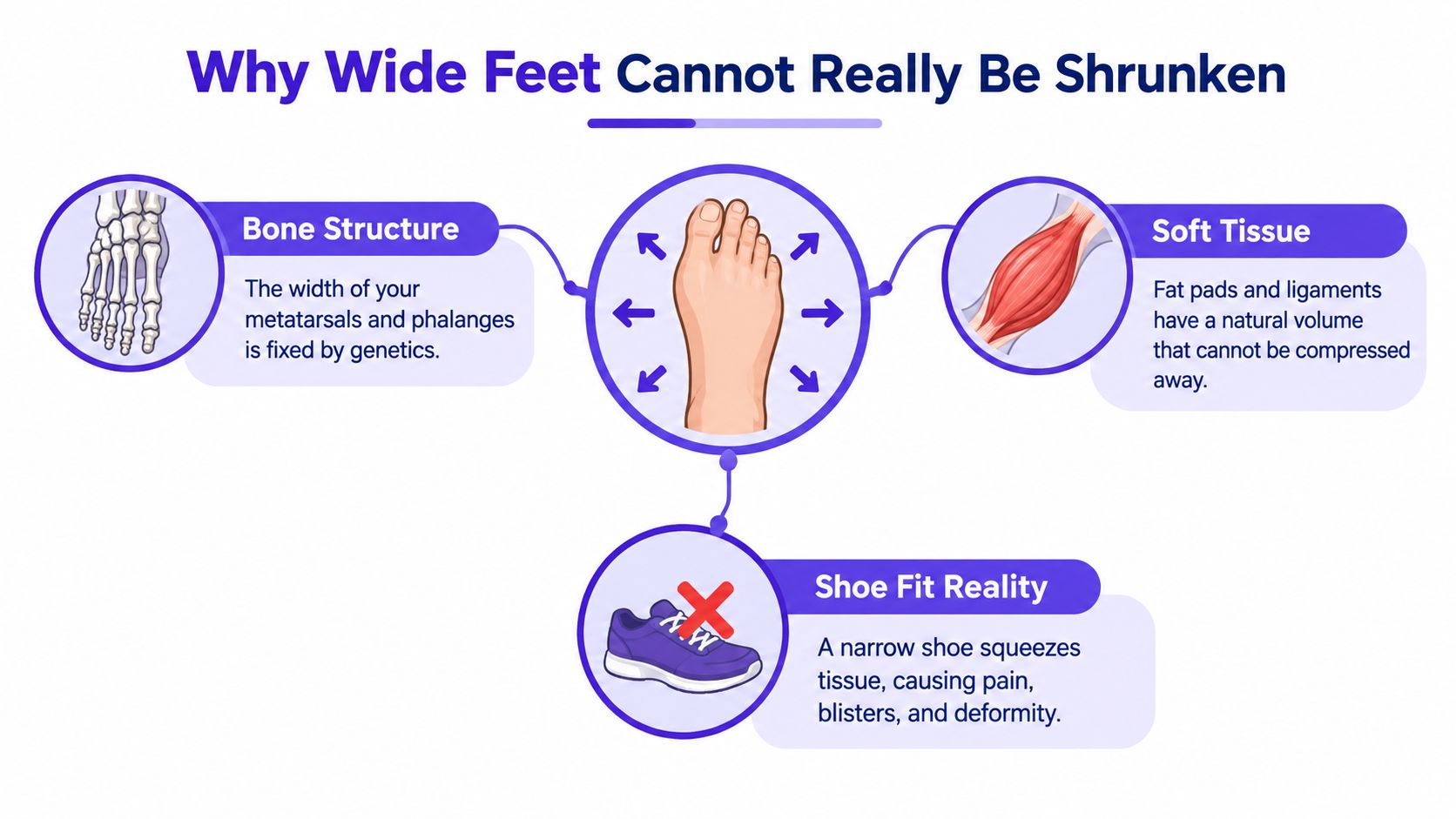
A wide forefoot is built from bone shape, joint alignment, ligaments, muscle, fat pads, and soft tissue. Shoes can manage how that structure sits and feels. They cannot safely make the foot itself narrower. If someone promises that insoles, tighter lacing, exercises, or a smaller bowling shoe will shrink foot width for good, they are selling a fantasy.
“Narrowing” also gets used for several different fit problems. Some feet spread more under load, some look broader after a long day, and some change shape because of swelling, inflammation, thick socks, bunions, or toe drift. Each of those changes what the shoe has to handle. They do not all call for the same correction.
The wrong width is often the problem
The bigger pattern is poor shoe matching. A systematic review of footwear fit and foot health found that 63% to 72% of people wore shoes that failed to accommodate their measured foot length or width. Across the studies, 30% to 88% wore footwear that was too narrow, with a median of 58%, while only about 1% wore shoes that were too wide.
That lines up with what happens in a pro shop. Bowlers see a forefoot spilling over the edge, assume the foot needs to be “trained” smaller, then buy down or cinch harder. The shoe may look tidier for a minute, but the pressure has to go somewhere. Usually it lands on the toes, the bunion side, the fifth metatarsal, or the nails.
The same review also described a study of 356 American women averaging 42 years old, where 88% wore footwear narrower than their feet, with an average width discrepancy of 1.2 cm. That is why I do not treat apparent width as a squeezing problem first. I treat it as a measurement and last-shape problem first.
Practical rule: If a shoe makes the foot look narrower by compressing it, the fit is still wrong.
Define success correctly
Useful “narrowing” means reduced apparent spread with symptom-free containment. The foot should sit in a shoe whose widest point lines up with the foot's widest point. The toes need room to move. The heel needs to stay controlled. The forefoot should stay on the platform instead of bulging over the sole.
That is a fit-engineering result, not an anatomy change. In bowling shoes, it matters more than people think. A slide shoe that pinches the forefoot can change how a player finishes and releases. A shoe with the wrong shape can also let the heel or midfoot drift, which is a fast way to lose repeatability on the approach.
Measuring Both Feet the Right Way
Don't start with a size label. Start with the foot under the conditions in which you'll use the shoe.
Measure both feet while standing, preferably late in the day when weight-bearing and normal swelling reveal the greatest practical demands. A seated measurement can make the forefoot look deceptively narrow because it doesn't capture how the metatarsals and soft tissue spread under load.
A reliable home protocol
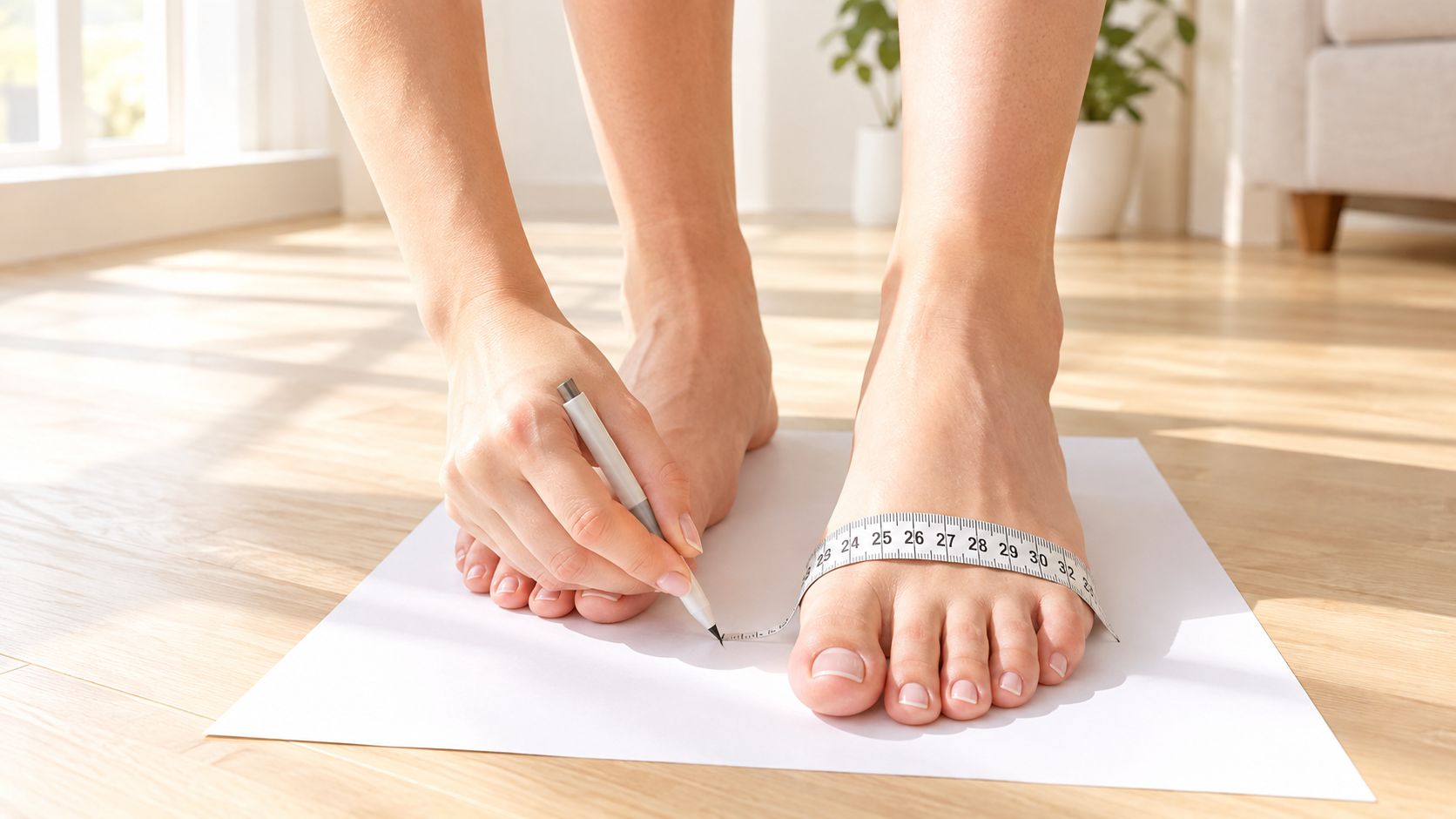
Place a sheet of paper on a hard floor and stand on it with your normal weight distributed across both feet. Keep the ankle relaxed rather than pulling the toes inward. Mark the longest toe and the back of the heel, then measure the forefoot at the metatarsal heads, where the foot is widest.
Record three things for each foot:
- Length: Measure from the heel to the longest toe.
- Forefoot width: Measure across the broadest part of the ball of the foot.
- Toe-box depth requirement: Note whether the toes need extra vertical room because of clawing, a high instep, bunion prominence, or nail pressure.
Use the larger foot to set the shoe's requirements. The smaller foot can be secured with lacing or a modest volume adjustment, but the larger foot shouldn't be forced into the smaller foot's dimensions.
Use clearance as a fit requirement
Aim for approximately 8 to 12 mm of clearance beyond the longest toe, based on the footwear guidance in this NHS footwear advice document. For width, functional allowance is approximately 1 to 3 mm, also from that guidance. That means room for movement, not a gap that lets the forefoot slide and not compression that reshapes it during play.
A Brannock-style device can help, but treat its reading as a starting point rather than a verdict. Width standards vary among manufacturers, and a printed D, EE, or EEE designation doesn't guarantee the same internal shape from one model to another. Compare the measurement with the actual shoe's sole, upper, and toe-box contour. For additional guidance on interpreting bowling footwear sizing, use this bowling shoe sizing guide.
Choosing Last Shape and Toe-Box Depth Over Size Label
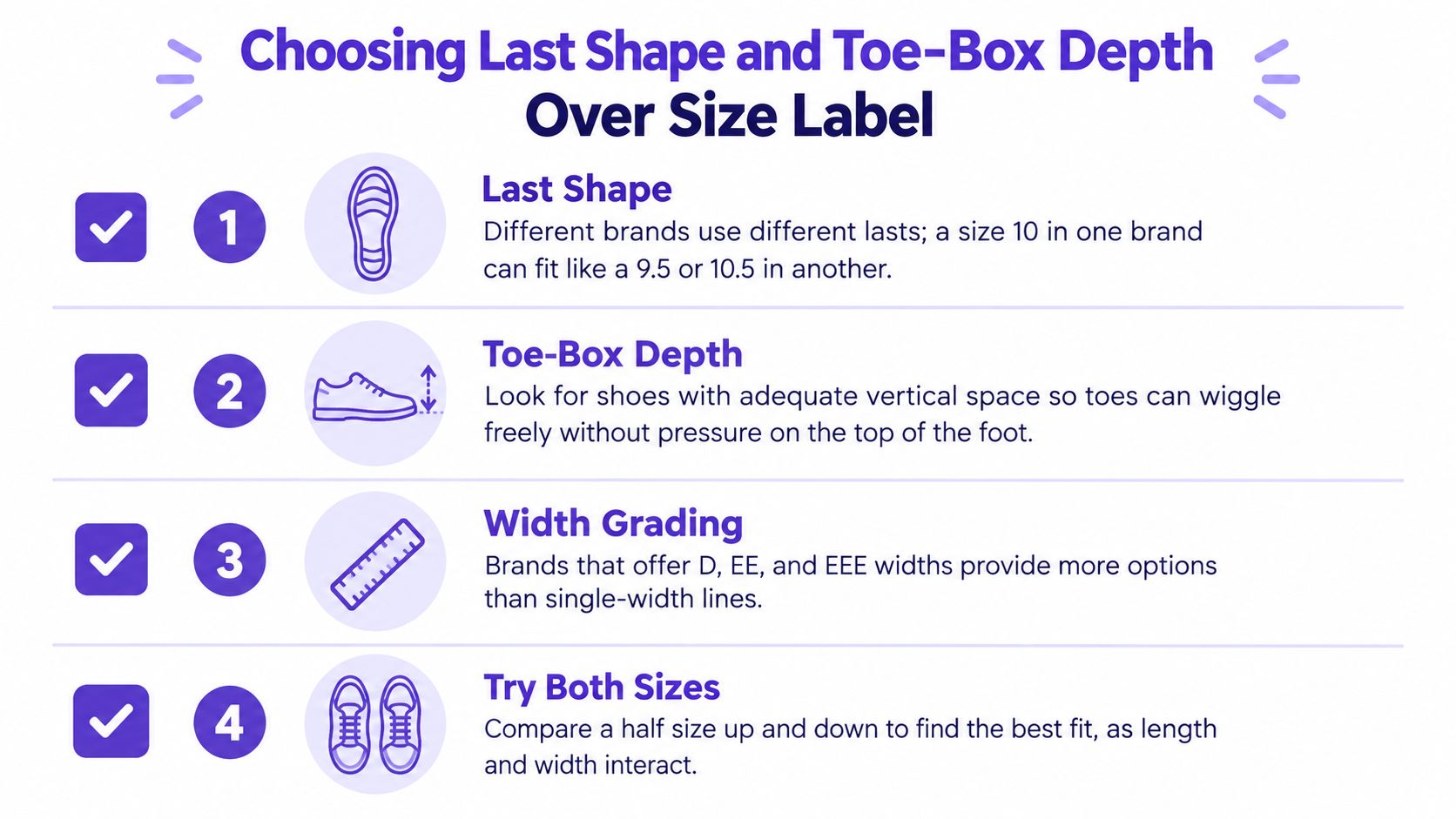
A size label describes length and sometimes width. It doesn't tell you where the shoe is broadest, how quickly the toe box tapers, or how much vertical room sits above the toes. Those details come from the last, the foot-shaped form around which the shoe is built.
Two shoes carrying the same size can feel completely different. One may have a rounded forefoot and a stable heel, while another narrows sharply toward the toes and rises too little over the nail. If your foot is wide at the metatarsals, the first shoe may feel smaller in length but better in every practical sense.
Match the shoe to the foot's outline
The widest point of the shoe should sit beneath the widest point of your foot. A pointed front, narrow last, or low toe box asks the foot to conform to the shoe. That's the direction you don't want.
Look for a rounded or square, foot-shaped toe box. The toes should be able to spread and wiggle without the upper pressing down. Vertical depth matters as much as horizontal width, particularly if the problem is a bunion, prominent joint, thick nail, or high instep.
Run the acceptance test
Stand fully weight-bearing in both shoes. Wiggle every toe, inspect whether the forefoot bulges beyond the sole, and walk for several minutes. Reject the shoe if pressure develops around the fifth metatarsal, bunion area, toe joints, or nails.
Don't accept “it'll break in” as a fitting method. Materials may soften, but the foot still meets the same internal boundary. A shoe that hurts during a short trial is giving you useful information, not asking for patience.
Bowling footwear adds another demand. The heel counter should hold the rear of the foot, the midfoot should stay secure without hard pressure, and the slide foot should have lateral freedom through the metatarsals. A stable heel and controlled midfoot matter more than a visually narrow upper. Compare models using the fit criteria in this men's bowling shoe guide, but verify every model on your own feet.
Insoles and Lacing Tricks That Change Perceived Width
Once the shoe has the right forefoot shape, fit-control tools can remove excess volume elsewhere. That's a different job from narrowing the foot. A heel-lock pattern can stop rearward movement, a tongue pad can fill space over the instep, and a low-profile insole can help the heel sit deeper in its pocket.
The mistake is using those tools to compensate for a shoe that's fundamentally too narrow. Lacing the forefoot harder may make the upper look tidier, but it can squeeze the metatarsals and create the same pain the shoe was supposed to prevent.
Match the tool to the problem
| Tool | Best for | Caveat |
|---|---|---|
| Heel-lock lacing | Heel lift and forward sliding | It won't create more forefoot width |
| Runner's loop | Securing the rear of the shoe during an approach | Excess tension can irritate the ankle |
| Tongue pad | Filling a midfoot or instep gap | It should not press on a high instep |
| Low-profile insole | Raising the foot into the heel pocket and controlling volume | A thick insole can reduce toe-box depth |
| Width-specific shoe | A forefoot that is actually too broad for the current model | It requires finding the correct last, not just a larger size |
Use lacing behind the widest point
Start with comfortable tension across the forefoot. The laces should hold the shoe around the midfoot without pulling the eyelets together aggressively. If the heel lifts, use a runner's loop or a heel-lock pattern at the top eyelets while leaving the forefoot less restricted.
For bowlers, this distinction is important. The slide foot needs to move smoothly without the shoe grabbing the forefoot, while the push-off foot needs enough rearfoot security to transfer force consistently. A lacing pattern that works for one foot may feel wrong on the other.
A tongue pad can take up a small amount of volume above the instep, but it isn't a substitute for correct width. Likewise, an insole can improve heel seating, yet it can't safely reduce the structural width of the forefoot. If the sides bulge over the outsole, change the shoe rather than adding more layers inside it.
Testing Bowling Shoe Fit on the Lane
A store fitting tells you how the shoe behaves while standing and walking. Bowling adds sliding, braking, lateral loading, and repeated approaches, so the lane is the final test.
Put on the socks you bowl in. Stand in your normal stance, then take several four-step approaches at controlled speed. Pay attention to the slide foot first. It should remain contained without the toes being trapped, and the forefoot shouldn't spill over the sole when your weight moves forward.
Watch each foot for a different failure
The slide foot needs room for the metatarsals to move laterally while the upper keeps the shoe aligned. If the toe box is shallow, the toes may catch or curl during the slide. If the forefoot is squeezed, the shoe can feel resistant even when the sole itself is functioning correctly.
The push-off foot has a different job. Look for heel lift, midfoot movement, or a platform that rolls under pressure. A secure heel counter should keep the rearfoot in place without requiring extreme lace tension.
Lane test: Take several normal approaches, not just a few steps around the shop. Pressure that appears only during the slide is still a fit failure.
Longer sessions reveal problems that a brief fitting can miss. Heat, activity, and swelling can increase the space the foot needs. Recheck the fifth metatarsal, bunion area, toe tops, and nails after practice. If a shoe starts comfortably but develops a hot spot as the session continues, don't treat that as a normal break-in stage.
The practical checklist is simple:
- Heel: It stays locked during the push-off and finish.
- Forefoot: It remains inside the sole outline without bulging.
- Toes: They can move during the approach and slide.
- Midfoot: It feels secure without lace pressure or numbness.
- Surface response: The shoe slides and brakes predictably on the approach.
Reversible vs Structural Causes of Wide Feet
Not every wide-looking foot needs a new shoe. Sometimes the foot has changed temporarily. Fluid retention after long periods of standing, inflammation after an injury, socks that bunch under the toes, or general swelling can increase apparent width. Those issues may improve when the cause settles, but a shoe still needs to fit the foot as it exists during bowling.
Body-weight changes can also alter how the foot loads the ground, particularly if the arch flattens and the forefoot splays. That doesn't mean weight loss should be presented as a guaranteed method for permanently narrowing the foot. It means loading conditions affect measurement and footwear demands.
Structural width needs structural honesty
Genetics, metatarsal shape, toe alignment, bunions, and age-related changes can define the foot's underlying outline. The forefoot can widen under load as the metatarsal joints move, and age-related changes can increase width and ball-of-foot circumference. A foot measured while sitting may therefore look narrower than the same foot during a standing bowling approach.
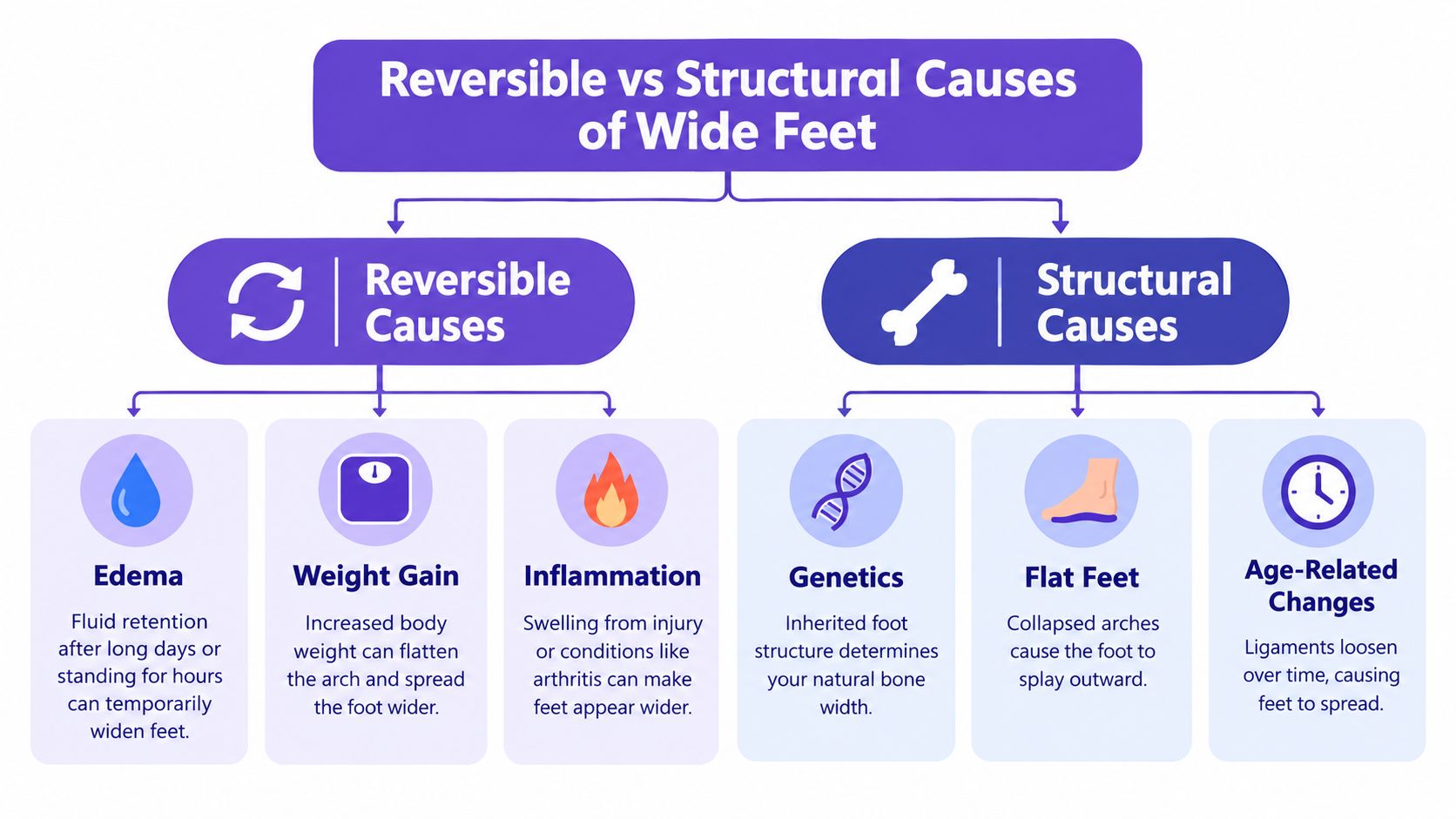
The distinction matters because fit work can control volume and pressure, but it can't change a naturally broad metatarsal structure. Products marketed as a permanent narrowing solution should be treated cautiously when they rely on compression, forced arch changes, or painful reshaping.
A medical assessment is appropriate if one foot changes suddenly, the difference between feet keeps increasing, or width comes with pain, redness, numbness, or visible deformity. A podiatrist can assess whether a bunion, joint problem, inflammation, or another condition is changing the foot. That visit isn't an admission that footwear failed. It prevents a changing medical problem from being disguised as a sizing issue.
Shoe Stretching and Modification Without the Foot Hype
Shoe stretching can create room in a specific place, but it can't turn a wrong last into a suitable one. If a bowling shoe has a mildly tight spot across the upper or near a non-progressive bunion, a targeted adjustment may help. If the entire forefoot is too narrow, stretching one section only relocates the pressure.
A ball-and-ring stretcher can target a small area around the bunion or fifth metatarsal. A professional shoe technician can make a more controlled modification and assess whether the material and construction will tolerate it. Those options are more rational than pulling the shoe apart indiscriminately.
Know what modification can and cannot do
Stretching may help with:
- A localized pressure point over the upper.
- Mild material tightness where the shoe already has a suitable general shape.
- A small amount of extra room around a prominent joint.
Stretching won't reliably fix:
- A pointed toe box.
- A last that is narrow from heel to forefoot.
- A shoe with inadequate vertical depth.
- A model whose heel, midfoot, and forefoot proportions don't match your foot.
Home heat methods deserve particular caution. Excessive heat can warp adhesives, distort the heel counter, soften structured components, or leave the upper uneven. Tight lacing is not stretching, and painful break-in is not evidence that the shoe will become safe.
If the shoe has the right last and only one area needs relief, modification may be sensible. If the shoe needs broad alteration, start again with the correct width. For bowlers replacing worn slide components, this guide to replacing soles on shoes can help separate maintenance work from fit problems. A new sole won't correct a narrow toe box, and no modification should be used to force a painful shoe into service.
Bowling Gear Reviews publishes bowling shoe sizing guidance, model comparisons, and practical equipment reviews focused on fit, slide systems, traction, and lane performance. Visit Bowling Gear Reviews to compare bowling footwear with your measured width and approach needs before you buy.
