

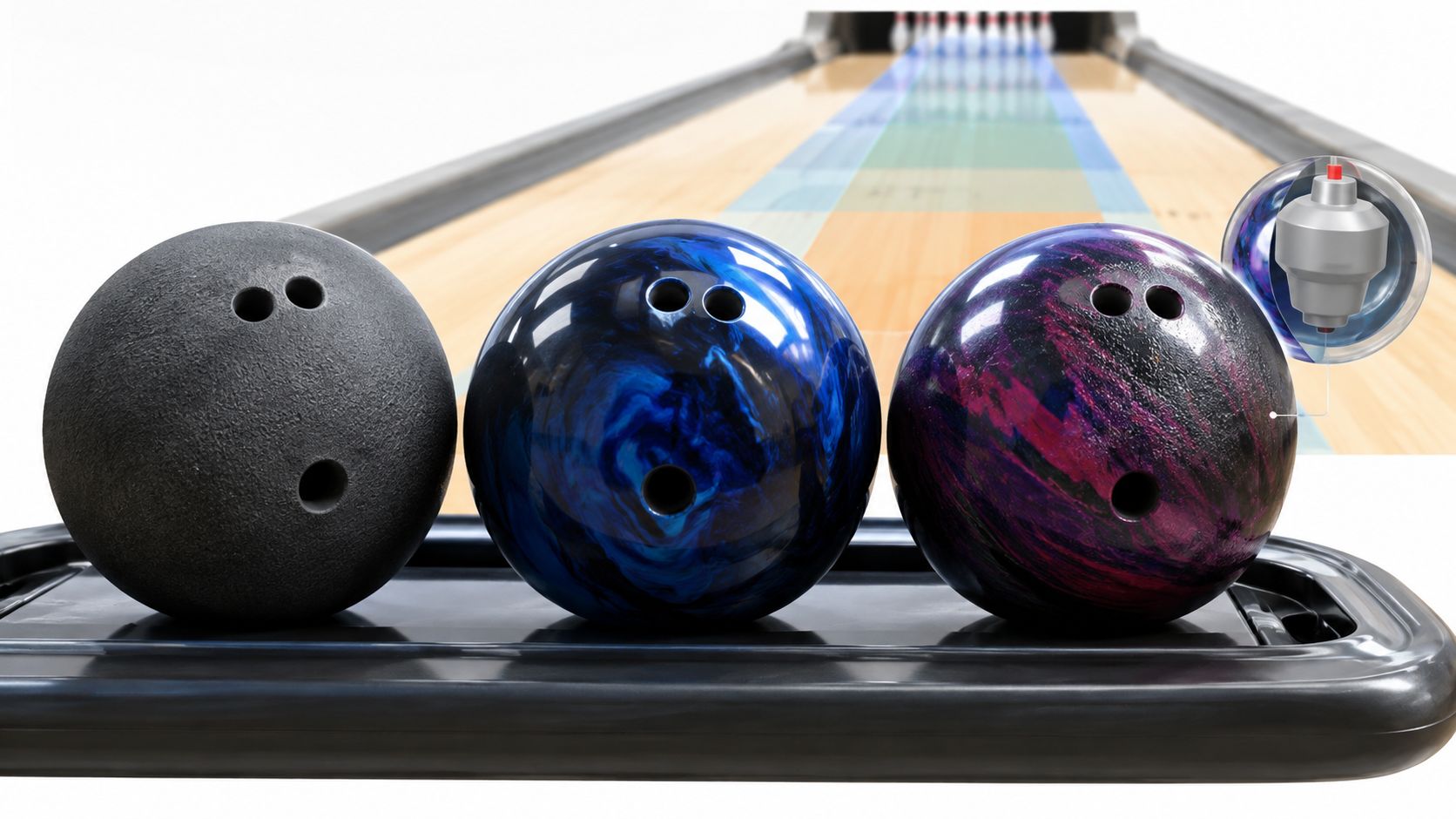
You've just finished the first game of league night. The strongest ball in your bag looked perfect on the fresh, then jumped off the spot, burned through the front, and left you guessing by the third frame. The problem may not be that the ball lacks hook. It may be that it creates too much friction too soon and stops being useful as the lane changes.
A reliable bowling ball comparison has to answer more than “Which ball hooks more?” It should show how coverstock, core, surface, drilling, oil absorption, and lane transition work together from the opening shot through the end of the session. The best choice is often the ball that gives you a playable reaction for the longest time, not the one that produces the biggest move on fresh oil.
Table of Contents
- Understanding Bowling Ball Motion Variables
- Coverstock Types and Their Real-World Impact
- Core Design and RG-DI Explained
- Matching Balls to Oil Patterns and Lane Conditions
- Surface Preparation and Hook Shape Control
- Beyond Initial Hook and Oil Depletion
- Making the Right Choice for Your Skill Level
- Navigating USBC Tournament Rules and Eligibility
Understanding Bowling Ball Motion Variables
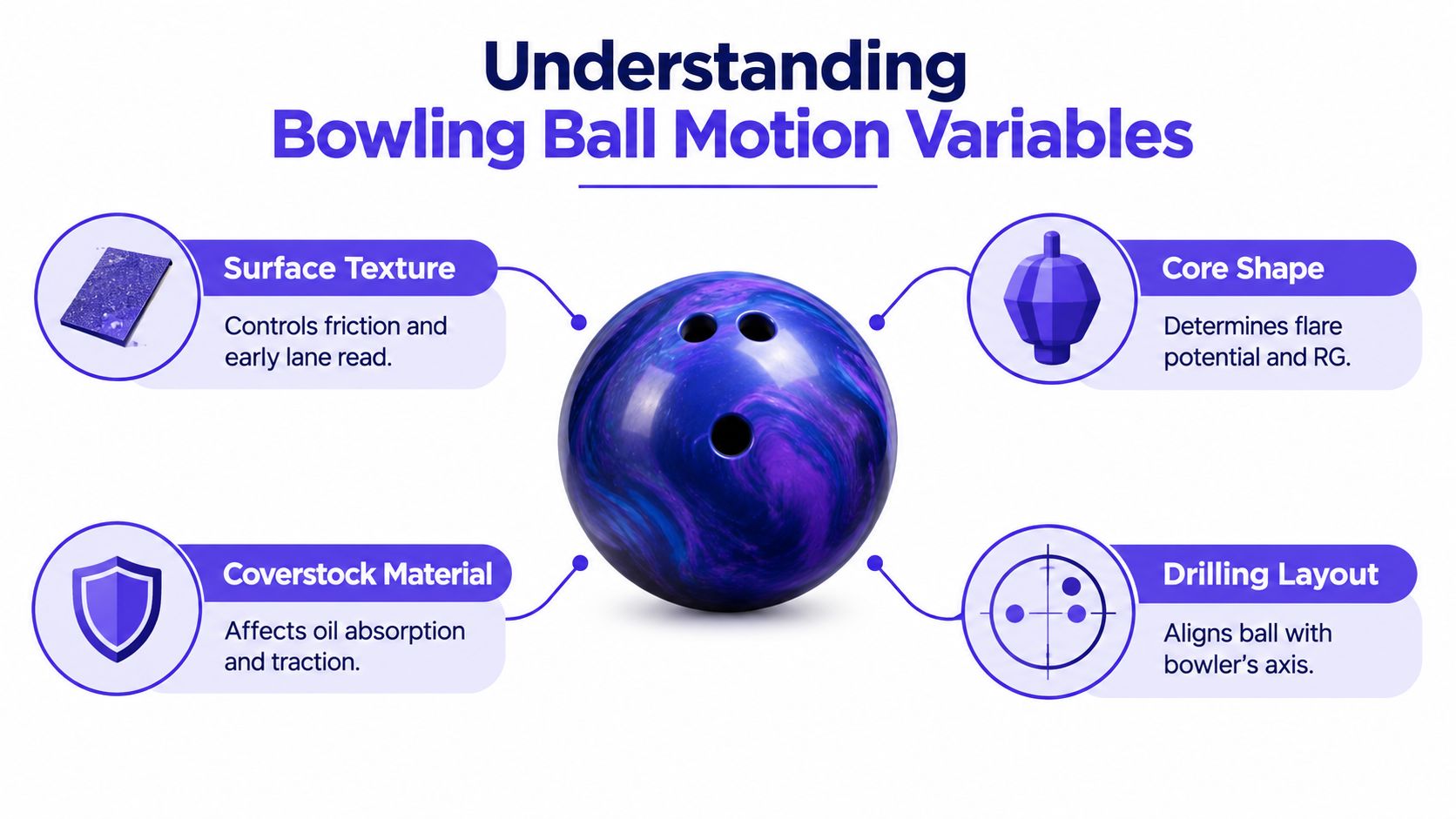
By the middle of league night, a ball that looked ideal on the fresh can read too early, burn through the front, and lose continuation. Comparing a higher advertised hook rating will not explain that change. Weight, diameter, surface, coverstock, core geometry, and drilling layout interact to shape breakpoint position, total hook, and usable energy as oil depletes.
The measurable starting point
The United States Bowling Congress equipment specifications limit a tenpin ball to a maximum weight of 16 pounds, or 7.3 kilograms, and a diameter between 8.500 and 8.595 inches, or 21.59 to 21.83 centimeters. The rules also address hardness, roughness, static balance, radius of gyration, drilling, and markings.
Those limits define the equipment, but they do not predict the complete reaction. Drilling changes how the core sits relative to the bowler's axis, while surface condition controls how soon the coverstock finds friction. The same nominal weight can therefore produce a different read, breakpoint shape, and energy profile after layout or surface changes.
Practical rule: Compare balls by motion phase, not by color, logo, or advertised weight.
What to log during a test
Record the ball's front-lane read, breakpoint location, total hook, continuation, and reaction after transition. Watch whether it clears the heads cleanly at the start, how it responds as oil moves downlane, and whether it still carries when you move your feet and target. Coverstock governs oil interaction, core design influences revving and flare characteristics, and layout helps position that reaction for the release.
Reactive-resin coverstocks emerged in the early 1990s by adding materials to urethane surfaces. Their microscopic oil-absorbing pores created a marked performance difference from plastic, polyester, and earlier urethane designs. During a league session, that traction can also accelerate transition as the ball repeatedly absorbs oil.
USBC competition rules banned balance or weight holes effective August 1, 2020, because drilling those holes could alter ball dynamics, as documented in the United States Bowling Congress equipment specifications. A useful bowling ball comparison therefore follows the ball from the fresh through oil depletion, not just its first-shot hook.
Coverstock Types and Their Real-World Impact
The coverstock is the ball's contact surface, so it usually has the clearest effect on when the ball begins to read the lane. USBC ball-motion research identifies surface roughness, on-lane coefficient of friction, dry-lane coefficient of friction, and oil-absorption rate among the strongest predictors of ball path. Core numbers matter, but they can't rescue a cover that mismatches the lane.
Reactive resin changed bowling ball comparison because its microscopic pores absorb oil and create more surface tack than traditional urethane. That combination can produce earlier traction in the oil, stronger midlane read, and more defined backend motion. It can also make the lane transition faster, especially when the ball absorbs oil repeatedly during a league session.
Reactive resin versus urethane
A strong reactive solid generally belongs on a lane where the bowler needs traction and doesn't want the ball to skid too far before reading. A pearl or polished reactive cover can save energy for the backend, but it may become difficult to control when the dry area grows. Urethane typically creates a smoother, earlier arc with less oil absorption, which can keep its reaction more stable when the bowler wants control rather than a sharp change of direction.
That doesn't make one coverstock universally better. A rough reactive ball can lose energy on medium or drier conditions, while a smoother urethane ball may fail to create enough recovery when the pattern demands more traction. The bowling ball coverstock guide offers a useful reference for separating cover categories before comparing specific models.
Why absorption changes the session
USBC research found that faster oil-absorbing balls hook more, deplete oil deeper inside the lane, and force bowlers to make more inside-line adjustments. That reaction can look impressive during the first game, but the same cover may become too early once the front lane dries.
Judge the cover by the shape it gives you after the first reaction changes. A ball that starts with moderate traction and continues through the pins may be more useful than a stronger ball that requires constant moves and loses energy before the pocket.
Core Design and RG-DI Explained
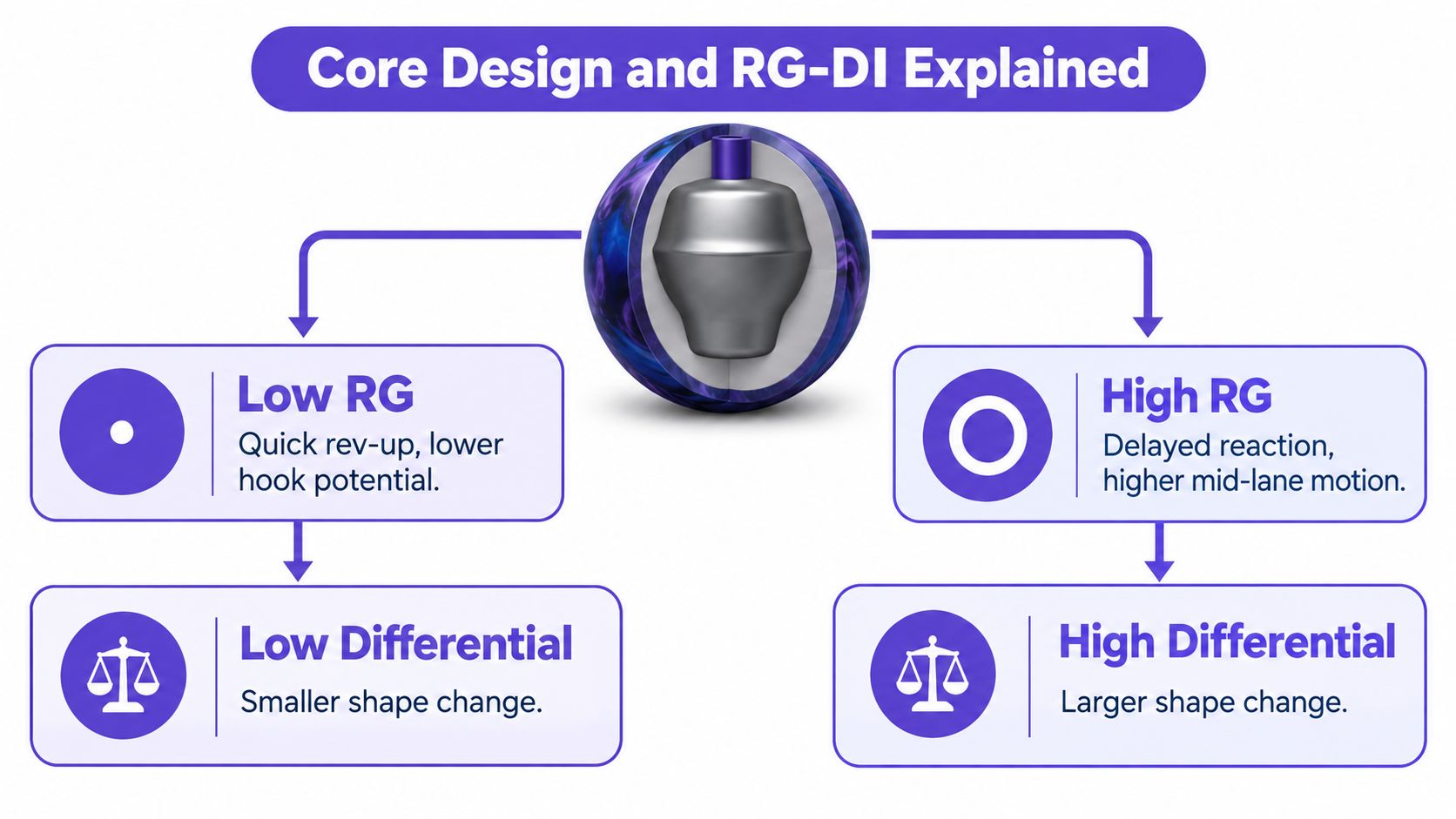
Core geometry influences how quickly the ball begins rotating and how much shape it can create as it travels downlane. Radius of gyration, or RG, describes how readily the ball revs around its axis. A lower RG generally helps the ball rev sooner, while a higher RG tends to preserve length before making its move.
Differential describes the difference between the ball's minimum and maximum RG values. A larger differential generally supports more track flare potential, which can expose fresh coverstock to the lane and increase the ball's ability to change direction. These are useful tendencies, not stand-alone verdicts.
Read the core with the cover
A low-RG core under a rough solid cover can read the lane very early and create a smooth, controlling shape. Put a similar core under a cleaner, more polished cover and the ball may retain more length before using its stored energy. A high-RG core with an aggressive surface can still read strongly, while a high-RG core with a polished cover may push farther and respond more sharply downlane.
USBC motion research found that low RG remains significant in predicting ball path, but coverstock variables generally dominate reaction. That is why a core-only bowling ball comparison often produces misleading conclusions. The same core geometry can behave very differently after a surface change or a different drilling layout.
A practical comparison should record:
- Rev-up timing: Does the ball begin rolling in the midlane or wait until the breakpoint?
- Shape change: Does differential create a gradual arc or a more obvious transition into the pocket?
- Energy retention: Does the ball continue through the pins, or does early friction make it roll out?
- Layout interaction: Does drilling help the ball match the bowler's axis rotation, speed, and rev rate?
The bowling ball weight-block guide can help clarify why manufacturers use different core structures and why their numbers need context.
The video below provides a visual introduction to how core design contributes to ball motion.
Use RG and differential to predict tendencies, then confirm those tendencies on the lane. The ball's actual reaction still depends on friction, surface preparation, oil volume, and the bowler delivering it.
Matching Balls to Oil Patterns and Lane Conditions
The right ball depends on where the lane gives you friction and how quickly that friction will grow. On heavier oil, a bowler usually needs a cover and surface that can read the midlane without skidding past the breakpoint. On drier conditions, the same setup can burn energy too early and leave weak corners.
A useful selection process starts with three questions:
- Where is the oil? More oil in the front and middle lanes usually calls for more traction.
- Where is the friction? Early dry boards can make an aggressive ball hook before it reaches the pocket.
- How fast will the lane change? A high-absorption cover may be excellent on the first shot and difficult after repeated traffic.
Oil Pattern Matching Guide
| Oil Pattern Type | Recommended Coverstock | RG Range | Surface Prep |
|---|---|---|---|
| Heavy oil | Strong solid reactive | Lower RG tendency | Rougher, higher-friction finish |
| Medium oil | Versatile solid or hybrid reactive | Mid-range RG tendency | Moderate surface preparation |
| Short or dry | Urethane, smoother reactive, or less absorbent cover | Higher RG tendency | Smoother or polished finish |
These are starting points, not prescriptions. A high-speed player may need more surface than a high-rev player on the same pattern. A bowler who creates substantial axis rotation may need a smoother cover to prevent an abrupt response, while a lower-rev player may need earlier traction to avoid leaving the ball in the oil too long.
Match the ball to the transition plan
The opening ball should leave you with a clear adjustment when the lane changes. If it reads the front too early, you may need to move inside, change ball, or reduce surface. If it skids too far, you may need more friction, a stronger cover, or a lower-RG option.
Don't choose a ball solely because it handles the first few shots. Choose the ball that lets you move gradually as the breakpoint changes. That approach usually produces a more predictable session than starting with maximum hook and reacting to every over-under miss.
Surface Preparation and Hook Shape Control
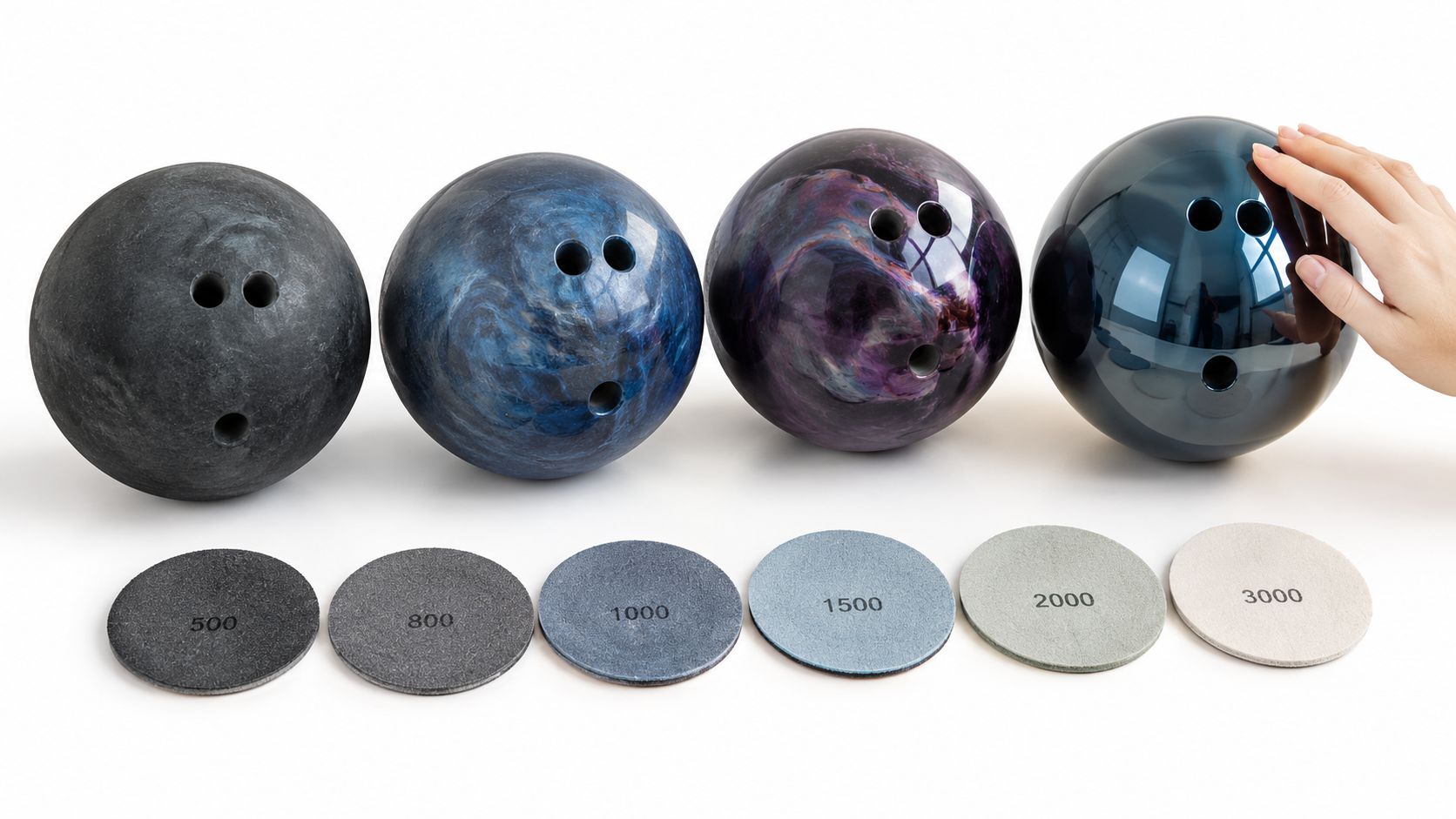
Surface preparation is the most accessible way to change a ball's reaction without replacing the ball. USBC research identifies roughness and friction as major predictors of ball path, so the finish affects more than appearance. It changes when the ball begins traction, how much energy it spends in the front, and how sharply it responds at the breakpoint.
Start with a controlled surface check
Use the manufacturer's intended finish as your baseline, then make one change at a time. A rougher surface generally creates earlier traction and a smoother arc. A polished or finer surface generally delays the transition, preserves length, and can create a sharper backend response.
The common mistake is to change surface because the ball “doesn't hook,” without deciding where the missing hook should occur. A ball that skids too long needs earlier friction. A ball that hooks before the breakpoint needs more length or a smoother response. Those are different problems.
A practical evaluation follows this order:
- Watch the front: If the ball reads before the intended breakpoint, the surface may be too aggressive for the lane or release.
- Watch the breakpoint: A controlled breakpoint begins its change of direction in the usable part of the lane, rather than jumping immediately off the dry.
- Watch the pins: Early hook can create visible motion but still leave weak corners when the ball has spent too much energy before impact.
- Make one adjustment: Change surface or ball choice, then retest the same line before drawing a conclusion.
The guide to bowling ball sanding and surface adjustment is useful when deciding whether a change should add traction or preserve length.
Surface also changes through use. Oil and friction can make a ball's reaction differ from its original finish, so a comparison should record the surface condition at the time of testing. A ball's label describes its starting point, not necessarily the reaction it gives after repeated league use.
Beyond Initial Hook and Oil Depletion
A fresh-lane test can make an aggressive reactive ball look like the obvious winner. It creates traction, corners hard, and sends the pins in every direction. That result says little about whether the ball remains playable after the lane has absorbed repeated shots.
USBC testing measured a modern reactive ball removing 1,483 units of lane oil over three games, compared with 1,421 units for reduced-reactive equipment and 917 for urethane, approximately 62% of the modern-reactive total. The USBC technology study on ball motion and oil depletion shows why cover choice affects the lane, not just the ball's individual reaction.
Game 1 is only the opening test
A stronger ball can remove oil from the front and inside part of the lane more quickly. As that oil moves or disappears, the breakpoint can migrate, the ball can start earlier, and the bowler may need to move inside sooner than expected. If the ball has already used too much energy before reaching the pins, more hook doesn't solve the problem.
Track the reaction by game:
| Session point | What to record | What it tells you |
|---|---|---|
| Game 1 | Front read and breakpoint | Whether the initial match is sound |
| Game 2 | Move required and continuation | How quickly the ball changes the lane |
| Game 3 | Carry and usable breakpoint | Whether the ball remains a practical choice |
In such cases, urethane or a less aggressive reactive option can outperform a stronger ball over time. Its lower oil interaction may produce less total hook, but it can leave a more manageable transition and a wider range of playable adjustments.
The ball with the biggest move on the first game isn't automatically the ball that gives you the best league night.
A serious comparison should report when the bowler moves, why the move happens, and whether the ball still drives through the pins after that adjustment. Longevity means more than cover durability. It means preserving a useful reaction as the lane evolves.
Making the Right Choice for Your Skill Level
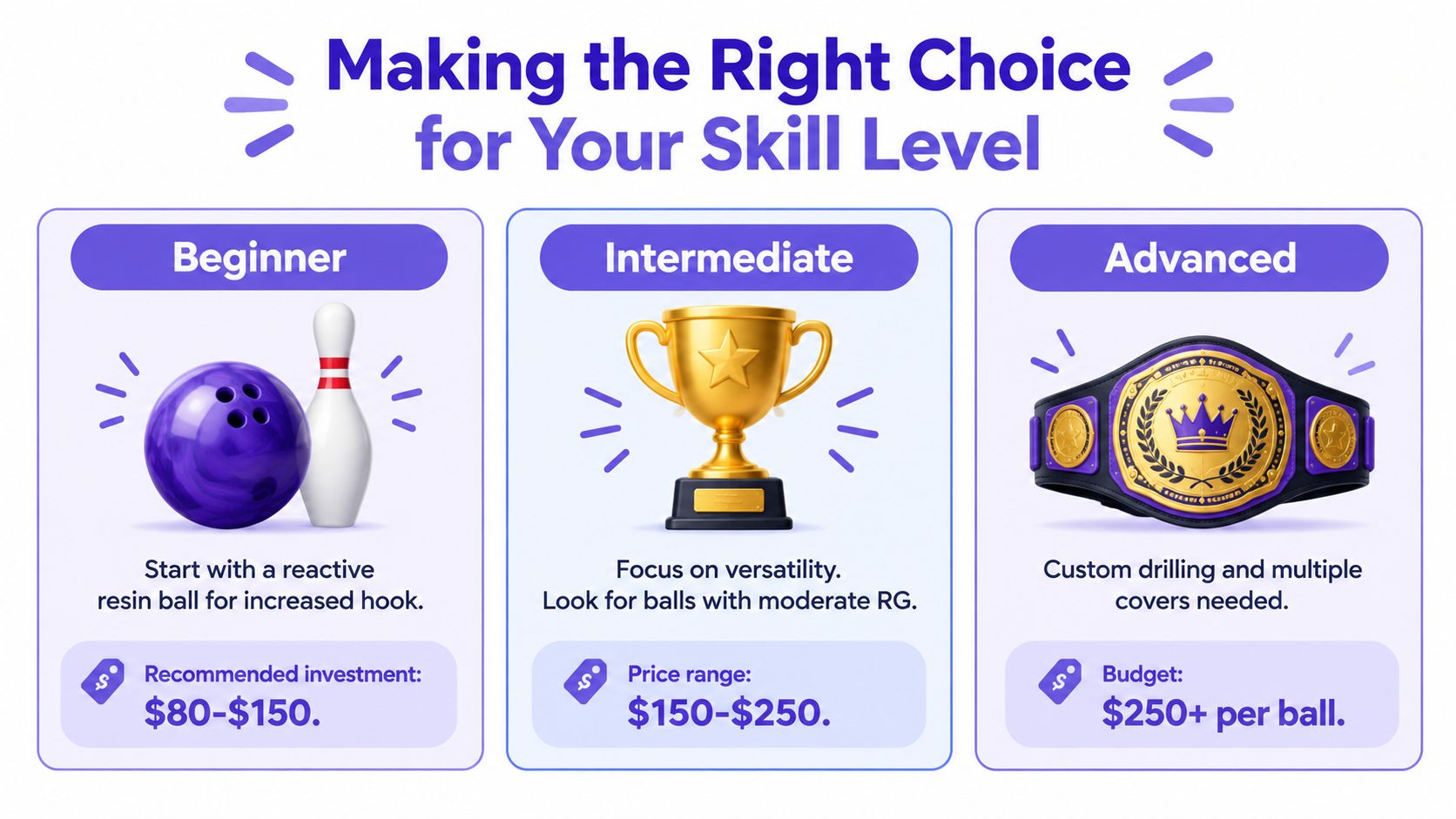
Choose equipment around repeatability, release, lane environment, and purpose. The United States Bowling Congress history of bowling reports that more than 67 million people in the United States bowl during a year, while more than 1.2 million compete regularly in USBC-certified league play. A first custom ball and a tournament arsenal address different problems, especially as oil depletes and the lane changes through a session.
Beginners need control before complexity
New bowlers benefit from predictable equipment that does not punish small changes in speed or release. A moderate hook profile with a versatile surface gives them room to learn pocket entry, spare shooting, and basic alignment before adding specialized shapes.
The strongest ball is rarely the best starting point. If the release is inconsistent, excessive reaction creates more variables, hides the actual lane condition, and makes adjustments harder. A controllable ball also helps a beginner see how oil depletion changes the breakpoint from game to game.
Intermediate bowlers can build a reaction system
Intermediate bowlers usually gain more by learning how one ball complements another than by buying the most aggressive option available. A versatile reactive ball may handle the opening condition, while a cleaner or less absorbent option can preserve control after the fronts begin to hook.
Compare equipment by motion:
- Earlier control: Useful when enough oil remains for the ball to create traction without burning up.
- Cleaner length: Useful after the front part of the lane starts to go away.
- Smooth continuation: Useful when a sharp backend reaction becomes difficult to repeat.
Know the next ball before the current one stops working. Log breakpoint movement, required feet and target changes, and pin carry across the session. A strike count alone will not show whether the ball is still creating a reliable shape.
Advanced bowlers should compare coverage
Tournament and high-level league bowlers often need distinct reactions because conditions vary across sessions and pairs. Build meaningful separation in cover strength, surface, core motion, and response to transition. Two balls with different colors but nearly identical reactions add little coverage.
The historical record also separates broad participation from organized league play. Combined ABC, YABC, and WIBC league membership was reported at 4.1 million during the 1997–98 season and had fallen 36% to 2.6 million by 2006–07. Frequent bowlers also declined from 8.8 million in 1999 to 6.95 million in 2007, a 21% reduction, according to the historical overview cited above. The practical lesson is clear: judge a competition ball by its usable reaction through transition, while a beginner needs repeatability and control first.
Navigating USBC Tournament Rules and Eligibility
A ball can perform exactly as advertised and still be the wrong purchase for a particular event. Serious bowlers need to check both manufactured approval and event-level eligibility, especially when equipment uses slow oil-absorbing urethane or other high-performance designs.
USBC reported that, effective December 31, 2025, qualifying balls with oil-absorption times over 90 minutes must meet a 78D hardness standard for approval in the United States. Beginning January 1, 2026, certain national tournaments may prohibit those balls entirely or permit only models meeting that specification, as described in the USBC report on bowling ball hardness governance and competitive impact.
Use a date-stamped rules check
Before buying or drilling a ball for competition, verify:
- Approval status: Confirm that the model is approved for the governing body and market where you'll compete.
- Oil-absorption category: Check whether the ball falls into a category affected by current restrictions.
- Hardness requirement: Determine whether the model meets the applicable standard and how officials assess it.
- Event rules: Read the tournament's own conditions, because an event may impose limits beyond general approval.
- Jurisdiction: Don't assume USBC rules apply unchanged to leagues or competitions governed elsewhere.
Hardness also shouldn't be treated as a complete performance prediction. USBC research found that urethane balls can soften through use without changing performance in the same way as a ball manufactured below the required hardness. That distinction matters when a bowler evaluates both legality and long-term reaction.
A trustworthy bowling ball comparison should publish the date of its rules check and separate measured motion from eligibility. If you're shopping internationally, ask the pro shop or event organizer for written confirmation before drilling. The question isn't only whether the ball hooks more. It's whether you can buy it, maintain it, and use it throughout the competition schedule you intend to enter.
Bowling Gear Reviews evaluates bowling balls through hands-on testing, logging coverstock, core design, surface preparation, control, carry, and lane-condition suitability across real-lane sessions. Visit Bowling Gear Reviews to compare equipment by fresh-to-transition behavior, practical fit, durability, and current buying guidance before choosing your next ball.
