

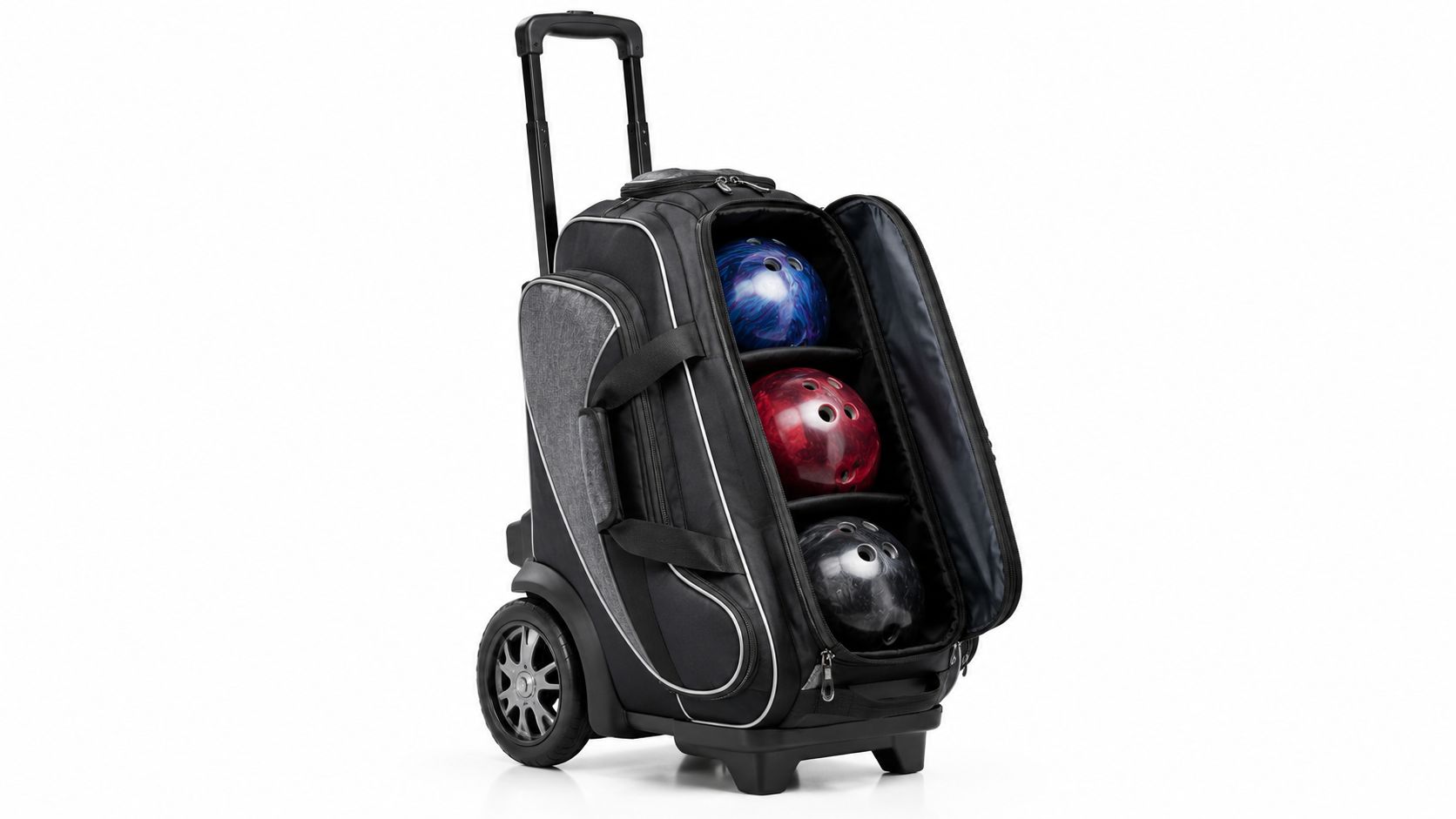
You notice the problem before you notice the bag. League night starts in the parking lot, where your tote drags against your leg, your shoes are wedged beside a ball, and the extra accessories seem to multiply every week. By the time you cross the cracked pavement and carpeted concourse, the equipment you bought to help your bowling has become the awkwardest part of getting to the lanes.
A wheeled bowling ball bag can solve that problem, but only if you choose it as transport equipment rather than as a colorful container with wheels. The important questions are how the loaded bag behaves, how well it protects balls during handling, how its wheel and handle geometry affects your effort, and how its hardware holds up through repeated league use. Capacity matters, but it's only the starting point.
Table of Contents
- The Moment Your Bag Becomes the Problem
- How Bowling Bags Evolved Into Rolling Systems
- Roller Versus Tote and the Real-World Trade-Offs
- Wheels, Handles, and the Geometry of Effort
- Internal Protection and How to Audit a Bag Before You Buy
- Travel Rules That Change Which Bag You Should Choose
- Matching the Bag to the Bowler in Front of It
- Care, Storage, and a Maintenance Routine That Pays You Back
The Moment Your Bag Becomes the Problem
Most bowlers begin with a tote because it's simple. One ball, a pair of shoes, a towel, and some tape fit without much thought. The arrangement changes when a second ball enters the rotation, or when the bowler adds a wrist support, cleaner, interchangeable shoe parts, spare tape, and other league-night essentials.
The tote still works in short stretches. It can be lifted into a car, placed beside a bench, or carried through a narrow hallway without asking you to manage a long handle and a wheel track. But the same design puts the full load on one shoulder or in one hand. A bowling ball commonly weighs several kilograms, so adding multiple balls and shoes turns a casual carry into a repeated physical task.
Practical rule: If you're choosing a bag for the way you actually move through the bowling center, don't judge it while empty. Judge it with the balls, shoes, and accessories inside.
Four decisions usually determine whether a bag feels useful or frustrating:
- Format: A tote is compact and easy to lift. A roller transfers much of the carrying task to the floor, but it needs clear space to pull and turn.
- Capacity: A single-ball roller suits a focused setup. Double- and triple-ball designs support changing lane conditions, but their added volume makes balance and structure more important.
- Hardware: Wheels, axles, handle tubes, and attachment points experience the repeated load. Decorative pockets matter less if the handle flexes or the wheels wobble.
- Fit: The best layout depends on your car, storage space, height, strength, travel habits, and the surfaces between the parking area and the lanes.
A roller isn't automatically an upgrade, and a tote isn't automatically outdated. A league regular who walks across a large parking lot may value rolling convenience, while a bowler who stores gear in a tight locker may prefer a compact carry format. The right purchase reduces the specific bottleneck you feel every week.
How Bowling Bags Evolved Into Rolling Systems
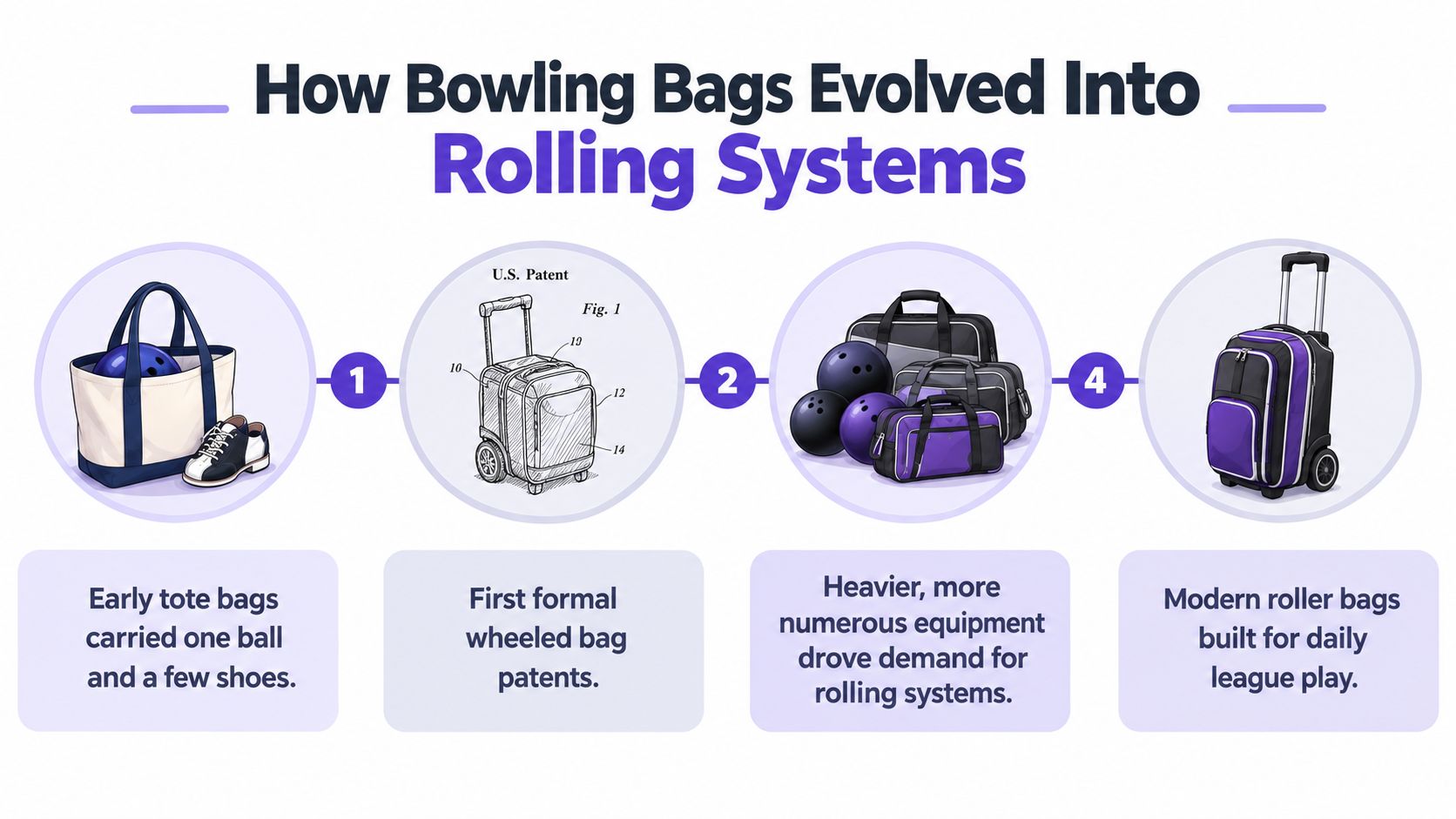
Bowling bags became rolling systems because the equipment load changed. As bowling balls grew more technologically advanced, bowlers began carrying multiple balls, which created demand for bags that could move a heavier collection of equipment without placing the full load on the shoulders. The result was a shift from a basic hand-carried container toward rolling luggage designed for mobility and load management.
The idea was formalized earlier than many shoppers realize. U.S. Patent 5,074,571, issued in 1991, describes a “spare bowling ball carrier” with vertically stacked compartments, each sized for one bowling ball, mounted on a base with rollers, wheels, or casters and a handle. You can examine the documented design in the U.S. Patent 5,074,571 record.
Reading the modern bag categories
The patent history helps explain why today's formats look different:
- Single-ball roller: A narrow setup for one ball, shoes, and basic accessories. It's easier to store and maneuver, though it doesn't support a second ball when your strategy changes.
- Double-ball roller: A common middle ground for league bowlers. It offers room for a primary ball and a complementary option without the full height and mass of a larger system.
- Triple-ball roller: Useful for bowlers who regularly carry a broader selection. The extra capacity also raises the importance of wheel stability, ball immobilization, and a handle that won't twist under load.
- Tote: A soft, lift-first design that works well when the route is short, storage is tight, or the bowler wants easy access from above.
- Hybrid: A roller base paired with removable or tote-style sections. This can separate daily equipment from the part that travels to competition.
Later designs refined the rolling format. U.S. Patent 6,109,627, filed in 1999 and granted on August 29, 2000, described a wheeled bag using telescoping columns to carry two or three bags containing multiple balls. That progression explains why reinforced bases, telescoping handles, dividers, compression straps, and replaceable wheel assemblies appear in more durable designs. They aren't random premium details. They address the mechanical problem created by moving several heavy, rounded objects in one unit.
Roller Versus Tote and the Real-World Trade-Offs
A roller wins when distance and repeated carrying dominate your routine. A tote wins when compact handling and quick access matter more. That sounds obvious, but bowlers often compare only ball capacity and miss the moments when each format becomes inconvenient.
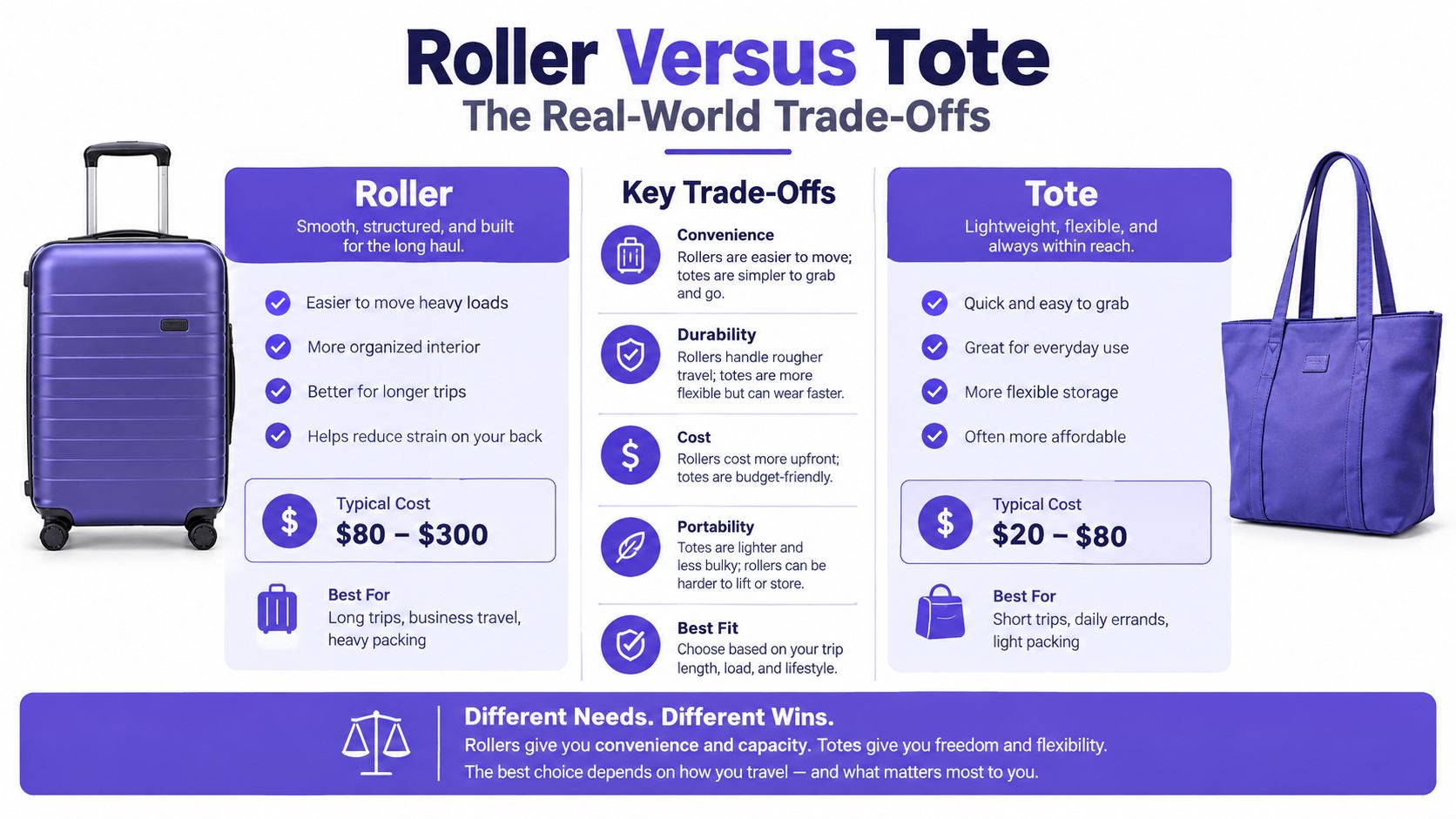
A single-ball tote is easy to lift into a trunk and carry through a crowded league room. It usually has a smaller storage footprint and fewer parts that can fail. It also keeps the ball close to your body, which can feel more controlled in a stairwell or narrow aisle. The cost is that your shoulder, wrist, or hand absorbs the entire load.
A roller changes the force rather than eliminating it. You pull instead of carrying, then lift the bag over thresholds, into a vehicle, or onto stairs. A tall, heavily loaded roller may tip when you turn sharply, and its extended handle can become awkward between seating rows. A two-ball roller isn't universally easier than a tote, especially in tight spaces where the wheel path and turning radius matter.
A roller reduces shoulder carrying, but it doesn't make a loaded bag weightless. It moves the challenge to pulling, turning, lifting, and storing.
Where each format earns its place
| Situation | Roller advantage | Tote advantage |
|---|---|---|
| Long walk from parking area | Less continuous shoulder carrying | More tiring over distance |
| Crowded league room | Can be awkward to turn and park | Compact and easy to reposition |
| Multiple balls | Keeps a larger setup together | Becomes harder to carry comfortably |
| Stairs and vehicle loading | Requires lifting the complete unit | Easier to grab and control |
| Small storage area | Needs room for wheels and handle | Usually folds or fits more easily |
| Frequent uneven surfaces | Larger wheels can cross obstacles better | No wheel damage risk |
For a new bowler with one ball and a short route, a tote may be the sensible choice. For a league regular who carries multiple balls across carpet, pavement, and the bowling center entrance, a roller usually becomes more practical. A three-ball bowler might still keep a tote for practice sessions, quick trips, or situations where the full rolling system would be more trouble than help.
The useful question isn't “Which format holds more?” Ask, “Which format makes my normal route easier without creating a new problem?” That answer should guide capacity, not the other way around.
Wheels, Handles, and the Geometry of Effort
A loaded bag's feel comes from geometry. Wheel diameter, load weight, center-of-mass position, handle length, pole angle, and handle orientation all change how the bag moves and how your body reacts.
A Pennsylvania State University ergonomic assessment tested wheeled luggage with 15- and 23-kg loads, 8- and 15-cm wheel diameters, 100- and 110-cm handle lengths, different pole angles, handle orientations, floor coverings, and center-of-mass positions. The assessment found that wheel diameter, load weight, and center-of-mass location influenced biomechanical, physiological, and subjective outcomes, while handle height, rotation, and pole angle mainly changed pulling kinematics. The full Penn State ergonomic assessment of wheeled luggage provides the technical basis for applying those findings to bowling bags.
What those measurements mean at the lanes
Larger wheels generally handle carpet transitions, door thresholds, and uneven sidewalks more smoothly than small casters. They can also raise the bag, increase the turning radius, and make vehicle storage more difficult. A wheel that rolls smoothly across a polished floor may still struggle when the same bag crosses a cracked sidewalk.
Load position affects stability. A low, centered ball compartment should reduce pitching and side-to-side sway, while a high or offset load can make the bag feel top-heavy. This matters most in a triple-ball design, where the bag's height and weight amplify every abrupt turn.
Handle length and angle affect your pulling posture. The Penn State findings favored a long handle, parallel handle orientation, straight pole, and larger wheels in the rugged-design tests. An angled pole could reduce user stress when paired with a rotated handle and large wheels, so the best arrangement isn't just “straight is always better.” It has to match the wheel size, handle position, and the way you pull.
A two-minute hardware test
Before buying, load the bag if the shop allows it, or apply firm downward pressure to simulate a filled compartment. Then check:
- The telescoping handle for twisting and flex.
- The wheel track to confirm it won't clip your heel.
- The bag's balance when tilted into its pulling position.
- The wheel assemblies for smooth rotation and accessible fasteners.
- The handle height at your natural walking position.
- The transition over a mat edge or low threshold.
Choose sealed or replaceable wheel assemblies if you bowl frequently. A smooth fabric shell can't compensate for an axle that loosens, a handle mount that tears, or wheels that develop flat spots.
Internal Protection and How to Audit a Bag Before You Buy
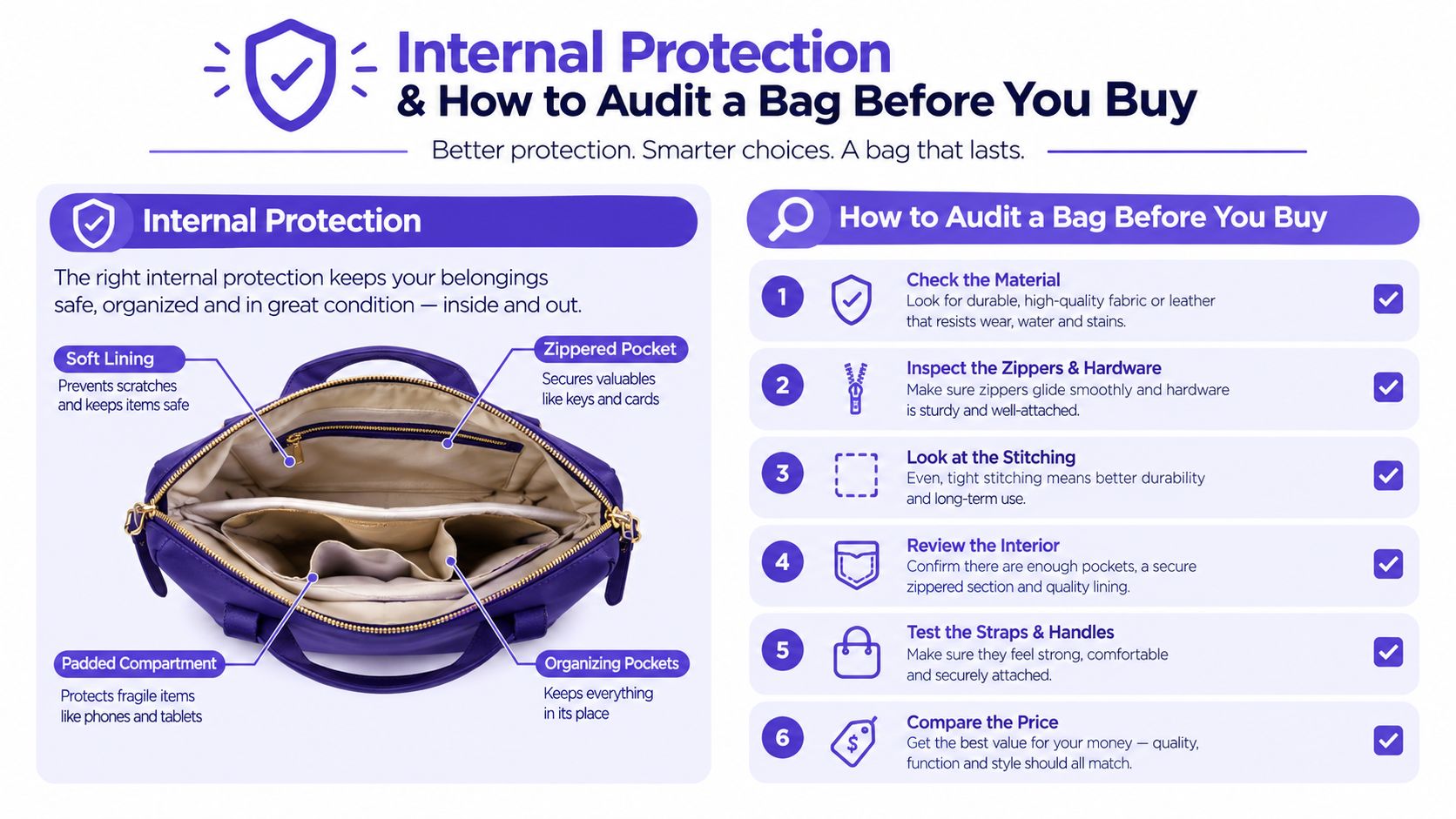
A bag protects bowling equipment by controlling movement. Padding matters, but a padded compartment that lets a ball roll into the zipper or divider still creates a problem. Inspect the complete interior as a system, including the base, lid, seams, dividers, straps, and accessory pockets.
Start with the ball wells. Each ball should sit securely without excessive empty space around it, and the base should feel supported rather than soft enough to collapse under the load. A lid with padding can help separate the ball from the outside world, but the zipper line and seams also need to stay clear of direct impact.
The closed-bag inspection
Use this checklist before committing:
- Ball immobilization: Zip the compartment and gently rock the bag. The balls shouldn't shift freely from side to side.
- Base support: Press underneath the ball wells. Look for a firm platform that distributes the load across the wheel base.
- Divider security: Check whether dividers stay attached when shoes or accessories press against them.
- Accessory control: Shake the closed accessory pocket. Loose cleaner bottles, tools, and tape shouldn't bounce into the ball compartment.
- Stitching and stress points: Inspect handle attachments, wheel mounts, corners, and the seam around the base.
- Compression: Look for straps or structured panels that keep the loaded shape stable rather than allowing the bag to sag.
A soft-sided roller can be suitable for ordinary league transport when its ball wells hold equipment firmly and its base remains structured. Checked air travel introduces a different level of risk because the bag may be dropped, stacked, or pressed by other luggage. A hard case or separate shipping arrangement may make more sense when impact protection matters more than low weight.
For a concrete product example, you can compare the compartment approach of a three-ball Storm bowling bag against your own checklist. Don't assume a larger interior equals better protection. Empty space, weak dividers, and an overloaded accessory pocket can make a spacious bag less secure.
Travel Rules That Change Which Bag You Should Choose
The largest roller isn't automatically the best travel bag. Airport convenience and checked-baggage protection are separate requirements, and a design that rolls easily through a terminal may not offer enough structure for rough handling.
American Airlines allows a bowling case with a maximum of three bowling balls plus shoes, and treats it as carry-on only when it fits under the seat. Bowling balls aren't permitted in overhead bins. The airline's general sports-equipment limit is 70 lb (32 kg) and 115 linear inches (292 cm), subject to aircraft capacity, as described in its sports equipment baggage rules.
United defines one bowling-equipment set as a bag holding up to three balls and one pair of shoes. Southwest accepts a metal-frame bowling bag containing balls and shoes as checked baggage, but applies standard and overweight fees and limits liability when the equipment isn't packed in a purpose-built bowling-ball bag. Southwest also says equipment above 100 pounds or 115 total linear inches can't be checked, according to its bowling equipment baggage policy.
The weight calculation that changes the decision
A 15-lb ball weighs about 6.8 kg, so three balls contribute roughly 45 lb (20.4 kg) before you add the bag, shoes, towels, and accessories. A bowling ball alone can weigh up to 16 lb, so two balls plus a heavy roller can approach common baggage limits quickly.
| Airline | Max balls plus shoes | Carry-on rule | Weight limit | Linear limit |
|---|---|---|---|---|
| American Airlines | Up to three balls plus shoes | Only if the case fits under the seat; no overhead-bin bowling balls | 70 lb (32 kg) general sports-equipment limit | 115 linear in (292 cm) |
| United | Up to three balls and one pair of shoes in one equipment set | Confirm current carrier and aircraft restrictions before travel | Confirm current carrier rules | Confirm current carrier rules |
| Southwest | Balls and shoes in a purpose-built bowling bag | Checked-equipment rules apply | Above 100 lb cannot be checked | Above 115 total linear inches cannot be checked |
For checked travel, prioritize reinforced ball wells, compression straps, and a load rating comfortably above the fully packed mass. A smaller, lighter roller may reduce handling concerns and possible fees, but only if it keeps the balls from moving and has a structure that can tolerate baggage handling.
For carry-on use, measure the packed bag and verify the specific carrier's rules before purchase. A compact roller isn't automatically cabin compliant. For frequent flyers, the safest buying process is simple: weigh the complete setup, measure its external dimensions, inspect the wheel and handle risk, and decide whether a soft-sided case offers enough protection for the trip.
Matching the Bag to the Bowler in Front of It
The same bag can feel convenient to one bowler and awkward to another. Height, strength, storage, route, and bowling habits determine whether a design earns its space.
The beginner with one ball
Start with a single-ball tote or compact single-ball roller if the bowler owns one ball, carries only basic accessories, and has a short route to the lanes. A tote keeps the setup simple and is easier to store. A single roller makes more sense when the bowler already dislikes shoulder carrying or expects to add equipment soon.
Ball choice and bag choice also interact. A beginner who is still learning fit and weight should use a practical guide such as how to choose a bowling ball for beginners before building a larger equipment system.
The league regular upgrading from a tote
A double-ball roller is often the balanced upgrade. It supports a primary ball, a second option, shoes, and common accessories without forcing the bowler into the height and mass of a larger system. Prioritize a firm base, smooth wheels, and a handle that stays rigid when tilted.
The tournament bowler who flies
Capacity alone shouldn't drive this purchase. Weigh the packed setup, check the airline's current equipment rules, and decide whether the bag will be checked or transported another way. Reinforced compartments and compression are more important than extra pockets if the bag will encounter baggage handling.
The gift buyer
Don't guess at capacity from appearance. Ask how many balls the bowler normally brings, whether they already own a tote, and whether the bag will stay in a car, locker, or home closet. If you can't ask, a compact roller or accessory-focused tote is less risky than a large system that may not fit the recipient's vehicle or storage space.
The bowler managing strength or mobility limits
A roller can reduce shoulder carrying, but it still demands controlled pulling, turning, threshold crossing, and lifting. Look for larger smooth-rolling wheels, a handle height that doesn't force hunching, a centered load, and a wheel track that won't catch the heel. Test the loaded bag over the exact surfaces the bowler uses, because a design that works on a flat shop floor may feel very different on carpet or uneven pavement.
Care, Storage, and a Maintenance Routine That Pays You Back
A wheeled bowling ball bag ages through small failures. Dirt reaches the wheels, moisture stays inside a closed shoe pocket, loose accessories press against dividers, and repeated pulling stresses the handle mount. A short routine after each session helps you catch those problems before they become a ruined league night.
After bowling, wipe the exterior and wheel area, remove damp clothing or towels, and leave the compartments open long enough to vent. Check that the handle retracts cleanly and that both wheels rotate without scraping or wobbling. Keep heavy accessories in their intended pockets instead of allowing them to settle against the ball wells.
Once a month, inspect the bag on the floor:
- Base: Look for sagging, cracks, or separation near the wheel mounts.
- Handle: Extend and retract every section, checking for looseness.
- Wheels: Remove visible hair and grit, then check for uneven wear.
- Interior: Confirm that padding, dividers, straps, and zippers still hold their shape.
- Storage: Keep the bag upright or supported on its base, away from prolonged dampness and excessive heat.
For a broader equipment-care routine, the bowling ball cleaning bag guide can help you organize cleaning supplies without overloading the main ball compartments.
The four-factor decision remains useful after purchase. Format should match the route, capacity should match the equipment you carry, hardware should match the surfaces and frequency, and fit should match your body and storage. Test the loaded bag, weigh it before flying, confirm its internal restraint, and maintain the wheels and handle instead of waiting for a failure.
Bowling Gear Reviews evaluates bowling bags and related equipment through independent reviews, comparisons, and practical how-to guides. Visit Bowling Gear Reviews to compare wheeled and tote formats, inspect fit-focused recommendations, and choose a bag that matches your league routine and travel needs.
