

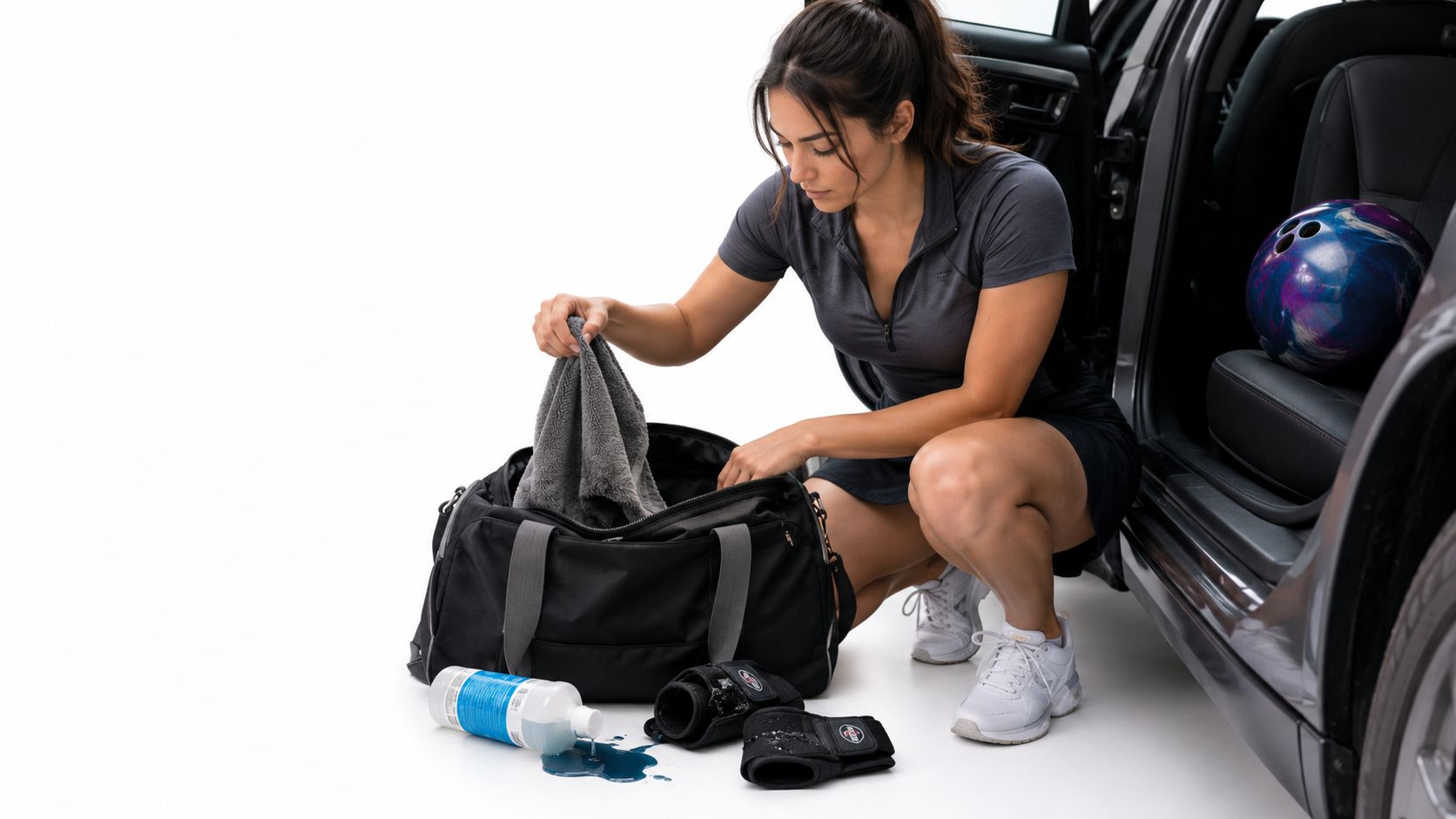
After league, the mess usually starts in the parking lot. You pull a damp shammy from a gym tote, find that your cleaner leaked onto your wrist braces, and discover that the ball still has oily streaks across the track area. The equipment is together, but nothing is organized well enough to work quickly.
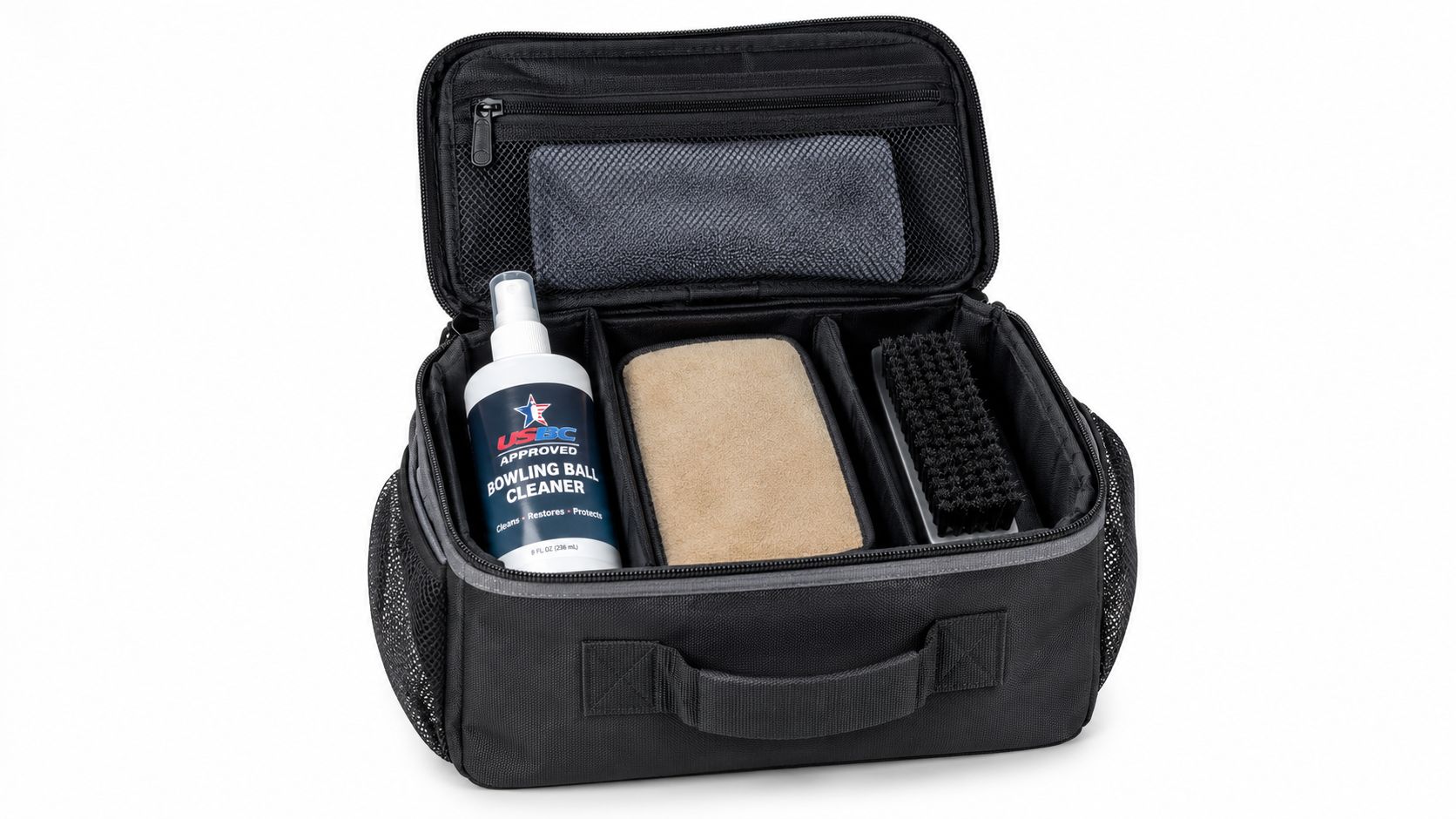
A bowling ball cleaning bag fixes that routine. It gives your microfiber towels, approved cleaner, shammy, brush, and small accessories a dedicated home, separate from shoes and sweaty wrist gear. The right bag isn't just storage. It's a simple workflow that helps you wipe, clean, dry, and restock without hunting through a large tote.
Table of Contents
- Why Every Bowler Needs a Cleaning Bag
- What a Bowling Ball Cleaning Bag Actually Is
- Key Features That Make a Cleaning Bag Worth Buying
- Recommended Bowling Ball Cleaning Bags Worth Considering
- How to Use a Cleaning Bag During and After League Play
- DIY Cleaning Bag Options for Bowlers on a Budget
- Cleaning Frequency and USBC Rules You Should Know
- Quick-Reference Checklist and Cross-Linked Tips
Why Every Bowler Needs a Cleaning Bag
The main benefit is separation. Keep your cleaner bottle upright in one compartment, clean microfiber in another, and used towels away from everything else. A ball bag or roller can carry your equipment, but its large compartments aren't designed to protect a clean towel from a saturated shammy or a leaking spray bottle.
That separation matters because reactive coverstocks respond to surface condition. Oil, cleaner residue, lint, and moisture shouldn't share the same loose pocket. A dedicated organizer reduces the chance that your grip towel picks up cleaner or that a damp shammy sits against accessories you use near your hand.
The lane-side payoff
Use the bag as a fixed four-part station:
- Clean wipe: Keep a dry microfiber cloth or shammy ready for the next delivery.
- Used wipe: Move the oil-loaded towel into a separate pocket instead of returning it to the clean section.
- Cleaner: Store the bottle upright and away from fabric whenever possible.
- Drying space: Leave room for a towel to breathe after use.
A clean ball surface gives you a more dependable starting point. It won't correct a poor release or eliminate lane transition, but it removes one avoidable variable from your routine. If you want to build a broader accessory setup, this guide to must-have bowling accessories is a useful companion.
Practical rule: If your cleaning supplies share a compartment with your shoes, wrist support, and spare tape, you don't have a maintenance system. You have a junk drawer.
A small pouch also saves time. You won't need to search for the shammy between games, wipe your ball with a shirt, or replace a towel because it picked up grit from the bottom of a tote. That consistency is the true value. The bag makes the correct action easy enough to repeat every league night.
What a Bowling Ball Cleaning Bag Actually Is
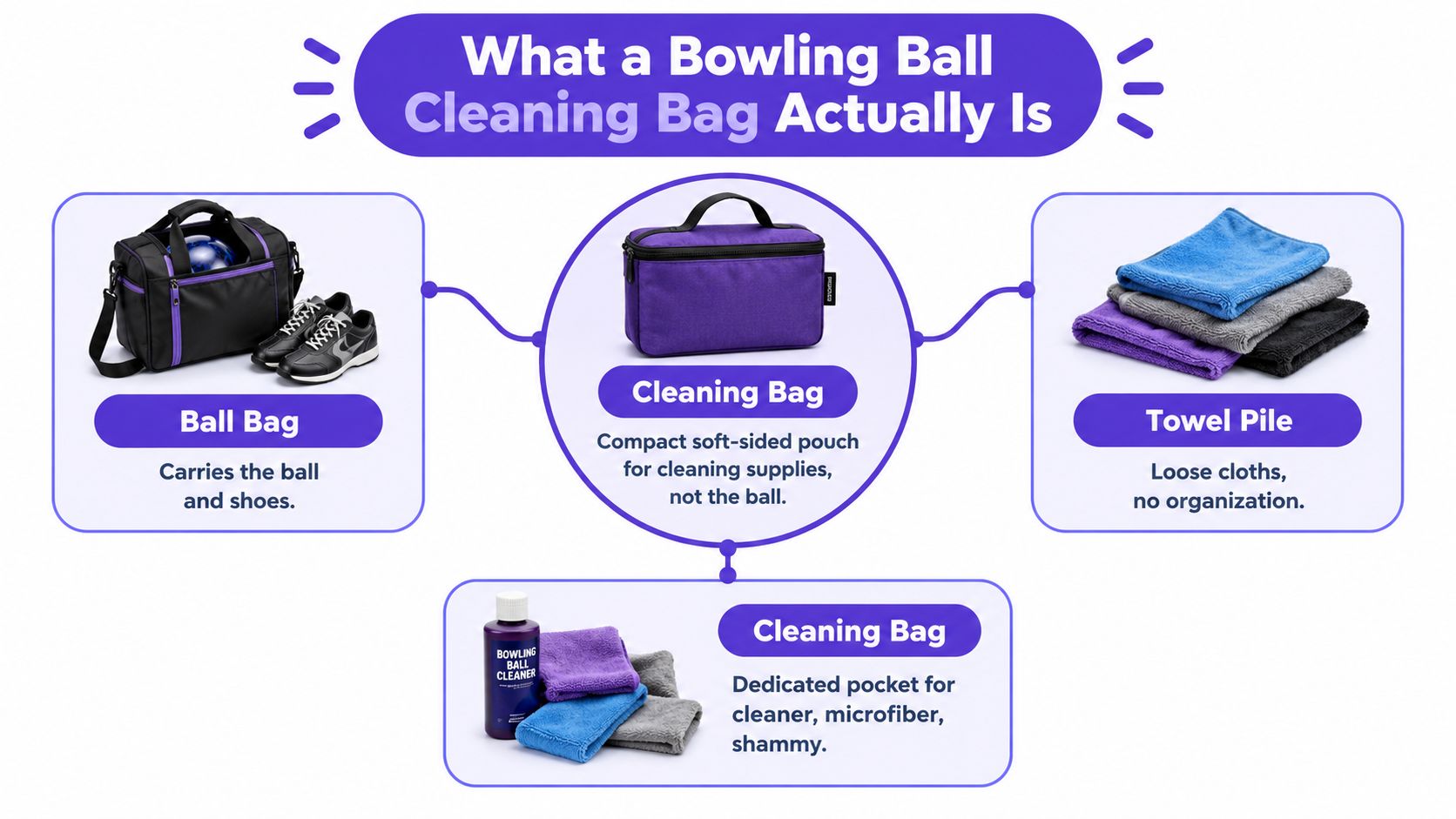
A bowling ball cleaning bag is a compact, soft-sided pouch for maintenance supplies, not for the bowling ball itself. It normally holds a cleaner, one or more microfiber towels, a shammy pad, and small tools such as a brush or tape. Some designs use a single open compartment. Better designs divide the supplies so wet, dirty, and clean items don't touch unnecessarily.
Don't confuse it with a ball bag. A ball bag or roller carries the ball, shoes, and sometimes clothing. A towel is one piece of fabric. A full accessory kit may add tape, rosin, grip aids, and thumb products. The cleaning bag is the focused middle ground, a portable organizer built around surface care.
What belongs inside
A practical setup might include a Storm shammy, a Motiv Revitalizer bottle, and two microfiber cloths. One cloth stays clean for final drying. The other handles the first wipe or goes into the used-towel compartment after it becomes saturated.
The pouch should be easy to carry from your main bag to the ball return. It shouldn't require you to unpack your shoes or lift out the ball. A flat profile works well for league play, while a deeper organizer suits bowlers who carry extra tape, grip tools, and replacement towels.
What it shouldn't do
The bag shouldn't replace cleaning technique, a legal cleaner, or proper drying. It also shouldn't become a sealed container for wet fabric. If the interior smells musty, the bag is being stored before its contents are dry.
Think of it as a portable maintenance station. It holds the things you use before, during, and after play, and it makes the order of those actions obvious.
Key Features That Make a Cleaning Bag Worth Buying
Start with drying, not branding. A bag that holds a cleaner bottle but traps damp towels is poorly designed for its primary job. The interior should resist lint, allow used microfiber to remain separate, and give you a way to air out the contents after play.
USBC equipment specifications make residue control part of competition-ready maintenance. A cleaner must appear on the USBC Approved Cleaners list, must not change ball hardness by more than 2 durometer-D points, and must be fully removed before competition so the ball's FTIR spectrum isn't altered beyond the permitted threshold described in the USBC equipment guidance. A bag can't make an illegal product legal, but it can support a wipe, dry, and inspect workflow.
Rank the features by usefulness
| Feature | Impact Level | Why It Matters |
|---|---|---|
| Residue-free drying | Highest | Keeps clean and used towels apart and gives the ball a proper final wipe |
| Pocket layout | Highest | Prevents bottles, shammies, microfiber, and tools from becoming one tangled bundle |
| Ventilation | High | Helps damp fabric dry instead of sitting in a closed, odor-holding compartment |
| Closure | High | A sturdy zipper keeps grit out and survives repeated lane-side handling |
| Shell material | Medium-high | Durable synthetic fabric handles dragging, spills, and regular league use |
| Extra pockets | Medium | Useful only if they support your actual tools rather than add clutter |
| Logo patches | Low | Branding doesn't improve drying, organization, or ball care |
The most useful layout has a main section for the cleaner, a flat sleeve for a folded shammy, and a small mesh or zip pocket for a brush, tape, or rosin sheet. Avoid a bag with many shallow compartments if they make the bottle hard to remove.
Material and closure choices
Current accessory-bag benchmarks cluster around 600D to 1680D polyester or nylon, with reinforced stitching and water-resistant construction, as described in bowling accessory bag material comparisons. A compact 600D pouch is enough for a single cleaner and a couple of towels. A heavier shell makes more sense if the bag gets dragged across shelves or rides in a crowded roller.
Choose a heavy-duty zipper over Velcro. Velcro collects lint and grit, then transfers that debris to towels and clothing. For towel selection and absorbency, use this practical guide to a microfiber bowling towel alongside the bag decision.
Recommended Bowling Ball Cleaning Bags Worth Considering
The honest buying advice is simple: shop by construction and workflow, not by a vague star rating. The brief doesn't provide verified specifications for named current products, so assigning exact pocket counts, denier ratings, or included accessories to a specific model would be guesswork. Use the profiles below as a buying shortlist, then confirm the product page before ordering.
| Product | Material (Denier) | Pockets | Closure | Ventilation | Best For |
|---|---|---|---|---|---|
| Mid-range organizer pouch | Look for 600D or stronger | Cleaner section, flat shammy sleeve, small tool pocket | Heavy-duty zipper | Mesh panel or air eyelets preferred | Weekly league bowlers carrying one ball |
| Heavy-duty ball bag with cleaning compartment | Check for reinforced synthetic shell, ideally in the 600D to 1680D range | Separate cleaning compartment plus main gear storage | Full-length zipper | Vented compartment preferred | Bowlers who want maintenance storage attached to a larger bag |
| Compact tournament pouch | Durable synthetic fabric | One bottle section and one towel sleeve | Secure zipper | Helpful, but not mandatory if contents dry outside the bag | Tournament bowlers who travel light |
| Budget zippered pouch | Fabric quality varies, verify the shell before purchase | Usually one main compartment | Basic zipper | Often limited | Casual bowlers who already own towels |
| DIY organizer | Depends on the pouch or shoe bag selected | You decide the layout | Existing zipper or roll closure | You add it or leave the pouch open to dry | Budget-conscious bowlers who want replaceable parts |
My buying verdicts
The mid-range organizer pouch is the sensible default. It earns its price when it has a genuine towel sleeve, upright bottle storage, and a compartment for used microfiber. It doesn't need a padded ball section because the ball belongs in the ball bag.
The heavy-duty option works for bowlers who carry several accessories and want the cleaning supplies attached to their main equipment. Watch the layout closely. A large compartment isn't automatically better if the cleaner rolls onto the towels.
The compact tournament pouch is the right choice when you move between centers and want one controlled kit. Prioritize a zipper that stays closed and a sleeve that keeps the shammy flat. It shouldn't be so tight that you have to crush damp fabric into it.
The budget pouch is acceptable if you already own reliable microfiber and a legal cleaner. It earns its price through basic organization, not advanced ventilation. If it has no separation, use labeled cloth bags or small washable inserts inside it.
A DIY setup can match the function of the budget and mid-range choices. Spend extra only when the commercial bag gives you a better drying path, stronger stitching, or a pocket arrangement you'll use every session.
How to Use a Cleaning Bag During and After League Play
A good bag works only when you load it consistently. Before leaving home, check the cleaner, clean microfiber, shammy, and any small tools. Open the pouch and make sure no residue or damp fabric remains from the previous session.
A repeatable league routine
- Pre-league check: Put the approved cleaner in its bottle section, fold a clean microfiber into the dry sleeve, and keep the shammy accessible. If the bag smells damp, air it out before packing it.
- Between frames: Wipe the ball with the cleanest available section of microfiber or shammy. Cover the track area rather than rubbing one visible spot repeatedly.
- Mid-night refresh: If the surface needs cleaner, apply it to the cloth according to the product directions, not directly onto a crowded bag or onto accessories. Wipe the ball, then use a dry section to remove residue.
- Post-league clean: Remove visible debris, clean the ball when appropriate, and towel it until the surface is streak-free. Put the used cloth in its own pocket.
- Restock: Take the towel and shammy out when you get home, leave the bag unzipped, and refill the kit once everything is dry.
The common failure is sealing a damp towel inside the pouch. That creates odor and leaves residue available to transfer back to the ball. A second mistake is returning an oil-saturated towel to the clean sleeve. Mark one pocket as clean and one as used, even if the bag doesn't label them.
Watch this practical demonstration before you settle on your own routine:
DIY Cleaning Bag Options for Bowlers on a Budget
You don't need a bowling-branded pouch to organize maintenance supplies. A small zippered pouch, a vented shoe bag, or a repurposed tool case can perform the same basic job if you create clear zones for cleaner, clean fabric, and used fabric.
Basic setup
Use a small zippered pouch from a travel, stationery, or household-supply collection. Add one microfiber towel and a cleaner that appears on the USBC approved list. This is the lowest-cost path and works for a casual bowler who doesn't carry many accessories.
The trade-off is obvious. A basic pouch may have no ventilation, no bottle divider, and no padding. Keep it unzipped when you're home, and place the cleaner inside a sealed secondary bag if leakage is a concern.
Intermediate setup
Start with a vented shoe bag or compact equipment organizer. Add a labeled interior pocket for the cleaner, a folded shammy, and a small brush. Use one mesh section for used towels so you can identify them immediately after play.
This build is more practical than a loose pouch because ventilation and separation are designed into the setup. It may still wear faster than a purpose-built organizer if the zipper and seams aren't reinforced.
Advanced setup
For a more polished DIY kit, use a compartmentalized tool roll or organizer pouch. Add a hanging carabiner so the kit can attach to your roller handle, plus a washable silicone mat that gives damp items a clean drying surface at home.
The DIY route has limits. Cheap microfiber loses absorbency sooner, improvised pouches can lack ventilation, and an unreinforced zipper may fail after repeated use. Buy a commercial bag when you routinely carry several towels, need dependable separation, or are tired of replacing pouches that collapse and leak.
The fair comparison isn't brand against brand. It's organized workflow against loose supplies. If your DIY setup keeps the cleaner upright, separates clean from dirty fabric, and dries properly, it has already solved the important problem.
Cleaning Frequency and USBC Rules You Should Know
Your maintenance schedule should follow how often you bowl and how much oil the ball collects. General industry guidance commonly recommends cleaning after about 20 games, while other guidance uses a range of 60 to 90 games depending on use. Some product education also recommends cleaning within 30 minutes after play. Those recommendations are summarized in bowling accessory maintenance guidance. Use the earlier end of a range when the ball carries heavy oil or the reaction clearly changes.
During league, wipe the ball regularly with a clean towel or shammy. After play, use an approved cleaner when the surface needs more than a dry wipe. Don't confuse an in-game wipe with a full cleaning session. The first controls surface oil. The second removes residue and debris after bowling.
Coverstock decisions
| Coverstock | Wipe After | Deep Clean | Resurface | Approved Cleaners |
|---|---|---|---|---|
| Plastic | Every session or when marked | When dirt or residue builds up | Only when the surface needs correction | Use a cleaner on the approved list |
| Urethane | Regularly during play | When surface oil or grime affects reaction | Based on observed reaction and authorized service | Use only a listed product |
| Reactive resin | Frequently during play | More promptly when oil accumulates | When reaction becomes dull and surface condition calls for it | Confirm the product is USBC approved |
| Particle or textured reactive | Frequently during play | Keep residue from filling the texture | Follow ball-specific surface guidance | Confirm approval before competition |
USBC rules make the cleaner choice non-negotiable. The product must be approved, it must not change hardness beyond the permitted 2 durometer-D points, and it must be fully removed before competition so the ball remains within the specified FTIR requirement. The relevant specifications are summarized in the bowling ball maintenance guide.
Do use a listed cleaner with microfiber. Don't soak the ball, use abrasives casually, or apply household chemicals without confirming their competition status. Don't leave a wet towel pressed against the coverstock inside a closed bag.
Store the ball and supplies in a stable indoor environment, away from excessive heat or cold. Let the cleaning bag breathe, and keep oil-loaded fabric away from the ball after play.
Quick-Reference Checklist and Cross-Linked Tips
The entire system comes down to four words: clean, dry, store, repeat. Choose a bag that supports those actions, then make the routine boring enough to happen automatically.
Fast-scan checklist
Before league
- Inspect the pouch: Make sure the interior is dry and free of old cleaner residue.
- Stock clean fabric: Pack a fresh microfiber towel and a shammy in the clean section.
- Secure the bottle: Keep the cleaner upright and separate from absorbent materials.
- Check legality: Use a product from the USBC Approved Cleaners list.
After each game
- Wipe the ball: Remove surface oil with a clean section of microfiber or shammy.
- Rotate fabric: Move a saturated towel into the used section instead of folding it back into the clean sleeve.
- Keep tools accessible: Store a brush or small accessory in the tool pocket, not loose beside the towels.
After league
- Clean when needed: Use approved cleaner and follow the product directions.
- Dry completely: Finish with a dry cloth until the surface has no visible streaking.
- Empty damp items: Take microfiber and shammy out of the pouch when you get home.
- Air the bag: Leave the zipper open until the interior and contents are dry.
Over the season
- Replace tired microfiber: Retire cloth that no longer absorbs or begins to shed lint.
- Check the zipper: Repair or replace a pouch before the closure starts catching grit.
- Review ball reaction: If the ball reads differently, check cleaning and surface condition before changing your release.
- Keep the setup simple: Use the pocket layout guidance above rather than buying storage you won't use.
Troubleshooting at a glance
The ball feels sticky. Stop adding more product. Wipe with a clean microfiber, remove residue fully, and confirm that the cleaner is approved. If the feel continues, inspect the ball surface and ask a pro shop for appropriate service.
The towels are oil-saturated. Separate them immediately. Wash or replace microfiber according to its care instructions, and never return a saturated towel to the clean compartment.
The bag smells musty. Empty it, wash or air the fabric as the manufacturer allows, and leave it open until dry. If the odor returns, the bag needs better ventilation or a different internal layout.
The pouch keeps leaking. Keep the bottle in a sealed secondary bag and replace the organizer if its zipper or lining can't contain routine spills. A waterproof shell is useful, but it doesn't excuse storing wet towels inside.
For a structured buying decision, return to the comparison of commercial bag types above. If price is the main concern, the DIY tiers provide a workable alternative. If you want to refine the actual layout, the ranked feature table gives more useful guidance than a logo or oversized accessory count.
A good bowling ball cleaning bag won't improve your release, but it will make proper care repeatable. Pair the right pockets with approved cleaner, regular wiping, complete drying, and sensible storage, then repeat that league-night habit.
Bowling Gear Reviews publishes hands-on reviews, comparisons, and maintenance guides for bowling equipment, including bags and accessories that help organize cleaning supplies. Visit Bowling Gear Reviews to compare practical gear options and build a maintenance setup that fits your league routine.
