

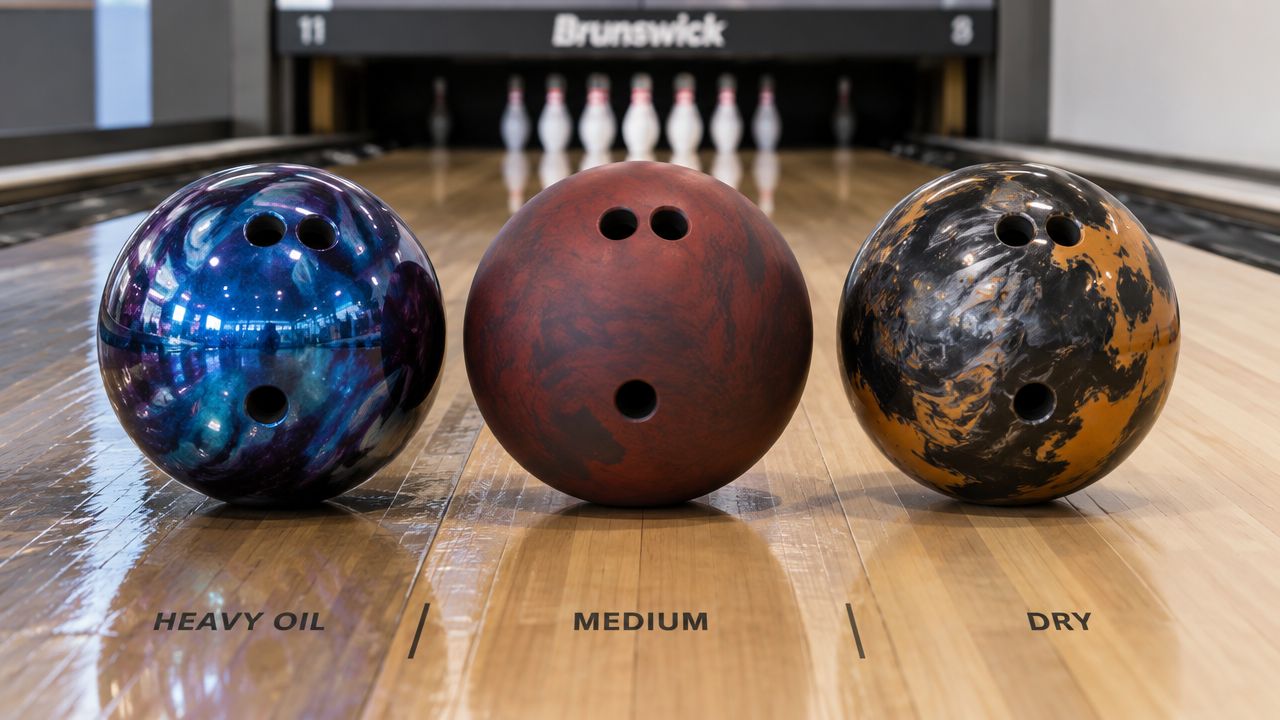
You're standing on a fresh sport pattern, watching your polished reactive ball skid past the breakpoint and finish weak into the 7-pin. The ball isn't defective. You brought a tool built for a different lane. That's the uncomfortable truth behind most searches for the best bowling ball for all lane conditions: no single shell and core can dominate fresh oil, mid-game transition, and burned heads without adjustment.
A good all-condition ball is better understood as a tunable benchmark. Its coverstock gives you a usable starting reaction, its core controls timing and flare, and its surface lets you move that reaction earlier or later. The right recommendation isn't the ball with the biggest hook rating. It's the ball you can keep matched to the lane as friction develops.
| Lane situation | Starting reaction | Useful ball profile | Adjustment |
|---|---|---|---|
| Fresh sport pattern | Early, rounded traction | Medium-strength solid or control hybrid | Use a duller surface |
| Typical house shot | Balanced read and continuation | Benchmark reactive | Keep the factory finish or tune modestly |
| Transition and burn | Clean fronts, controlled response | Pearl reactive or urethane-style control | Use a smoother or cleaner surface |
Table of Contents
- Why the All-Conditions Promise Is Mostly Hype
- What All Lane Conditions Actually Means
- Coverstock, Core, and Surface Building Blocks
- Mapping Benchmark Balls to Oily, Medium, and Dry Patterns
- Head-to-Head Benchmark Ball Comparison
- Surface Prep That Turns One Ball Into Three Reactions
- 2026 USBC Rules That Shape Your Real Buying List
- Final Recommendations by Bowler and Lane Profile
Why the All-Conditions Promise Is Mostly Hype
A tournament bowler can make a polished ball look brilliant on a medium house shot, then watch it fail on a fresh sport pattern. The outside of a tighter pattern offers less recovery room, while oil in the heads delays traction. A shiny cover that needs friction may never turn, leaving a straight, weak shape instead of a controlled pocket entry.
Marketing calls modern equipment versatile because one ball can cover a broad reaction range. That does not make its motion identical on every lane. A high-performance solid that handles fresh oil can burn energy once the heads develop friction. A clean pearl that clears transition can skid too far through fresh oil and lose continuation.
The lane changes faster than the box label
USBC's lane-condition guidance separates sport patterns, challenge conditions, and standard house shots by oil distribution. Sport patterns are typically at an oil ratio of 4:1 or lower, challenge conditions run about 4:1 to 8:1, and standard house shots used in many leagues are 8:1 or higher, with an average pattern length around 40 feet. Lower ratios create less forgiveness, so a ball that looks comfortable on a house shot may lack the control required on a flatter sport pattern.
“All conditions” therefore describes a tunable benchmark, not a universal ball specification. The coverstock family sets the starting traction, the core numbers influence timing and flare, and surface prep changes how soon the ball reads. Those parts must work together across the fresh, mid-game transition, and burn. A medium-strength benchmark with adjustable surface usually travels farther across those stages than an extreme oil ball or an ultra-clean pearl.
Surface work and layout changes can also alter the same ball's reaction sharply. I do not sell a magic ball that never needs maintenance. I sell a starting shape with enough room to adjust.
Shop rule: If a ball only works when the lane is exactly right, it is not an all-condition benchmark. It is a condition-specific piece.
A serious arsenal still needs complementary equipment. Start with the benchmark, then move to a stronger ball when the fresh demands more traction, a cleaner ball when the fronts go, or a urethane-style option when control matters most. The goal is not forcing one ball through every transition. It is choosing a benchmark that remains useful longer than an extreme design.
What All Lane Conditions Actually Means
“All conditions” is a tunable benchmark, not a promise that one ball handles every lane unchanged. Define the lane through three variables: oil volume, pattern length, and oil ratio. Together, they show how soon the ball should read, how much traction it needs, and how much recovery room exists when your shot misses inside or outside.
Oil volume describes how much conditioner sits on the lane. More oil generally delays friction, although placement still determines the ball shape. Pattern length, measured in feet, shows how far the ball travels before reaching the dry backend. Longer patterns usually ask for earlier traction, while shorter patterns can make a strong cover respond too soon.
Oil ratio compares the conditioner in the middle with the amount toward the outside. Higher ratios generally provide more built-in miss room. Lower ratios create a flatter, less forgiving look, where overreaction and underreaction become harder to hide. USBC places sport patterns at 4:1 or lower, challenge patterns around 4:1 to 8:1, and standard house shots at 8:1 or higher. The USBC lane-condition framework provides the right classification starting point.
A practical lane-reading routine
Start with the lane sheet if your center or tournament provides one. If it does not, watch the ball and answer three questions:
- Where does the ball first read? Early traction points toward more surface or a stronger cover.
- How far does it travel before changing direction? Excessive skid suggests earlier traction, while an early hook calls for a cleaner surface.
- How much does a small miss change the result? Large over-under reaction usually means the pattern offers less forgiveness.
Read the lane in stages. On the fresh, a benchmark should create enough traction without burning up its energy. Mid-game, it must clear the fronts while still reading the middle. On a dry or burned lane, it needs control and length instead of another early move. That is why a medium-strength cover with adjustable surface usually travels across more conditions than an extreme oil ball or an ultra-clean pearl.
The lane-condition buckets remain broad, not rigid. Lane length and breakpoint placement can change the correct target, so USBC's lane-reading material deserves more attention than a ball's marketing category.
Do not use visible oil as a precise measurement. Treat it as a clue, then confirm it with ball motion. Wet-looking heads with an early read can indicate midlane friction. Dry-looking fronts with continued skid can point to carrydown or a tight breakpoint. That observation determines whether you adjust surface, move your feet, or change balls.
Coverstock, Core, and Surface Building Blocks
A benchmark ball is a three-part system. Coverstock sets the traction family, core geometry controls timing and flare, and surface preparation determines when the cover meets friction. “All lane conditions” works only when those three pieces leave room for adjustment.
Reactive solids read earliest and create a smoother, stronger arc. Reactive hybrids sit between solid and pearl, combining earlier traction with more continuation downlane. Reactive pearls clear the front more easily and respond later. Urethane-style covers create earlier friction with a controlled, rounded shape. Use this guide to reactive, urethane, and plastic bowling balls to compare how those cover families behave.
Core numbers change the timing
RG, or radius of gyration, helps describe when a ball moves from skid into roll. Differential describes axis migration and influences track flare. USBC's core guidance explains that greater flare exposes fresh coverstock to the lane and increases friction. It also limits differential radius of gyration to 0.060 inches. USBC's core-properties guidance gives the technical basis for comparing these specifications.
Lower RG generally promotes earlier roll, while higher RG supports more length. Higher differential increases flare and hook potential. For a benchmark ball, I prefer a medium RG with moderate-to-high differential. That combination gives the ball enough midlane read on fresh conditions without forcing an overly strong reaction after friction develops. An aggressive cover can still overpower that core once the fronts begin to go.
Surface is your reaction dial
Surface can turn one benchmark into different lane-condition tools. A lower finish, such as 500 to 1500 grit, creates earlier traction for heavier oil. A cleaner finish, such as 3000 to 4000 grit or polish, adds length and a later response for drier or transitioning lanes. Bowling.com's surface guidance describes this practical adjustment range.
| Layer | Key variable | Typical range | Effect on motion |
|---|---|---|---|
| Coverstock | Solid, hybrid, pearl, urethane-style | Family-dependent | Sets traction and response shape |
| Core | RG and differential | Medium benchmark profile | Controls roll timing and flare |
| Surface | Grit, compound, polish | 500 to 4000 grit and polish | Moves reaction earlier or later |
The combination matters more than any single specification. A mid-differential core with a solid cover at a duller finish becomes an earlier-reading option for oil. The same core paired with a cleaner pearl cover and polish produces more length and backend response. The box finish is only the starting point. Your surface work determines whether that ball can transition from fresh to mid-game and then remain usable as the lane burns.
Mapping Benchmark Balls to Oily, Medium, and Dry Patterns
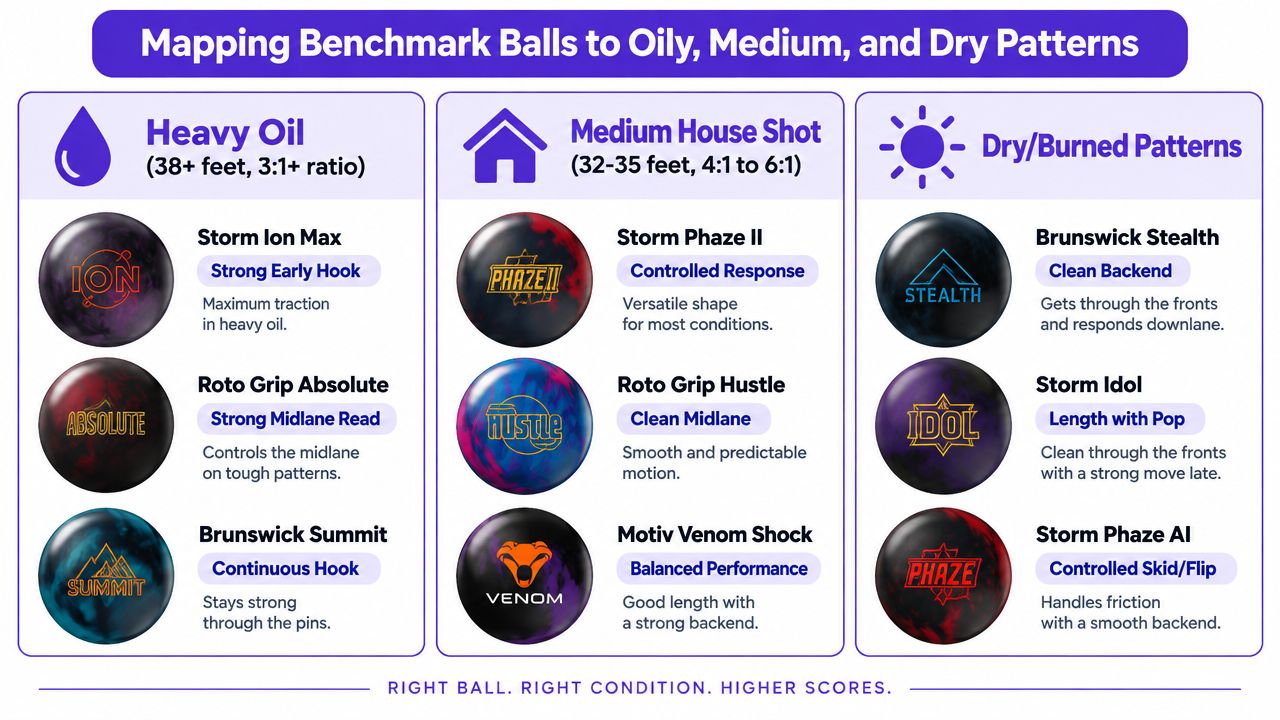
Rank benchmark candidates by transition quality, not maximum hook. On fresh oil, the ball must read the heads without jerking off the dry. Through the middle of a session, it should clear the front and keep the breakpoint readable. On a burned lane, controlled continuation matters more than raw recovery.
Heavy oil
For heavier or longer conditions, start with a solid or hybrid reactive cover. A duller finish, often in the 500 to 1500 grit range, creates earlier traction. Pair it with a medium RG and moderate-to-high differential when you need earlier roll and enough flare to reach the pocket through oil.
That setup spends energy quickly. It works on fresh oil, then can lose continuation after friction builds. If the ball reads before the breakpoint and stops driving, check the surface before changing your target. Too much roughness can make a strong ball run out of energy early.
Medium house shots
A medium-strength reactive benchmark remains the safest one-ball starting point for many league bowlers. It should read the midlane, recover from a reasonable inside miss, and avoid the violent response that makes transition hard to manage. A hybrid or controlled solid usually provides that balance.
House shots can conceal a poor match because their wider oil distribution forgives small errors. Standard house shots are commonly described as 8:1 or higher, while sport patterns are 4:1 or lower. The USBC sport-bowling guidance explains why a ball that looks ideal in league may need a surface change before tournament use.
Dry and burned lanes
When the fronts go away, move to a pearl reactive or urethane-style control piece. The goal is to limit early friction and preserve a predictable shape. Urethane suits lanes that demand control without a sharp backend. A cleaner pearl fits a lane with downlane friction but heads too dry for a strong solid.
Read the beginner's guide to reading bowling lane oil patterns before assigning a ball to any category. Pattern names do not replace ball motion. Choose the benchmark that controls the transition, then adjust ball, hand position, or surface before chasing the pocket every frame.
Head-to-Head Benchmark Ball Comparison
A benchmark ball earns its place by transitioning cleanly, not by claiming to handle everything. The useful comparison is how each construction behaves after drilling and surface work across fresh, mid-game, and burned lanes. Storm IQ Tour models, the Storm IQ Tour Emerald, Motiv Venom-style control pieces, and urethane options cover different parts of that job.
Verified data does not provide the exact RG, differential, intermediate differential, box finish, or measured shop results for specific 2026 models. Do not guess those specifications. Ask the pro shop to confirm the manufacturer's current technical sheet before drilling, especially when a family includes multiple cores or cover formulations.
| Ball category | Coverstock | RG / differential | Box finish | Best lane condition | Verdict |
|---|---|---|---|---|---|
| Benchmark solid reactive | Solid reactive | Verify current model sheet | Factory finish, then tune | Fresh to medium oil | Best starting point for broad use |
| Benchmark hybrid | Reactive hybrid | Verify current model sheet | Factory finish or modest surface | Medium oil and transition | Best balance of traction and length |
| Benchmark pearl | Reactive pearl | Verify current model sheet | Cleaner factory finish | Medium to dry transition | Useful after the fronts develop friction |
| Urethane-style control | Urethane-style | Verify current model sheet | Smooth control surface | Drying heads and short control needs | Best for rounded, non-flippy motion |
My direct ranking
1. Controlled hybrid for the widest range. A benchmark hybrid is my first choice for a bowler who needs one primary ball. On medium oil, it clears the front without losing midlane read. As the lane transitions, it usually gives you room to move inside without producing an abrupt breakpoint. That makes it the strongest bridge from fresh to mid-game.
2. Benchmark solid for demanding fresh. On fresh sport, I choose a solid reactive or controlled hybrid with enough surface to read the heads. The reaction should blend the lane and recover from a reasonable inside miss. If the ball only gets through the pattern when you add speed, it is the wrong fresh-ball match.
3. Pearl or urethane-style control for burn. Once the heads are dry, a strong solid spends energy too early. A pearl reactive provides length and continuation when downlane friction remains available. Urethane-style control is the safer choice when the lane is over-frictioned and you need a rounded, non-flippy shape.
The coverstock family sets the range, while core numbers and surface prep determine how cleanly the ball moves through each phase. That combination matters more than the name on the box.
My verdict: Buy the controllable benchmark first. Add stronger traction or cleaner length only after you identify whether your regular miss comes from fresh oil, mid-game transition, or burned heads.
Surface Prep That Turns One Ball Into Three Reactions
Surface work controls when the coverstock starts reading and how much energy reaches the breakpoint. Lower grit creates earlier traction, while finer grit or polish adds length, as explained in Bowling.com's ball-surface guide.
Clean the ball before changing its surface. Lane oil can hide the texture you intend to apply. Work evenly around the shell, keep the pad moving, and maintain consistent pressure. Uneven preparation can produce an inconsistent reaction that looks like a layout or core problem.
Three useful starting surfaces
- Early traction: Use a lower grit finish in the 500 to 1500 range when the heads are oily and the ball needs to read sooner. I use this direction on demanding fresh conditions when a polished benchmark skates too far.
- Balanced benchmark motion: Use a medium finish around 2000 grit when you need front-lane traction with downlane continuation. For a one-ball player, this is usually the most useful starting point.
- Cleaner length: Move toward 3000 to 4000 grit or polish after the lane transitions and the ball burns energy before the breakpoint. It should clear the front more easily. Polish will not make an overly strong cover suitable for a bowler with limited speed and high rev rate.
Record every change. A pad, compound, and polish can create different textures even when the grit number looks similar. Careless blending can also make one side of the ball read differently from the other.
Follow the manufacturer's preparation instructions before making a major adjustment. If the ball still misses the intended shape, inspect the drilling layout, release, and lane condition. Bowling Gear Reviews' bowling-ball drilling-layout guide explains why the same coverstock and core can produce different motion after drilling.
Surface prep changes the timing and shape of hook. It does not create a new coverstock or remove the ball's underlying reaction.
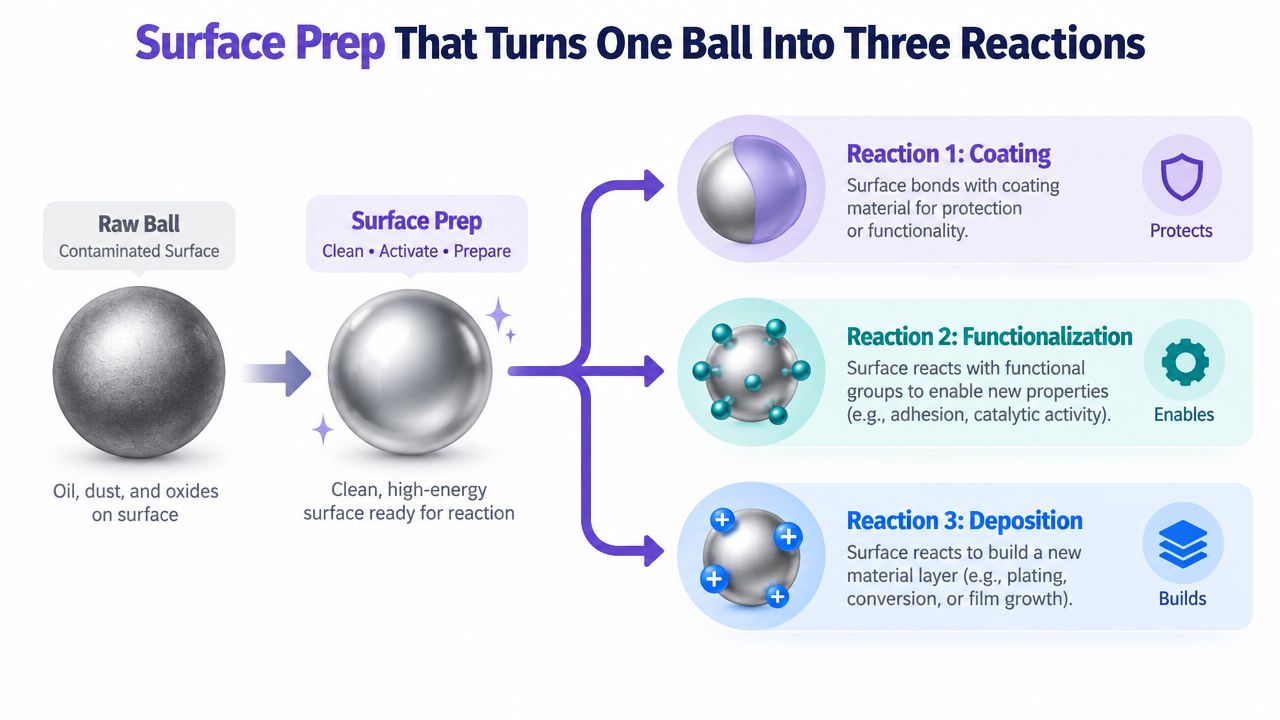
A short visual demonstration shows why preparation changes the read rather than adding or removing hook.
2026 USBC Rules That Shape Your Real Buying List
Your benchmark ball must be legal for the competition you enter. USBC sets the maximum ball weight at 16.00 pounds, and approved equipment must retain its original brand name, ball name, and serial number. Starting Jan. 1, 2027, re-engraved or unidentifiable serial numbers will not be permitted in certified competition. Check The USBC playing rules document before drilling a ball intended for sanctioned events.
The 2026 buying issue is slow oil absorption in high-performance balls. USBC stated that balls with oil absorption times over 90 minutes must meet minimum 78D hardness to be approved for sale in the United States by Dec. 31, 2025. National events such as the U.S. Open, USBC Masters, PWBA Tour, and USBC Queens prohibit those balls. Compliant models remain permitted in some national championships, including the USBC Open Championships and Women's Championships. Use the USBC playing rules document as the final authority for event-specific eligibility.
| Rule | 2026 requirement | What it means for buyers |
|---|---|---|
| Weight | 16.00 pounds maximum | Select a legal weight your physical game can control |
| Identification | Original brand, ball name, and serial number | Reject altered or unidentifiable equipment |
| Slow oil absorption | Over 90 minutes requires 78D hardness for approval | Verify the model's approval status |
| Restricted events | Some national events prohibit these balls | Check tournament policy before packing the ball |
| Approval | USBC-approved equipment | Confirm approval instead of trusting performance copy |
A familiar coverstock description does not make an unapproved ball legal. Have your pro shop verify the approval marking and exact model before drilling. That check matters most when your benchmark is expected to transition across fresh, mid-game, and burn conditions. A ball that performs well on a house shot is still a poor buying choice if the event rules prohibit it.
Final Recommendations by Bowler and Lane Profile
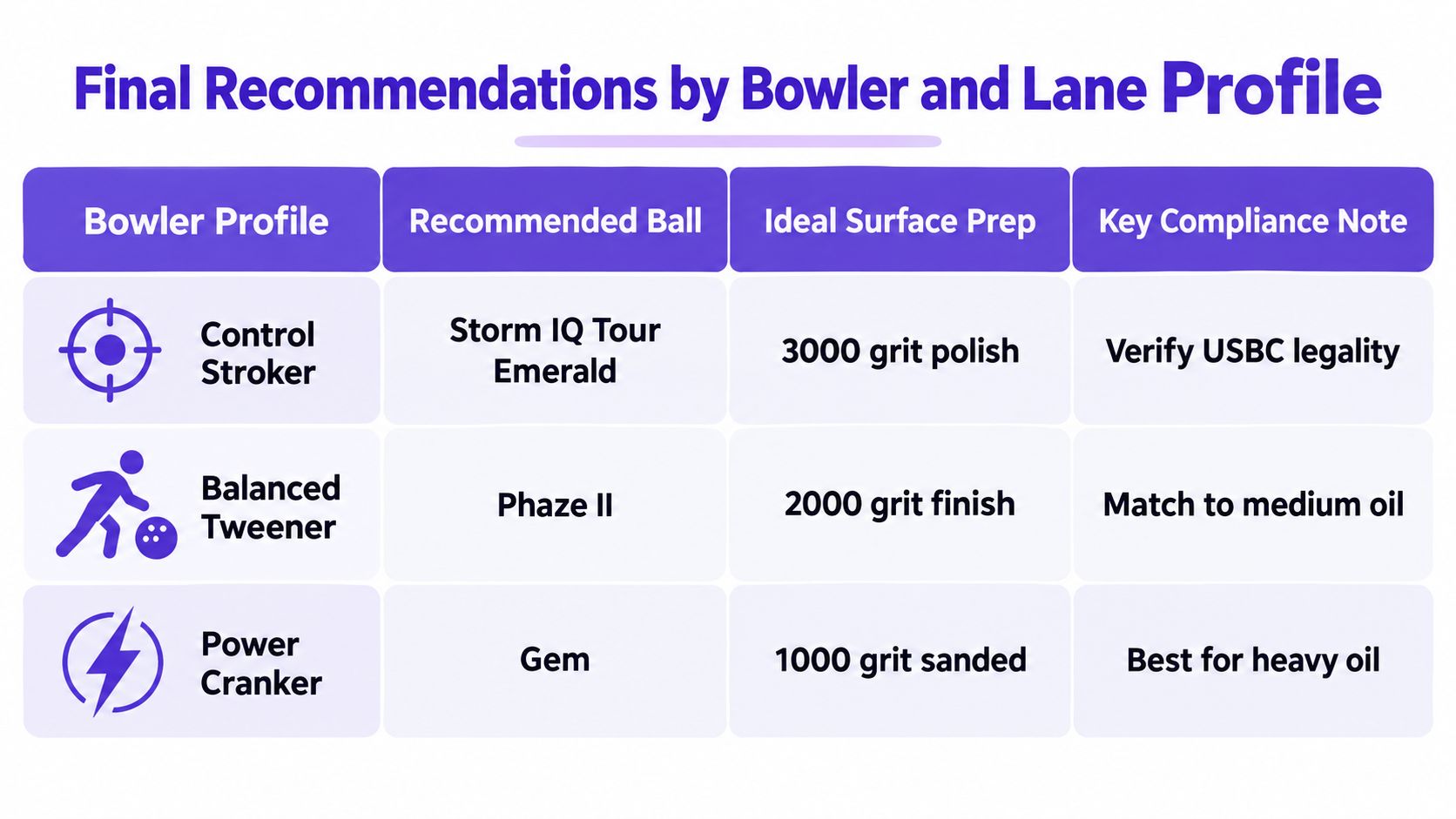
The best bowling ball for all lane conditions is a tunable benchmark, not a magic ball that dominates every pattern. Choose the coverstock family, core numbers, and starting surface around your release, then rank the ball by how cleanly it transitions from fresh to mid-game and burn.
League house-shot bowler
For a league bowler on a forgiving house shot, choose a controllable benchmark reactive such as the Storm IQ Tour Emerald when your release can use its shape. If forgiveness matters more than total hook, the Ebonite Maxim hybrid is easier to manage. Both options make more sense than a maximum-flare ball that forces you to chase the lane.
Use the manufacturer's box surface first. On the fresh, if the ball jumps off the dry, smooth the reaction. If it skates through the heads, add texture before moving farther inside. A house shot gives you recovery room, but it can also hide poor timing and an overly aggressive fit.
Sport-pattern tournament player
Tournament players need a readable benchmark that blends through the midlane and continues without a violent breakpoint. A Storm IQ Tour style ball or a controlled Motiv option fits that job better than a high-flare piece. On a longer or flatter fresh pattern, use an earlier surface when the ball misses the midlane. The target is traction you can read and a rounded breakpoint you can repeat.
That choice must also fit the event. Verify the model's current USBC approval and tournament restrictions before relying on any high-performance or slow oil-absorbing design. A ball that is effective in one certified event can be restricted in another.
Casual multi-condition bowler
A casual bowler should buy predictable motion rather than technical complexity. The Columbia 300 Eruption or Pyramid Path Rising offers a practical starting point when you need length and a forgiving response across changing conditions. Keep the surface manageable. If ball speed is modest, a dull finish can make the ball read too early and lose energy, even when the lane appears oily.
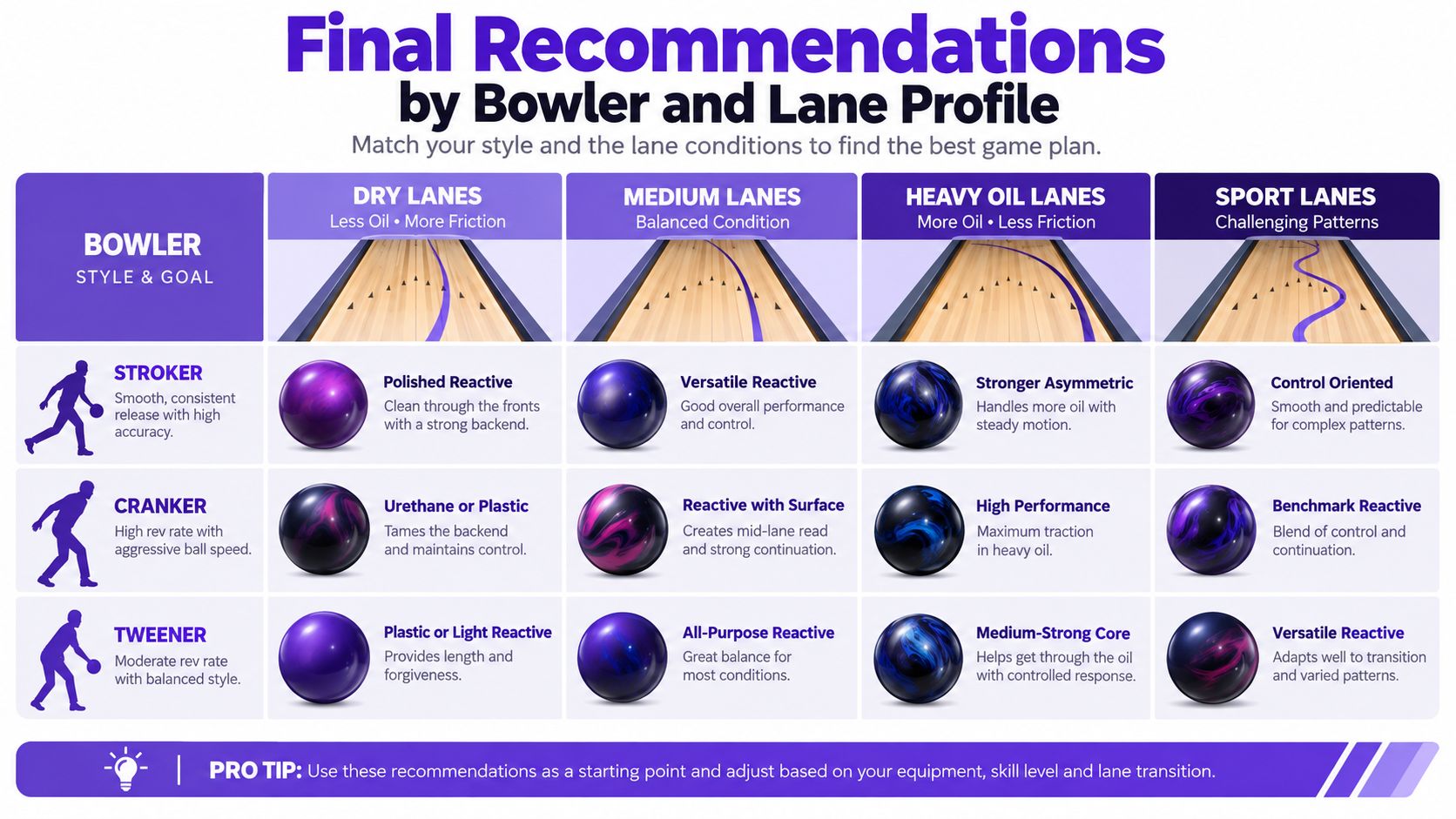
For a one-ball plan, select a medium-strength cover, confirm the core numbers, keep the surface clean, and make small surface changes as the lane moves. No ball stays optimal from fresh to burn without adjustment. Your benchmark earns the all-conditions label by giving you usable reactions after tuning, not by hooking everywhere.
Bowling Gear Reviews publishes hands-on bowling-ball reviews, comparisons, and lane-condition guides covering coverstock, core design, surface prep, and practical fit. Visit Bowling Gear Reviews to compare current models and match a benchmark ball to the lanes you bowl on.
