

You're halfway through league night, and your ball choice has stopped making sense. The solid you brought reads too early and burns energy before the pocket, while the pearl skids past the breakpoint and makes a sharp move too late. A hybrid reactive ball can give you a more manageable middle option, but its real value goes beyond sitting between two coverstock types. The right hybrid can help you read transition, control changing friction, and decide when your next move should involve your feet, your surface, or a different ball.
"Introduction to Hybrid Reactive Bowling Balls"
A hybrid is often the ball a bowler reaches for when the lane is giving mixed signals. You need enough traction to pick up the midlane, but you also need the ball to retain energy for the backend. That balance makes hybrid reactive bowling balls useful as benchmark equipment, especially when you're still learning how the lane is changing from frame to frame.
Reactive resin bowling balls emerged in the early 1990s, when manufacturers began adding reactive resin additives to a urethane base. Those additives increased porosity and created microscopic oil-absorbing pores, which helped the cover generate more friction and hook potential. Bowling This Month's coverstock overview describes how those pores influence traction, while USBC research documents the early development of reactive coverstocks.
The hybrid category developed as manufacturers blended solid reactive and pearl reactive materials in one shell. The result isn't automatically the perfect ball for every lane, but it can offer a useful combination of midlane read, front-lane cleanliness, and continuation. On medium oil, that combination often gives a bowler more room to identify whether the lane is drying in front, holding in the middle, or becoming too slick at the breakpoint.
This guide focuses on that practical role. The seven picks are evaluated by coverstock family, core influence, motion shape, surface needs, and the type of bowler most likely to benefit. Because product availability and pricing on Amazon can change, check the current listing, weight options, drilling policy, and seller details before ordering.
You'll first learn how hybrid covers work, then compare solids, pearls, and hybrids directly. After that, the focus shifts to surface preparation and league-set transition. The buying section presents seven Amazon options, and the final checklist covers fit, drilling, cleaning, and long-term reaction.
Table of Contents
- "What Hybrid Reactive Coverstocks Are and How They Work"
- "Solid vs Pearl vs Hybrid Reactive Compared"
- "How Hybrid Motion Matches Lane Conditions and Surface Prep"
- "Why Hybrids Change Transition and When to Stay or Switch"
- "7 Best Hybrid Reactive Bowling Balls Tested for 2026"
- "Choosing and Caring for Your Hybrid Reactive Ball"
"What Hybrid Reactive Coverstocks Are and How They Work"
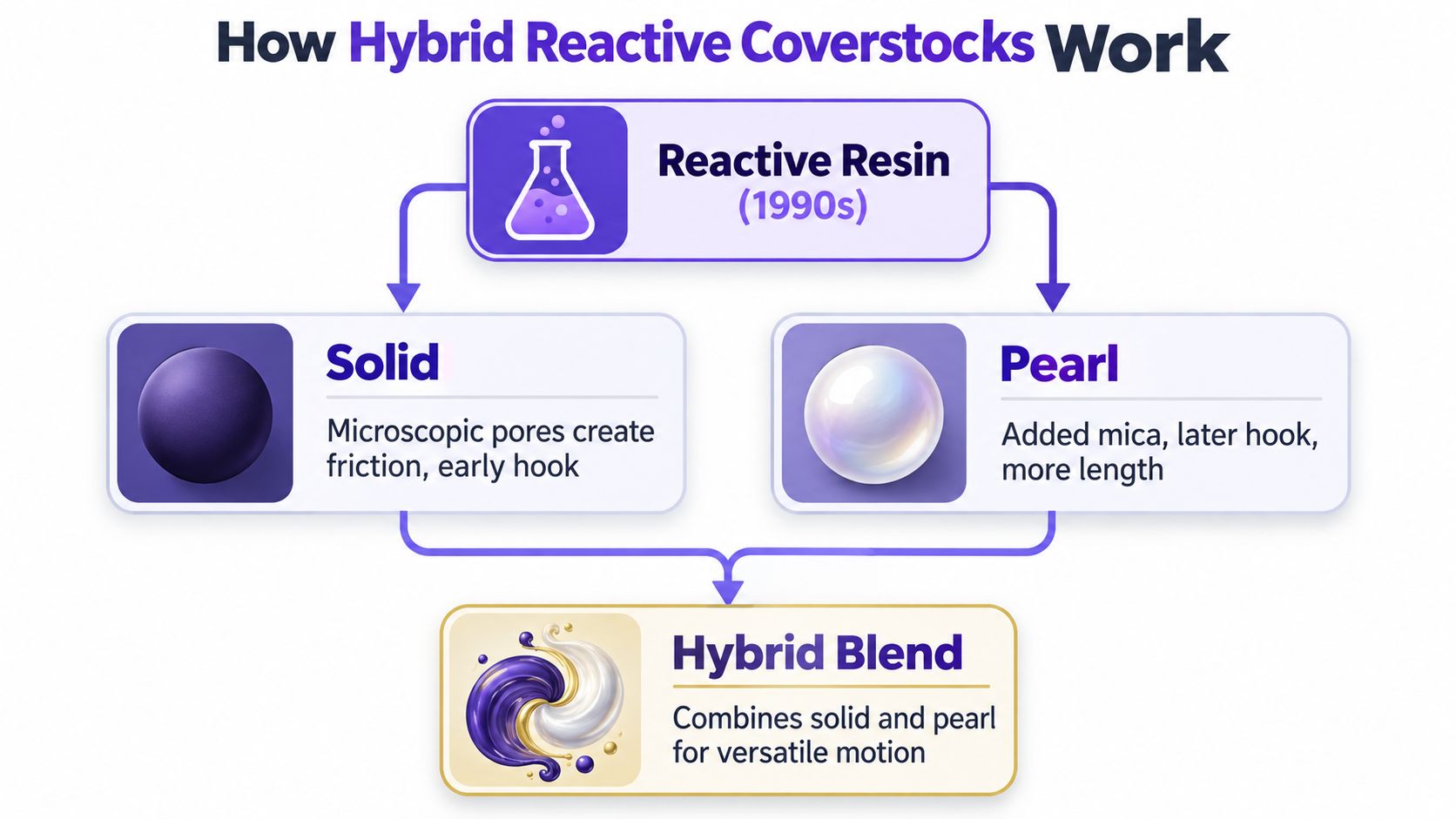
Start with the coverstock, because the cover is the part of the ball that touches the lane. A plastic ball slides for a long distance. Urethane creates a smoother, earlier friction response. Reactive resin adds microscopic pores that absorb oil and increase the cover's ability to create traction. Those pores are the reason reactive balls can produce more defined hook shapes than traditional plastic or urethane equipment.
Manufacturers then adjust the chemistry and texture of the reactive shell. A solid reactive cover usually presents a stronger, earlier read because its surface is built to create traction sooner. A pearl reactive cover generally moves more easily through the front of the lane and produces a more responsive move when it encounters friction. A hybrid combines elements of both rather than placing one layer over another.
A paint-mixing analogy
Think of solid and pearl reactive materials as two paints. One is thicker and grips the canvas quickly. The other spreads more cleanly before becoming bright and responsive. Mixing them doesn't produce a perfectly predictable midpoint, but it creates a new blend with characteristics from both ingredients.
On the lane, that blend can provide more midlane traction and control than a pearl, while offering cleaner front-lane movement and stronger continuation than a solid. The core still matters. Differential, RG, intermediate differential, drilling layout, speed, and rev rate all influence how much the cover's personality appears.
Plain-language definition: A hybrid reactive bowling ball uses one coverstock blend to combine the traction of solid reactive material with the length and response associated with pearl reactive material.
Oil absorption and surface texture shape the reaction more directly than a dramatic softening process. USBC hardness testing found that reactive balls changed by only about 2.1 and 2.2 hardness points on average after friction testing that simulated lane equipment and ball-return contact. The USBC hardness research report notes that reactive covers showed little to no change compared with urethane.
That means a hybrid usually doesn't become a completely different ball just because you've thrown it for a while. Cleaning, oil removal, and restoring the intended surface are more important than waiting for the cover to “break in.”
"Solid vs Pearl vs Hybrid Reactive Compared"
The easiest way to understand the three families is to watch where each one begins its work. A solid tends to pick up friction sooner and create a rounder, more controlled arc. A pearl usually clears the front more easily, saves energy, and responds more sharply when it reaches dry boards. A hybrid tries to connect those phases without becoming as early as the solid or as dependent on a precise breakpoint as the pearl.
That description is useful, but it isn't a complete ball reaction. A strong asymmetric core can make a hybrid read much earlier than a weaker symmetric design. A high-differential core can increase flare and expose fresh cover to the lane, while drilling can shift the timing and shape of the motion. The label tells you the cover family, not the entire ball personality.
| Coverstock Type | Midlane Traction | Length and Backend | Best Lane Fit |
|---|---|---|---|
| Solid reactive | Strong and earlier | Smoother, more continuous | Higher-volume or oilier conditions |
| Pearl reactive | Cleaner and later | Sharper or more angular response | Drier fronts, transition, or more length |
| Hybrid reactive | Moderate to strong, with control | Balanced length and continuation | Medium oil and benchmark use |
The practical trade-off
Choose a solid when your ball is skidding too far and refusing to read the middle of the lane. Choose a pearl when your solid is burning up early or when the fronts have opened enough that you need the ball to clear them. Choose a hybrid when neither extreme gives you a reliable read.
For bowlers comparing coverstock families more broadly, this reactive, urethane, and plastic ball comparison provides useful context. The key point is simple: hybrid doesn't mean average. It means the manufacturer has designed the cover to manage a particular balance of friction and energy.
"How Hybrid Motion Matches Lane Conditions and Surface Prep"
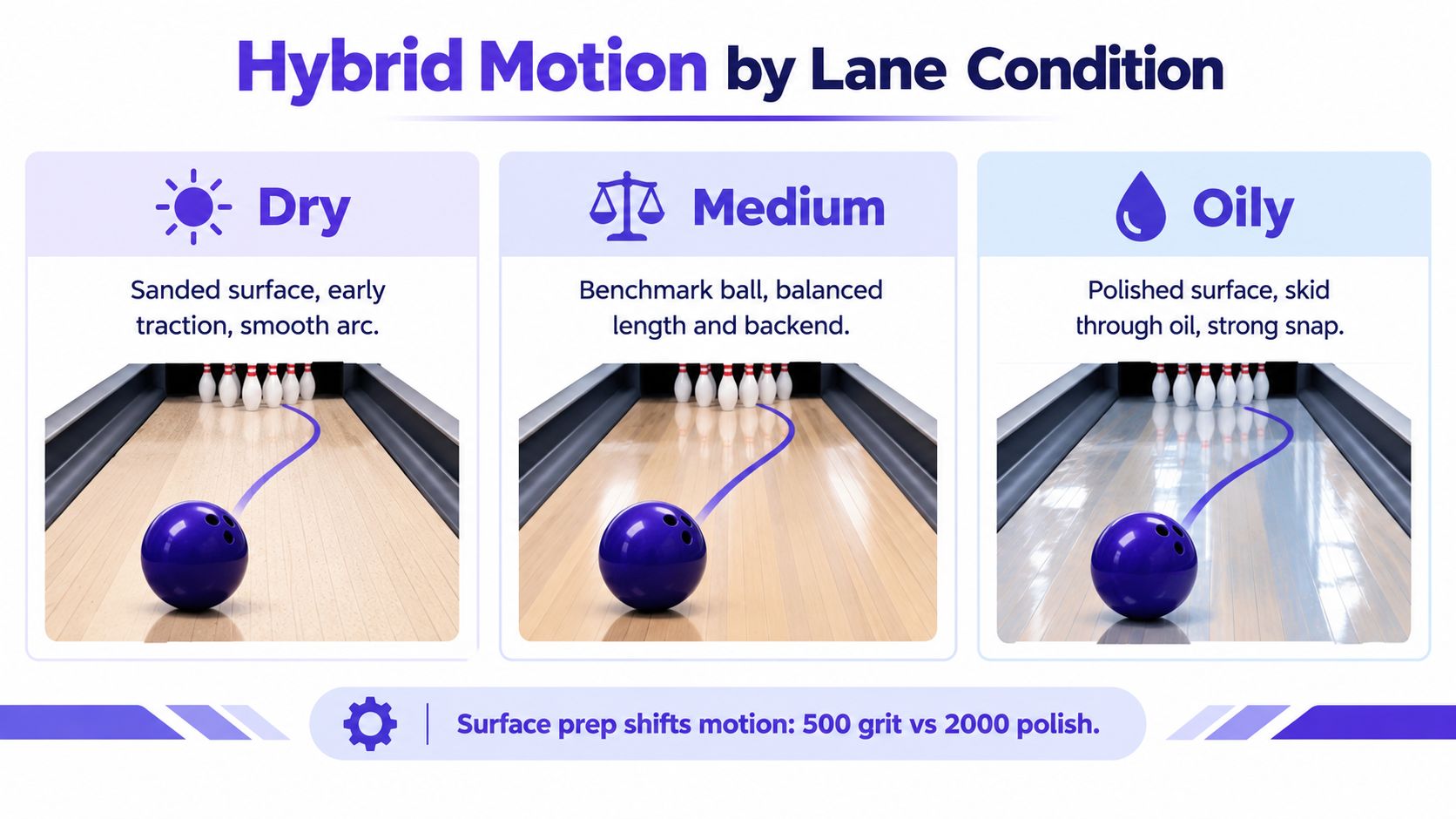
A hybrid can be versatile, but versatility depends on the surface matching the lane. On a dry lane, a rough finish may make the ball pick up too soon, especially for a bowler with a high rev rate or slower speed. On an oily lane, a polished hybrid may push too far before it finds enough friction. The same ball can look smooth and controllable in one setting, then either hook immediately or skid unpredictably in another.
USBC coaching guidance connects sanded finishes with high-volume and medium-volume oil, while benchmark balls are associated with medium conditions. The USBC coaching guide supports a useful starting principle: surface preparation can be as important as the coverstock name.
Match the finish to the problem
- Too early: A smoother or more polished surface can help the ball clear the front, but don't use polish to hide a ball that is too strong for the lane.
- Too long: A controlled sanding process can create earlier traction and a smoother transition, provided the lane has enough oil to support it.
- Unpredictable reaction: Clean the ball first. Oil in the pores can make a reactive cover appear weaker in the midlane and more erratic at the breakpoint.
- Changing lane volume: Adjust gradually. A small surface change is easier to evaluate than several changes made at once.
USBC's equipment manual categorizes coverstocks by oil-absorption time, including slow oil-absorbing covers that take 90 minutes or longer to absorb oil. It also lists test ranges such as 2:15 to 4:00 and greater than 4:00, showing why two hybrid balls can have noticeably different timing even when both carry the hybrid label. The USBC equipment specifications manual offers the technical background for those absorption categories.
For a deeper explanation of reading oil movement before you change equipment, use this beginner's guide to bowling lane oil patterns.
A hybrid's intended finish also matters after purchase. Clean the cover after bowling, inspect it under good light, and ask your pro shop to restore the surface when the reaction no longer matches your notes. Reactive covers are relatively stable under use, so surface maintenance usually does more for consistency than throwing the ball until it changes.
"Why Hybrids Change Transition and When to Stay or Switch"
The first shot of a league set and the last shot of that set are not played on the same lane. Every ball removes some oil and changes the friction map. The important question isn't only whether your hybrid hooks. It's whether its reaction changes gradually enough for you to make useful moves.
USBC bowling technology research found that high-differential reactive balls removed the most oil and forced bowlers to move the most. Lower-differential reactive balls removed 4.2% less oil than their high-differential counterparts and helped bowlers move less over the night. The USBC coverstock technology study gives a practical reason to consider more moderate equipment when transition control matters more than maximum hook.
Read the change, not the label
A hybrid can be a strong starting point when you want the lane to reveal itself. If the ball rolls through the pocket with a stable shape, stay with it and make small moves. If it begins reading earlier but still enters the pocket properly, move your feet and target rather than immediately changing balls.
The switch becomes clearer when the ball stops making the same shape:
- Stay on the hybrid when the pocket remains available and the ball's read is predictable. Move inside as the fronts dry, but keep watching whether the backend continues.
- Switch to a solid when the ball skids too long through the oil or loses its midlane read. The stronger traction can help the ball pick up earlier.
- Switch to a pearl when the hybrid starts burning up in the front and fails to retain energy. The cleaner cover can push through the worn track area.
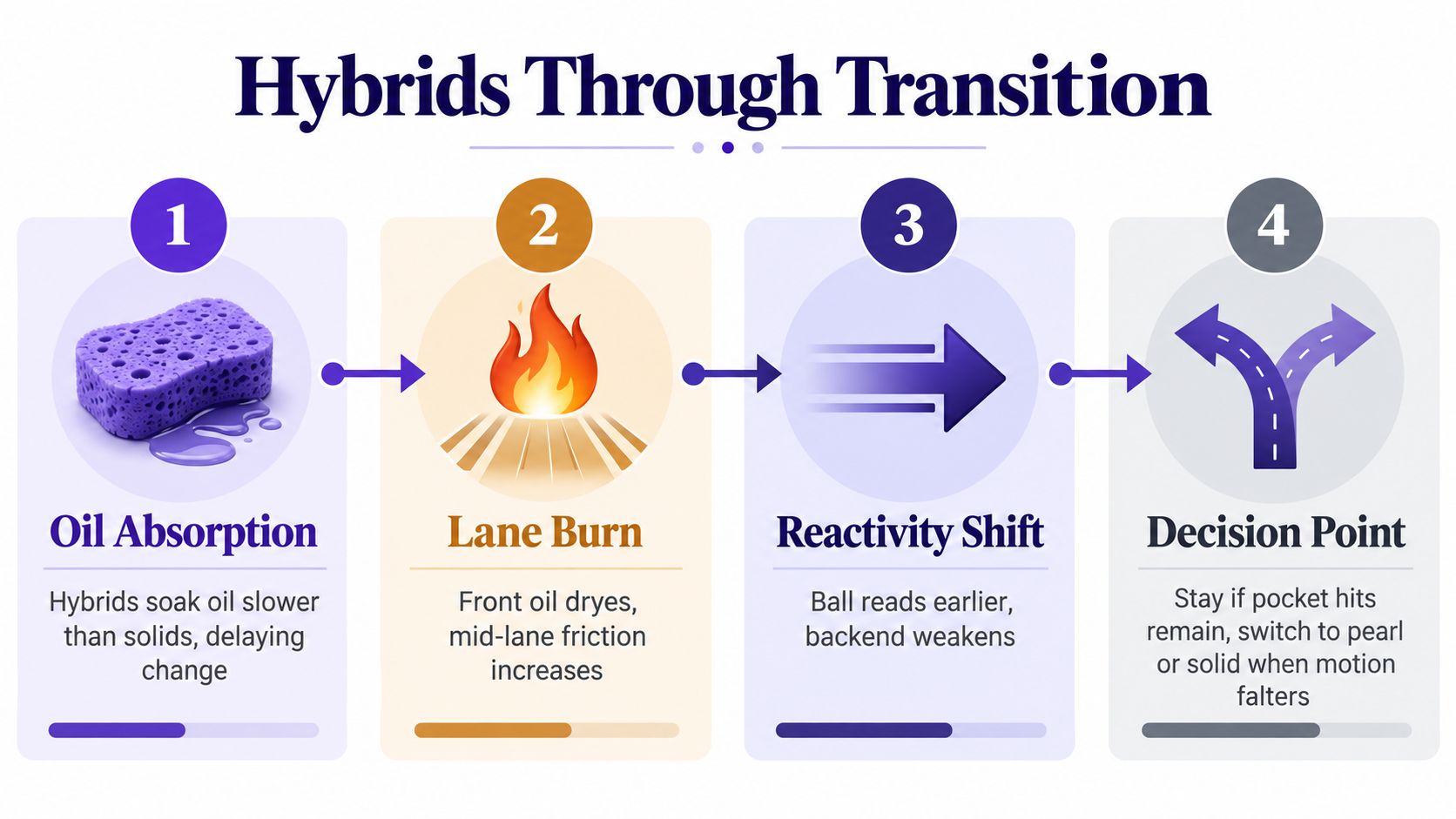
USBC research also found that fast oil-absorbing coverstocks affected transition and forced bowlers deeper inside. The continued USBC bowling technology research helps explain why a hybrid can be valuable when you want traction without creating the fastest possible lane change.
The best hybrid isn't necessarily the one with the biggest hook. It's the one that lets you recognize transition early, make a controlled move, and keep your physical game stable.
"7 Best Hybrid Reactive Bowling Balls Tested for 2026"
The following shortlist is organized by use case rather than an invented universal ranking. Amazon availability can change, so verify the current seller, weight, drilling options, and return policy before checkout. Product specifications and release details should also be confirmed on the live listing.
1. Storm EquinoX Hybrid
Best for: League bowlers who want a strong benchmark with continuation.
The Storm EquinoX Hybrid uses an A2S Hybrid Reactive cover and a Solarion A.I. asymmetrical core. The design is intended to bridge the stronger traction of a solid with the cleaner response associated with a pearl. Its stated motion is traction-forward through the midlane, followed by controlled continuation rather than an abrupt change of direction.
The ball is most suitable for bowlers who find a pearl too clean but don't want a solid that burns energy immediately. Balanced players can use it as a first read on medium conditions, while speed-dominant bowlers may appreciate the added traction.
- Pros: Strong benchmark role, controlled continuation, useful bridge between solid and pearl.
- Cons: It may be too much ball for dry lanes or bowlers who already create substantial friction.
- Surface note: Start with the factory finish, then adjust only after observing whether the ball reads too early or too late.
2. Roto Grip Gremlin Tour-X
Best for: League regulars seeking a readable hybrid shape.
The Gremlin Tour-X belongs to Roto Grip's hybrid family and is positioned as a transition-friendly option between stronger solid equipment and cleaner pearl pieces. Its appeal is the ability to blend midlane read with a defined backend without demanding an extreme move immediately.
It suits bowlers who want a ball that shows them where the lane is changing. That makes it useful for house-shot practice and league play, particularly when you're building a small arsenal and need one ball to provide a reliable reference.
- Pros: Readable shape, practical benchmark potential, balanced reaction.
- Cons: Bowlers needing maximum oil traction may prefer a stronger solid.
- Surface note: Preserve the box surface first. A surface change should solve a specific reaction problem, not add hook.
3. Storm Phaze V
Best for: Balanced bowlers who value a smooth but responsive benchmark.
The Storm Phaze V is a familiar hybrid-style choice for bowlers who want the cover to read the lane without producing an overly sharp breakpoint. Its role makes sense for players transitioning from entry-level reactive equipment into a more complete ball lineup.
The ball can help a bowler learn to separate front-lane, midlane, and backend reaction. If it begins too early, a cleaner surface may restore length. If it skids too long, controlled surface adjustment can bring the midlane read back.
- Pros: Strong learning tool, versatile motion, suitable for a broad range of league styles.
- Cons: It isn't a substitute for a dedicated heavy-oil solid or a very clean transition pearl.
- Surface note: Ask a pro shop to match the finish to your speed and rev rate rather than copying another bowler's surface.
4. Track Stealth Hybrid
Best for: Bowlers who prefer controlled traction over a violent breakpoint.
Track's hybrid coverstock families are part of a broader category that includes multiple manufacturer approaches. The Stealth Hybrid is a sensible option for players who want the ball to pick up in the midlane while maintaining enough response to continue through the pins.
Its value is strongest for bowlers who struggle with over-under. A cover that is too clean may skid past the friction, while an extremely strong shell can hook early on the dry and stop. A controlled hybrid can narrow that gap, although the core and layout still determine how much shape appears.
- Pros: Manageable traction, smooth breakpoint, useful for developing consistency.
- Cons: May require surface work when lanes are heavily flooded.
- Surface note: Use cleaning as the first adjustment before changing the finish.
5. Radical Conspiracy Hybrid
Best for: Tournament-minded bowlers who want a versatile transition piece.
The Radical Conspiracy Hybrid is aimed at bowlers who want a hybrid reaction with enough structure to handle oil but enough continuation to remain useful as the track changes. Its role is less about maximum overall hook and more about maintaining a predictable shape while you move.
This type of ball can work well when you need to keep your angles reasonable. Instead of chasing the pocket with increasingly sharp moves, you can use the hybrid to read the lane and decide whether the next step is a stronger shell or a cleaner cover.
- Pros: Transition utility, controlled overall shape, useful for equipment blending.
- Cons: Bowlers with very low speed may find it stronger than expected on medium conditions.
- Surface note: Keep notes after each session so you know whether the ball is changing because of lane friction or cover contamination.
6. Motiv Trident Tempest
Best for: Bowlers who want a hybrid option with a benchmark purpose.
The Motiv Trident Tempest appears in the reactive-ball marketplace as a hybrid-oriented option for bowlers who want traction and continuation without choosing the most aggressive available shape. Its main appeal is the role it can play between a strong fresh-ball option and a cleaner transition ball.
Treat the hybrid label as a starting point, not a final prediction. Your drilling layout, release, and lane angle can make the Trident Tempest look earlier, smoother, or more responsive than another bowler's version.
- Pros: Useful middle-of-the-lineup role, adaptable motion, good comparison ball.
- Cons: It won't solve every lane problem without the right surface and layout.
- Surface note: Have the ball measured and drilled by a qualified pro shop rather than relying on a generic layout.
7. Track 505C
Best for: Beginners and improving league bowlers building a practical first arsenal.
The Track 505C offers the type of hybrid positioning that helps newer bowlers understand reaction without jumping straight into an extremely strong ball. It can provide enough traction to show the breakpoint while retaining useful continuation when the lane opens.
For a first custom ball, the most important question is whether the bowler can control the shape. A ball that creates more hook than the player can manage often produces forced speed changes and rushed timing. A readable hybrid may support better decisions because the bowler can see how small moves affect the pocket.
- Pros: Approachable benchmark role, useful for skill development, practical league fit.
- Cons: Advanced bowlers may outgrow its total hook on demanding conditions.
- Surface note: Order the correct weight and confirm drilling compatibility before purchase.
These picks cover different strength levels and player profiles. The most important comparison isn't the product name. It's whether the ball gives you the reaction window your usual lane conditions demand.
"Choosing and Caring for Your Hybrid Reactive Ball"
Start with your physical game. Match the ball weight to what you can swing and release comfortably for an entire session, then discuss RG, differential, layout, and pin placement with a pro shop operator who can measure your PAP and fit your hand. Bowling Gear Reviews' guide to bowling-ball drilling layouts can help you understand why two bowlers may need different layouts in the same model.
Use this checklist before ordering:
- Match the lane: Choose a smoother hybrid for more traction or a cleaner one when the fronts are already creating friction.
- Match the motion: Consider speed, rev rate, axis rotation, and how quickly your current ball changes direction.
- Confirm the fit: Verify the seller, weight, drilling service, and return terms on Amazon.
- Protect the cover: Clean the ball after bowling and store it away from extreme heat and direct sunlight.
- Restore the surface: Ask a pro shop to refresh the finish when the ball no longer reads like your notes indicate.
For many bowlers, a hybrid is the smartest first custom reactive ball because it teaches lane reading while remaining useful as the pattern changes. Once you understand its reaction, adding a stronger solid or cleaner pearl becomes a targeted decision rather than a guess.
Bowling Gear Reviews offers hands-on bowling-ball reviews, comparison guides, and practical equipment advice covering coverstocks, cores, surface preparation, drilling, shoes, bags, and accessories. Visit Bowling Gear Reviews to compare hybrid reactive options and build a lineup that fits your lanes, release, and league goals.
