

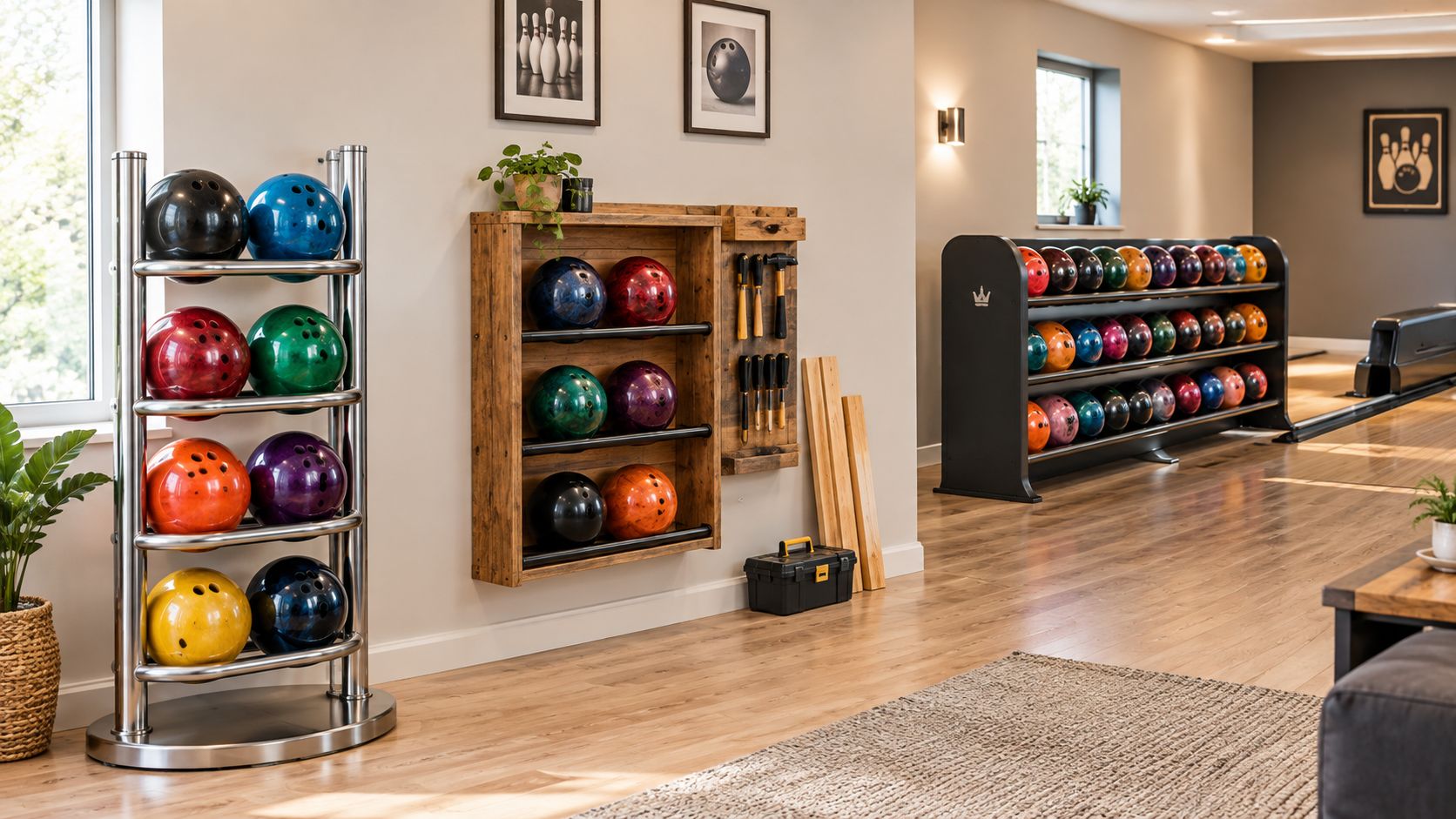
You've got a bowling ball in the garage doorway, another under a workbench, and a third sitting directly on the concrete. Every time someone carries groceries past them, the balls become obstacles. Worse, the rack you bought for shoes and accessories was never designed to support dense bowling equipment.
The right bowling ball rack for home storage should do more than display your collection. It should keep balls stable, make the correct equipment easy to grab, reduce awkward lifting, and protect the coverstock from harsh garage or basement conditions. The seven options below cover compact Amazon-style storage, larger commercial formats, and realistic DIY alternatives, with the trade-offs explained plainly.
Table of Contents
- Why Home Bowling Ball Storage Deserves Serious Attention
- Key Dimensions and Environmental Factors for Home Racks
- 7 Best Bowling Ball Racks Available on Amazon
- Building Your Own Bowling Ball Rack at Home
- Matching Rack Type to Your Space and Bowling Lifestyle
- Situational Recommendations for Different Bowler Profiles
- Protecting Your Investment with Proper Rack Placement and Care
Why Home Bowling Ball Storage Deserves Serious Attention
A ball left beside the lane turns every pickup into an awkward squat and creates an obstacle for everyone using the room. That matters even more when children, older adults, or bowlers with limited mobility need access. A rack should place equipment where users can lift with both hands, keep their backs neutral, and avoid twisting around furniture.
Storage also affects the ball itself. Concrete floors expose equipment to a hard, cold surface, while garages and basements can swing between uncontrolled heat, cold, and moisture. Those conditions can contribute to cracking and other coverstock damage. Bowling equipment storage guidance correctly treats the storage location as part of equipment care, not a separate furniture decision.
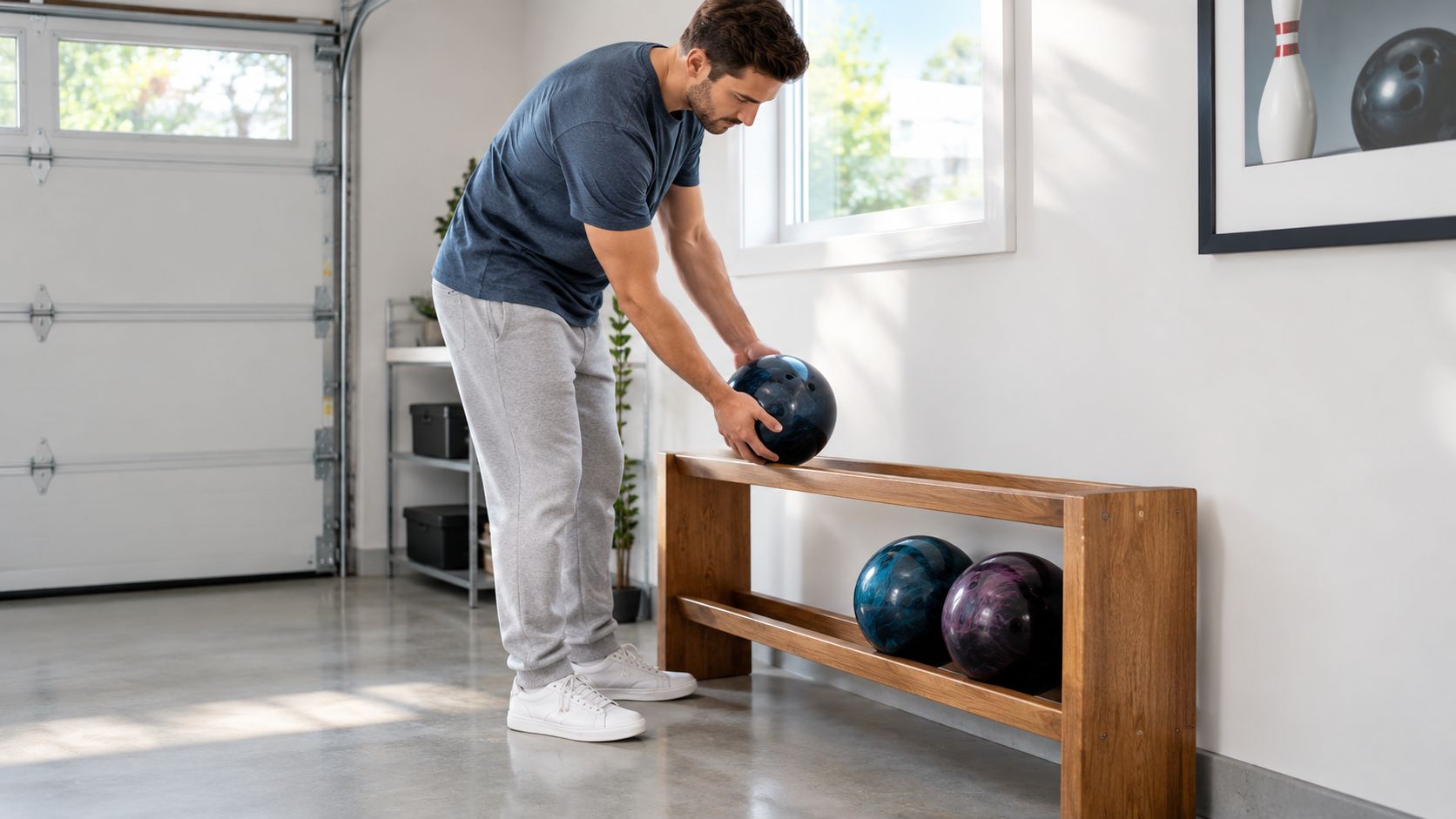
Ergonomics decide whether a rack works
A high rack forces an overhead lift with a dense, difficult-to-control object. A low rack encourages bending and torso rotation. Start around waist height, then adjust for the people who will use it. The home bowling rack installation guide provides a useful cabinet-style reference, but the final position must match your room and the user's reach.
Store-bought racks usually win on finished edges, predictable assembly, and clean presentation. DIY racks can win on height, spacing, and fit, especially when a family member needs easier access or the rack must share a narrow wall. In either case, use a cradle or front lip that stops rolling without forcing fingers into a tight opening. Open shelves also make it easier to identify the correct ball quickly.
Coach's rule: If anyone must lift, twist, or reach above shoulder level to retrieve a ball, relocate or redesign the rack.
Storage becomes more useful when maintenance supplies stay nearby. A visible cleaning routine helps bowlers notice dust, moisture, residue, or surface damage before league night. Keep a bowling ball cleaning kit guide with the rack, rather than hiding the kit in a cabinet.
The right rack protects more than the coverstock. It reduces lifting strain, prevents avoidable impacts, and makes regular care practical. That is why home storage deserves the same attention as the equipment itself.
Key Dimensions and Environmental Factors for Home Racks
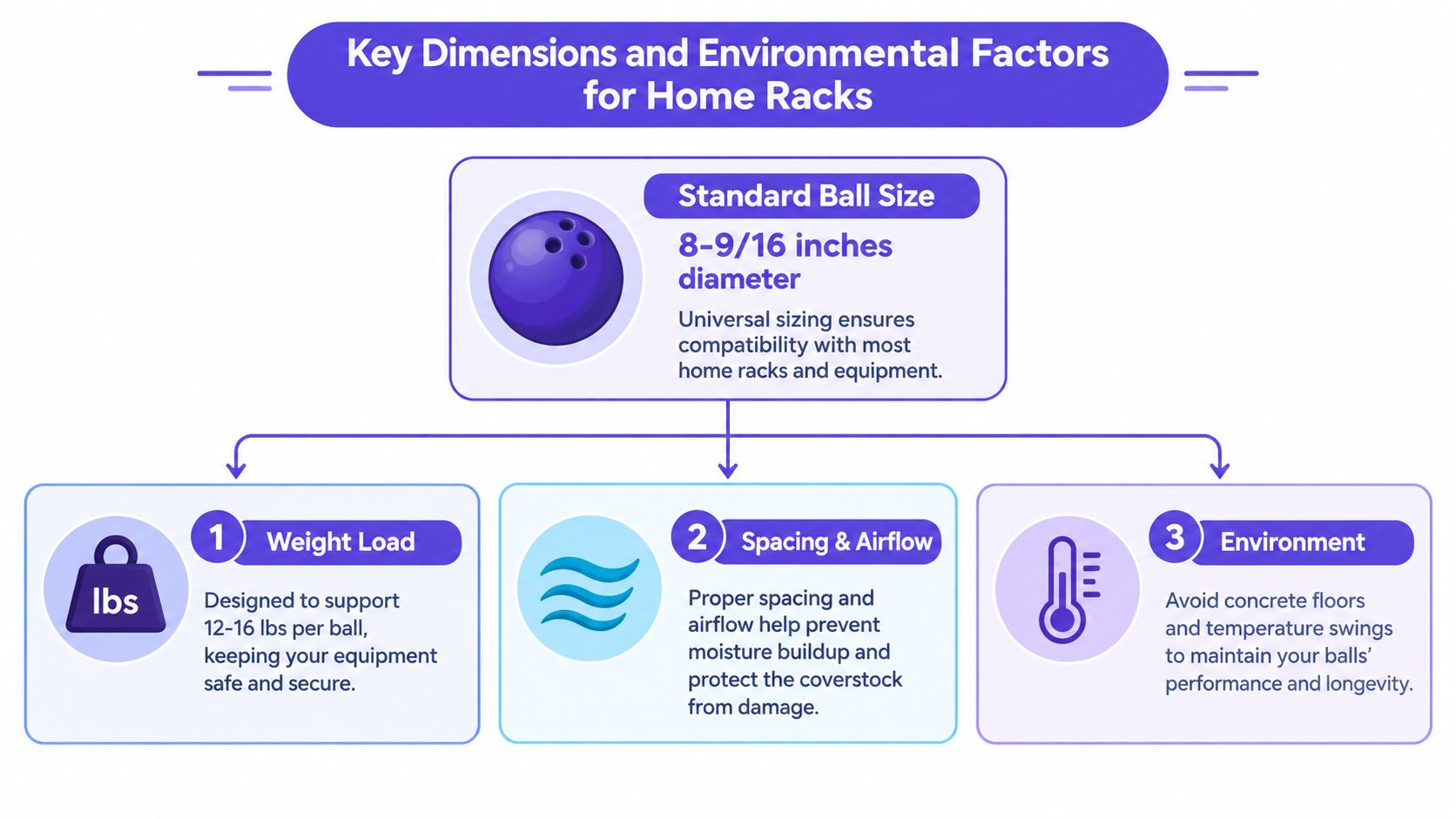
A rack that fits the balls can still fail in daily use. Bowling balls have a standardized diameter of 8-9/16 inches, so each opening needs space for the ball and the bowler's hands. Practical home-storage guidance commonly uses cubbies or shelf openings around 9 to 12 inches wide and 6 to 9 inches high. A 12-inch depth gives adults more room to grip and remove a ball without scraping the wall or neighboring equipment. The VEN500 rack guide offers a useful cabinet-style reference, but your room and users determine the final dimensions.
Measure the whole approach, not only the rack footprint. Check wall length, floor depth, door swings, and the route between storage and the garage or game-room entrance. A best-selling Amazon rack may suit a compact room, while a DIY unit can provide better spacing for larger hands, limited reach, or an awkward wall.
Build around support, not decoration
A finished appearance matters, but a loaded rack must stay stable. Bowling balls place concentrated weight on small contact points. Use sound joints, adequate shelf supports, and a front lip or cradle that prevents rolling without trapping fingers. Anchor a tall unit against tipping, especially in a family room.
Spacing determines whether the rack feels easy or frustrating. A recent installation guide recommends about 12 to 16 inches of vertical spacing between stacked shelves and roughly 12 inches of shelf depth when shoes share the unit. Permanent storage guidance for home bowling installations distinguishes a permanent storage system from a temporary ball-return rack. That benchmark helps when comparing a store-bought model with a DIY design.
Control the room before choosing the material
Independent storage guidance recommends keeping bowling equipment around 60 to 75°F, preferably in an interior space away from windows, with moisture control such as silica packs. Garages and basements often produce temperature and humidity swings. Those conditions can make unsealed wood, bare metal, or improvised PVC a poor choice, even when the rack looks durable.
Use this checklist before installation:
- Measure the opening: Leave room for ball diameter and hand clearance.
- Check the floor: Keep the rack off bare concrete where possible.
- Inspect the wall: Confirm that a tall, loaded rack can be anchored safely.
- Plan airflow: Do not seal damp equipment inside a tight, unventilated cabinet.
- Match the finish to the room: Seal wood in variable conditions and add soft lining at contact points.
7 Best Bowling Ball Racks Available on Amazon
A rack that fits the wall can still fail at hand height, aisle clearance, or room climate. Amazon's popularity rankings help identify active listings, but they do not tell you whether a loaded rack is comfortable to use or suitable for your space. Amazon's bowling ball best-sellers page is a useful starting point. Treat it as a shortlist, then verify dimensions, materials, hardware, and anchoring requirements on the live product page.
The seven options below solve different storage problems. The commercial dimensions provide practical comparison points for compact, mid-size, display-oriented, and high-capacity racks. Product availability and seller specifications can change, so confirm the current listing before ordering.
Quick Comparison of Top 7 Home Bowling Ball Racks
| Rack Model | Capacity | Dimensions | Best For |
|---|---|---|---|
| Compact 8-Ball Rack | 8 balls | 12″ H × 8″ D × 38″ L | Apartments and small game rooms |
| 15-Ball Wood Rack | 15 balls | 48″ W × 35″ H × 8″ D | League bowlers with a modest collection |
| 20-Ball Wood Rack | 20 balls | 48″ W × 46″ H × 8″ D | Families and growing collections |
| 25-Ball Wood Rack | 25 balls | 48″ W × 54″ H × 8″ D | Serious home setups |
| Brunswick Circular Ball Rack | Not specified in the cited listing | 30″ W × 41.75″ H | Display-focused rooms |
| Brunswick 30-Ball Storage Rack | 30 balls | 101.7″ L × 17″ W × 41.8″ H | Dedicated bowling rooms |
| DIY Lumber Rack | Variable | Custom | Budget builders and unusual spaces |
1. Compact 8-Ball Rack
The compact 8-ball format suits a bowler with a small collection and very little floor space. Its listed footprint, 12 inches high by 8 inches deep by 38 inches long, keeps the rack shallow enough for a closet, apartment, or narrow spare room. Depth matters here because every extra inch reduces walking clearance. Current rack dimension examples illustrate why a compact format works in restricted rooms.
The trade-off is limited growth. Buy this rack for a defined setup, not for a collection that will expand through league play. Keep the storage positions within easy reach, because a low rack is useful only when balls can be lifted without awkward bending or twisting.
2. 15-Ball Wood Rack
A 15-ball wood rack gives a league bowler a practical middle ground. The cited format measures 48 inches wide, 35 inches high, and 8 inches deep, using wall length efficiently while keeping projection into an aisle low. The 15-ball rack listing and dimension family provide a useful commercial benchmark for this capacity range.
Choose it for open access and a furniture-like appearance. It works well when the rack serves one regular bowler or a small household collection. Fixed capacity becomes a limitation when several users store bowling balls, shoes, bags, and accessories in the same area.
3. 20-Ball Wood Rack
The 20-ball version keeps the 48-inch width and 8-inch depth but raises the height to 46 inches. That arrangement adds capacity without consuming more floor depth, making it a strong choice for a family room with usable wall space.
Height changes the ergonomics. Do not place the most frequently used balls in positions that require overhead lifting. A rack that holds more equipment but forces repeated reaching above shoulder level is poorly configured for home use. Reserve higher positions for lighter accessories or less frequently used balls, and anchor the unit securely.
4. 25-Ball Wood Rack
For a serious collection, the 25-ball wood rack provides substantial fixed storage. Its listed footprint is 48 inches wide, 54 inches high, and 8 inches deep, so it adds capacity vertically rather than through cabinet depth.
Use this format in a dedicated game room or controlled garage where the rack can be anchored and approached from the front. Its height can feel excessive in a hallway or shared family room, and the upper positions may be inconvenient for shorter users. Leave enough surrounding space to remove a ball without striking nearby furniture or walls.
5. Brunswick Circular Ball Rack
The Brunswick Circular Ball Rack measures 30 inches wide and 41.75 inches high, according to Brunswick's product listing. Its circular presentation fits a display-first room where equipment should remain visible and organized.
This format favors presentation over maximum capacity per inch of wall. Choose it as a visual centerpiece or for a room where users want quick access to a small, clearly displayed selection. It is less suitable when the priority is storing a large collection in the smallest possible footprint.
6. Brunswick 30-Ball Storage Rack
The 30-ball format belongs in a dedicated bowling room, not a casual corner beside a garage door. Brunswick lists this system at 101.7 inches long, 17 inches wide, and 41.8 inches high, with storage for 30 balls.
Its advantage is centralized organization for a large collection. Its cost is wall length and installation commitment. Measure the entire wall, the aisle, and door swings before buying. A rack this long cannot be treated like a movable accent piece, and placing it beside a lane entrance can create a constant obstruction.
7. DIY Lumber Rack
A custom lumber rack is the right solution for an irregular wall, a built-in game-room design, or a household that needs a precise mix of ball and accessory storage. You control the width, shelf height, finish, and access zones, so the rack can place frequently used balls near waist height and keep less-used equipment higher.
DIY also transfers responsibility to the builder. Commercial racks arrive with a defined capacity and hardware plan, while a homemade unit requires sound supports, a stable frame, suitable finish, and reliable anchoring. Use the documented DIY benchmarks in the next section as a reality check. A rack saves money only when it is built for the weight, room conditions, and daily handling it will face.
Building Your Own Bowling Ball Rack at Home
DIY fits a room with an awkward footprint, a custom storage plan, or a commercial rack price that exceeds the rest of the project. It also demands honest assessment. If you cannot build a rigid frame or anchor a loaded unit securely, buy a rack with a defined capacity and hardware plan. Bowling balls are too heavy for a decorative shelf supported by light hardware.
A documented 2015 rack project used 37-inch 4×4 posts, 40.5-inch 2×2 rails, and 24 lag screws measuring 4 7/8 to 6 inches, with a reported total cost of about $100. The archived rack project provides a useful historical benchmark, including a second homemade design reported at 60-ball capacity in a footprint of roughly 5 feet long, 4 feet high with balls, and 22 inches deep. That design reportedly held 42 fifteen-pound balls for 6 months without bowing or buckling, but those results do not guarantee the same performance from another build.
Build the frame around the room
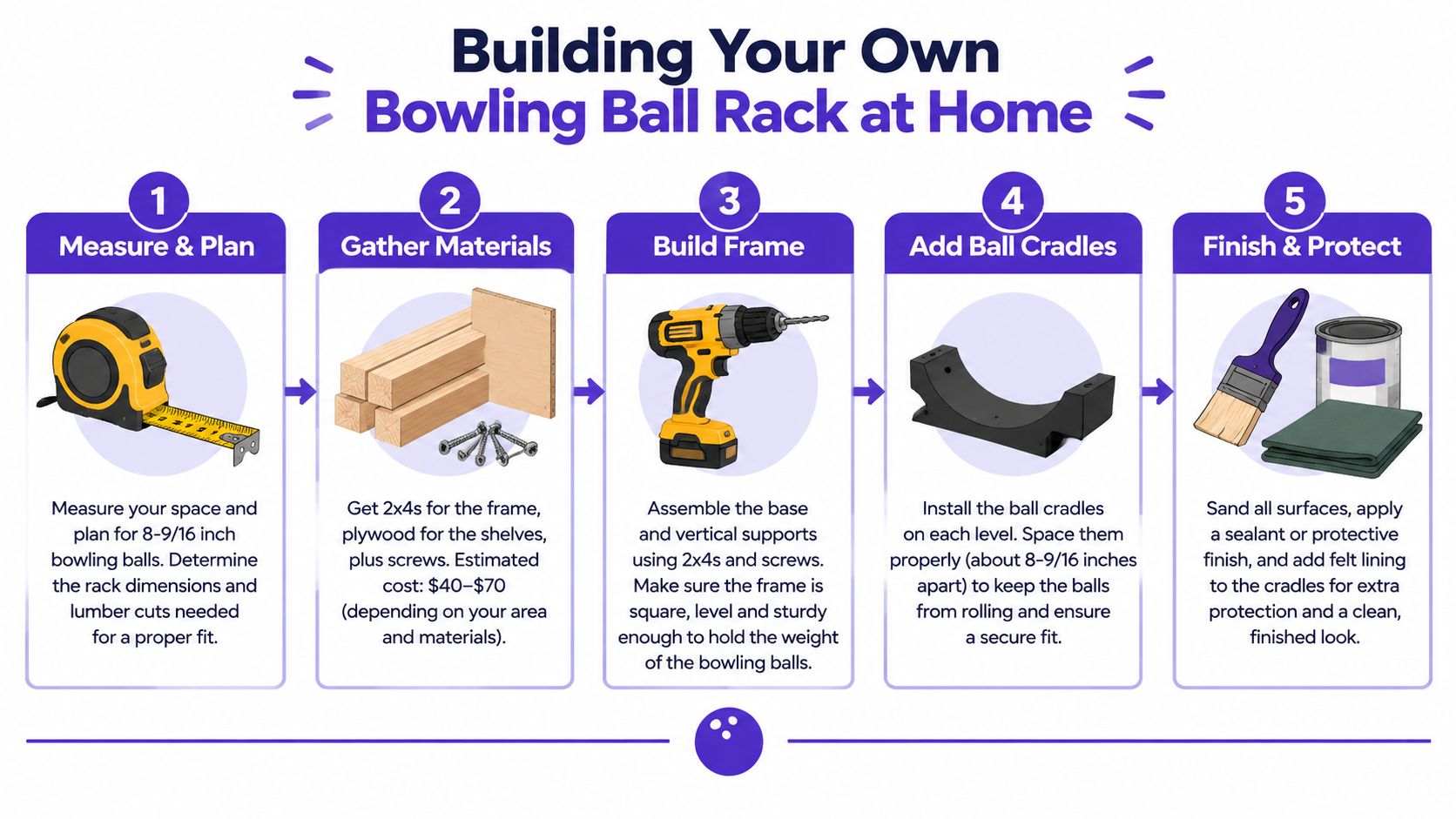
Measure the wall first, then choose individual cradles, rails, or cubbies. Allow openings for the 8-9/16-inch ball diameter and enough room for an adult hand to remove each ball. Put the primary storage zone near waist height. That placement reduces repeated bending and makes heavier balls easier to handle.
Use 4×4 posts for vertical support and 2×2 rails for horizontal structure, following the documented build logic instead of substituting thin decorative trim. Add a rigid back or cross-bracing if the frame can sway sideways. Secure the main joints with long lag screws or equivalent structural hardware, then anchor the completed rack so it cannot tip.
Add contact protection and climate protection
Give every ball a cradle or restrained resting surface. A shallow front lip stops rolling, while felt or another soft liner protects the coverstock from hard edges. Sand every contact point before applying the finish.
Seal the wood on every face, especially in a garage or basement. Leave airflow around the equipment so moisture can escape, and keep the rack off bare concrete. These details matter more than a polished appearance when temperature and humidity change.
The trade-off is clear. Commercial racks provide known footprints, tested-looking hardware packages, and a finished appearance. DIY provides better control over width, shelf height, ball access, and accessory zones, but you must verify every joint, support, edge, and anchor yourself.
Matching Rack Type to Your Space and Bowling Lifestyle
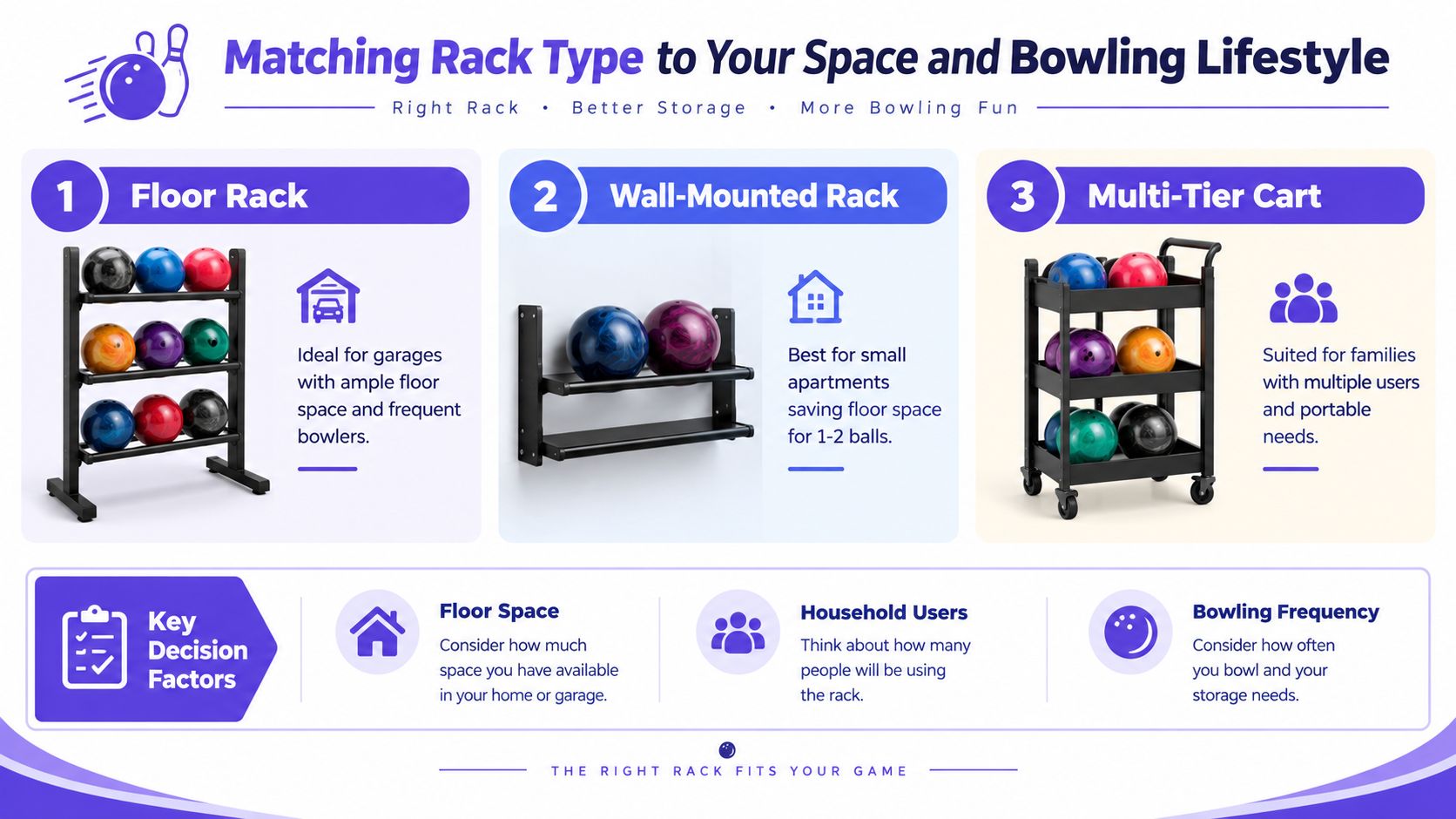
The room dictates the rack. A unit that fits beside a dedicated lane may overwhelm an apartment closet, while an attractive wall rack can slow down a family that moves equipment often. Match the rack to available floor area, walking paths, reach height, and the conditions around the storage zone.
Small rooms need shallow storage
Apartments, closets, and narrow spare rooms usually suit a shallow wall rack or compact floor unit. Market examples commonly fall within 8 to 17 inches deep, making aisle clearance more important than maximum capacity. A longer, shallower rack can leave a safer passage than a tall cabinet that projects into the room.
Check the wall before buying. The anchors must match its construction, and the ball should come out without forcing your shoulder against nearby furniture. In a rental, a compact floor rack may be the better choice if mounting hardware is restricted.
Family rooms need visibility and flexible access
Open shelves or a cart work well when several people share equipment. Users can identify balls quickly, and the rack can keep shoes, towels, and cleaners within reach without placing daily-use items above adult shoulder level. Put frequent-use gear between knee and shoulder height, then assign higher positions to occasional-use items.
If the household carries accessories with the balls, review this bowling ball bag guide before adding shelves. A rack should keep equipment sorted, not turn into an unstable catchall. Carts also help when equipment changes rooms, provided the wheels lock and the loaded frame stays steady during retrieval.
Dedicated lanes can justify large floor racks
A garage lane or game room with clear wall length can accommodate a freestanding rack or large commercial system. Large-format designs suit serious collections, but their footprint can consume more walking space than expected. Measure the full rack, door swings, and the route to the lane before committing.
For frequent bowlers, access matters more than squeezing in another ball. Keep a direct, unobstructed path from the rack to the lane or exit, and avoid placing equipment where temperature swings, damp concrete, or condensation can affect the balls.
Situational Recommendations for Different Bowler Profiles
The right rack depends on how the equipment gets used, not how impressive the product page looks.
Beginners with one or two fitted balls
Buy the compact 8-ball style only if the footprint suits your room, but don't fill it just because space exists. A beginner needs easy identification, a low-strain lifting position, and a stable cradle more than maximum capacity. A small open rack keeps the first custom ball visible and prevents it from becoming a floor obstacle.
The budget alternative is a simple, well-braced DIY shelf with a restrained front edge. Avoid an improvised board balanced on storage bins. That arrangement offers neither reliable stability nor safe access.
League bowlers with a working rotation
Choose the 15-ball or 20-ball wood format when you need organized access without dedicating an entire wall. The 15-ball tier suits a controlled collection, while the 20-ball tier gives growing households more breathing room. Select the lower profile if the rack will sit in a shared room and the taller format only when every shelf remains reachable.
A portable cart makes sense if equipment moves between rooms, but wheels must lock and the loaded frame must remain stable during retrieval. Portability is useful only when it doesn't create rolling or tipping hazards.
Families sharing balls and accessories
Families should prioritize open visibility, waist-height access, and a layout that separates frequently used equipment from occasional items. A multi-tier cart can work well when several people need access, provided the path stays clear and the rack doesn't become a moving obstacle.
For families with a growing collection, a 20-ball or 25-ball format gives more structure than a tiny rack. Don't put children's equipment on the highest shelf, and don't store a ball where a child must pull it toward the edge before lifting.
Competitive bowlers with large collections
Serious bowlers should use a dedicated, anchored system with room for expansion. A 25-ball wood rack is a sensible fixed-storage tier, while a 30-ball format suits a full home lane or equipment room. Climate control becomes decisive here because a large collection represents more equipment exposed to the same room conditions.
DIY is worthwhile only when you need a custom wall length or unusual cradle arrangement. Otherwise, a commercial frame reduces the number of structural decisions you must get right.
Protecting Your Investment with Proper Rack Placement and Care
Rack placement affects both lifting comfort and ball condition. Set the rack so users can retrieve a ball without bending, twisting, or reaching overhead. Waist-high storage suits the balls used most often. The front lip should stop rolling while leaving enough room for a hand to grip the ball without scraping the shelf.
Keep equipment in a stable, dry room around 60 to 75°F. Avoid windows, uncontrolled heat, cold, moisture, and direct contact with concrete floors. In damp rooms, silica packs help control moisture. Store wet towels and shoes elsewhere, not beside the balls. Follow the earlier maintenance guidance for the same basic rule: protect the coverstock from moisture and sharp contact.
Use a simple care routine
- Inspect contact points: Replace crushed felt or damaged liners before hard edges touch the coverstock.
- Check the anchors: Tighten loose hardware and correct frame movement or shelf deflection before loading more equipment.
- Control moisture: Use silica packs in damp rooms and keep wet gear away from the balls.
- Rotate attention: Examine balls left untouched for long periods instead of assuming they remain fine.
- Watch for warning signs: Cracks, unusual surface changes, moisture residue, and unstable storage require immediate correction.
Material choice also affects upkeep. Sealed, sanded wood suits a permanent rack when the room avoids repeated moisture swings. Bare metal can last, but every contact point needs protection from sharp edges. PVC works for a temporary test, provided the frame has proper bracing and a stable base before carrying a collection.
Keep cleaning and inspection supplies beside the rack. This makes routine care easier to maintain. For polishing and deeper cleaning, use this premium bowling ball polishing and maintenance kit guide.
The right rack fits the room, stays stable under load, and lets every household member lift safely. Measure the available space, account for reach and floor conditions, then choose capacity based on actual use rather than a product photo.
Bowling Gear Reviews publishes independent bowling equipment reviews, comparisons, and practical care guides for balls, bags, shoes, and accessories. Visit Bowling Gear Reviews to compare storage gear and organize a home bowling setup.
