

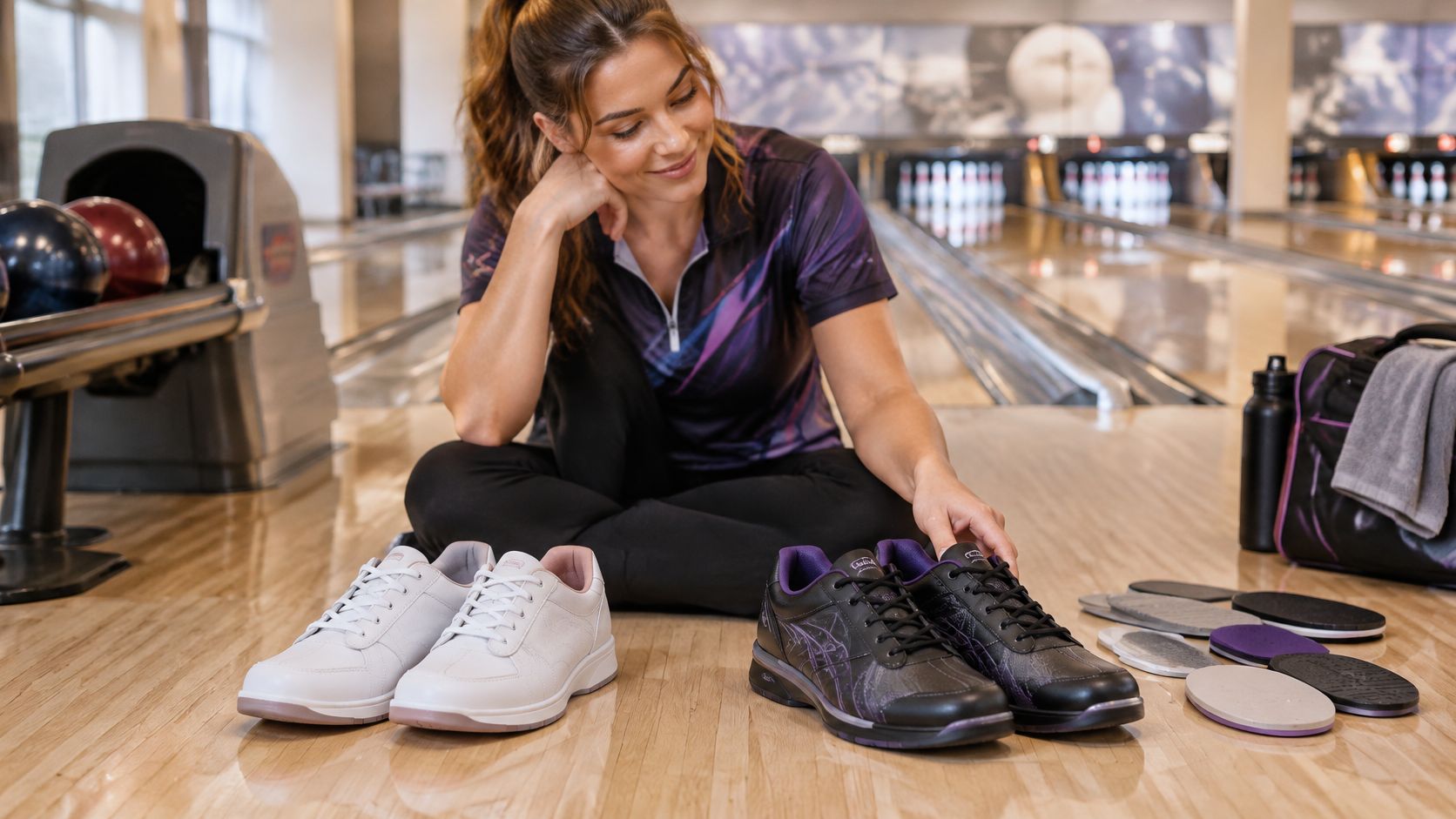
Buy a women's D or wide-labeled last, confirm it against an inch chart, and fit-test it in bowling socks before the return window closes. That's the direct answer for wide bowling shoes for women, and it's the only answer that works. A standard B shoe sized up for width gives you length you don't need and pressure you can still feel. A men's conversion gives you a different last, not a women's wide.
Most bowlers with broad forefeet don't have a technique problem at the foul line. They have a forefoot being squeezed through every push-off, slide, and finish, then a heel that won't stay seated because they bought extra length to escape the squeeze. Measure the foot first. Name the shoe second.
Table of Contents
- Why Standard Width Shoes Fail Wide Feet
- Women's Width Codes and Fit Test
- Wide Women's Models Side by Side
- Soles Heels and Parts You Can Swap
- League Nights Versus Casual Sessions
- Choose the Shoe That Matches Your Week
Why Standard Width Shoes Fail Wide Feet
A systematic review published through the U.S. National Library of Medicine found that 88% of a study of 356 American women wore shoes narrower than their feet, with an average width discrepancy of 1.2 cm. Those women were aged 20 to 60, with an average age of 42 years. That isn't a niche sizing quirk. It's the normal experience for women buying standard footwear.
The same review found that 63% to 72% of participants in the included studies wore footwear that failed to accommodate either foot length or width. Put that mismatch on a bowling approach and it stops being abstract.
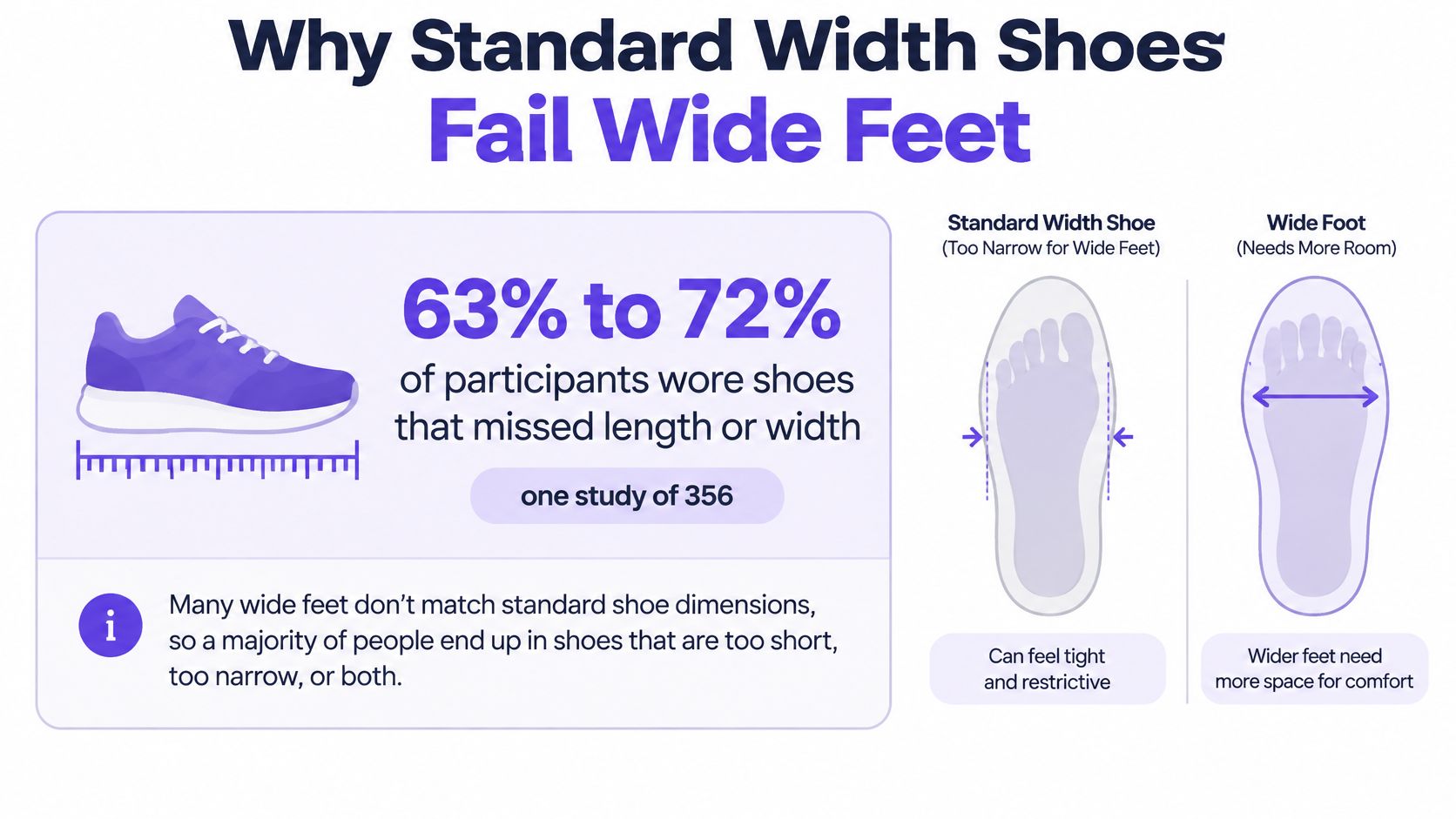
What a narrow shoe does during a league block
You load the forefoot on the push-off, you load it again as the slide foot travels, and you load it a third time as you post the shot at the finish. Do that for a full league block and a narrow toe box concentrates pressure at the toes and at the fifth metatarsal, the bony bump on the outside of the forefoot. The shoe doesn't need to feel brutal in frame one to ruin game three.
Sizing up doesn't fix it. Going a half or full size longer in a standard B buys a little width, but it also buys toe clearance you can't control. Your heel lifts, your slide foot arrives late or wobbles, and your plant stops being repeatable. You're trading forefoot pain for a sloppy finish.
Width is necessary, but it isn't the whole fit. A shoe can be wide enough and still fail you at the heel or over the instep.
That caveat matters. The review also reported that 64% of people whose footwear was not narrower than their feet still experienced foot pain. So don't buy a wide label and assume you're done. Judge every candidate on three checks instead of a vague claim that it feels roomy.
- Actual forefoot room: Your toes spread at address without the upper pressing on the fifth metatarsal.
- Heel security: Your heel stays seated through the slide, with no popping or swimming.
- Stability across repeated slides: Your finish position looks the same in game three as it did in practice.
If a shoe fails any one of those, it fails, whatever the box says. The next step is turning those checks into letters and inches you can verify before you pay.
Women's Width Codes and Fit Test
Women's medium is generally B, and women's wide is commonly D, as the ASICS size and fit guide sets out. Those letters are not interchangeable with men's codes. A women's D is a wide women's last. A men's shoe in a converted size is a different shape built on a different last, and treating the conversion as if it were a women's D is how you end up with the right length on paper and the wrong shoe on your foot.
The size 9 inch lookup
Letters drift between makers, so anchor them to inches. One women's chart lists a US women's size 9 at approximately 3.6 inches for medium, 4.0 inches for wide, and 4.5 inches for extra-wide, as shown in the ShoeSize women's width chart.
| Label | Common name | Approx. width at US 9 | What it changes |
|---|---|---|---|
| B | Women's medium | 3.6 inches | Standard forefoot; often too narrow if the foot already spills street shoes |
| D | Women's wide | 4.0 inches | About 0.4 inch more than medium; first real wide option |
| E / 2E | Extra-wide | 4.5 inches | Another clear step for a very broad forefoot or bunion pressure |
| Men's conversion | Not a women's width | Measure on the men's chart, not this one | Can add length and a different last; do not treat it as a D |
That 0.4-inch step from medium to wide sounds small. Across a three-game set it's the difference between toes that spread and toes that brace. But width at the ball of the foot is only one of three separate variables, and confusing them is the most common buying mistake.
- Forefoot width is the loaded measurement across the ball of your foot. It's what the table describes.
- Upper volume is the room over your instep and around your toes. A wide shoe with a low toe box still crushes a high-volume foot.
- Heel retention is whether the back of the shoe holds you during the slide. Wide lasts sometimes widen the heel too, and that's a problem, not a feature.
A broad forefoot needs a wider last. A high instep or end-of-day swelling needs volume, different lacing, or both, and a wider letter alone may not deliver either. Keep that distinction in mind as you run the test. If you want the full length and letter framework in one place, our bowling shoe sizes guide lays it out before you measure.
The five step fit test
Run these in order, and don't skip ahead because a shoe feels fine standing at the counter.
- Measure both feet standing, late in the day. Put your weight on the foot, measure across the widest part of the forefoot, and record the wider foot. Feet are rarely identical, and you fit the bigger one.
- Compare against the brand's women-specific chart. Width codes aren't perfectly standardized across manufacturers, so the maker's own chart outranks the letter on the box.
- Check length and pressure points in bowling socks. Seat your heel fully, confirm about a thumb's width at your longest toe, then press on the fifth metatarsal and any bunion. Any localized pressure now becomes a hot spot later.
- Walk, set at address, and take several slides. Watch for heel lift and for your foot spilling over the edge of the outsole. Either one is an automatic reject, even if the nominal width matches your measurement.
- Bowl enough shots to feel game three warmth. Feet spread and swell slightly as they warm up. A shoe that's borderline in practice balls is too tight by the seventh frame of game two.
Practical rule: If you have to talk yourself into the fit during practice, return the shoe. League night will not make it better.
Pass signs are toes spreading freely, a heel that stays seated, and a slide distance that matches your normal finish. Fail signs are hot spots at the forefoot, a heel that pops, or a vague, drifting plant that tells you there's extra length doing nothing useful.
Two sock notes before you decide. A thicker sock eats forefoot room and can make a correct wide feel tight, while a thinner sock can rescue heel hold on your narrower foot. Test in the socks you'll bowl in, note the labeled width and the measured internal forefoot width, and record which sock you used. That's actionable. Calling a shoe roomy isn't.
Wide Women's Models Side by Side
Start with the table, because price and sole setup decide most of this purchase before style enters the conversation.
| Model | 2026 price | Width | Slide and heel | Best for |
|---|---|---|---|---|
| KR Strikeforce Women's Maui Grey Wide | $55.95 | Wide width | Fixed slide sole and traction heel; confirm replaceable parts on the tag | Casual and light league on a tight budget |
| Dexter Women's Raquel LX Wide | $69.95 (was $79.95) | Wide | Dexter slide sole with a braking opposite shoe | Weekly league when a true wide last matters more than tuning soles |
| Dexter SST-style women's performance shoe | Confirm the shop tag before ordering | Wide or roomy where offered | Interchangeable slide soles and heels | Bowlers who change approaches or lane friction |
| Dexter The 9 women's | Confirm the shop tag before ordering | Check women-specific wide or standard last | Performance slide with replaceable parts on equipped versions | Competitive play if the last clears the forefoot |
| House or universal rental shoe | Usually included | One medium-ish width | Fixed rubber, little slide tuning | One casual game only; skip if the foot already hurts |
For a visual version of the headline comparison, here's the Raquel against another common wide option.
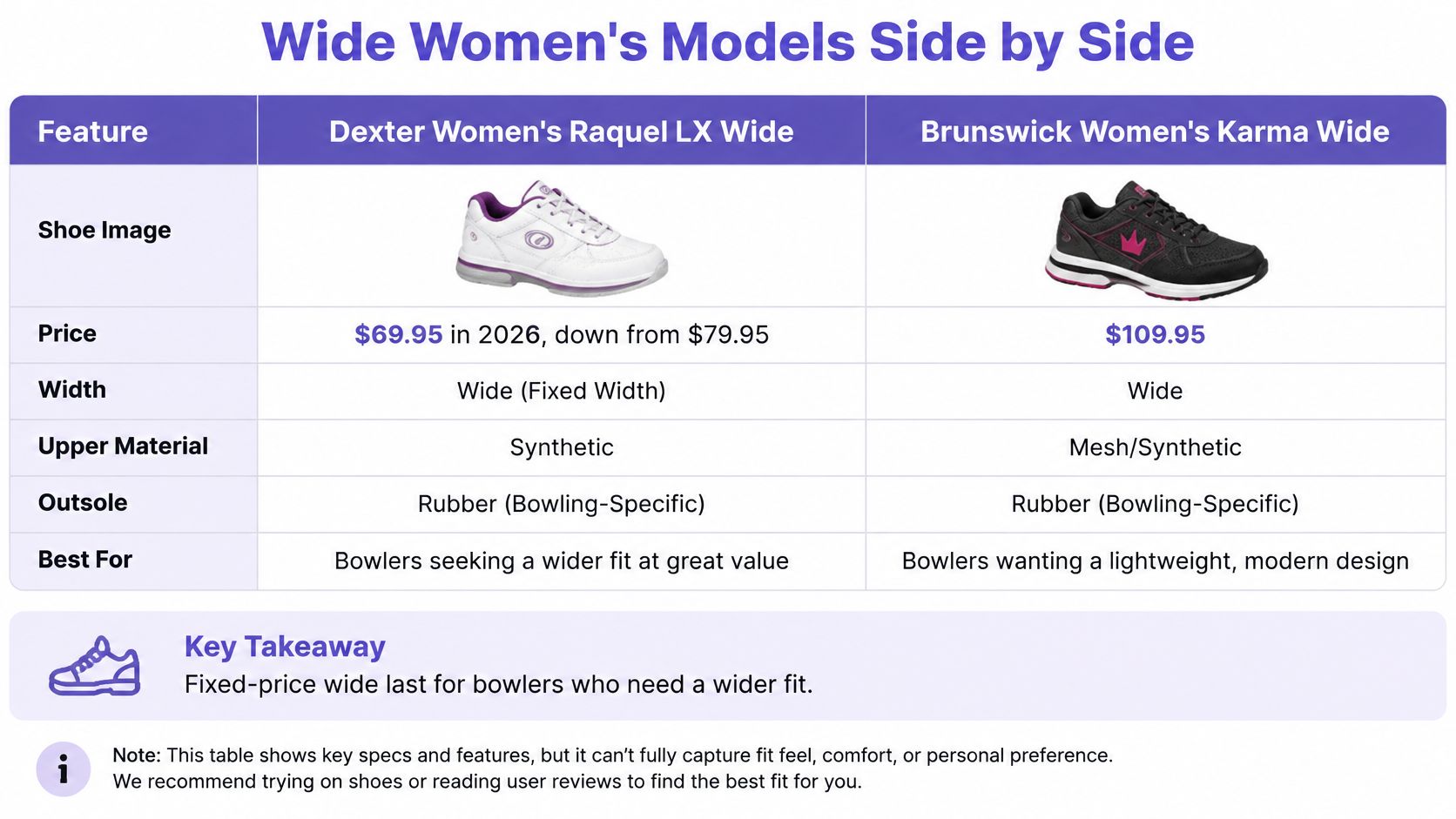
In 2026, Bowlerstore.com listed the Dexter Women's Raquel LX Wide at $69.95, reduced from $79.95. That makes it a fixed-price wide last from the brand most league bowlers already trust for slide feel, without a performance-shoe budget. If you bowl weekly at one house and you want a recognizable factory slide, this is the sensible default in the table.
What the columns can't show you
The KR Strikeforce Women's Maui Grey Wide is the lowest labeled-wide entry here, and for casual or once-a-week play that price gap is real money saved for lane time. What you're giving up isn't width. It's refinement in the slide sole and the depth of the parts ecosystem if you later want to tune friction.
The SST-style and The 9 rows earn their higher cost through replaceable soles and heels, not through extra width. Don't pay performance money expecting a wider shoe. Pay it only if you'll swap parts when an approach runs sticky or slick, and only after you've confirmed in person that the specific last clears your forefoot. A performance shoe in a standard last is a worse buy for a wide foot than a modest fixed-sole shoe that fits well.
Watch how a slide sole behaves under a real approach before you judge any of these on specifications alone.
A microfiber or leather slide sole changes your approach feel more than any colorway ever will, so read that column before you look at photos. And whatever row you land on, check the D or Wide label against the size 9 inch figures rather than trusting the word wide on its own.
Our position on comparisons like this one is simple. Bowling gear is tested in real bowling conditions, brands do not influence our reviews, and all reviews are created by bowlers with real experience and a deep understanding of the game. A shoe makes this table because it fits a defined job, not because a brand asked for the slot.
Soles Heels and Parts You Can Swap
A right-handed bowler wears two different tools. The left shoe slides into the release, and the right shoe brakes and drives during the approach. Left-handers reverse that split. Once you understand that each foot has its own job, sole shopping stops being confusing.
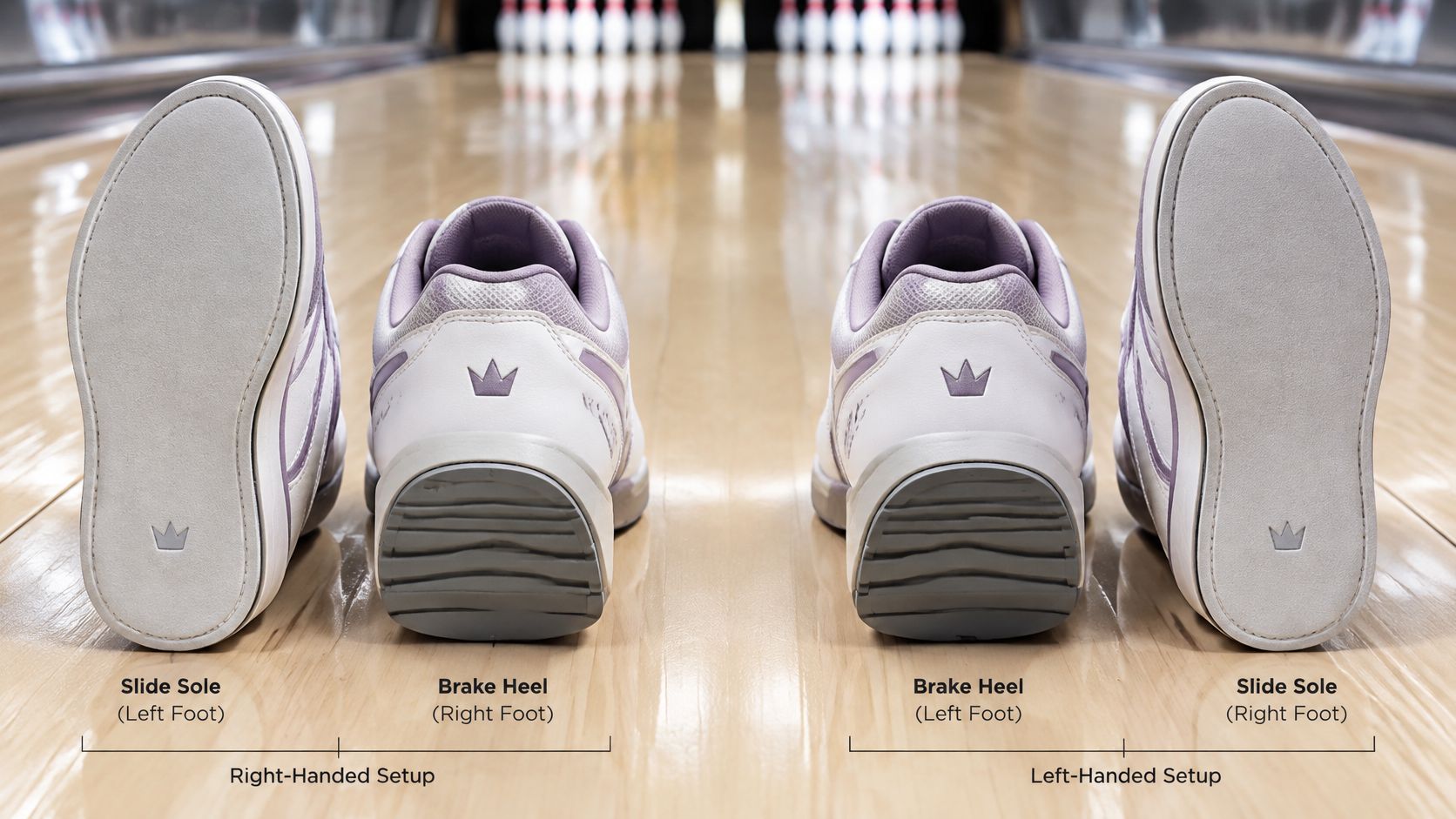
A typical stack on each foot
The slide foot usually carries a leather or microfiber slide sole that lets you glide to a controlled stop. The brake foot carries a rubber or felt traction sole that grips as you push off. The heel on the slide shoe fine-tunes the ending. A harder rubber heel shortens the stop, and a softer stack lets the slide run longer before it settles.
Fixed soles are enough when you bowl at one house, the approaches there behave consistently, and you aren't fighting a sticky or icy finish from week to week. Most once-a-week league bowlers live in exactly that situation, and paying for a parts kit they'll never open is wasted money.
Replaceable soles and heels earn their cost when the same bowler moves between houses. Say you bowl league on a freshly oiled wood approach on Tuesdays and a tournament on a sticky synthetic approach on Saturday. One fixed setup can't be right for both. The same logic applies within a single night when a sole warms up, picks up approach dirt, and starts grabbing in game three. Our bowling shoes sole guide covers the friction grades in detail if you're building that kit.
The swap order that actually works
Change one variable at a time, in this order, so you know what fixed the problem.
- Name the fault first. Is the slide foot sticking short, or running long past your normal finish?
- Clean the sole before you blame the shoe. Brush off dust and pick up debris. A dirty sole mimics a wrong sole.
- Change only the slide sole. Bowl several shots and judge the new distance before touching anything else.
- Change the heel only if the finish still feels late or abrupt. The heel shapes the end of the slide, not the middle.
- Keep the old part in your bag. If the new setup is worse, you can restore the slide you know mid-set.
Parts tune friction. They don't fix a shoe that's narrow.
Two edge cases catch wide-foot bowlers out. A very wide forefoot settled into a high-volume upper can still slide badly if the heel lifts, because the foot moves inside the shoe before the sole even matters. And a sock change can mimic a sole change by altering how firmly your foot sits, so don't swap parts and socks in the same session and then wonder which one helped.
League Nights Versus Casual Sessions
Choose by the session you'll bowl, not by brand loyalty. The right shoe for two open-play games is the wrong recommendation for a bowler posting three games every Thursday, and pretending otherwise wastes her money in one direction or her comfort in the other.
Casual open play
For one or two games, often in thin socks, with no need to tune slide length, the KR Strikeforce Women's Maui Grey Wide is the buy. It's the cheapest labeled-wide option in this guide, and it solves the actual problem for this bowler, which is a standard B forefoot that's too tight. She doesn't need a sole kit. She needs her toes to stop hurting. If your main complaint is sticking or skating rather than width, our picks for the best bowling shoes for sliding address that separate problem directly.
Weekly league
A three-game league night means a repeated four or five step approach, the same slide foot on every shot, and a forefoot that warms and spreads as the block goes on. That pattern favors the Dexter Women's Raquel LX Wide. You get a wide last and a consistent factory slide you can trust without managing parts between frames. Consistency is the product here, and it's worth the step up from the entry price.
Tournament and multi-center play
When you bowl multiple houses and you already know you slide long on fresh approaches and stick on worn ones, buy the interchangeable-sole performance shoe. Pay the higher price, confirm the wide last in person, and build a small kit of soles and heels you understand. This is the one case where the expensive shoe is the correct shoe, because you're buying adjustment range, not prestige.
Renting hides the difference for exactly one game. A house shoe gets a new bowler onto the lane, but it will not hold a wide forefoot through a league block.
Two edge cases deserve direct answers. If one foot is wider than the other, fit the wider foot and manage the narrower one with a thinner sock or a heel-lock lacing pattern through the top eyelet. Don't buy two lengths. If your feet swell from standing at work, do your trying on late in the day in bowling socks, because that's the foot that shows up for league at night. A shoe fitted to a rested morning foot is fitted to a foot you don't bowl on.
Choose the Shoe That Matches Your Week
Here's the verdict, in the order most readers should consider it.
- Buy the KR Strikeforce Women's Maui Grey Wide Width for casual or low-stakes league play when a wide last is the main need. In 2026, Discount Bowling Supply listed it at $55.95.
- Buy the Dexter Women's Raquel LX Wide for weekly league if you want a proven women's wide slide shoe without building a sole kit.
- Step up to an interchangeable-sole performance model only after the fit test shows the wide last clears your forefoot and you already fight sticky or icy approaches at more than one house.
Three buying rules protect you whichever row you pick. First, skip sizing up a B shoe to chase width, because you'll get length and heel slip instead of forefoot room. Second, skip men's conversions unless a fitter has checked both length and heel hold on your actual feet. Third, keep the receipt through one full league night, and return anything that pinches the fifth metatarsal or lets your heel lift, no matter how good the price was.
The cheapest wide shoe that passes the fit test beats the expensive shoe that almost passes it. Almost is where the pain lives.
A note on how we work, since you're about to spend money. Gary shares personalized recommendations to help bowlers find equipment that fits their style and goals, and we only recommend products we believe offer value to our readers. We participate in affiliate marketing programs, so some links may be affiliate links and we may earn a commission on purchases made through them at no additional cost to you. Recheck prices at the shop before you order, because tags move during the season.
Measure both feet tonight, standing, in the socks you bowl in. Write down the wider forefoot in inches, find your row on the size 9 scale, and order the wide shoe that matches your week. Then bowl one full league night in it before you decide it's yours.
If you're still torn between a fixed-sole wide shoe and a performance model with swappable parts, our hands-on shoe reviews break down fit, slide feel, and durability model by model so you can match a last to your measured forefoot. Visit Bowling Gear Reviews to compare the current wide options, read the full sizing breakdowns, and pick the shoe that fits your feet and your league schedule.
