

Asymmetrical pearl bowling balls combine an off-center core with a polished reactive coverstock to create more track flare and a sharper, more angular backend hook than symmetric designs. With published asymmetrical pearl examples often near 2.47–2.50 RG, about 0.052–0.053 differential, and roughly 0.019 intermediate differential, they're built for medium-to-heavy oil patterns where length and recovery matter.
You've probably felt the problem already. Your symmetric pearl gets through the front cleanly, but it loses direction when it reaches the pocket. You move left, open your angles, and still can't create the continuation you need. An asymmetrical pearl can solve that specific problem, but only if its numbers match your release and the lane in front of you.
Table of Contents
- What Are Asymmetrical Pearl Bowling Balls
- How Core Shape and Coverstock Create Motion
- Comparing Asymmetrical Pearls to Symmetric and Solid Options
- Drilling Layouts and Fit Considerations
- Top 7 Asymmetrical Pearl Bowling Balls for 2026
- When Asymmetrical Pearls Are Not the Best Choice
What Are Asymmetrical Pearl Bowling Balls
An asymmetrical pearl bowling ball combines two design choices that affect different parts of the shot. The core has measurable mass bias, while the coverstock uses pearl additives and a polished surface to delay early friction. The result is usually a cleaner front, stronger flare potential, and a more directional move when the ball reaches the dry.
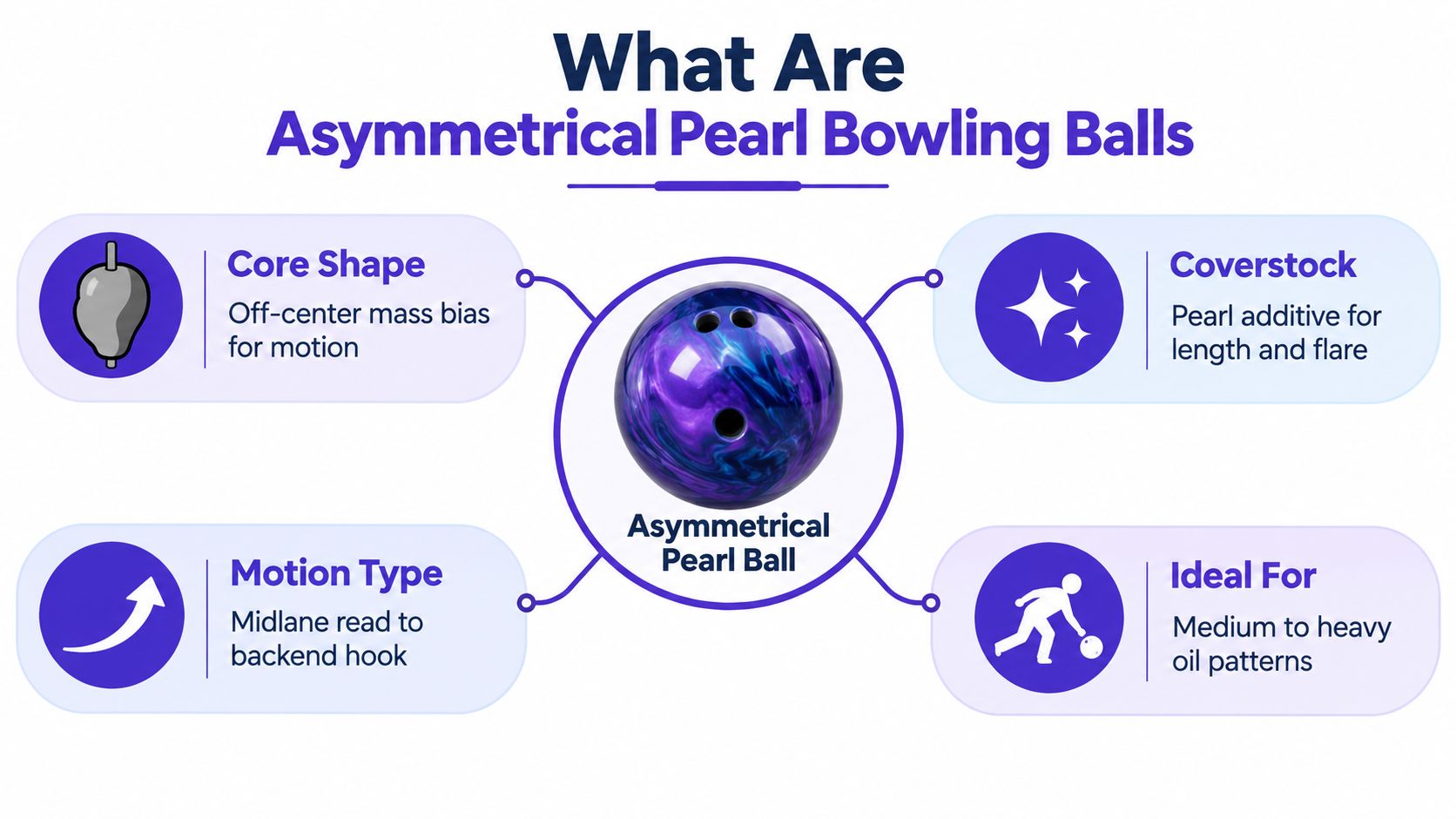
The word asymmetrical isn't just a marketing label. Under USBC terminology, an asymmetrical core has a measurable difference between its radii of gyration. The Y, or high RG, and Z, or intermediate RG, axes differ by more than 5% of the ball's total differential, which is why the design is classified separately from a symmetrical core. The USBC's technology materials explain that changing core shape changes differential RG, so manufacturers can influence how a ball revs, flares, and changes direction without relying on coverstock chemistry alone. USBC terminology and the USBC Bowling Technology Study provide the technical foundation for that distinction.
The pearl coverstock handles the first part of the lane. Its polished, reactive surface is designed to reduce early friction, allowing the ball to skid farther before it begins to read the midlane. The asymmetrical core then helps the ball create more flare and a stronger change of direction once the coverstock finds friction.
The two-stage motion
Think of the ball's reaction in two stages:
- Front-lane clearance: The pearlized shell delays traction, so the ball doesn't spend all its energy in the heads.
- Backend recovery: The mass bias and flare potential help the ball respond more sharply when it reaches dry boards.
That doesn't mean every asymmetrical pearl is a violent skid-flip ball. Coverstock strength, surface finish, RG, differential, drilling layout, and your release all change the final shape. A polished pearl with a strong core can still read earlier than expected if the cover is aggressive or the lane has enough oil to support traction.
Practical rule: Choose an asymmetrical pearl when you need the ball to travel through the front and still make a confident move toward the pocket. Don't choose one simply because “asymmetrical” sounds stronger.
How Core Shape and Coverstock Create Motion
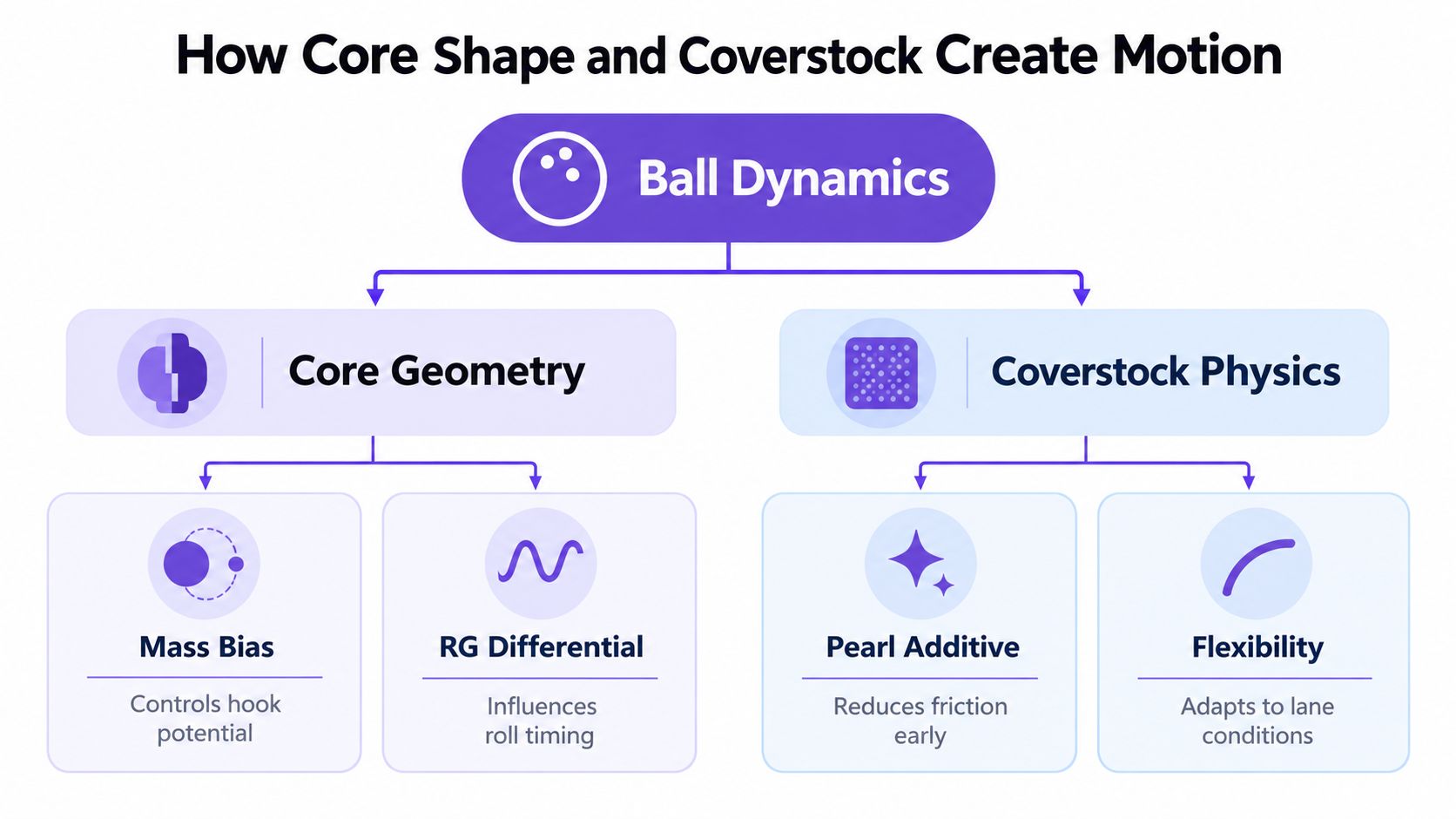
A useful coaching analogy is to treat the core as the engine and the coverstock as the tires. The engine influences how the ball wants to rotate and transition. The tires determine how quickly that energy meets the lane. An asymmetrical pearl gets its distinctive shape from the interaction, not from either component in isolation.
Reading RG and differential
RG, or radius of gyration, helps describe how quickly a ball wants to begin revving. A lower RG generally encourages earlier revving, while a higher RG tends to preserve more energy downlane. Differential describes how much the ball's rotation changes as it travels, which affects track flare and the amount of fresh coverstock the ball presents to the lane.
A low RG paired with a high differential generally creates an aggressive overall motion. The ball revs sooner, changes its axis more substantially, and can create strong traction and continuation. A higher RG can push the read farther downlane, which may be useful when the pearl cover needs help clearing the front.
Intermediate differential, also called mass bias, separates an asymmetrical design from a symmetrical one. Industry guidance commonly treats values below 0.008 inches as effectively symmetrical, while 0.021–0.037 inches represents a high asymmetry range. Those figures aren't a promise of a particular breakpoint, but they give you a repeatable way to compare core designs. Bowling ball core guidance explains how these measurements relate to ball motion.
Published pearl asymmetrical examples often sit around 2.47–2.50 RG, 0.052–0.053 differential, and approximately 0.019 intermediate differential. That combination typically supports a strong change of direction without requiring the coverstock to be rough or dull. To understand how manufacturers arrange these measurements inside the shell, use this guide to bowling ball weight blocks.
Why the cover changes the picture
The pearl additive and polished finish help the ball conserve energy through the front. Compared with a solid cover, a pearl cover generally produces less early hook and a sharper backend response, especially when the lane has enough oil to let the ball get through the heads.
The core still matters after the cover clears the front. An asymmetrical design generally creates higher flare and a more angular backend than a symmetrical design with comparable cover strength. That flare exposes fresh surface to the lane, allowing the ball to keep reading instead of sliding through the breakpoint without recovery.
Your release remains the final variable. A high-rev player may make the same ball read too soon, while a lower-rev player may need its stronger core to create the shape they can't generate naturally. Specs help you predict the motion, but they don't replace observation of your speed, axis rotation, tilt, and target.
Comparing Asymmetrical Pearls to Symmetric and Solid Options
The right comparison isn't “which ball hooks more?” A better question is, where does the ball use its hook, and how controllable is that shape? Asymmetrical pearls usually blend length with a stronger directional move. Symmetrical pearls often give you a smoother, more continuous arc, while solid reactives tend to create earlier traction and a rounder transition.
| Ball Type | Core Shape | Coverstock | Best Lane Condition | Motion Profile |
|---|---|---|---|---|
| Asymmetrical pearl | Asymmetrical, measurable mass bias | Pearl reactive, often polished | Medium to heavy oil and transition | Clean front, strong flare, sharper backend |
| Symmetrical pearl | Symmetrical | Pearl reactive, often polished | Medium oil and open transition | Longer, smoother, more predictable arc |
| Asymmetrical solid | Asymmetrical | Solid reactive | Heavy oil or situations needing earlier traction | Earlier read, strong continuation, substantial total hook |
| Symmetrical solid | Symmetrical | Solid reactive | Medium to heavier oil | Smooth traction and controlled continuation |
A symmetrical pearl can be the better tool when you need length without a sudden change of direction. Its motion is often easier to control for bowlers with high axis rotation, a quick release, or limited room for error. It can also fit better once the lane transitions and the asymmetrical pearl starts responding too sharply to small misses.
An asymmetrical solid generally gives you more traction in the earlier part of the lane. That makes it useful when the pattern has enough oil to hold the ball back, but it can become difficult to manage when the fronts dry or when you need the ball to preserve energy for the pins.
The pearl versus solid decision depends heavily on surface and coverstock construction. A shiny pearl isn't automatically weak, and a solid isn't automatically smooth. Learn the differences in bowling ball coverstocks before judging a model from its finish alone.
Match shape to the lane
Use an asymmetrical pearl when your current ball either quits at the breakpoint or forces you to create too much angle with your release. Use a symmetric pearl when you need the same general length with a calmer response. Reach for a solid when the ball must establish traction earlier and continue through heavier oil.
The most important distinction is versatility. Asymmetrical pearls aren't just “more hook” versions of symmetric pearls. Their value comes from combining length with directional backend motion, which can be excellent on medium oil and transition but too condition-specific for a one-ball arsenal.
Drilling Layouts and Fit Considerations
An asymmetrical pearl doesn't perform independently of its drilling. The layout changes how quickly the core responds, how much flare the ball develops, and how easily you can control the breakpoint. The same shell and core can feel earlier, smoother, longer, or more angular after a different layout.
USBC equipment guidance includes specific mechanics for asymmetrical cores. The low RG axis must be within a 1-inch radius of the pin's center. For an asymmetrical ball, the high RG axis or preferred spin axis must be within 1.5 inches of the center of a surface marking indicator. These requirements don't tell you which layout to choose, but they explain why your driller must identify the core axes correctly. USBC equipment specifications covers those layout-related mechanics.
Start with your release
A good driller should ask about more than your preferred pin placement. Bring information about your rev rate, ball speed, axis rotation, axis tilt, PAP, hand size, thumb fit, and typical target. If you don't know those measurements, a pro shop can observe your release and record them.
- Higher rev rate: You may need a layout or surface choice that calms the breakpoint.
- Lower rev rate: A stronger asymmetrical core can help create the traction and flare your release doesn't produce naturally.
- More axis rotation: Expect a more angular response, especially with a polished pearl cover.
- Lower axis rotation: The ball may read earlier and look smoother, so a more responsive layout can preserve shape.
- Poor fit: Thumb tightness, excessive span, or unsuitable pitches can alter your release and make the ball appear inconsistent.
Beginners shouldn't chase a complicated layout before establishing a repeatable fit. Ask the pro shop to build a comfortable, legal setup that matches your current release. Competitive bowlers can then fine-tune the layout as their PAP and release become more stable. A practical reference on bowling ball drilling layouts can help you understand the vocabulary before that conversation.
Watch the drilling process with the motion goal in mind. The marker placement identifies the core orientation, but the finished reaction depends on how that orientation interacts with your hand and the lane.
Before buying, confirm that the ball fits your league's equipment rules. USBC specifications set a maximum weight of 16 pounds, a diameter range of 8.500 to 8.595 inches, RG values between 2.46 and 2.80, and a maximum RG differential of 0.060. The published equipment limits provide the governing framework for legal ball specifications.
Top 7 Asymmetrical Pearl Bowling Balls for 2026
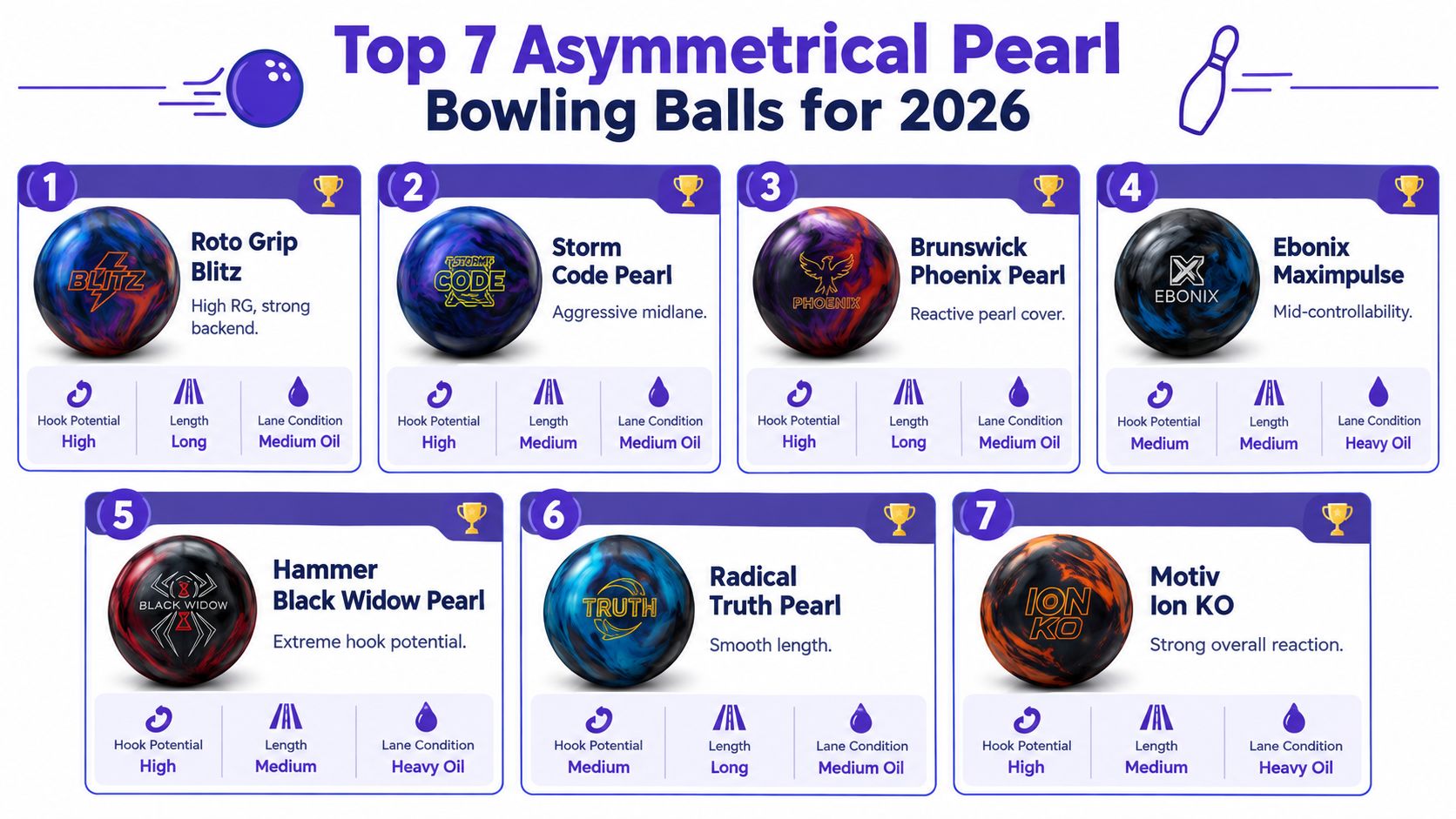
A bowler standing on medium oil may need length through the front, enough midlane definition to read the lane, and recovery when the ball reaches friction. The seven models below approach that job differently. Read each specification as a motion clue: RG describes how readily the ball revs, differential indicates flare potential, intermediate differential helps describe asymmetry, and the coverstock and factory surface shape traction.
Availability and specifications can change, so confirm the current manufacturer details and Amazon listing before ordering.
1. Roto Grip Blitz
The Roto Grip Blitz pairs a high-RG asymmetrical core, RG 2.52, differential 0.048, and intermediate differential 0.016, with a polished pearl cover. That combination stores energy through the front and supports a defined backend move. It suits medium oil when the heads need to stay clean. Higher-rev players should watch the layout and surface, since both can make the response too quick on a lane that is already opening.
2. Storm Code Pearl
The Storm Code Pearl lists RG 2.50, differential 0.052, and intermediate differential 0.021, using an R2S Pearl cover at 1500-grit polish. Its stronger differential supports flare, while the pearl cover and polished finish help it reach the breakpoint with energy. The result is an aggressive midlane read followed by continuation. Bowlers who prefer a soft, rounded arc may find the transition too assertive.
3. Brunswick Phoenix Pearl
The Brunswick Phoenix Pearl combines RG 2.48, differential 0.053, and intermediate differential 0.019 with an Activator 3.0 Pearl cover at 500/2000 SiaAir with Crown Factory Compound. The cover and compound encourage length, while the asymmetrical core adds downlane response. It can suit league bowlers who need a visible move off friction without immediately choosing the strongest solid in the bag. Match it to speed and axis rotation.
4. Ebonix Maximpulse
The Ebonix Maximpulse uses RG 2.49, differential 0.050, and intermediate differential 0.015, paired with a pearl reactive cover at 500/1000/2000 Abralon with Powerhouse Factory Finish. Its moderate asymmetry and finished surface aim for midlane control with recovery. That makes it useful when a stronger asymmetrical ball begins reading too early, while a weaker symmetric option leaves too much angle.
5. Hammer Black Widow Pearl
The Hammer Black Widow Pearl features RG 2.50, differential 0.058, and intermediate differential 0.016, with NBT Pearl coverstock at 500/1000/2000 Abralon with Powerhouse Factory Finish. The high differential creates substantial flare potential, and the pearl finish preserves length before the breakpoint. It fits oilier conditions and bowlers with room to move inside. On drier or shorter patterns, that available shape can exceed the control the lane provides.
6. Radical Truth Pearl
The Radical Truth Pearl has RG 2.50, differential 0.051, and intermediate differential 0.018, using Ai-20 Pearl coverstock at 500/1000/2000 Abralon with Powerhouse Factory Finish. Its polished pearl construction emphasizes smooth length rather than only explosive backend motion. It can help a bowler clear the front while keeping the midlane readable, a useful balance as friction develops.
7. Motiv Ion KO
The Motiv Ion KO combines RG 2.47, differential 0.052, and intermediate differential 0.019 with Agility LPF Reactive coverstock at 2000-grit sanded. The lower RG encourages earlier revving, while its asymmetry and differential provide continuation through medium-to-heavy oil. It offers a wide usable range across fresh medium oil and moderate transition without a surface change, provided the layout matches the bowler's release. Use it for strength and control rather than just chasing the sharpest corner.
Amazon helps compare these models, but confirm weight, availability, return terms, and the drilling plan with your pro shop before buying an undrilled ball. The strongest-looking listing can still be wrong if your current equipment already creates excessive backend.
When Asymmetrical Pearls Are Not the Best Choice
More asymmetry doesn't automatically mean better scoring. A high-differential asymmetrical pearl can be too fast off the spot when the lane is dry enough to create an immediate reaction. You may see the ball jump past the breakpoint, miss the pocket high, or force you to move so far inside that your margin for error disappears.
A symmetric pearl often wins when you need a calmer shape. It can preserve length while smoothing the transition, which helps bowlers who already create plenty of axis rotation or who play lanes with a narrow usable window. A solid reactive may be better when the ball must read the midlane earlier and blend the pattern instead of saving energy for a sharp backend.
Read the actual reaction
Don't judge the ball by the label on the box. Watch three checkpoints:
- Front: Does it clear the heads without skidding too long?
- Midlane: Does it slow down enough to establish direction?
- Backend: Does it continue through the pocket, or does it jump sideways and lose energy?
A 2026 review of the Storm Ion Max Pearl illustrates why polished pearl equipment can surprise bowlers. Testers found substantial traction, limited versatility, and a reaction that “wasn't snappy off the end of the pattern,” showing that pearl and asymmetrical construction don't guarantee a dramatic skid-flip shape. Bowling This Month's Storm Ion Max Pearl review offers that useful reminder.
Surface maintenance also changes the verdict. Polishing a pearl cover can extend skid and sharpen the response, while adding texture can make the ball read earlier and blend the breakpoint. If the ball becomes too angular, don't immediately replace it. Ask whether the surface, lane transition, or layout is creating the problem.
The best asymmetrical pearl is the one that gives you a controllable path to the pocket. If you can't repeat the shot, can't manage the breakpoint, or can't find a lane condition that supports the shape, a smoother symmetric option may produce better results even if its specifications look less impressive.
Bowling Gear Reviews publishes independent bowling equipment reviews, comparisons, and how-to guides that examine coverstock, core design, drilling choices, and lane-condition fit. Visit Bowling Gear Reviews to compare asymmetrical pearl options and use practical testing notes to choose a ball that matches your release rather than chasing specifications alone.
