

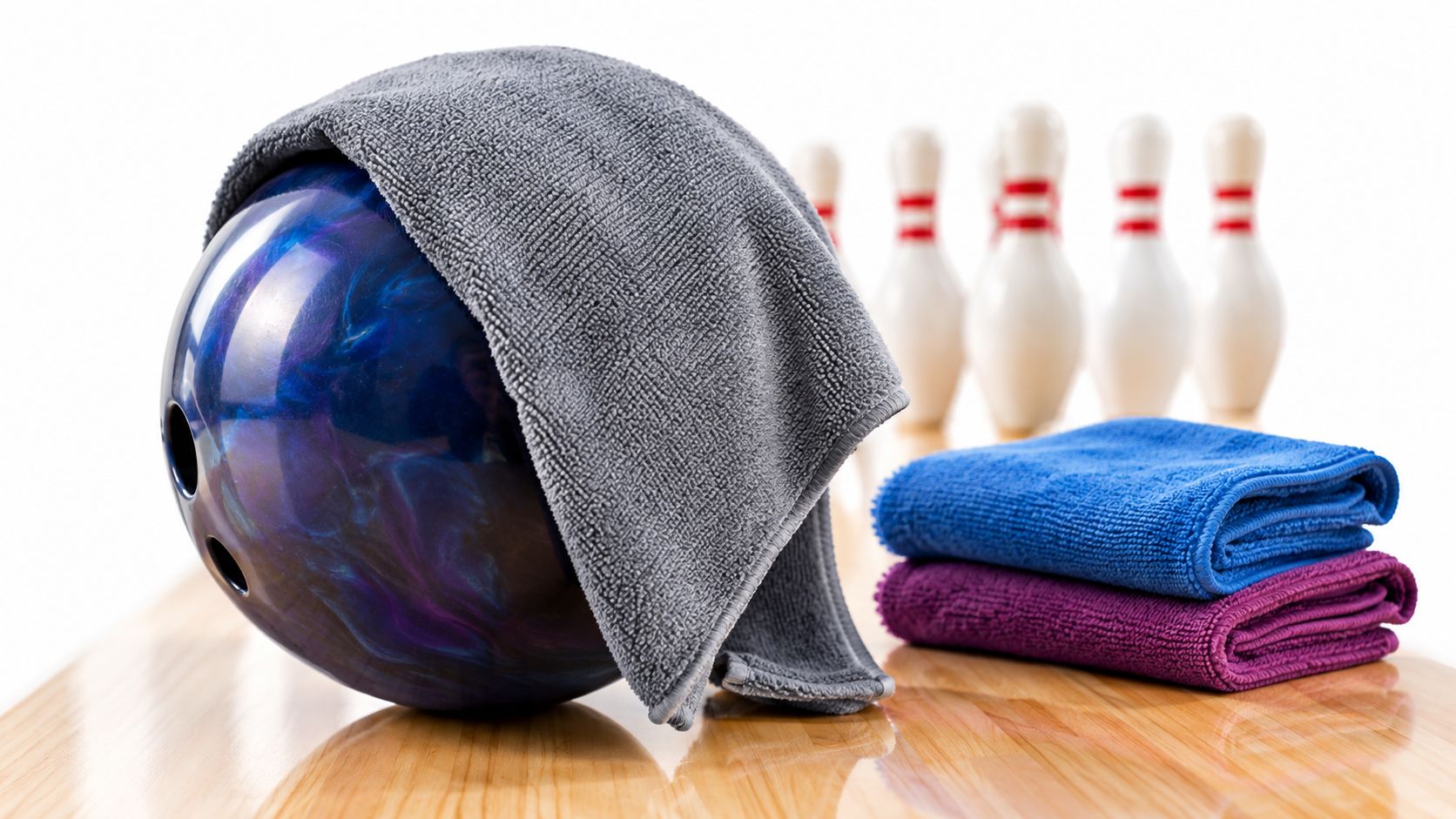
You've probably had this happen in the middle of league night. The first game looks good, the ball reads the lane the way you expected, and then a few frames later it starts pushing a little too far. Corners stand. The shape looks softer. You make a move with your feet, then another, and still the reaction feels a little dull.
A lot of bowlers blame release first. Sometimes it is release. But often the ball is carrying a film of oil that changes what you see downlane. That's where a microfiber bowling towel earns its spot in the bag.
Table of Contents
- Introduction Why Your Towel Matters More Than You Think
- What Makes a Microfiber Bowling Towel Different
- How GSM Weight and Size Affect Cleaning Performance
- Microfiber Towel vs Shammy Pad When to Use Each
- 7 Best Microfiber Bowling Towels on Amazon Reviewed
- Comparison snapshot
- TonGass Microfiber Bowling Ball Towel
- Windspeed Microfiber Bowling Towels
- Athletico Microfiber Bowling See-Saw
- Classic Economy Microfiber Towel
- Generic 300 GSM Microfiber Bowling Towel
- Dual-Sided Microfiber Bowling Towel
- Multi-Color Amazon Microfiber Pack
- Which one should most bowlers buy
- How to Use and Care for Your Bowling Towel
- Choosing the Right Towel for Your Bowling Level
Introduction Why Your Towel Matters More Than You Think
Between frames, most bowlers give the ball a quick wipe and move on. The habit looks small, but it affects the one thing every bowler chases, consistency. If oil stays on the surface, the ball can lose some of that clean, predictable motion you saw earlier in the set.
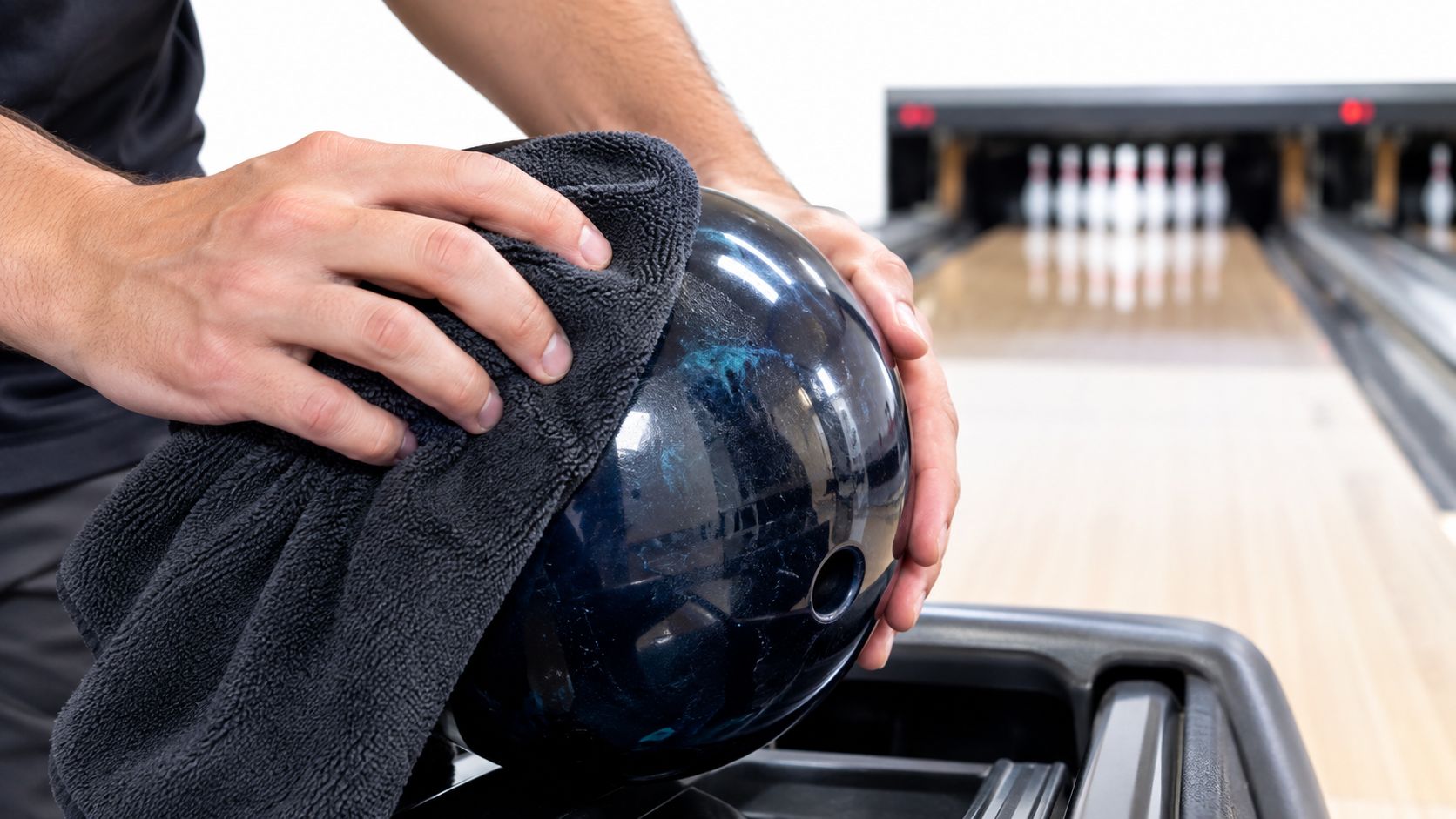
A good towel helps beginners build smart habits. It helps league bowlers keep reaction steadier from game to game. It helps competitive players separate quick in-game oil removal from deeper post-session cleanup. That last part matters because many bowlers treat every wiping tool like it does the same job. It doesn't.
What this guide focuses on
This roundup stays practical. The picks use Amazon products, and the goal isn't to chase marketing language. It's to sort towels by how they fit real bowling use.
Here's what matters when you're deciding:
- Material behavior: How the fibers deal with oil, moisture, and cleaner residue.
- Size and carry: Whether the towel fits in a pocket, sits flat in a bag, or works better for a full-ball wipe.
- Pack count: Whether one towel is enough, or if rotating multiple towels makes more sense.
- Care routine: How washing and storage affect feel, odor, and absorbency over time.
Practical rule: If your towel is an afterthought, your ball maintenance probably is too.
Why this small accessory matters
Microfiber towels aren't some niche novelty. The broader microfiber cleaning cloth market is projected at about USD 979.2 million in 2025 with a 4.5% CAGR through 2033, and a separate estimate places it at USD 978.3 million in 2025 and USD 1,533.7 million by 2035, which tells you demand for performance cleaning textiles is already well established beyond bowling (microfiber cleaning cloth market estimates).
That doesn't mean every towel is equal. It means the material category is mature enough that bowlers can be picky. You should be. A towel is inexpensive compared with a new ball, but it can help you protect the reaction you already paid for.
What Makes a Microfiber Bowling Towel Different
A microfiber towel works differently from an old cotton rag. The difference starts at the fiber level.
Start with the fiber itself
Microfiber dates back to the late 1950s, when ultra-fine fibers finer than 0.7 denier were first produced through melt-blown and flash spinning methods. Continuous-filament breakthroughs followed in Japan in the 1960s through work by Miyoshi Okamoto at Toray Industries, and Ultrasuede reached the market in the 1970s as one of the first commercial microfiber products. Microfiber use became widely publicized in Europe in the early 1990s (microfiber history and development).
That history matters because the cleaning behavior didn't appear by accident. The material was developed over roughly two decades before it became common in textiles people use.
Why tiny fibers matter on a bowling ball
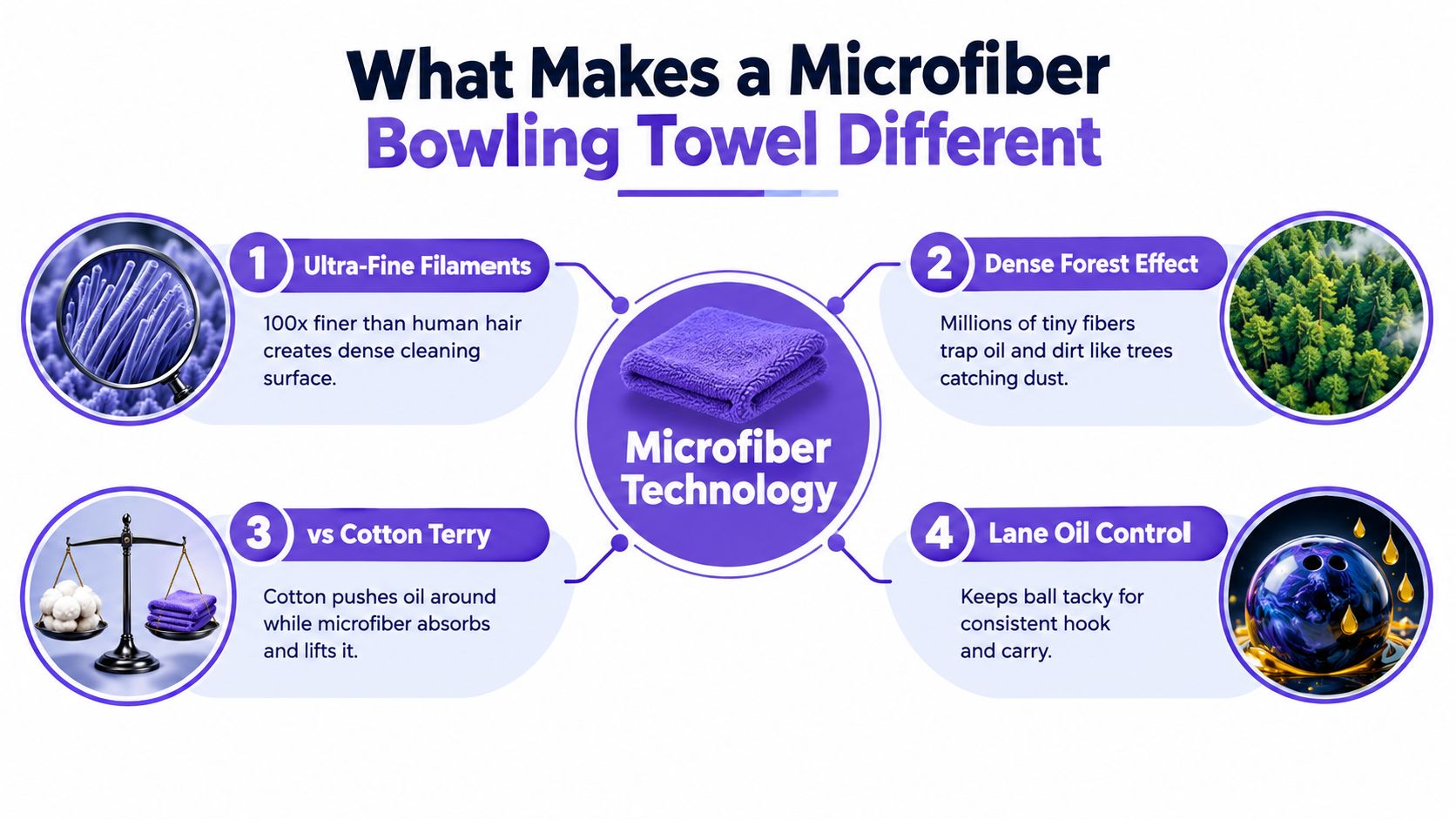
Think of cotton like a few thick tree branches. Now think of microfiber like a dense forest. The forest gives you far more places for oil and moisture to catch.
That's the simplest way to understand surface area. A microfiber bowling towel has many more tiny contact points touching the coverstock than a traditional towel. Instead of mostly pushing oil around, it has a better chance to lift and hold what it picks up.
One textile source notes microfiber towels can absorb about 5 to 7 times their own weight in water, and also explains that absorbency improves with finer fiber structure, higher yarn surface area, and fabric design (microfiber absorbency discussion). For bowling, that means a faster wipe when you've got surface oil, cleaner residue, or a little moisture on the ball.
Here's a quick visual that helps:
It cleans by contact, not just by thickness
A lot of bowlers think a towel works better only if it feels thicker. That's not the full story. A technical cloth reference describes microfiber as having a fiber density several times greater than common wiping fabrics, with a unit-area mass around 200 to 210 g/m², which creates many more contact points for capturing soil and liquid films (microfiber fiber density and fabric mass).
A bowling ball doesn't need a fluffy blanket. It needs a surface that can touch a lot of the coverstock at once and pull film away cleanly.
That's why a microfiber bowling towel can feel light in the hand but still work well. The value is in the structure of the fibers, not just in bulk.
How GSM Weight and Size Affect Cleaning Performance
A lot of bowlers buy a microfiber towel the same way they buy a keychain accessory. Then they wonder why one towel feels useful for weeks and another starts smearing oil around after a few sets.
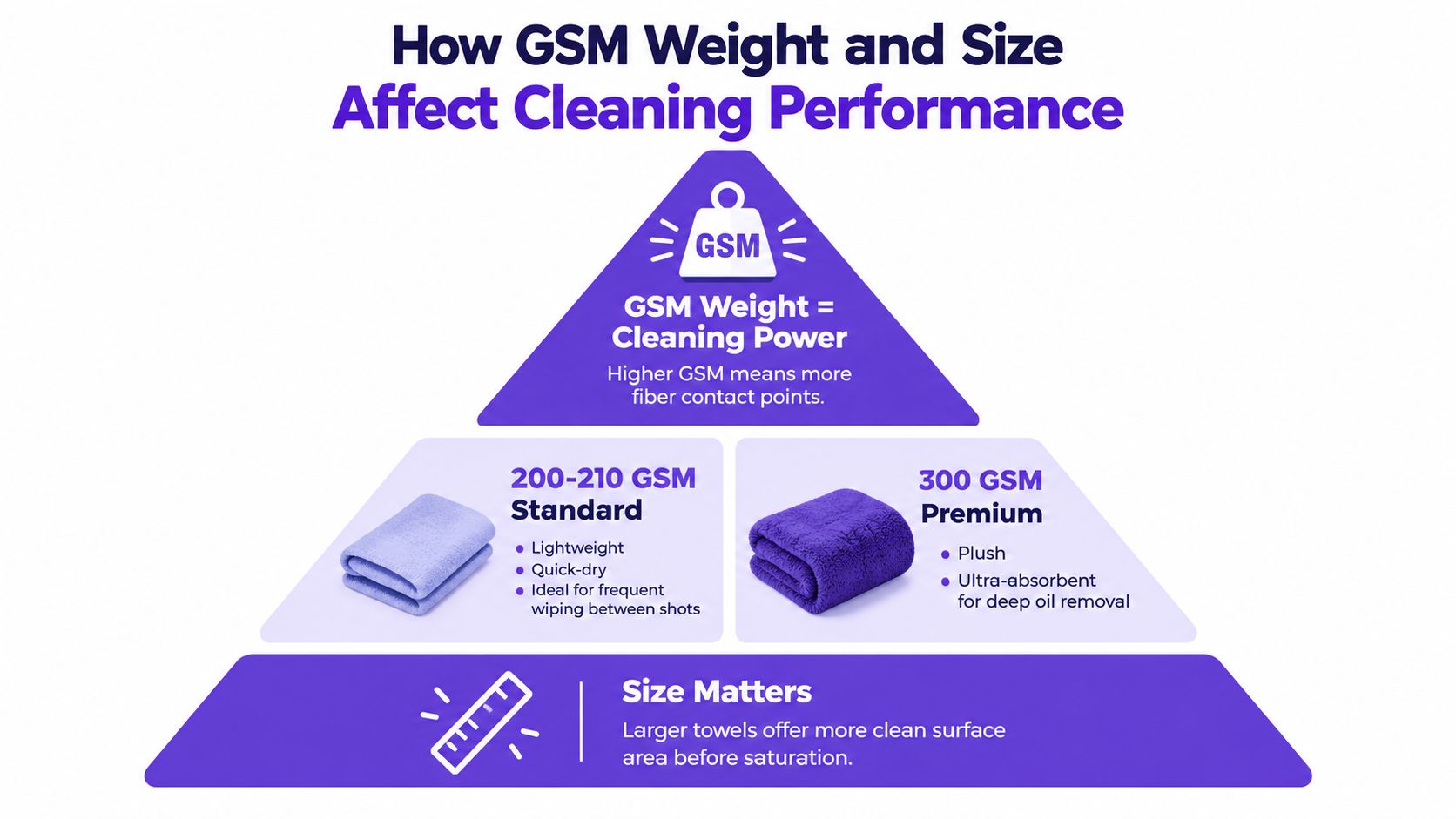
GSM is one of the specs that explains that difference. It stands for grams per square meter, which is a simple way to describe how much fabric is packed into a given area. In practice, GSM helps you predict how the towel will feel in your hand, how much oil or moisture it can hold before it feels loaded up, and how quickly it will dry in your bag.
What GSM changes on the lanes
A lower-GSM towel usually feels lighter and less bulky. That makes it easier to fold, easier to rotate to a clean side, and less annoying if you like a quick wipe during practice.
A higher-GSM towel usually feels thicker and more cushioned. That can be nice after bowling, when you want a fuller wipe and a little more material between your hand and the ball.
The key point is simple. Heavier does not always mean better cleaning.
A bowling ball wipes clean when the towel makes broad, even contact and still has enough clean fiber exposed to pick up surface film. If the towel is too plush, it can bunch up. If it is too light for your habits, it can saturate faster and start pushing oil around instead of lifting it. Bowlers who keep a premium bowling ball polishing and maintenance kit often notice this sooner, because the towel becomes part of a repeatable cleaning routine instead of a random add-on.
Why size affects results, not just comfort
Size sounds like a convenience choice, but it changes your workflow.
A smaller towel is easier to grip and easier to keep in one hand between shots. A larger towel gives you more usable surface area, which means more clean sections before the whole cloth starts feeling slick. That matters if you bowl long league blocks, practice with surface changes, or like to wipe the full track area instead of just one spot.
Here is a simple way to judge size:
- Too small: You run out of clean sections fast.
- Too large: It gets floppy, bunches, or feels slow to manage.
- Right size: You can fold it neatly, wipe with control, and rotate to a fresh area without thinking about it.
That last part matters more than bowlers expect. Good towel size supports rhythm. Bad towel size interrupts it.
Use a simple towel workflow
If you are deciding between towel options, split the choice by job first, then by specs.
- Pick the job. Quick wipe during practice, fuller cleanup after bowling, or both.
- Pick the weight. Lighter towels suit frequent handling. Heavier towels suit broader cleanup.
- Pick the size. Choose one you can fold and rotate easily with one hand.
- Pick the quantity. One in use, one clean, one spare is a practical setup for league bowlers.
This is why all microfiber towels should not be treated as interchangeable. The wrong GSM and size combination can leave the ball feeling oily sooner, make the towel feel saturated halfway through a session, or turn a simple wipe into extra fidgeting on the approach.
Pack count matters because clean fiber matters
A fresh towel section cleans better than an oily one. That sounds obvious, but it gets missed all the time.
If you only carry one towel, it has to do every job. It picks up lane oil, sits in the bag, grabs dust, and comes back out for the next session already partly loaded. Rotating towels solves a lot of complaints that bowlers blame on quality.
A practical setup looks like this:
- One towel for active use
- One clean backup in the bag
- One at home or in the wash cycle
If your towel feels slick, stays damp, or seems less effective each week, the issue may be care and rotation more than fabric weight alone.
Microfiber Towel vs Shammy Pad When to Use Each
Bowlers often get stuck. They ask which is better, as if one tool should replace the other. In practice, each does a different job.
A bowling.com knowledge article highlights a useful gap in most advice. It notes that content often repeats that microfiber traps oil better than cotton, but doesn't give enough practical guidance on when microfiber loses to a shammy. The clearest decision rule is this: use a shammy for quick between-shot oil removal and a microfiber towel for broader post-session cleaning (shammy pads and microfiber towels guidance).
Quick decision table
| Feature | Microfiber Bowling Towel | Shammy Pad |
|---|---|---|
| Best moment to use | After the set, during practice, or for a fuller wipe | Between shots when you want fast oil removal |
| Feel in hand | Soft, flexible, easy to fold | Grippy, firmer, more direct |
| Main strength | Broad cleanup of oil, residue, and moisture | Fast surface oil removal during play |
| Weak spot | Can feel less efficient for rapid between-shot use | Less convenient for general wiping and bag cleanup |
| Ideal workflow | Keep one clean for post-session use | Keep one ready on every shot |
A simple workflow that works
League bowlers don't need complicated routines. They need one they'll follow.
Try this:
- Before each shot: Use the shammy pad for a quick wipe over the track and full surface.
- After the session: Use your microfiber bowling towel for a more complete hand wipe, especially if you've used cleaner.
- At home: Wash the towel and let the shammy air out separately.
That split keeps you from asking one item to do everything. If you also use liquid cleaners, a review like this Storm Reacta Clean bowling ball cleaner review can help you think about where the towel fits in the bigger maintenance routine.
When microfiber still makes sense during play
Some bowlers still prefer microfiber in league because it feels familiar and soft. That's reasonable. If the pattern is lighter and your ball reaction stays stable, a microfiber towel may be enough for your pace of play.
But if you want the simplest answer, it's this:
Bring both. Use the shammy for speed. Use microfiber for cleanup.
7 Best Microfiber Bowling Towels on Amazon Reviewed
You finish game two, your ball starts reading early, and you reach into the bag for a towel that felt fine at home but now seems too small, too thin, or already loaded with oil. That is why this choice matters more than it looks on an Amazon page.
A lot of these listings use the same microfiber language. The useful differences are simpler. Look at how the towel fits your hand, how much clean surface you get, how thick the fabric feels, and whether you need one towel or a rotation. Those details affect what happens on the lane far more than marketing labels.
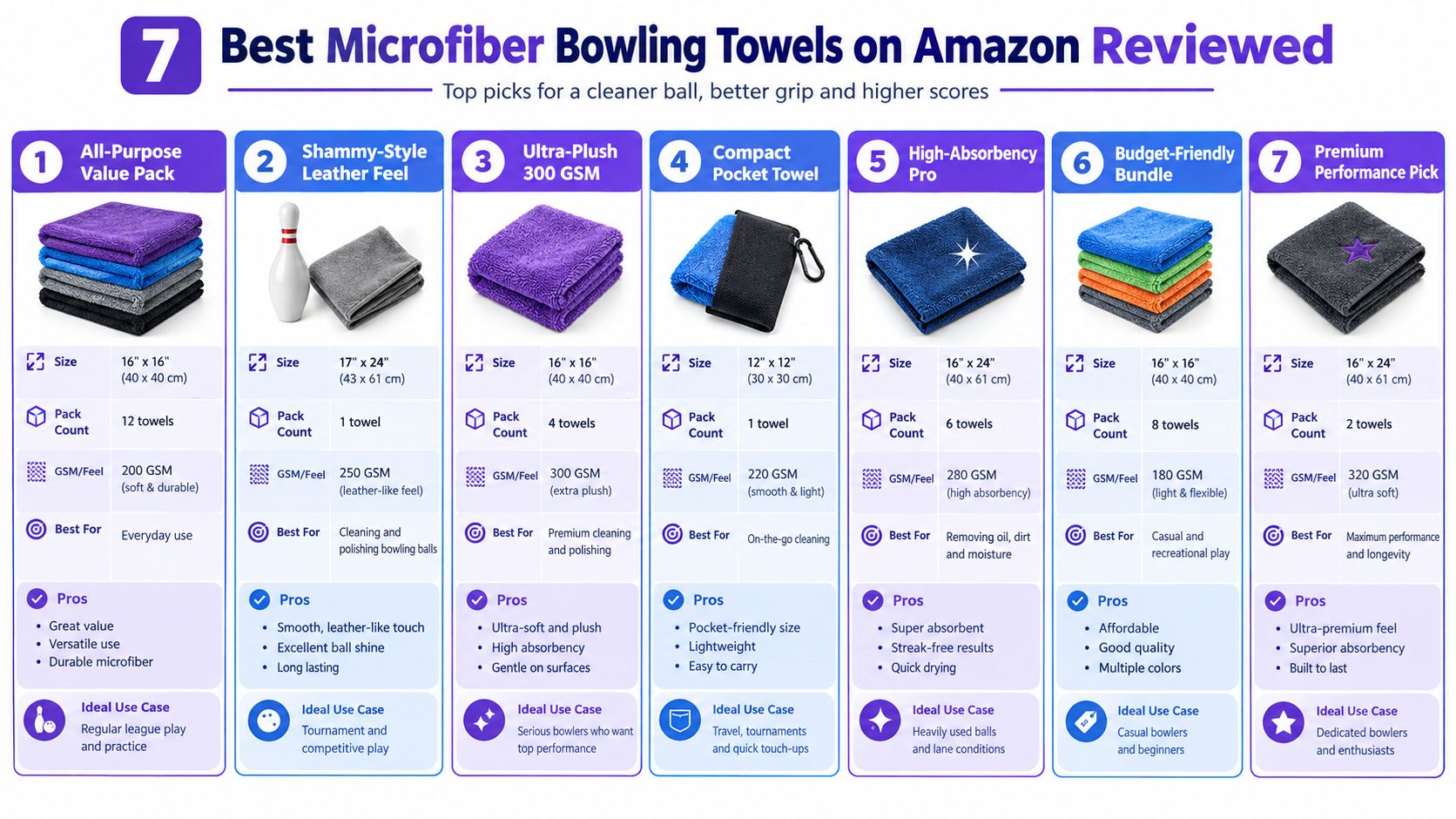
Comparison snapshot
| Product | Size | Pack Count | Feel | Best For |
|---|---|---|---|---|
| TonGass Microfiber Bowling Ball Towel | 10 x 8 inch | 3-pack | Standard microfiber | Value and rotation |
| Windspeed Microfiber Bowling Towels | 10 x 8 inch | 3-piece set | Soft, compact | Budget-minded bowlers |
| Athletico Microfiber Bowling See-Saw | See-saw style | Single | Wrap-around feel | Full-surface wipe |
| Classic Economy Microfiber Towel | Standard hand towel format | Single | Basic microfiber | Spare bag towel |
| Generic 300 GSM Microfiber Bowling Towel | Varies by listing | Single or multi-pack | Plush | Bowlers who like a thicker hand feel |
| Dual-Sided Microfiber Bowling Towel | Varies by listing | Usually single | Mixed texture sides | Cleaner-plus-dry wipe routine |
| Multi-Color Amazon Microfiber Pack | Compact format | Multi-pack | Everyday microfiber | Shared household or league use |
TonGass Microfiber Bowling Ball Towel
TonGass makes sense for bowlers who want a simple system right away. The common listing format is a 3-pack in a compact 10 x 8 inch size, which is easy to keep in a side pocket and easy to rotate when one towel starts feeling slick with oil.
Best use case: Bowlers who want one towel for league, one clean backup, and one in the laundry cycle.
Pros
- Built-in rotation: You are less likely to keep using one saturated towel for weeks.
- Easy bag fit: The small format does not bunch up in a crowded accessory pocket.
- Good starter choice: Simple specs, low guesswork.
Cons
- Basic feel: It will not feel as full in the hand as a thicker towel.
- Flat format only: Bowlers who like a wrap-around wipe may prefer a see-saw shape.
Verdict: A practical buy for beginners and league bowlers who care more about routine than fancy construction.
Windspeed Microfiber Bowling Towels
Windspeed lands in almost the same lane as TonGass. You are getting a compact multi-towel setup that works best for bowlers who fold the towel into sections and keep turning to a cleaner side during a set.
Best use case: A bowler who wants a small microfiber towel set for regular use and does not need a specialty shape.
The appeal here is workflow. A three-towel set gives you one for ball wiping, one for cleaner at home, and one spare. That is smarter than treating every microfiber towel as if it will perform the same once oil starts building up.
Athletico Microfiber Bowling See-Saw
Athletico changes the handling more than the fabric. The see-saw design lets you pull the material around the ball instead of chasing the surface with a folded square towel. For some bowlers, that means quicker full-cover contact and less fumbling between shots.
The product page also stands out because it has a large review history compared with many look-alike listings in this category (Athletico microfiber bowling see-saw on Amazon).
Best use case: Bowlers who want a compact towel that wipes the whole ball with a familiar wrap-around motion.
Pros
- Even contact: Easy to cover more of the ball surface in one pass.
- Purpose-built shape: Feels natural if you already like see-saw accessories.
- Travel friendly: Stores neatly without taking much room.
Cons
- Single towel: You will need a second towel if you like to rotate or separate cleaner use.
- Less flexible for other tasks: Not as convenient for wiping hands or accessories.
Verdict: A good match for league bowlers who prefer shape and handling over pack count.
Classic Economy Microfiber Towel
This is the spare-player of the group. It is a straightforward microfiber towel with no special shape and no special promise. That is not a criticism. Every bag usually needs one plain towel that can stay clean for post-session work, hand drying, or cleaner duty.
As noted earlier in the article, this type of towel is usually washable, quick-drying, and best washed without fabric softener.
Best use case: A backup towel or a dedicated towel for home cleaning and wipe-downs after bowling.
Generic 300 GSM Microfiber Bowling Towel
A 300 GSM towel usually feels thicker and fuller in the hand. GSM is fabric weight, so the quick way to read that number is simple. Higher weight often means more body and a plusher wipe. It does not automatically mean better lane performance.
That tradeoff matters. A thicker towel can feel excellent for post-session cleaning because it gives you more material between your hand and the ball. During play, some bowlers feel that same thickness makes the towel slower to handle or harder to keep neatly folded.
Best use case: Bowlers who want a softer, fuller towel for cleanup after the set or for use with ball cleaner.
Pros
- Plush feel: More substantial in the hand.
- Good cleaner companion: Helpful for slower, more deliberate wipe-downs.
Cons
- Can feel bulky: Not everyone wants extra thickness in the middle of competition.
- Results still vary: Stitching, weave, and size matter along with GSM.
Dual-Sided Microfiber Bowling Towel
Dual-sided towels try to split jobs. One side is often smoother, while the other has a little more bite. That setup works well for bowlers who like to use one face with cleaner and keep the other side drier for a finishing wipe.
Best use case: Bowlers who want one towel to cover two light-duty jobs without adding another accessory.
The benefit is convenience, not magic. If you already know you like a cleaner-and-buff routine at home, this style can keep that process organized.
Multi-Color Amazon Microfiber Pack
A multi-color pack is the organized choice. Different colors make it easy to assign different jobs, which helps more than people expect once oil, cleaner, and shoe dust all end up in the same bag.
A color-coded towel system sounds picky until you grab the wrong towel and wipe cleaner residue onto your ball before practice.
Best use case: Families, frequent practice bowlers, or anyone who likes separate towels for separate tasks.
Which one should most bowlers buy
For a safe first purchase, start with a 3-pack in the 10 x 8 inch range. That size is easy to handle, and the extra towels give you a rotation before performance drops from oil buildup.
If your lane routine depends on quick full-surface contact, the Athletico see-saw is the clearer choice. If your towel is mainly for after-session cleaning, a thicker 300 GSM style will probably feel better in use.
The simplest buying workflow is this. Choose pack count first, because rotation changes real-world performance. Choose size second, because a towel you cannot handle quickly will stay in the bag. Choose GSM last, because thickness matters, but only after the towel fits the job you do.
How to Use and Care for Your Bowling Towel
You finish a shot, pick up the ball, and the surface still feels slick. In that moment, the towel is either helping you remove oil or just spreading it into a thinner film. Good results come from contact, rotation, and using a clean part of the fabric at the right time.
A simple routine that works
Start with the job. If you are wiping oil between shots, use light pressure and cover the full ball as you turn it in your hands. Oil behaves a lot like cooking grease on a plate. If you keep wiping with the same dirty spot, you push residue around instead of lifting it away.
That is also where the towel versus shammy choice becomes practical. Use the shammy for quick between-shot oil removal when you want stronger bite on the surface. Use the microfiber towel after bowling, or during practice, when you want broader wipe-downs, cleaner application, or a separate towel for hands and gear.
If you keep your supplies together, complete bowling equipment cleaning kits can help you store the towel, cleaner, and other basics in one place so your routine stays consistent.
Care mistakes that hurt performance
A microfiber towel does not stay effective just because it still looks clean. Once the fibers load up with oil, dust, and cleaner residue, they grab less and smear more. Higher-GSM towels can hide this a little because they feel plush longer, but the lane result still drops if the towel is saturated.
Use this checklist:
- Wash it regularly: A towel used on reactive coverstocks collects oil quickly.
- Skip fabric softener: It coats the fibers and reduces their grip.
- Dry it fully: A damp towel stored in the bag can pick up odor and feel sluggish next session.
- Rotate towels: A small rotation gives you a dry, cleaner surface more often.
- Assign jobs by towel: Keep one for the ball, one for cleaner, and one for general bag mess if you carry multiples.
Storage affects next session's performance
Storage sounds minor until you pull out a towel that is cold, damp, and packed with shoe dust. Fold it loosely, let it dry before it goes in the bag, and avoid burying it under soles, tape, and rosin.
Size matters in real use. A compact towel is easier to air out and rotate during league night. A larger towel can cover more surface, but if it stays balled up in the bag, you lose the benefit. Clean fibers, a dry towel, and the right tool for the job usually matter more than brand names.
Choosing the Right Towel for Your Bowling Level
If you're new to bowling, buy a straightforward microfiber multi-pack. A compact 10 x 8 inch towel gives you enough surface for regular wipes without filling your bag with extra bulk. You don't need a fancy system yet. You need a towel you'll use every session.
League bowlers should think in pairs. Carry a shammy for quick between-shot oil removal and keep a microfiber bowling towel for broader cleanup after practice or league. A multi-pack is usually smarter than a single towel because you can rotate clean ones.
Tournament bowlers should be pickier about feel, storage, and routine. A see-saw style or premium microfiber can make sense if it fits your pre-shot habits, but the larger lesson is workflow. Don't ask one accessory to do every job.
One other option in this space is Bowling Gear Reviews, which publishes hands-on bowling equipment reviews, comparisons, and maintenance guides for accessories like cleaners, bags, and support gear. That's useful if you want to connect your towel choice to the rest of your ball care routine.
The right towel won't replace execution. It will make your ball care more repeatable. And repeatable usually scores better than random.
Bowling Gear Reviews offers independent bowling gear reviews, practical comparisons, and maintenance guides built around real lane use. If you want help matching a microfiber bowling towel, shammy, cleaner, or full care routine to your game, visit Bowling Gear Reviews.
