

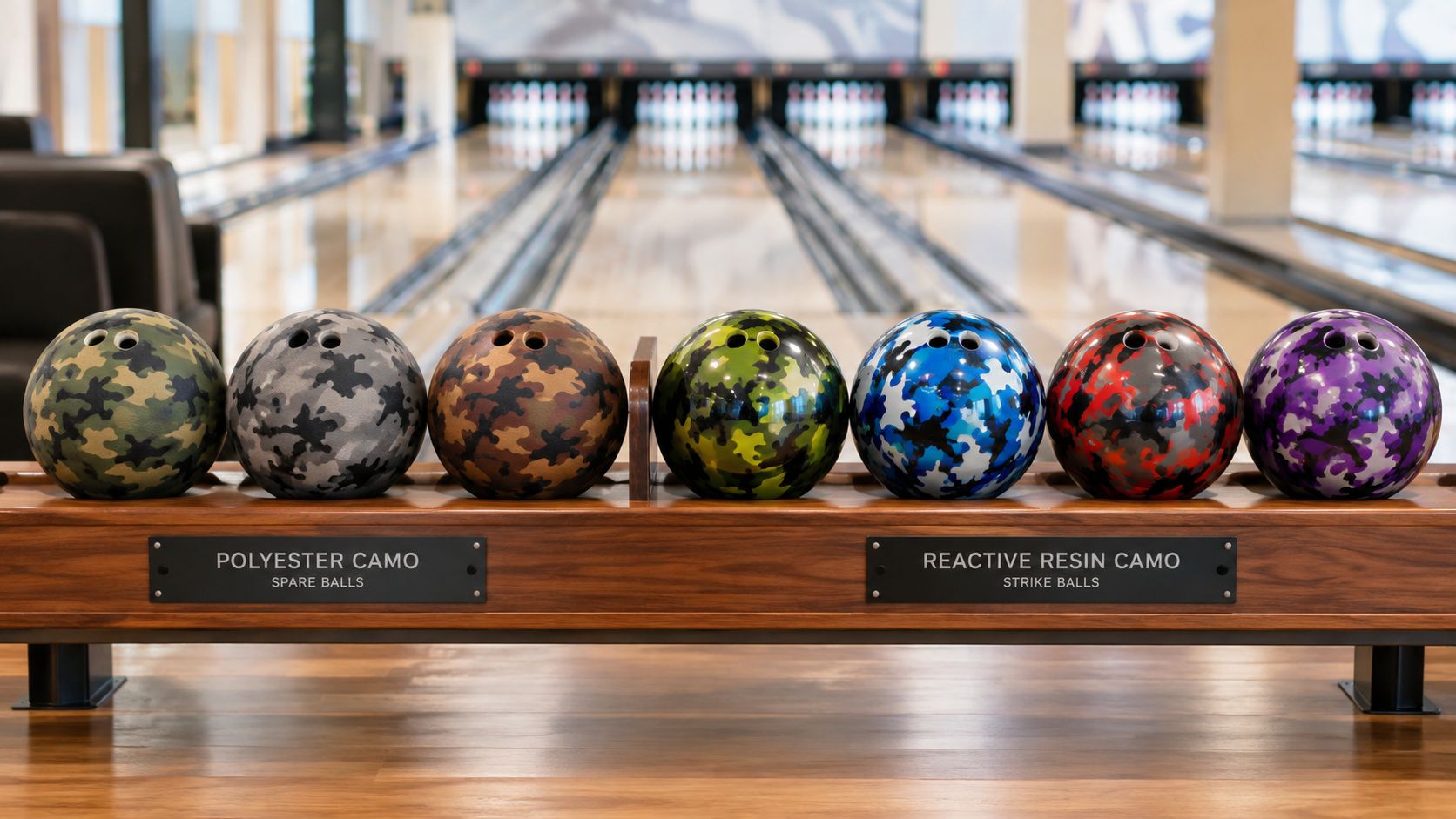
You're standing at the rack with a plain spare ball in one hand and a camouflage bowling ball in the other. The camo shell looks ready for the woods, but the question is simpler: will it help you strike, cover spares, or just make your equipment easier to spot?
The answer depends on which side of the category you're buying. Most camouflage bowling balls are novelty polyester spare balls, built to roll straight with a polished shell. A smaller group borrows the pattern for reactive equipment, where the underlying coverstock and core, not the print, determine lane motion. This guide separates those two groups and reviews seven camouflage bowling balls for 2026, including options to look for through Amazon listings and other bowling retailers.
| Best for | What to look for | Lane expectation |
|---|---|---|
| Spare shooting | Polyester coverstock, polished finish, low flare | Straight control |
| Junior or casual bowling | Light polyester option, conventional core | Forgiving, low-hook motion |
| Hunter or outdoors gift | Mossy Oak or themed graphic | Presentation and identity |
| Dry lanes | Polished polyester or mild reactive cover | Length with limited response |
| League versatility | Reactive camo coverstock and usable core | Defined shape, depending on surface |
| Competitive equipment | Verified reactive construction | Treat it as bowling equipment first |
| Easy maintenance | Glossy polyester shell | Wipe after use and protect the graphic |
Table of Contents
- What Camouflage Bowling Balls Actually Are
- How Camo Balls Are Built and Why It Matters
- Quick Comparison of the 7 Best Camouflage Bowling Balls
- The 7 Picks Reviewed for Style and Lane Role
- Which Camo Ball Fits Your Situation
- Durability, Lighting, and Resale Concerns Most Listings Skip
- USBC Rules, Care Tips, and Final Verdict
What Camouflage Bowling Balls Actually Are
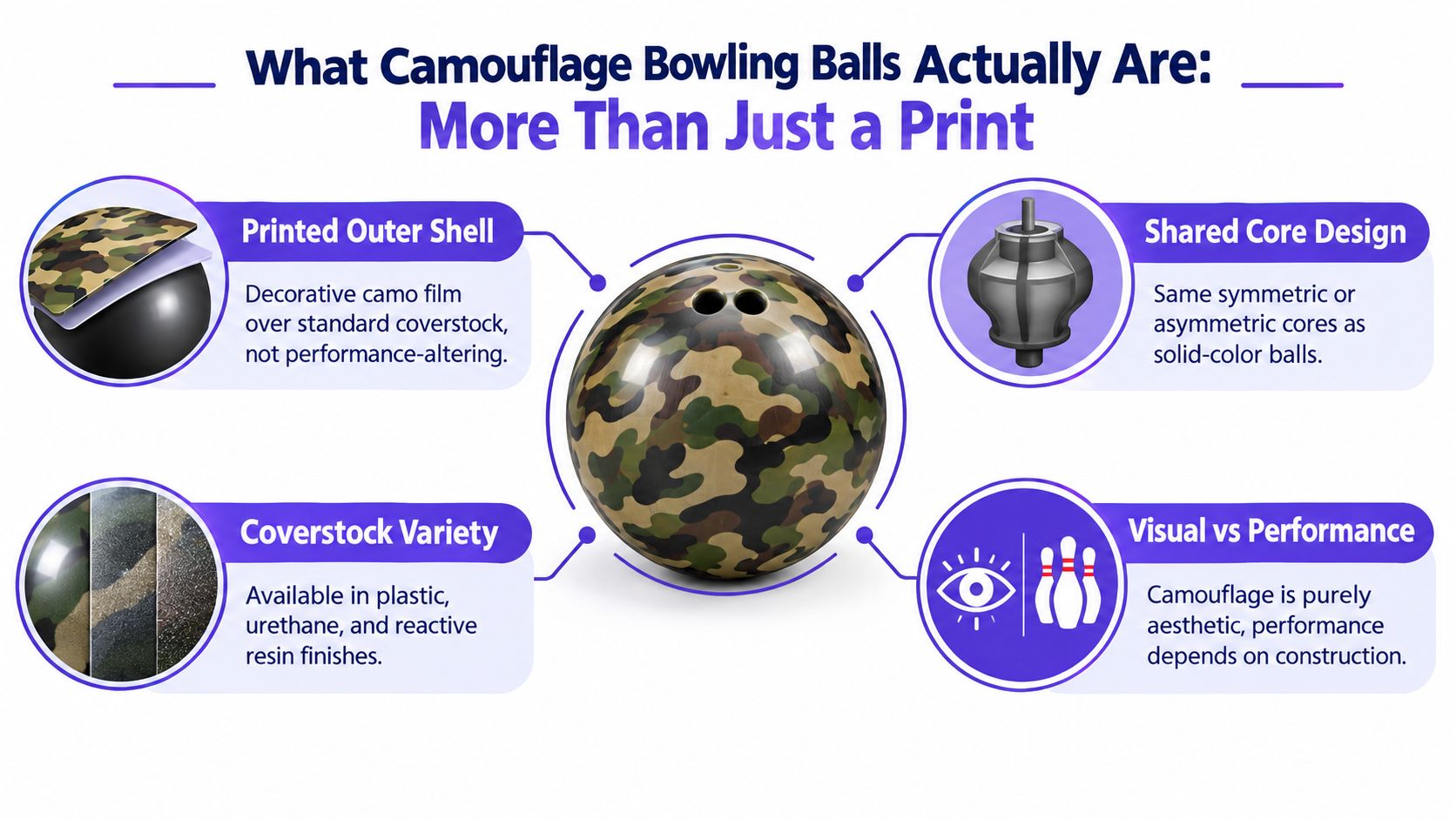
A bowler can pull a camo-printed ball from the rack beside a plain plastic spare ball and assume the pattern signals a special performance class. It doesn't. Camouflage describes the visual shell, while the coverstock, core, surface preparation, and drilling determine what the ball does after release.
Most camouflage bowling balls sold as novelty products are polyester. Retail listings for OnTheBallBowling Mossy Oak and camouflage models describe them as straight-rolling polyester shells, with colorways including green, blue, and grey. That places them in the same broad equipment family as many entry-level and spare balls, not alongside high-performance reactive resin equipment. The OnTheBallBowling Mossy Oak product listing frames the appeal around visual identity and standing out on the lanes, while the polyester construction keeps the motion predictable.
Lane-side rule: Buy the pattern for appearance. Buy the coverstock and core for ball reaction.
The three useful categories
Think of the market as three practical lanes:
- Novelty polyester spares: These are the most common camouflage designs. They're polished, low-flare balls intended for straight shots, spare coverage, dry lanes, or casual use.
- Hunter and military-themed gifts: Mossy Oak styling and similar graphics appeal to outdoors enthusiasts, children, and bowlers who want equipment that feels personal rather than anonymous.
- Reactive camouflage releases: A smaller group uses a reactive, pearl, or hybrid coverstock beneath the cosmetic theme. Those balls can belong in a league bag, but the camo pattern still isn't what creates hook.
The distinction matters because a graphic overlay doesn't change the ball's porosity, friction profile, or gripping properties by itself. A polished polyester shell generally skids longer and changes direction less than a sanded reactive ball. A reactive camo ball can create stronger traction and backend motion, but that comes from its coverstock and surface condition.
Swirl, pearl, and solid describe coverstock appearance or formulation, not a color theme. A swirl may be polyester or reactive. A pearl reactive ball may look bright, dark, or camouflaged. A solid reactive ball can carry a graphic too. If you're unsure, use this comparison of reactive, urethane, and plastic bowling balls to identify the construction before judging the artwork.
The historical context supports the same conclusion. Bowling balls moved from hard rubber, which appeared in 1905, to colorful plastic balls in the 1960s, before reactive resin reshaped high-performance bowling in the 1990s, as outlined in this bowling-ball material history video. Camouflage is therefore a later design treatment applied to an established product category, not a separate performance revolution.
How Camo Balls Are Built and Why It Matters
The quickest way to read a camouflage bowling ball listing is to ignore the photograph first. Find the coverstock, finish, and core. Those three details tell you whether the ball belongs in a spare kit or deserves a place among your strike equipment.
A polyester camo spare commonly uses a traditional three-piece construction with a polished, high-gloss surface and very low flare potential, around one inch, according to Bowling.com's equipment guidance on camo-patterned polyester balls. That combination favors length, minimal friction, and straight-line control. A reactive option may use a symmetric or asymmetric dynamic core, a pearl or solid reactive coverstock, and a factory surface prepared somewhere along the polished-to-sanded spectrum.
Read the listing in this order
- Coverstock first: Polyester means spare and low-hook duty. Reactive resin means the ball may create meaningful traction and shape, depending on the lane and surface.
- Finish second: Crown polish helps a ball clear the front part of the lane. A lower-grit reactive surface creates earlier traction, especially when oil is present.
- Core third: A basic pancake or symmetric bulb supports controllable spare motion. A dynamic symmetric or asymmetric core can influence flare and overall shape.
- Weight block options last: A specification listed for a heavier ball doesn't automatically apply to every weight. Weight-specific numbers matter.
The graphic itself may be printed, embedded, or hydro-inked beneath or within the outer material. That's why sanding requires caution. Surface work can improve reaction on a reactive ball, but aggressive resurfacing may thin or remove the pattern, particularly when the design sits close to the surface.
| Spec | Polyester Camo Spare | Reactive Camo Option |
|---|---|---|
| Coverstock | Polyester | Reactive resin, pearl, solid, or hybrid |
| Core | Traditional three-piece, pancake, or simple symmetric design | Symmetric or asymmetric dynamic core |
| Factory finish | High-gloss polish | Polish, rougher preparation, or adjustable surface |
| Typical role | Spares, dry lanes, entry-level bowling | Strike shots, league versatility, oil-dependent reaction |
| Flare expectation | Very low, around one inch on typical novelty designs | Varies by core, coverstock, weight, and layout |
| Surface caution | Preserve the graphic and gloss | Resurfacing can alter or remove the pattern |
For bowlers comparing drilling choices, the bowling-ball drilling layouts guide is useful because layout changes how a reactive core presents itself. It won't turn a polyester spare into a hook ball, though.
Here's a visual reference for the construction gap:
Quick Comparison of the 7 Best Camouflage Bowling Balls
The seven picks below represent the category split rather than pretending every camo design performs alike. The first group is built around straight control and gift appeal. The reactive entries are the ones to investigate when you want camouflage styling without giving up a genuine strike-ball role.
| Ball | Coverstock | Finish | Best Use |
|---|---|---|---|
| OnTheBallBowling Mossy Oak Nautical | Polyester | High-gloss polish | Spare shooting and outdoors-themed gifting |
| OnTheBallBowling Mossy Oak Camo | Polyester | High-gloss polish | Straight spare ball and novelty use |
| Brunswick Rhino Camo | Reactive pearl | Factory polish | Entry-level league versatility |
| Roto Grip Hustle Camo | Reactive | Factory performance finish | Controllable league benchmark shape |
| Hammer Tough Muddy Girl Camo Spare | Polyester | Glossy polish | Junior, casual, or gift purchase |
| Camouflage Green Polyester Spare Ball | Polyester | Glossy polish | Basic spare coverage |
| Camouflage Blue or Grey Polyester Spare Ball | Polyester | Glossy polish | Visual variety and dry-lane control |
Quick answers for common buyers
- For spare shooting: Start with the OnTheBallBowling Mossy Oak Camo, the Mossy Oak Nautical, or a basic camouflage polyester spare. Their straight behavior is the point.
- For a hunter or outdoors fan: The Mossy Oak designs offer the clearest connection between bowling equipment and outdoor styling.
- For a junior or casual bowler: The Hammer Tough Muddy Girl Camo Spare is the most presentation-focused option in the group, provided the available weight suits the player.
- For league versatility: Look at the Roto Grip Hustle Camo or Brunswick Rhino Camo. These aren't substitutes for every modern performance ball, but they belong to the reactive side of the category.
- For a competitive player: Treat the reactive rows as equipment choices and the polyester rows as spare tools. Don't choose solely from the graphic.
Amazon availability changes by seller, weight, drilling status, and inventory. For that reason, use the model name and specifications as your search filters rather than assuming every listing represents the same ball.
The 7 Picks Reviewed for Style and Lane Role
1. OnTheBallBowling Mossy Oak Nautical
The Mossy Oak Nautical is the clearest example of a camouflage bowling ball designed around identity first. Its polyester shell and polished finish place it in the straight-ball category, where it makes sense for spare shooting, beginners, dry lanes, and bowlers who want an outdoors-themed ball in the rack.
On the lane, expect the motion of plastic rather than the motion suggested by the dramatic print. It won't create the traction or entry angle associated with a sanded reactive ball. That predictability can be an advantage for corner pins and controlled straight shots, especially when you don't want your spare ball reacting to lane friction.
Amazon-style buying note: Search Amazon by the full Mossy Oak Nautical name and confirm the listed weight, drilling status, and seller before ordering. It suits gift buyers and spare-ball users, but the caveat is simple: the visual theme doesn't add strike-ball performance.
2. OnTheBallBowling Mossy Oak Camo
The standard Mossy Oak Camo is a practical choice for bowlers who want the camouflage look without moving away from polyester's familiar behavior. Retail descriptions identify the construction as polyester and emphasize the straight-rolling shell, so it belongs in a beginner's starter setup or a league bowler's spare kit.
The polished surface helps the ball travel with limited friction. That makes it more useful for straight spare lines than for trying to open up the lane with hook. If you're buying from Amazon, compare the graphic, weight, and whether the listing includes factory drilling or an undrilled ball.
Amazon-style buying note: This is the best fit for someone who wants a recognizable Mossy Oak design and straightforward maintenance. The limitation is that it's a specialty aesthetic product, not a replacement for a reactive strike ball.
3. Brunswick Rhino Camo
The Brunswick Rhino Camo represents the more interesting side of the category because the camouflage styling sits on reactive equipment rather than a conventional plastic spare. That gives it a legitimate league role for bowlers who want an approachable strike ball with more shape than polyester can provide.
A polished reactive ball can offer length and a readable change of direction, but reaction still depends on lane oil, speed, release, drilling, and surface condition. I'd place a ball like this with a newer league bowler or someone building a controlled, lower-intensity reactive option, not with a player expecting heavy-oil traction from a graphic alone.
Amazon-style buying note: Confirm the exact coverstock and finish in the listing because marketplace titles can blur cosmetic and construction details. It suits league bowlers who want versatility, while the caveat is that the camo graphic may limit resale appeal compared with a plain model.
4. Roto Grip Hustle Camo
The Roto Grip Hustle Camo is the strongest candidate here for a bowler who wants camouflage styling and a real benchmark-style role. Its Hustle core is listed for 14 to 16 pound balls with an RG of 2.53 and differential of 0.030, while the 12 pound version lists an RG of 2.65 and differential of 0.011, according to Bowling.com's technical discussion. Those weight-specific figures point toward a controllable, medium-flare profile rather than maximum flare.
On a league pair, that profile is more about predictable transition and manageable backend response than a violent move. It can make sense for a bowler who wants easier length and a defined shape, especially when a stronger reactive ball feels too early or too angular.
Amazon-style buying note: Search by the complete Roto Grip Hustle Camo model and verify weight before checkout. It suits league bowlers who want a reactive camo option, but availability and weight selection can be narrower than with standard spare balls.
5. Hammer Tough Muddy Girl Camo Spare
The Hammer Tough Muddy Girl Camo Spare is aimed squarely at presentation, personality, and straight control. Its polyester spare-ball identity makes it appropriate for junior bowlers, casual players, and gift buyers who care about a graphic that feels distinctive on the rack.
The BowlersMart listing for the Hammer Tough Muddy Girl Camo Spare also illustrates an important buying issue. Manufacturer descriptions may discuss image-embedded clear polyester and durability, but independent long-term wear comparisons remain limited. Treat those durability statements as product positioning, not as proof that the graphic will resist every scuff, cleaner, or resurfacing process.
Amazon-style buying note: Look for the exact weight and whether the ball is drilled to fit the recipient. It's a strong gift option, but it isn't intended to replace a reactive ball for strike play.
6. Camouflage Green Polyester Spare Ball
A green camouflage polyester spare ball is the straightforward choice when you care more about color and function than a specific licensed pattern. The construction to prioritize is a polished polyester cover, a simple traditional core, and a weight that matches the bowler's comfort and existing equipment.
This type of ball earns its place by staying uncomplicated. It can cover straight spares, give a casual bowler a personal-looking first ball, or provide a visual alternative to a plain black plastic shell. The graphic won't change the release or create extra hook, so the purchase decision should focus on fit, drilling, and whether the seller accurately describes the coverstock.
Amazon-style buying note: Amazon searches can return several visually similar products, so check the manufacturer, weight, and return terms carefully. It suits budget-conscious gift buyers, with the caveat that generic patterns may have less predictable availability and resale demand.
7. Camouflage Blue or Grey Polyester Spare Ball
Blue and grey camouflage polyester balls offer the same basic lane role as the green versions, but the cooler colorways can stand out differently under bowling-center lighting. They're useful for bowlers who want a recognizable spare ball without choosing a hunting-branded design.
The correct expectation remains low-hook control. A polished polyester shell is valuable when you want a ball to hold its line, particularly for spare practice or drier conditions where a reactive ball may respond too quickly. If the listing describes a reactive coverstock, reassess the recommendation because the lane role changes with the material.
Amazon-style buying note: Search Amazon for the exact color and confirm the ball's coverstock before buying. These models suit visual-focused gift purchases and casual bowling, but the graphic may be harder to match with a replacement later.
Which Camo Ball Fits Your Situation
Your best choice depends less on the pattern than on the job the ball must perform. Start with the bowler, then decide whether the purchase is for spare control, strike-ball versatility, or presentation.
A parent or coach buying a first ball
For a junior or casual player, the Hammer Tough Muddy Girl Camo Spare offers a clear gift identity, while the OnTheBallBowling Mossy Oak Camo gives an outdoors-oriented player a recognizable design. A green polyester camouflage spare also makes sense when you want a simple shell and broad visual appeal.
Choose the lightest suitable weight offered by the listing, but don't select by age or appearance alone. The ball should fit the player's hand, allow a controlled swing, and be drilled by someone who can set the thumb and finger positions correctly. A flashy graphic can encourage practice, but poor fit will undermine the experience.
A league bowler adding a spare ball
For a spare kit, the Mossy Oak Nautical or standard Mossy Oak Camo is the cleaner decision. Both align with polyester's straight behavior, which is exactly what you want when covering pins without introducing unnecessary lane movement.
If you already carry a plastic spare ball and want a different look for dry lanes, consider the Brunswick Rhino Camo only if you need reactive shape. It's not a spare-ball substitute. It belongs in the strike-ball conversation and should be matched to your current bag rather than purchased as a novelty add-on.
A competitive player considering reactive camouflage
The Roto Grip Hustle Camo is the most defensible choice from this list for a competitive bowler curious about reactive camouflage. Its listed core numbers support a controllable profile, but you'll still need to assess surface, layout, speed, rev rate, and the lane environment.
Don't let the word “camo” push you toward a ball that duplicates something already in your bag. Compare the reactive option against your current benchmark and observe where it clears the fronts, transitions, and changes direction. The polyester picks remain useful as spares, even when your strike lineup is entirely reactive.
A gift buyer focused on presentation
The Mossy Oak models are the safest visual match for a hunter or outdoors enthusiast. The Hammer Tough Muddy Girl Camo Spare is more specific in its audience, while blue and grey polyester options photograph with a cleaner, cooler look.
For a display-worthy purchase, verify that the product photos show the actual colorway, not a generic catalog image. Confirm the shipping condition, drilling status, and return policy before ordering because graphic preference is personal and marketplace listings can vary.
Durability, Lighting, and Resale Concerns Most Listings Skip
A camouflage print doesn't make a ball tougher, and a glossy shell can reveal wear in ways product photography hides. Polyester balls can collect lane oil, scuff marks, and wipe streaks across the graphic, especially when the ball travels loose in a bag or gets handled repeatedly at the return.
Lighting creates another practical issue. A polished graphic surface can reflect overhead league lights, and high-contrast patterns may become visually busy during setup. Most bowlers adapt quickly, but anyone who uses a precise target reference should check whether glare or a bright patch distracts them at address.
Practical observation: The pattern matters more between shots than during the roll. On the lane, construction wins.
Resale is also narrower. A plain reactive ball usually appeals to more bowlers because buyers can evaluate its performance without caring about the artwork. A camouflage graphic may attract the right person immediately, but it can also reduce the pool of interested used-equipment buyers.
Watch the thumb area for peeling or wear, particularly if the graphic sits near an insert or drilling edge. On reactive camo balls, ask a pro shop before requesting an aggressive resurface because removing material can alter or erase the design. For cleaning and polishing decisions, use a purpose-built bowling-ball polishing and maintenance kit guide rather than an abrasive household product.
USBC Rules, Care Tips, and Final Verdict
A camouflage bowling ball can be legal for competition if it meets the same equipment requirements as any other ball. USBC specifications require solid construction without liquids or voids in the center, and the surface must be free of unauthorized depressions, grooves, or foreign material such as powder, rosin, marker, or paint. Cosmetic graphics aren't automatically disqualifying.
USBC also banned balance holes beginning August 1, 2020, and introduced oil-absorption and conformance requirements for new ball samples, as described in USBC's specification update. Have a pro shop verify any unusual model before league use.
Wipe a polyester shell after every session, store it away from direct UV exposure, and avoid abrasive cleaners that dull the finish or damage the graphic. The final verdict is straightforward: camouflage bowling balls are legitimate spare and gift options, while the rare reactive models are genuine equipment choices wearing a themed cosmetic.
Bowling Gear Reviews offers independent bowling-ball reviews, comparisons, hands-on testing notes, and practical buying guidance for bowlers choosing between polyester spares and reactive equipment. Visit Bowling Gear Reviews to compare coverstocks, cores, surface choices, and lane roles before you buy your next camouflage bowling ball.
