

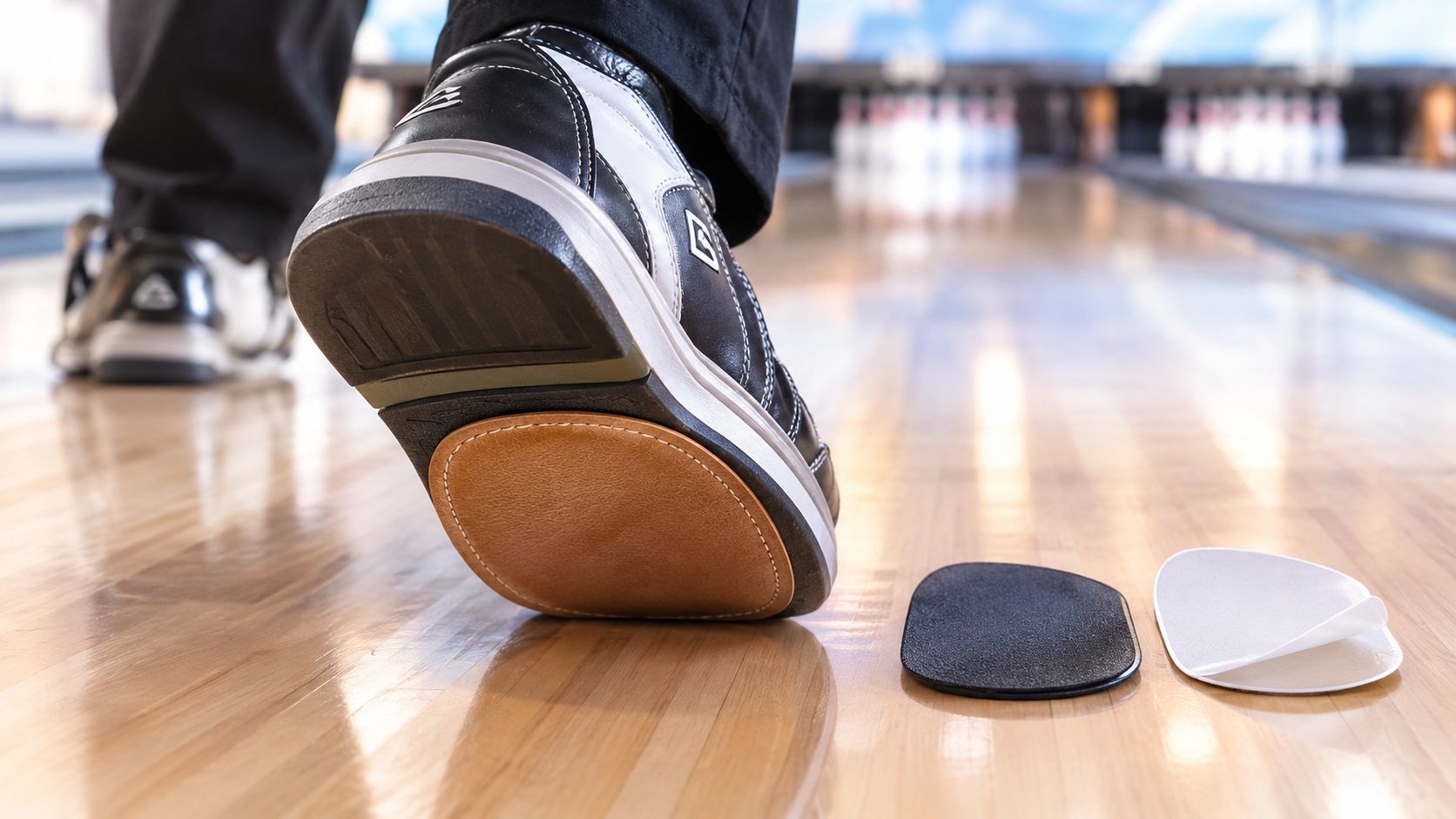
You reach the foul line, plant your sliding foot, and feel it hesitate. Your hips get pulled forward, the ball leaves late, and the shot misses the pocket. On the next delivery, you overcorrect with a slicker sole and slide past your balance point.
That's the problem a bowling shoe slider is meant to solve. It controls the friction beneath your sliding foot, helping you move into the finish without sticking or drifting too far. The right slider won't repair poor timing, but it can make a sound approach more predictable.
This guide cuts through the three choices bowlers usually face, integrated pads, interchangeable systems, and slip-on covers. It also separates the Amazon products worth considering from the options that are better treated as temporary fixes.
Table of Contents
- Why Your Bowling Shoe Slider Decides Your Approach
- The Short History of Slide Technology
- How Slide Numbers Control Your Foot Speed
- Three Slider Formats Compared Side by Side
- Seven Amazon Bowling Shoe Sliders Worth Buying
- Installing, Trimming, and Caring for Slide Soles
- Choosing the Right Slider for Your Game
Why Your Bowling Shoe Slider Decides Your Approach
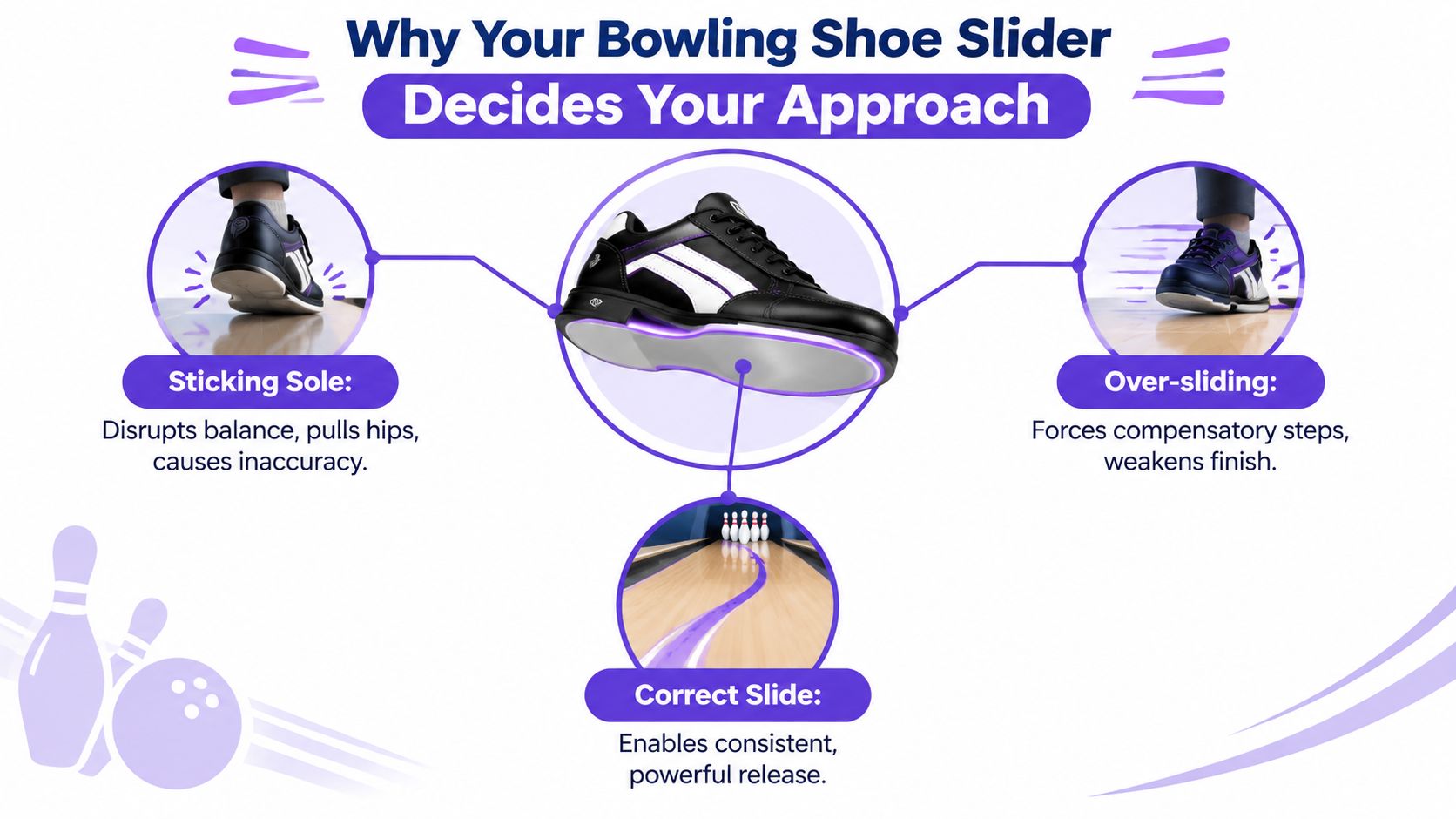
The slider sits on the sole of the foot that moves forward during the approach. Its job is simple, but its effect is substantial. Too much friction stops the foot before the body is ready. Too little friction lets the foot continue moving after the bowler has reached the intended finishing position.
A sticking sole often pulls the hips toward the foul line. That changes posture, delays the release, and makes the bowler rush to regain balance. An over-sliding sole creates the opposite problem. The bowler must catch the body with the trailing foot or shorten the finish, which usually weakens power.
Read the finish before changing the sole
Watch where your sliding foot stops and what your upper body does immediately afterward.
- The foot sticks early: You'll often feel the knee stop abruptly, with the shoulders and hips continuing forward. A lower-friction slider may help, provided your approach is otherwise balanced.
- The foot slides too far: You'll reach for the foul line, lose a firm posture, or take a recovery step. Move toward a higher-friction option rather than assuming the slickest pad is better.
- The finish stays quiet: Your foot reaches the line smoothly, your torso remains stable, and the ball exits without a last-second correction. That's the feel you're chasing.
The opposite foot matters too. A bowling shoe balances a sliding component with a braking surface, so changing only the slider may expose a problem in the heel or traction sole. A worn heel can make the finish feel unstable even when the slide pad is still usable.
Practical rule: Tune for a controlled glide, not maximum distance.
Approach conditions also change the answer. Dust, moisture, lane-cleaning residue, and inconsistent housekeeping can alter how the same sole feels. Test after wiping the pad clean, use your normal approach, and change only one variable at a time. Small adjustments are easier to evaluate than jumping straight to the most aggressive slide.
The Short History of Slide Technology
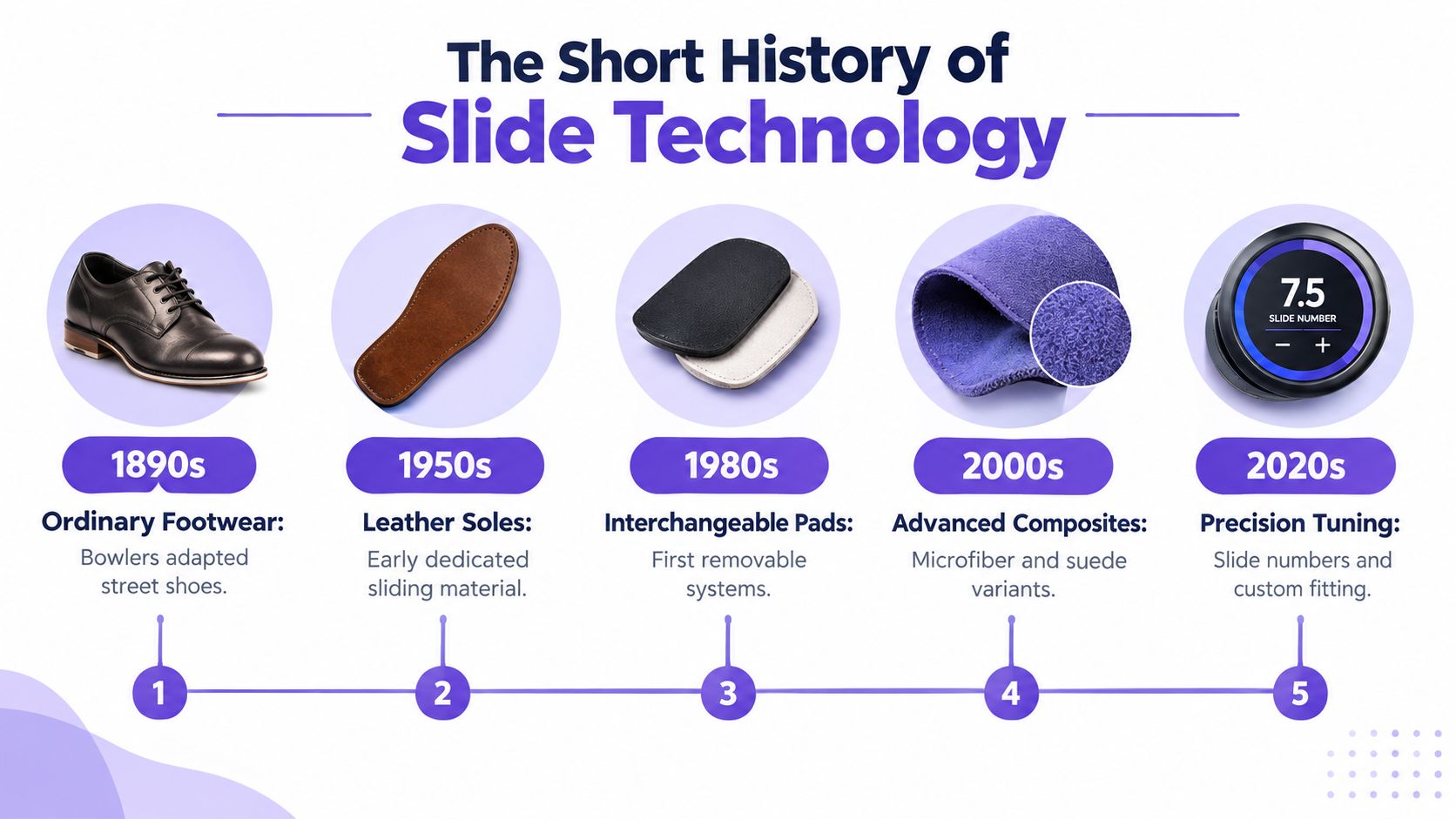
The modern slider grew from a practical need. Bowlers needed one shoe to move freely during the delivery while the other foot provided enough resistance to help them stop. Early leather and buckskin solutions established that separation between sliding and braking functions.
A commonly cited historical marker comes from 1936, when a member of a Hamm's Brewery bowling team requested a buckskin sole. The request spread through the team, showing how quickly player demand could influence equipment design. The account is documented by Bowling This Month's history of bowling slide technique.
From leather patches to interchangeable parts
Fixed leather patches were useful because they created a more repeatable approach feel than ordinary footwear. They still left bowlers with one basic friction level, however. As centers adopted more consistent approaches and bowlers became more deliberate about equipment tuning, removable soles and heels became more valuable.
Patent records show the technical lineage clearly. Earlier filings referenced in the Dexter record include bowling-shoe methods dating to 1963, replaceable heel construction from 1980, and removable traction surfaces from 1982. Dexter's patent, filed on December 21, 1994 and granted on August 6, 1996, documented a removable slide pad covering the slide area and a removable heel, evidence that interchangeable components had reached commercial development by the mid-1990s. See the Dexter removable slide and heel patent record.
Numbered systems changed the conversation. Instead of asking whether a shoe was slick or sticky, bowlers could carry different pads and select a feel suited to the approach. Hook-and-loop fastening made changes practical between sessions, and later materials added more consistent texture and fit.
The important lesson is that newer doesn't automatically mean faster. The useful advance is adjustability. A bowler can choose traction for a tacky approach, moderate movement for a familiar house condition, or freer slide when the surface feels resistant.
How Slide Numbers Control Your Foot Speed
Slide numbers describe relative friction within a sole system. Lower numbers generally provide more friction and less slide, while higher numbers reduce resistance and allow a longer, freer glide. The Bowling.com guide to interchangeable soles places S2 through S5 in the short-slide, higher-traction range and S8 through S10+ toward maximum slide.
These numbers aren't a universal measurement of braking distance. An S8 from one manufacturer may not feel identical to an S8 from another because material, construction, and testing methods differ. Compare pads within the same brand system whenever possible.
Start in the middle, then test adjacent numbers
Use your normal approach during practice, not a rushed competition-speed delivery. Notice where the slide ends and whether you finish comfortably over the ankle.
| Range | Typical feel | Best starting point |
|---|---|---|
| S2–S5 | Controlled movement with stronger traction | Bowlers who stick, slide a short distance, or need a firmer finish |
| S6–S7 | Moderate glide and balanced control | Bowlers who want a neutral baseline |
| S8–S10+ | Freer, longer movement with less resistance | Bowlers facing a sticky approach or seeking maximum slide |
Many bowlers begin around S6 to S8, while higher-slide choices such as S8 to S10 are used when the approach feels sticky or tacky, as described in Bowling.com's interchangeable sole guidance.
Fresh or resistant approaches can reward more slide. Dry, dusty, or worn surfaces usually call for more traction. Your delivery matters just as much. A fast, powerful approach can create enough momentum that a very slick sole becomes difficult to control, while a slower approach may need more freedom to reach the line comfortably.
If you're also working on delivery tempo, compare your slider change with the approach advice in this guide to increasing ball speed. Don't change your footwork and sole at the same time. Otherwise, you won't know which adjustment produced the new feel.
Three Slider Formats Compared Side by Side
There are three practical ways to control slide. The best choice depends less on marketing language and more on the problem you're trying to fix.
Integrated slide pads are bonded or built into the shoe. They're the cleanest option for beginners and league bowlers who want to lace up and bowl without carrying spare parts. The drawback is obvious: once the pad's feel no longer suits your approach, the entire shoe becomes the adjustment.
Interchangeable systems are the serious bowler's tool. Shoes from performance lines such as Dexter's SST family and Brunswick's interchangeable models let you change slide pads and, in some systems, heels. You get the broadest tuning range, but you'll pay more upfront and need to keep track of the components.
Slip-on covers are the low-commitment fix. The Hammer Bowling Products Bowling Shoe Slider on Amazon fits over an existing slide sole, uses a duraflex and suede construction, and is described as fitting most shoes. It's useful when house shoes feel too resistant, but a cover won't feel as integrated or secure as a properly fitted replacement sole.
| Format | Price range | Slide adjustability | Durability | Best bowler profile |
|---|---|---|---|---|
| Integrated slide pad | Entry to mid-level | Fixed feel | Practical for regular recreational use | Beginners and casual league bowlers |
| Interchangeable sole system | Mid to premium | Broad, often numbered range | Strongest long-term serviceability when maintained | Serious league and tournament bowlers |
| Slip-on slide cover | Budget | Adds slide without replacing the shoe | Convenient but more vulnerable to movement and wear | Casual bowlers using house or basic shoes |
The trade-off is straightforward. Integrated shoes cost less in complexity, interchangeable systems cost more but solve changing-condition problems, and slip-on covers make sense when you're not ready to buy dedicated equipment.
Seven Amazon Bowling Shoe Sliders Worth Buying
Amazon's selection mixes replacement parts, complete shoes, covers, and adhesive pads. These are the seven options I'd put on a practical shortlist, with one warning: several products require a compatible shoe or careful fitting.
1. Dexter SST 8 interchangeable sole and heel replacement set
This is the reference point for bowlers who want a complete tuning system. Dexter's interchangeable approach lets you adjust both the sliding and braking sides, making it a strong fit for competitive bowlers who need to respond to different approaches.
Its weak spot is ownership complexity. You'll need compatible Dexter footwear, spare parts can disappear into a gear bag, and the system costs more than a fixed-pad shoe. Buy it if you're committed to regular league or tournament bowling and want the freedom to work across the S2 to S10 range.
2. Dexter H5 ST replacement soles
The H5 ST replacement sole is aimed at bowlers whose existing Dexter shoes still fit well but whose pad has lost its original feel. It's a sensible stock-shoe refresh, especially when the rest of the upper and outsole remain sound.
It won't transform a fixed shoe into a fully tunable platform. Choose it for a Dexter owner who wants to restore familiar movement, not for someone seeking a broad range of slide choices.
3. Brunswick Aviator replacement soles
Brunswick Aviator replacement soles suit bowlers who like the shoe but need a fresh sliding surface. Brunswick's numbered approach makes it easier to think in terms of friction and movement instead of vague descriptions such as “fast” or “smooth.”
Compatibility is the limitation. Confirm the attachment pattern and shoe model before ordering. This is the right pick for a Brunswick owner who wants a direct replacement without replacing the entire pair.
4. Bowlerstore S4 leather slide
An S4 leather slide is a traction-focused choice for bowlers who feel unstable on slicker pads. It gives a more controlled transition and suits a bowler who tends to over-slide or wants a shorter, firmer finish.
Leather requires sensible care and won't compensate for a contaminated approach. Pick it when you already know you need a lower-slide feel and don't want to buy a complete interchangeable assortment.
5. Bowlerstore S10 leather slide
The S10 option goes in the opposite direction. It's for bowlers who fight a sticky approach, especially those whose sliding foot stops before their timing is complete.
The trade-off is control. A high-slide pad can expose poor posture and make a weak finish harder to hide. It fits experienced bowlers who have tested their current approach and know they need a freer sole.
6. Bionic Glide adhesive slide pad
A peel-and-stick pad is the inexpensive way to experiment with added glide on a house shoe or basic bowling shoe. It works best as a trial solution or emergency replacement, not as a permanent performance platform.
Adhesive pads depend heavily on preparation and bonding. They can shift, collect debris, or wear unevenly if the shoe surface isn't clean and flat. Choose it for a casual bowler who wants to test a different feel before investing in interchangeable footwear.
7. Hammer Bowling Products Bowling Shoe Slider
The Hammer cover is the most convenient option for a bowler who wants more movement without removing the shoe's existing sole. Its duraflex and suede construction is designed to increase sliding ability, and Amazon describes it as fitting most shoes.
The compromise is fit security and long-term consistency. A cover is still an added layer, so it won't feel as natural as a fitted replacement sole. It suits occasional bowlers, house-shoe users, and anyone who needs a portable solution.
Amazon also lists an adjustable slide-cover pair using an elastic band and a one-size-fits-most design for men's and women's bowling shoes on its bowling accessories best sellers page. If you're shopping for a complete shoe instead, the ELITE Men's Basic Bowling Shoes provide a useful example of an integrated design, with a #8 white microfiber slide pad and high-abrasion, non-marking rubber heel pads, as shown in the Amazon product listing.
Installing, Trimming, and Caring for Slide Soles
A slider performs only as well as its installation. A crooked edge, weak bond, or dirty hook-and-loop base can change the feel under your foot and create a safety problem.
Fit the sole carefully
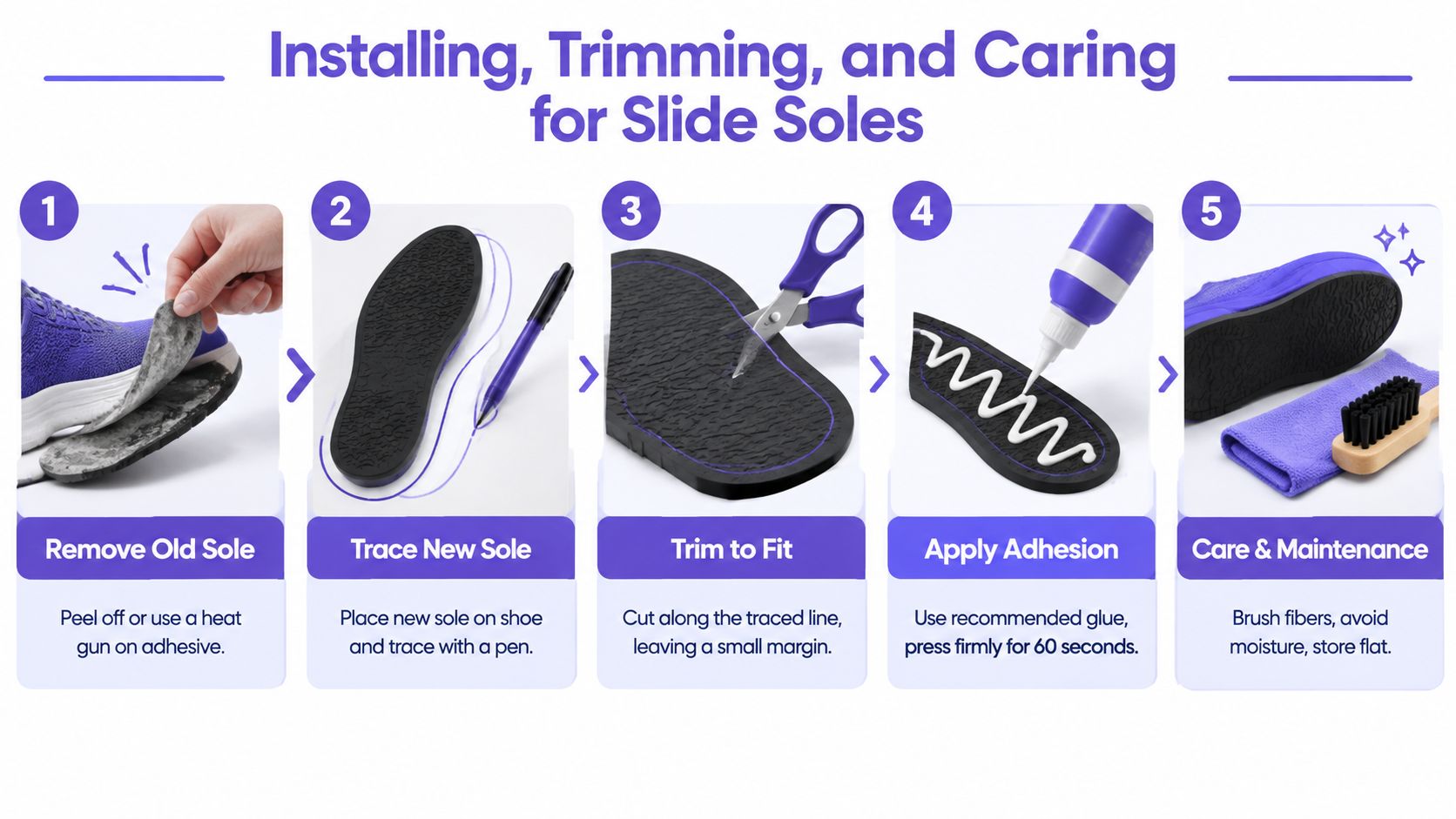
- Remove the old sole. Peel it away slowly. If adhesive holds stubbornly, use controlled heat from a heat gun rather than forcing the shoe material.
- Prepare the surface. Remove residue and make sure the bonding area is dry. Lightly scuff the surface with 80-grit abrasive when the replacement instructions call for it.
- Trace the replacement. Place the new sole over the shoe and mark the outline. Leave a small margin, then trim gradually with a sharp utility knife.
- Bond and press. Apply the recommended adhesive, align the leading edge, and press firmly. The installation infographic specifies firm pressure for 60 seconds, but follow the product's own curing instructions before bowling.
- Fit the heel separately. Heels often wear differently from slide soles, so check the heel's edge and attachment rather than assuming both parts need replacement together.
Keep fibers and fastening surfaces clean
Keep the sole dry and brush away debris after use. For hook-and-loop systems, clean dirt and oil from the fastening base regularly so the pad sits flat and stays attached. Guidance from Brunswick interchangeable slide sole care information also recommends trimming oversized soles to fit and replacing worn pads when adhesion weakens.
Look for visible thinning beneath the ball of the foot, a patchy glossy sheen, or a slide that suddenly feels much slower than its label suggests. Those signs matter more than a calendar because wear depends on how often you bowl, how you transport the shoes, and how clean the approach stays.
Don't soak leather. Avoid harsh or alcohol-based cleaners that can dry the material, and wipe the surface with a dry microfiber cloth after each session. If you're prone to foot irritation while testing new footwear, use the practical fit advice in this guide to anti-blister socks for bowling.
A short installation demonstration can help before you cut a replacement pad. Watch it after reading the product instructions, because adhesive and fastening systems vary.
Choosing the Right Slider for Your Game
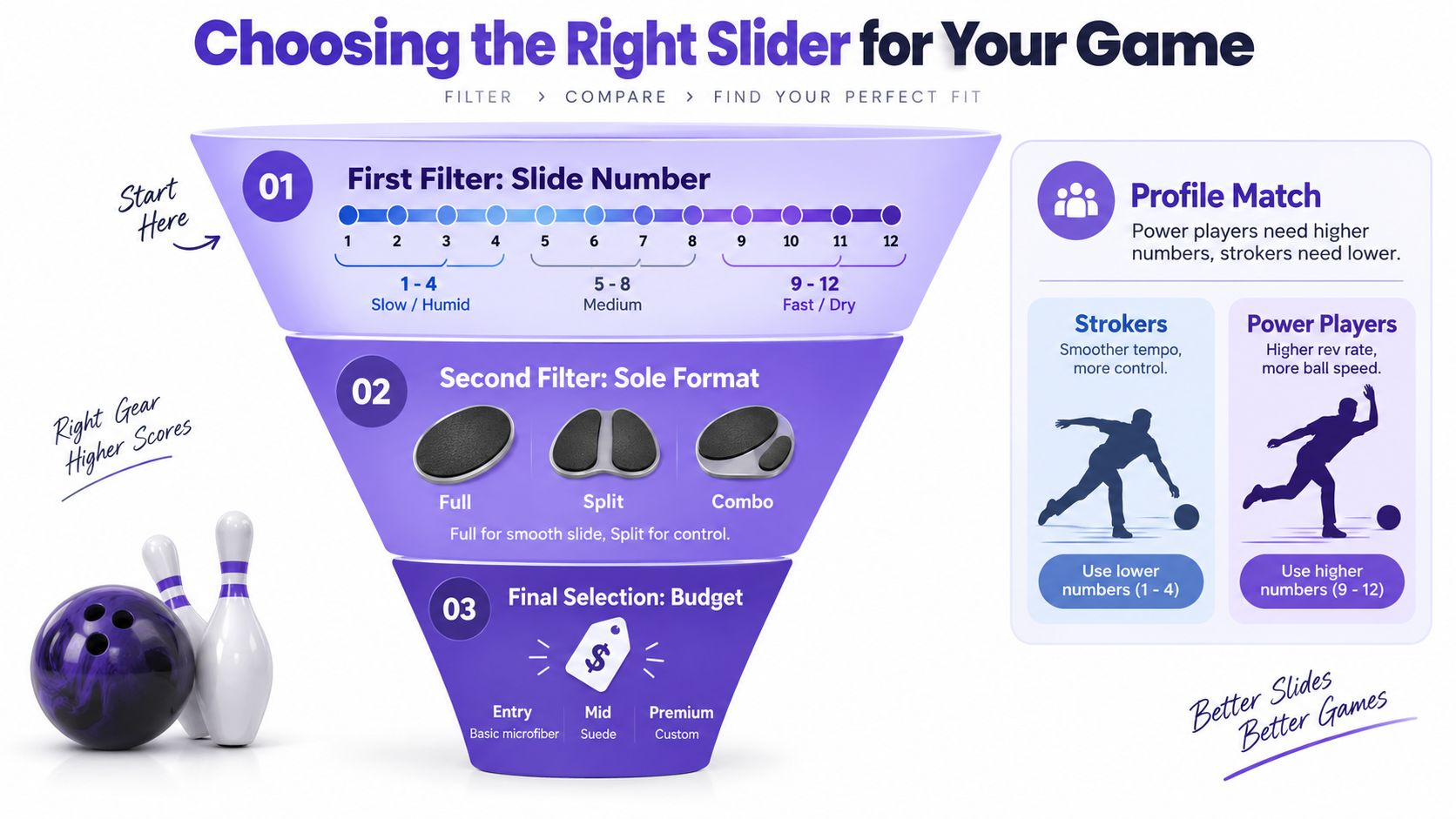
Choose in this order: slide number, format, then budget. Starting with price is how bowlers end up buying a slick cover when they need a firmer S4 or S5 pad.
For a stroker on a 35-foot house shot, I'd start with an interchangeable sole in the S5 to S8 range and test the middle before moving higher. For a two-handed cranker on a flatter 40-foot sport pattern, an S10 or an aggressive slip-on cover may provide the freedom needed to complete the approach, but only after the bowler confirms that timing and posture are sound.
Match the number to the approach
Sticky or tacky approaches call for more slide, which usually means a higher number. Dry, dusty, or resistant surfaces call for more traction, which usually means a lower number. Don't treat those rules as automatic prescriptions. Your speed, body position, shoe fit, and braking heel can change the result.
Match the format to your commitment
- Fixed integrated pad: Choose this if you bowl casually and want no setup.
- Interchangeable system: Choose this if you practice regularly, travel, or compete across varied approaches.
- Slip-on cover: Choose this if you need a low-cost experiment or temporary increase in glide.
The seven Amazon choices fit different profiles. The Dexter SST 8 system is for serious tuners, Dexter H5 ST and Brunswick Aviator soles refresh compatible shoes, Bowlerstore S4 and S10 pads target known friction needs, Bionic Glide tests adhesive slide, and Hammer's cover adds portability. A complete-shoe alternative is also covered in Bowling Gear Reviews' best bowling shoes guide.
The most expensive pad is wasted if you haven't measured your current slide feel. Book a practice set, watch where your foot stops, test one adjacent number, and choose the slider that leaves you balanced at the foul line.
Bowling Gear Reviews evaluates bowling shoes, replaceable slide systems, and related equipment through practical comparisons and fit-focused buying guides. Visit Bowling Gear Reviews to compare bowling shoes and accessories before you commit to your next slider.

1 Comment
Pingback: Bowling Shoes with Interchangeable Soles: 7 Best Picks